
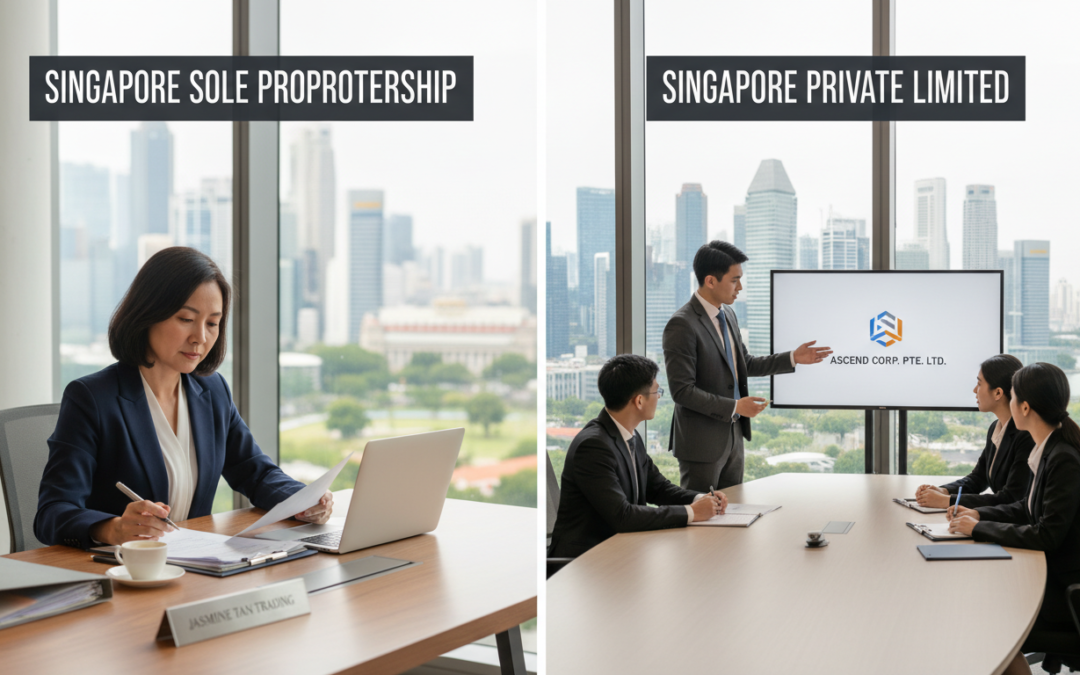
Which path shields your personal assets while still letting your business grow? That choice can change how you pay tax, take on risk, and attract funding.
This guide is a practical comparison for founders deciding between a quick, low-cost proprietorship and a more formal company setup such as a Pte Ltd or private limited company. It spells out the core trade-off: speed and simplicity versus legal protection, credibility and long-term options.
We will clarify legal entity status, liability, tax, compliance and scaling in a present-day context so you can make an informed decision before signing contracts or applying for banking facilities. Both routes can be legitimate depending on risk, income profile and growth goals, and switching later is possible with planning.
Key Takeaways
- Quick proprietorships suit low-risk, low-cost starts but offer no legal separation from the owner.
- A private limited company gives limited liability and stronger access to tax benefits and funding.
- Consider liability, compliance and scale when choosing a business structure.
- Decide before taking on debts or signing major contracts to avoid personal exposure.
- Changing from one route to another is doable, but it needs careful planning.
Choosing the right business structure in Singapore today
A business structure choice shapes how you pay tax, shoulder risk and pursue growth.
Why this decision affects tax, liability and growth
The legal form determines whether profits are taxed as personal income or as corporate tax. That choice affects how much tax you pay and when.
Liability is a commercial reality: one option leaves an owner personally liable and can put personal assets at risk if the business fails. The other offers limited liability that separates owner risk from company obligations.
Who this comparison is for: freelancers, SMEs and scaling founders
This guide helps three groups make a fact-based decision:
- Freelancers and solo operators considering a simple proprietorship for low overheads.
- SME owners weighing compliance costs against protection and tax options.
- Founders aiming to raise capital, hire staff or work with larger corporate partners.
| Area | Proprietorship | Pte Ltd company | When to consider |
|---|---|---|---|
| Tax treatment | Income taxed with owner | Corporate tax; possible exemptions | Higher income or incentives |
| Liability | Owner personally liable | Limited liability | Protect personal assets |
| Growth | Good for low-risk freelancing | Better for fundraising and hiring | Plan to scale or take investment |
What is a sole proprietorship in Singapore?
In this setup the business and the individual are legally identical, so the owner acts and signs in a personal capacity.
Not a separate legal entity
A sole proprietorship is the simplest business form. The business has no separate legal entity from its owner. That means contracts are signed by the person, not a company.
Who can register
Citizens, permanent residents and eligible pass holders may register a proprietorship. Foreign founders must appoint a local resident authorised representative and usually use a registered filing agent to file via BizFile+.
Liability and tax
The owner can be personally liable for debts and disputes. This exposes personal assets if the business cannot meet obligations.
Profits are assessed as the owner’s personal income and taxed under income tax rules. This combines business earnings with other personal income.
Ongoing obligations
Registration renewal is required, commonly every one or three years. Self-employed persons must also top up CPF Medisave before registration or renewal.
“A simple start can be right for low-risk trading, but it brings direct personal exposure to every contract and debt.”

| Feature | Detail | Practical note |
|---|---|---|
| Legal status | Not a separate legal entity | Owner signs and is liable |
| Who may register | Citizens, PRs, eligible pass holders | Foreigners need local representative |
| Tax | Profits taxed as personal income | Reported in owner’s income tax return |
| Ongoing | Renewal; Medisave top-up | Plan for CPF and filing dates |
What is a private limited company (Pte Ltd)?
A private limited company creates a formal legal structure that separates the business from its owners. This structure lets the entity hold assets, sign contracts and continue independently of changes in ownership.
Separate legal status and practical benefits
A Pte Ltd is a separate legal entity. That status makes contracting clearer, helps when bringing partners on board and supports a more scalable governance model.
Limited liability for shareholders
Shareholders generally enjoy limited liability, meaning their loss is usually limited to the value of their shares. Personal assets are typically shielded from company debts.
Key statutory appointments and requirements
- At least one local resident director must be appointed.
- A company secretary must be named within the statutory timeframe.
- Other incorporation requirements include a registered address and issued shares.
Tax treatment and start-up relief
Profits are subject to corporate tax at the headline rate of 17%. Eligible new companies may claim start-up tax exemptions — 75% on the first S$100,000 and 50% on the next S$100,000 of normal chargeable income — lowering early tax bills.
“A Pte Ltd is designed for founders who plan to issue shares, attract investors and formalise ownership and control.”
singapore sole proprietorship vs private limited: side-by-side comparison
A side-by-side look clarifies who is legally accountable, how debt risk is shared and how funding options differ.

Legal entity and contracts
A proprietorship means the owner signs contracts in their personal name. That person can be sued or sue in their own capacity.
A pte ltd company signs and enforces contracts in the company name as a separate legal entity. The company is the contracting party, not the individual director in most cases.
Liability for debts
In a proprietorship the owner is often personally liable for business debts and obligations.
In a private limited company liability is normally limited to the value of shares. This protects personal assets from company debts in most scenarios.
Ownership and control
A proprietorship is controlled by one owner who makes decisions directly.
A limited company has shareholders and at least one director who runs the company. Shareholders vote on major matters while directors handle day-to-day management.
Capital and funding
Proprietorships usually rely on personal capital, loans or retained earnings.
Private limited companies can issue shares to investors, and they generally find it easier to secure bank facilities and equity funding.
Public perception and credibility
Proprietorships are often seen as less formal by banks and partners.
A pte ltd or limited company typically projects greater credibility for investors, suppliers and larger customers. That perception matters when you hire, scale or seek finance.
| Area | Proprietorship | Private limited company |
|---|---|---|
| Legal entity | Owner and business are the same | Separate legal entity |
| Liability | Owner personally liable | Limited to share capital |
| Funding | Personal funds; loans | Issue shares; easier investor access |
Best for: a low-risk freelance business typically suits a proprietorship, while a business planning to hire, protect assets and attract investors usually benefits from a private limited company structure.
Registration requirements and set-up process differences
Registering a business starts with clear paperwork and the right filings; the route you pick affects cost, time and compliance.
Registering a proprietorship via BizFile+
Register on BizFile+ by choosing a compliant business name, selecting the correct activity code and providing owner details. Typical ACRA fees are around S$115 and approval is often same day or within a few days.
Ensure the name and activity align with bank and licence checks to avoid rework. This option is usually faster and cheaper to set up than a corporate entity.
Incorporating a pte ltd company
Incorporation requires a company constitution, a Singapore registered address and at least S$1 initial share capital. Expect a name application fee (~S$15) and an incorporation fee (~S$300).
Decide on share allocation, directors and the company secretary before filing. Appoint at least one director (with a resident requirement) and name a company secretary within the statutory timeframe.
Foreign founders: authorised representative vs resident director
Foreign founders often appoint an authorised representative and filing agent for a proprietorship. For a pte ltd the usual route is to secure a resident director to meet statutory requirements.
Practical tip: prepare incorporation details—business activities, share structure and registered office—before filing. Doing so reduces delays with bank onboarding and licence approvals.
For a comparative walkthrough and further registration notes, see a detailed registration guide.
| Item | Proprietorship | Pte Ltd company |
|---|---|---|
| Typical fees | S$115 (approx) | S$15 name + S$300 incorporation (approx) |
| Speed | Quick — often same day | Short but needs more checks |
| Key appointments | Owner details | Director(s), company secretary |
Tax and financial considerations: corporate tax vs personal income
Tax rules can change how much cash you keep after running a business and influence strategic choices on growth.

Progressive personal income tax for proprietors
When a business is not a separate company, profits flow straight into the owner’s personal income and are taxed under progressive rates.
This means higher earnings can push the owner into higher income tax bands, increasing the effective tax on business profits.
Corporate tax rate and common exemptions for new companies
A company pays corporate tax at the headline rate of 17%, which creates a different base for planning.
Eligible new companies may claim the Start‑Up Tax Exemption: 75% off the first S$100,000 and 50% off the next S$100,000 of normal chargeable income.
That relief can materially lower early tax bills and improve cash flow for reinvestment and growth.
When a company may be more tax‑efficient
Consider a company structure when profits rise, when you plan to retain earnings for expansion, or when owner pay can be split between salary and dividends.
Tax efficiency must be weighed against extra compliance, administrative time and statutory requirements.
- Record keeping: Maintain clean accounts whichever route you choose — this supports accurate income tax filings and lender checks.
- Decision trigger: If post‑tax cash for reinvestment is vital, a company with start‑up relief often makes sense.
| Item | Owner taxed as | Company taxed as |
|---|---|---|
| Basic treatment | Personal income (progressive) | Corporate tax (17%) |
| Early relief | Not applicable | Start‑Up Tax Exemption possible |
| When preferable | Low profit, simple operations | Growing profits, reinvestment plans |
Compliance, governance and ongoing statutory obligations
Good governance is the backbone of a company’s reputation and legal standing.
Private limited company compliance: annual returns, filings and statutory registers
Companies must keep statutory registers up to date and file statutory returns on time under the Companies Act.
Company secretary duties include maintaining registers, lodging annual returns and ensuring filings meet deadlines.
Annual general meetings and director disclosures
Annual general meetings and annual general requirements apply depending on company class and exemptions. These meetings formalise approval of accounts and director appointments.
Directors must make accurate disclosures. A director carries statutory duties and should understand what information is filed in the company name.
Audit and accounting expectations versus minimal proprietorship filings
A pte ltd entity needs stronger bookkeeping and, unless exempt, an auditor will review financial statements.
By contrast, a proprietorship typically faces simpler renewal and tax reporting: business income is declared on the owner’s personal return.
Why compliance matters: sound governance improves credibility with banks and investors, though it adds administrative cost. Tax filings remain essential for both entity types — corporate tax for companies and income reporting for proprietors.
| Area | Company | Proprietorship |
|---|---|---|
| Registers & filings | Statutory registers; annual returns | Minimal registration renewal |
| Meetings | Annual general meetings where required | No formal AGMs |
| Accounting & audit | Formal accounts; possible audit | Basic bookkeeping; personal tax reporting |
Continuity, risk and exit: what happens if circumstances change
Planning for change preserves value and limits surprises when an owner retires, a partner departs or a creditor calls.
Business succession is a key risk factor. A proprietorship typically ends when the owner dies or retires unless a formal arrangement exists to transfer assets and contracts.
By contrast, a private limited company benefits from perpetual succession as a separate legal entity. The company continues even if shareholders or directors change.

Transfer of ownership
Selling a proprietorship commonly means selling individual assets, re‑signing supplier and client agreements and moving licences. This can be time‑consuming and may interrupt revenue streams.
A company sale is often cleaner: ownership can transfer through share transfers or sale of shares, keeping contracts intact and reducing reprocuring work.
Closing the entity
To cease a proprietorship, an owner may file cessation via BizFile+ or simply not renew registration. Outstanding debts remain the owner’s responsibility.
Closing a company requires more formal steps: ACRA strike‑off if solvent and inactive, or a winding‑up process where creditors are settled and directors and shareholders follow statutory procedures.
Outstanding debts and liabilities complicate any exit. In a proprietorship, liability sits with the owner and can affect personal assets. In a private limited company, liabilities usually sit with the company and may protect owners, subject to guarantees and director duties.
Practical takeaway: if you expect to sell, bring in co‑owners or ensure multi‑year continuity, a company structure normally offers more flexibility and clearer routes for succession and exit.
| Issue | Proprietorship | Private limited company |
|---|---|---|
| Continuity | Ceases on owner’s death or retirement | Perpetual succession; continues despite owner changes |
| Transfer | Sell assets; re‑paper contracts | Transfer shares; contracts usually unchanged |
| Closing process | BizFile+ cessation or non‑renewal | ACRA strike‑off or formal winding‑up |
| Debts & liability | Owner personally liable for debts | Debts held by company; owners generally limited to share value |
When to convert from sole proprietorship to Pte Ltd
Deciding when to migrate your trading activities into a formal company is a strategic move, not just an administrative one.
Common triggers include rising risk that threatens personal assets, plans to raise capital or bring in investors, and the need to hire staff or bid for larger contracts.
Common triggers
- Protect assets: personal exposure grows as liabilities rise.
- Raise capital: investors prefer a private limited company vehicle.
- Scale operations: hiring and larger clients demand formal governance.
Practical conversion steps
Conversion is not automatic. You set up a new pte ltd as a separate legal entity, then move the business across in stages.
- Obtain a no‑objection letter if you want to retain the business name.
- Incorporate the private limited company and appoint shareholders, a director and a company secretary.
- Transfer or novate contracts and move key assets and liabilities carefully to the new company.
Operational housekeeping
Open new company bank accounts, reissue licences and update tax registrations (GST if applicable). Finally, cease the sole proprietorship on BizFile+ once migration is complete.
| Stage | Action | Why it matters |
|---|---|---|
| Name retention | Get no‑objection letter | Prevents brand disruption |
| Incorporation | File for Pte Ltd; appoint resident director and company secretary | Meets statutory requirements and creates a separate legal entity |
| Transfers | Novate contracts; transfer assets; settle liabilities | Ensures continuity and clears personal exposure |
| Housekeeping | Bank accounts, licences, tax registrations | Maintains operations and compliance |
Conclusion
Choose the path that matches your risk tolerance, cash needs and growth plan.
For a low-cost, low-risk start, a sole proprietorship or proprietorship keeps things simple and fast.
By contrast, a private limited company or pte ltd offers a separate legal entity and shifts liability away from the individual. That brings credibility, more funding options and possible tax relief, at the cost of extra compliance.
Match your business structure to near‑term needs — contracts, funding and hiring — and to long‑term aims like succession or sale. Shortlist priorities (risk, cost, compliance appetite) and confirm residency or foreign founder pathways before you file.
FAQ
What are the core differences between a sole trader and a Pte Ltd company?
Who should consider registering as a sole trader rather than a company?
Who can register each structure?
How does liability differ between the two structures?
How are taxes applied under each structure?
What are the compliance and governance differences?
How do registration and set-up processes differ?
Can a company raise external capital more easily than a sole trader?
What about public perception and credibility with banks and partners?
What happens on the owner’s death or incapacity?
When should an owner consider converting a sole trader business into a company?
What practical steps are involved in converting to a company?
Are there additional costs for running a company compared with a sole trader?
How do accounting and audit obligations compare?
What are the implications for hiring and employee benefits?

Dean Cheong is a Singapore-based B2B growth strategist and the CEO of VOffice. He helps companies scale revenue through sharper sales execution, CRM implementation, and go-to-market strategy, backed by a strong foundation in business banking and finance from Nanyang Technological University and a track record of driving sustainable, performance-led growth.