

Curious why some business registrations sail through while others stall?
This guide explains the key paperwork you must gather to register a company with ACRA. It shows how each item proves identity, confirms consent to act, records share ownership and sets out the constitution. Accurate paperwork matters more than ever due to stronger KYC, AML checks and beneficial ownership disclosures in 2026.
Who you are and what you register affects the list: local residents differ from foreigners, and individuals differ from corporate shareholders. Expect variations by entity type and by who signs.
Typical flow is simple: name reservation, preparing the documents, filing via BizFile+, then receiving an e‑certificate and business profile. Approval is often quick for standard cases but may slow if referrals to other agencies occur.
This piece is a step‑by‑step checklist to help founders gather the right items before they, or a Corporate Service Provider, file with ACRA.
Key Takeaways
- Gather accurate ID and consent papers to avoid delays.
- KYC and AML checks mean higher scrutiny in 2026.
- Resident status and shareholder type change the list.
- File via BizFile+ after name reservation to get e‑documents.
- Use this checklist before a CSR or adviser files with ACRA.
Why Singapore incorporation paperwork matters in 2026
Clear, accurate paperwork is now the front line in getting your registration approved quickly.
ACRA is the regulatory authority that evaluates whether a new entity meets the Companies Act. The online filing is made via BizFile+. The forms and proofs you submit are the evidence ACRA uses to verify declarations and to judge regulatory risk.
ACRA and the Companies Act: what drives the requirements
ACRA acts as the corporate regulatory authority and enforces AML/ATF and beneficial ownership transparency. Modern expectations mean identity and ownership records carry more weight than before.
How complete submissions shorten approval timeframes
High‑quality, consistent files reduce follow‑up questions and resubmission cycles. That keeps the approval timeline tight and protects launch plans.
- What ACRA reviews: matching names, readable ID copies, correct addresses and an SSIC that fits the business activity.
- Why quality matters: clean paperwork avoids referrals to other agencies.
- Timelines: standard BizFile+ approvals can be fast, but referrals may add weeks — sometimes up to 60 days.
- Mindset: treat paperwork as a risk control step, especially with foreign shareholders and cross‑border funds.
Eligibility and minimum incorporation requirements you must meet first
Confirming basic eligibility early saves time and avoids referrals during the online filing process.
Baseline checklist: at least one shareholder, at least one resident director, a local registered address and minimum paid-up capital of S$1.
100% foreign ownership is permitted. Shareholders may be individuals or corporate entities, which affects the later paperwork and evidentiary pack.

Resident director and nominee option
A resident director must be a Singapore citizen, permanent resident or an employment pass holder. Founders without local residency commonly appoint a nominee director to meet this requirement.
Company secretary timing
A qualified Singapore-resident company secretary must be appointed within six months of registration. The secretary supports ongoing statutory compliance and minute-keeping.
Registered address and paid-up capital
The registered address must be a physical Singapore location, accessible during normal business hours; P.O. Boxes are not acceptable.
Paid-up capital starts at S$1. Some banks, licences or visa cases justify increasing capital to show substance and to meet third-party expectations.
- Pre-check: if you cannot meet the resident director or address rules, consider a CSP package that supplies a nominee director and registered address services.
Choose the right entity type before you prepare documents
Picking the correct legal form early saves time and avoids extra filings later.
Private Limited as the default
Private Limited (Pte Ltd) is the default for growth-focused founders. It gives limited liability, a separate legal identity and credibility with banks and investors.
Use this structure when you want scale, access to tax schemes and clear separation of personal risk.
LLP, sole trader and partnerships
An LLP offers partnership flexibility plus a separate legal entity. Its pack asks for partner or manager particulars rather than share capital details.
Sole traders and general partnerships are simpler but carry unlimited liability. They suit low-risk, owner-run business models.
Foreign options: subsidiary, branch or rep office
A subsidiary (a limited company) is a distinct legal entity and shields the parent from liability. A branch is an extension of the parent; the parent remains liable. A representative office cannot trade and is for liaison or market study only.
Practical cue: if you need ring-fenced liability and local incentives, set up a subsidiary (Pte Ltd). Note that foreign routes increase corporate paperwork and change who signs which authorisation.
| Structure | Liability | Key paperwork |
|---|---|---|
| Private Limited | Limited | Constitution, share registers, director consents |
| LLP | Limited | Partnership agreement, partner particulars |
| Sole Trader / Partnership | Unlimited | Owner ID, business registration |
| Subsidiary / Branch / Rep Office | Varies (subsidiary limited) | Parent extracts, board resolution, authorisations |
Company name reservation with ACRA: what you’ll need to submit
Reserving a business name with ACRA is the first practical step to lock your brand before formal filing.
Why reserve a name? A reservation locks the company name so no one else can take it while you finish the registration pack. This reduces the risk of a clash at submission and keeps your launch timetable intact.

Name guidelines: uniqueness, restricted words and compliance checks
The chosen name must be unique and not too similar to existing names. Avoid restricted or regulated words unless you can supply extra approvals. Certain terms may trigger a referral to another agency and slow the approval.
Timing and the 120‑day reservation window
Simple, compliant names can get approval in under an hour and typically within a day. Once approved, the name is reserved for 120 days, giving a clear window to complete signatures and filings.
- What to submit: proposed name(s), a short business activity matching an SSIC, and any explanations if the name hints at regulated services.
- Practical tips: prepare two or three alternatives, avoid confusing abbreviations, and ensure your activity description matches the name.
- Launch note: name approval feeds bank onboarding, domain purchases and vendor registration—keep the name consistent across these steps.
Documents required for singapore company incorporation
Prepare a compact set of core items that form the minimum viable file for a standard private registration.
Company Constitution and what it covers
Company constitution is the rulebook. It sets share rights, voting rules, director powers and meeting procedures. Keep a clear, signed copy on file.
Director and shareholder consents
Each director and shareholder must sign consent to act and a statement of non-disqualification. These reduce governance risk and help registration proceed smoothly.
Identification and beneficial ownership details
Provide full legal name, date of birth, nationality, residential address and ID scans for each officer and shareholder. Declare ultimate beneficial owners separately.
Business activity, SSIC code and registered address
Give a short activity description and correct SSIC code to avoid referrals. Supply evidence of a local registered office; P.O. Boxes are not acceptable.
Share capital structure and quality check
State paid-up capital, number of shares, currency and allocations. Finally, ensure names and punctuation match across all files to avoid resubmission.
| Item | Why it matters | Typical form |
|---|---|---|
| Company constitution | Governance and rights | Signed constitution |
| Consents & declarations | Legal eligibility | Signed letters |
| ID & BO details | KYC and transparency | Passport/ID scans, statements |
| Address & capital | Operational and funding setup | Lease/utility proof, share schedule |
Identity and KYC documents: residents vs non-residents
KYC verification separates quick approvals from lengthy follow-ups during business set-up.
Why KYC is non-negotiable in 2026: it supports AML/ATF obligations and confirms every director, shareholder and UBO is identified and screened. Good KYC reduces regulatory risk and speeds the overall registration process.
For residents
Provide a clear NRIC copy and a recent proof of address. Scans must be legible and unexpired. Minor mismatches in name formatting often trigger queries.
For non‑residents
Submit the passport bio page plus a proof of residential address such as a recent utility bill or bank statement that shows the same name and address as the filing.
Common supporting items
- Bank reference letter to show financial standing and credibility.
- Short CV or LinkedIn profile to explain professional background and business activities.
Timeline impact and fast‑track tips
KYC screening can add 1–2+ days to the filing timeline, especially where names are common or ownership chains are complex. To speed the process, standardise name formatting, supply certified translations for non‑English proofs and ensure address evidence is recent and matches exactly.
Result: thorough, consistent KYC reduces last‑minute requests that delay incorporation and downstream bank onboarding.
Extra checks when shareholders are corporate entities
Where an entity holds shares, expect a wider evidentiary pack that traces ownership and board authorisation.
When this applies: If any shareholder is a corporate investor — a holding vehicle, fund vehicle or operating firm — the submission scope widens beyond individual ID and signatures.
Certificate and business extract
Providers normally ask for the parent’s certificate of incorporation and a current business profile or extract. These confirm the legal existence and standing of the parent entity.
Ownership chart and UBO details
An ownership chart must map the chain up to the ultimate beneficial owners with percentage holdings that total 100%.
UBO disclosures identify the natural persons who control or benefit from the corporate shareholder. These names must be screened even when ownership is multi-layered or cross-border.
Board resolution and drafting tips
The parent must supply a board resolution authorising the registration or share subscription and naming an authorised signatory to execute paperwork.
Draft the resolution to match the final entity name, share amounts and signatory details exactly. Mismatches or outdated extracts are a common cause of delay.
- Practical tip: confirm extracts are current and that ownership charts reconcile to KYC files.
- Common friction: outdated certificates or incomplete charts often trigger follow-up and slow the registration timeline.
Role-based paperwork: directors, shareholders, and the company secretary
Clear role allocation speeds the process and reduces avoidable queries.
Director particulars and local residency evidence
Directors must supply concise particulars: legal name, date of birth, nationality, ID and contact address. At least one director must be a Singapore-resident and produce proof of local residency.
Good practice: collect these items in parallel so the registration is not held up by a single missing file.
Company secretary particulars and compliance responsibilities
The company secretary must be appointed within six months. The secretary’s details — name, ID and business address — are captured at filing.
Secretary duties include maintaining registers, preparing resolutions, and supporting annual returns. Do not treat the secretary as a name on paper; poor support increases the risk of missed filings and penalties.
Shareholder registers and statutory record set-up expectations
Shareholder records must mirror the share allotment and capital structure submitted at registration. Maintain registers of directors, shareholders and controllers and keep minutes and resolutions accessible.
“Well‑kept registers make bank onboarding and audits far simpler.”

| Role | Key particulars | Ongoing duty |
|---|---|---|
| Directors | Name, ID, nationality, address, residency proof | Declare conflicts, attend meetings |
| Company secretary | Name, ID, address | Maintain registers, file annual returns |
| Shareholders | Shareholdings, ID, contact details | Update share register, inform changes |
How to file through BizFile+ (ACRA) and avoid document rejection
The online portal guides you from name reservation to certificate issuance, but timing depends on checks behind the scenes.
Step‑by‑step BizFile+ flow:
- Reserve the name.
- Prepare and sign the incorporation papers.
- Submit the filing online.
- Pay the statutory fees.
- Receive the Certificate of Incorporation and business extracts.
Why rejections and referrals happen
Rejection often stems from inconsistent names, mismatched addresses, missing consents or unclear beneficial ownership. An SSIC or activity description that does not align with your name also triggers queries.
Common referral triggers and timeline impact
Using regulated words, or proposing regulated activities like finance, health or education, can route your file to another agency. That review can extend timelines up to 60 days, even though the online submission itself takes minutes.
When a licensed CSP is mandatory and what they do
Foreign founders must engage a licensed Corporate Service Provider to submit a registration. Locals often use a CSP to reduce risk and speed approval.
Typical CSP services: verify KYC, draft the constitution and resolutions, check the filing, and maintain statutory records in a secure system.
“Finalise the name, align SSIC to the real activity, prepare clean ID and confirm the registered address and resident director ahead of filing.”
What you receive after approval: certificates and official extracts
Once ACRA completes the online review, the registry issues two primary e‑outputs that unlock next steps.
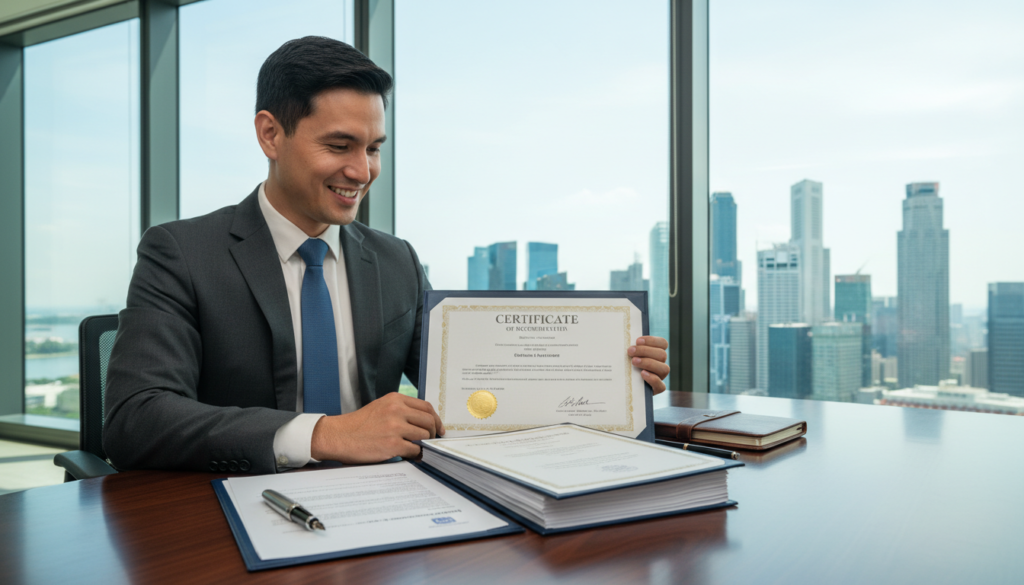
Certificate of Incorporation (and sometimes a Notice of Incorporation) is the formal e‑certificate that proves legal formation. Hold the certificate incorporation as the core legal artefact. Many banks accept electronic copies, but some higher‑risk accounts may request a certified paper copy.
ACRA Business Profile and practical use
The ACRA Business Profile summarises key business facts: shareholders, directors, registered address and share capital. It acts as the practical “proof pack” when you open a bank or corporate bank account, register with payment processors, or onboard vendors.
Accuracy matters. If the profile shows incorrect details, rectifying the record can delay bank onboarding and contracting. Store the e‑outputs securely and share them only with trusted parties.
“Keep the official extracts under controlled access; they are reused across banking, payroll and licensing workflows.”
- Use the Certificate to prove legal existence.
- Use the Business Profile to verify operational details with third parties.
- Expect some institutions to require certified hard copies depending on risk policies.
Post-incorporation documents you’ll need to become operational
Legal registration is only the start; getting operational means lining up banking, tax and licensing proofs.
Operational readiness is a documentation exercise. The e‑certificate and profile let you file with banks, hire staff and invoice customers, but you must present a fuller pack to move funds and onboard partners.
Corporate bank account opening pack
Banks typically want the certificate/notice of incorporation, the constitution, the business profile, and IDs for directors and shareholders. Proof of residential address for key persons and completed bank forms are standard.
High‑risk sectors face extra due diligence. Prepare board resolutions authorising signatories and a short ownership chart to avoid follow‑ups.
- Certificate or notice of formation
- Constitution and business profile
- Director/shareholder IDs and proof of address
- Bank account forms and authorised signatory resolution
Timing: digital banks such as Aspire, Wise or Airwallex often onboard faster; traditional banks like UOB may take longer due to deeper AML checks.
Tax registration touchpoints
Begin tax planning early. IRAS expects an Estimated Chargeable Income (ECI) filing within three months after the financial year‑end unless you qualify for an exemption.
Annual corporate tax filings follow standard timelines; keep accounts up to date to meet those deadlines.
GST is optional until taxable turnover exceeds SGD 1 million, at which point registration becomes mandatory and creates ongoing reporting obligations.
Licences and permits
Regulated activities require permits and extra proof of eligibility. Operating without proper permission risks penalties and forced cessation of operations.
Confirm licensing needs early and supply any sectoral certificates, technical qualifications or facility approvals to regulators and banks where asked.
Ongoing compliance and record‑keeping
Maintain up‑to‑date statutory registers, meeting minutes and financial records. Annual returns must be filed with ACRA and corporate records kept for at least five years.
Timely updates for changes in directors, shareholders or registered office reduce friction with banks, investors and regulators.
Compliance hygiene: disciplined record‑keeping makes banking, tax filing and licence renewals far easier and protects your standing with stakeholders.
For a practical post‑formation checklist and templates, see the post‑incorporation guide. Review service terms that may affect nominee or registered address options in the provider terms and conditions.
Conclusion
A tidy pre-filing pack and matching data across forms are the best ways to avoid delays.
Key takeaway: prepare ID, KYC proofs, the constitution and signed consents early, align the name and activity and check that names match exactly across forms.
Minimum checklist: at least one shareholder, one resident director, a local registered address, S$1 paid-up capital and a company secretary appointed within six months.
Standard company registration in company singapore can complete in 1–3 days for straightforward cases. Expect longer timelines when referrals or incomplete KYC occur. Foreign founders should plan to use a licensed CSP to file and support compliance.
After approval, adopt a compliance-first approach: keep statutory registers current, prepare bank onboarding packs and plan tax and licence steps. Use this guide’s checklists as your pre-filing pack and engage a CSP where needed to reduce rework and delays.
FAQ
What core paperwork is needed to register a private limited company in Singapore?
Why does accurate paperwork matter in 2026?
How does the Companies Act influence the filing requirements?
Can incomplete paperwork lengthen approval timeframes?
How many shareholders are needed and can foreigners own 100%?
Is a resident director mandatory and what about nominee directors?
When must a company secretary be appointed?
Can the registered office be a PO Box?
What is the minimum paid-up capital at incorporation?
FAQ
What core paperwork is needed to register a private limited company in Singapore?
You must submit a company constitution, particulars of directors and shareholders, identification and address verification for officers and beneficial owners, a description of business activities with the appropriate SSIC code, and a local registered office address. Paid-up capital details and consents from directors and shareholders are also necessary.
Why does accurate paperwork matter in 2026?
Precise submission reduces queries from the Accounting and Corporate Regulatory Authority (ACRA) and other agencies. Clear, compliant filings speed approval, avoid multi‑agency referrals, and cut the risk of penalties or prolonged delays that can stretch processing into weeks.
How does the Companies Act influence the filing requirements?
The Companies Act sets out statutory duties for directors, disclosure obligations, and rules on company records and registers. ACRA enforces those provisions, so filings must reflect legal requirements such as residency of directors, secretary appointment and maintenance of statutory registers.
Can incomplete paperwork lengthen approval timeframes?
Yes. Missing or inconsistent information often triggers ACRA follow-up or referrals to other regulators, which can add days or even weeks to the process. Providing verified identity, clear business activity descriptions and correct address evidence shortens turnaround.
How many shareholders are needed and can foreigners own 100%?
A private limited company requires at least one shareholder, and foreigners may hold 100% ownership. Corporate or individual shareholders are acceptable, but corporate shareholders must supply their own incorporation evidence and ownership chart.
Is a resident director mandatory and what about nominee directors?
Yes, a company must appoint at least one resident director — a Singapore citizen, permanent resident, or an EntrePass/Employment Pass holder. Nominee directorships are possible, but the nominee must be suitably authorised and must meet ACRA’s fit-and-proper expectations.
When must a company secretary be appointed?
A company must appoint a qualified company secretary within six months of incorporation. The secretary must be a natural person, ordinarily resident in Singapore, and is responsible for many statutory filings and governance tasks.
Can the registered office be a PO Box?
No. The registered office must be a physical street address in Singapore and be available during normal business hours. Virtual office services are acceptable provided they supply appropriate tenancy proof and meet regulatory standards.
What is the minimum paid-up capital at incorporation?
The baseline paid-up capital is typically S
FAQ
What core paperwork is needed to register a private limited company in Singapore?
You must submit a company constitution, particulars of directors and shareholders, identification and address verification for officers and beneficial owners, a description of business activities with the appropriate SSIC code, and a local registered office address. Paid-up capital details and consents from directors and shareholders are also necessary.
Why does accurate paperwork matter in 2026?
Precise submission reduces queries from the Accounting and Corporate Regulatory Authority (ACRA) and other agencies. Clear, compliant filings speed approval, avoid multi‑agency referrals, and cut the risk of penalties or prolonged delays that can stretch processing into weeks.
How does the Companies Act influence the filing requirements?
The Companies Act sets out statutory duties for directors, disclosure obligations, and rules on company records and registers. ACRA enforces those provisions, so filings must reflect legal requirements such as residency of directors, secretary appointment and maintenance of statutory registers.
Can incomplete paperwork lengthen approval timeframes?
Yes. Missing or inconsistent information often triggers ACRA follow-up or referrals to other regulators, which can add days or even weeks to the process. Providing verified identity, clear business activity descriptions and correct address evidence shortens turnaround.
How many shareholders are needed and can foreigners own 100%?
A private limited company requires at least one shareholder, and foreigners may hold 100% ownership. Corporate or individual shareholders are acceptable, but corporate shareholders must supply their own incorporation evidence and ownership chart.
Is a resident director mandatory and what about nominee directors?
Yes, a company must appoint at least one resident director — a Singapore citizen, permanent resident, or an EntrePass/Employment Pass holder. Nominee directorships are possible, but the nominee must be suitably authorised and must meet ACRA’s fit-and-proper expectations.
When must a company secretary be appointed?
A company must appoint a qualified company secretary within six months of incorporation. The secretary must be a natural person, ordinarily resident in Singapore, and is responsible for many statutory filings and governance tasks.
Can the registered office be a PO Box?
No. The registered office must be a physical street address in Singapore and be available during normal business hours. Virtual office services are acceptable provided they supply appropriate tenancy proof and meet regulatory standards.
What is the minimum paid-up capital at incorporation?
The baseline paid-up capital is typically S$1 for a private limited company. However, certain industries or bank account requirements may insist on higher subscribed capital, and you can increase capital after incorporation if needed.
Which entity type should I choose before preparing filings?
Most founders use a Private Limited Company (Pte Ltd) because it limits shareholder liability and supports growth. Consider LLP, sole proprietorship or partnership if you want simpler compliance. Foreign firms may prefer a subsidiary, branch or representative office depending on control, tax and reporting needs.
How do name reservation rules work with ACRA?
You reserve a name via BizFile+. The name must be unique, not offensive or restricted, and comply with guidelines on trade marks and regulated words. Once approved, the reservation is typically valid for 120 days.
What should the company constitution contain?
The constitution sets out share classes, directors’ powers, shareholder rights, transfer restrictions and meeting rules. It governs internal management and must be filed at incorporation if used instead of the default provisions under the Companies Act.
What consents and declarations must officers provide?
Directors and company secretaries must sign consent to act and a statement of non‑disqualification. Shareholders may need to provide consents when special arrangements exist. These confirmations are essential to satisfy ACRA’s fit-and-proper assessments.
What identification is needed for residents versus non‑residents?
Singapore residents use NRIC plus proof of local address. Foreign individuals must supply a passport, recent residential address proof and any immigration pass details if applicable. Banks and regulators often ask for certified translations if documents are not in English.
What supporting KYC items do banks and regulators commonly request?
Typical items include a bank reference letter, professional profile or CV for key officers, utility bills or tenancy agreements for address proof, and background checks on ultimate beneficial owners. Strong KYC reduces friction when opening corporate bank accounts.
Do corporate shareholders need extra paperwork?
Yes. A corporate shareholder must provide its certificate of incorporation, business profile, memorandum and articles (or constitution), an ownership chart showing ultimate beneficial owners, and a board resolution authorising the Singapore investment.
What director particulars are required at filing?
Filings must include full name, nationality, date of birth, residential and correspondence addresses, contact details and identification numbers. If the director is local, evidence of residency is necessary to meet statutory requirements.
What are the company secretary’s compliance responsibilities?
The secretary maintains statutory registers, lodges annual returns, ensures board and shareholder meetings comply with the constitution and Companies Act, and assists with regulatory filings. Their particulars and consent must be filed with ACRA.
How does BizFile+ submission work and how can I avoid rejection?
Use BizFile+ to reserve the name, then file incorporation particulars and pay fees online. Avoid rejection by ensuring consistent information across all forms, uploading certified identity and address proofs when required, and using approved formats for corporate documents.
What common errors cause referrals to other agencies and delays up to 60 days?
Typical issues include using restricted words without prior approval, inadequate licences for regulated activities, incomplete KYC on beneficial owners, and discrepancies in officer or shareholder identities. These trigger checks by bodies such as the Monetary Authority of Singapore or sector regulators.
When must I engage a licensed Corporate Service Provider (CSP)?
If you lack a local resident director or secretary, or if ACRA or other authorities require licensed intermediary involvement—such as for certain regulated sectors—you must use a CSP. Banks may also prefer CSPs for account opening support.
What official records are issued after approval?
After incorporation you receive a Certificate of Incorporation and Notice of Incorporation. You can also obtain an ACRA Business Profile extract, which banks and vendors commonly request to confirm registration details.
What documents do banks typically require to open a corporate account?
Banks usually ask for the certificate of incorporation, business profile, constitution, director and signatory identity proofs, ultimate beneficial owner declarations, board resolution authorising account opening, and an account opening pack outlining expected transaction activity.
When must the company register with IRAS and what about ECI and GST?
Register for tax with the Inland Revenue Authority of Singapore (IRAS) promptly after incorporation. Companies must file Estimated Chargeable Income (ECI) within three months of the financial year end if taxable. GST registration is mandatory when annual taxable turnover exceeds S$1 million, though voluntary registration is possible earlier.
What licences or permits might be needed post-incorporation?
Licences depend on the business activity — for example food, finance, education or import/export activities need sectoral approvals. Verify regulatory requirements early and include licence evidence when applying for permits or bank services.
What ongoing compliance paperwork must be maintained?
Companies must keep statutory registers, file annual returns, hold annual general meetings when required, update ACRA within prescribed timelines for officer or address changes, and retain accounting records to support tax filings and audits where applicable.
for a private limited company. However, certain industries or bank account requirements may insist on higher subscribed capital, and you can increase capital after incorporation if needed.
Which entity type should I choose before preparing filings?
Most founders use a Private Limited Company (Pte Ltd) because it limits shareholder liability and supports growth. Consider LLP, sole proprietorship or partnership if you want simpler compliance. Foreign firms may prefer a subsidiary, branch or representative office depending on control, tax and reporting needs.
How do name reservation rules work with ACRA?
You reserve a name via BizFile+. The name must be unique, not offensive or restricted, and comply with guidelines on trade marks and regulated words. Once approved, the reservation is typically valid for 120 days.
What should the company constitution contain?
The constitution sets out share classes, directors’ powers, shareholder rights, transfer restrictions and meeting rules. It governs internal management and must be filed at incorporation if used instead of the default provisions under the Companies Act.
What consents and declarations must officers provide?
Directors and company secretaries must sign consent to act and a statement of non‑disqualification. Shareholders may need to provide consents when special arrangements exist. These confirmations are essential to satisfy ACRA’s fit-and-proper assessments.
What identification is needed for residents versus non‑residents?
Singapore residents use NRIC plus proof of local address. Foreign individuals must supply a passport, recent residential address proof and any immigration pass details if applicable. Banks and regulators often ask for certified translations if documents are not in English.
What supporting KYC items do banks and regulators commonly request?
Typical items include a bank reference letter, professional profile or CV for key officers, utility bills or tenancy agreements for address proof, and background checks on ultimate beneficial owners. Strong KYC reduces friction when opening corporate bank accounts.
Do corporate shareholders need extra paperwork?
Yes. A corporate shareholder must provide its certificate of incorporation, business profile, memorandum and articles (or constitution), an ownership chart showing ultimate beneficial owners, and a board resolution authorising the Singapore investment.
What director particulars are required at filing?
Filings must include full name, nationality, date of birth, residential and correspondence addresses, contact details and identification numbers. If the director is local, evidence of residency is necessary to meet statutory requirements.
What are the company secretary’s compliance responsibilities?
The secretary maintains statutory registers, lodges annual returns, ensures board and shareholder meetings comply with the constitution and Companies Act, and assists with regulatory filings. Their particulars and consent must be filed with ACRA.
How does BizFile+ submission work and how can I avoid rejection?
Use BizFile+ to reserve the name, then file incorporation particulars and pay fees online. Avoid rejection by ensuring consistent information across all forms, uploading certified identity and address proofs when required, and using approved formats for corporate documents.
What common errors cause referrals to other agencies and delays up to 60 days?
Typical issues include using restricted words without prior approval, inadequate licences for regulated activities, incomplete KYC on beneficial owners, and discrepancies in officer or shareholder identities. These trigger checks by bodies such as the Monetary Authority of Singapore or sector regulators.
When must I engage a licensed Corporate Service Provider (CSP)?
If you lack a local resident director or secretary, or if ACRA or other authorities require licensed intermediary involvement—such as for certain regulated sectors—you must use a CSP. Banks may also prefer CSPs for account opening support.
What official records are issued after approval?
After incorporation you receive a Certificate of Incorporation and Notice of Incorporation. You can also obtain an ACRA Business Profile extract, which banks and vendors commonly request to confirm registration details.
What documents do banks typically require to open a corporate account?
Banks usually ask for the certificate of incorporation, business profile, constitution, director and signatory identity proofs, ultimate beneficial owner declarations, board resolution authorising account opening, and an account opening pack outlining expected transaction activity.
When must the company register with IRAS and what about ECI and GST?
Register for tax with the Inland Revenue Authority of Singapore (IRAS) promptly after incorporation. Companies must file Estimated Chargeable Income (ECI) within three months of the financial year end if taxable. GST registration is mandatory when annual taxable turnover exceeds S
FAQ
What core paperwork is needed to register a private limited company in Singapore?
You must submit a company constitution, particulars of directors and shareholders, identification and address verification for officers and beneficial owners, a description of business activities with the appropriate SSIC code, and a local registered office address. Paid-up capital details and consents from directors and shareholders are also necessary.
Why does accurate paperwork matter in 2026?
Precise submission reduces queries from the Accounting and Corporate Regulatory Authority (ACRA) and other agencies. Clear, compliant filings speed approval, avoid multi‑agency referrals, and cut the risk of penalties or prolonged delays that can stretch processing into weeks.
How does the Companies Act influence the filing requirements?
The Companies Act sets out statutory duties for directors, disclosure obligations, and rules on company records and registers. ACRA enforces those provisions, so filings must reflect legal requirements such as residency of directors, secretary appointment and maintenance of statutory registers.
Can incomplete paperwork lengthen approval timeframes?
Yes. Missing or inconsistent information often triggers ACRA follow-up or referrals to other regulators, which can add days or even weeks to the process. Providing verified identity, clear business activity descriptions and correct address evidence shortens turnaround.
How many shareholders are needed and can foreigners own 100%?
A private limited company requires at least one shareholder, and foreigners may hold 100% ownership. Corporate or individual shareholders are acceptable, but corporate shareholders must supply their own incorporation evidence and ownership chart.
Is a resident director mandatory and what about nominee directors?
Yes, a company must appoint at least one resident director — a Singapore citizen, permanent resident, or an EntrePass/Employment Pass holder. Nominee directorships are possible, but the nominee must be suitably authorised and must meet ACRA’s fit-and-proper expectations.
When must a company secretary be appointed?
A company must appoint a qualified company secretary within six months of incorporation. The secretary must be a natural person, ordinarily resident in Singapore, and is responsible for many statutory filings and governance tasks.
Can the registered office be a PO Box?
No. The registered office must be a physical street address in Singapore and be available during normal business hours. Virtual office services are acceptable provided they supply appropriate tenancy proof and meet regulatory standards.
What is the minimum paid-up capital at incorporation?
The baseline paid-up capital is typically S$1 for a private limited company. However, certain industries or bank account requirements may insist on higher subscribed capital, and you can increase capital after incorporation if needed.
Which entity type should I choose before preparing filings?
Most founders use a Private Limited Company (Pte Ltd) because it limits shareholder liability and supports growth. Consider LLP, sole proprietorship or partnership if you want simpler compliance. Foreign firms may prefer a subsidiary, branch or representative office depending on control, tax and reporting needs.
How do name reservation rules work with ACRA?
You reserve a name via BizFile+. The name must be unique, not offensive or restricted, and comply with guidelines on trade marks and regulated words. Once approved, the reservation is typically valid for 120 days.
What should the company constitution contain?
The constitution sets out share classes, directors’ powers, shareholder rights, transfer restrictions and meeting rules. It governs internal management and must be filed at incorporation if used instead of the default provisions under the Companies Act.
What consents and declarations must officers provide?
Directors and company secretaries must sign consent to act and a statement of non‑disqualification. Shareholders may need to provide consents when special arrangements exist. These confirmations are essential to satisfy ACRA’s fit-and-proper assessments.
What identification is needed for residents versus non‑residents?
Singapore residents use NRIC plus proof of local address. Foreign individuals must supply a passport, recent residential address proof and any immigration pass details if applicable. Banks and regulators often ask for certified translations if documents are not in English.
What supporting KYC items do banks and regulators commonly request?
Typical items include a bank reference letter, professional profile or CV for key officers, utility bills or tenancy agreements for address proof, and background checks on ultimate beneficial owners. Strong KYC reduces friction when opening corporate bank accounts.
Do corporate shareholders need extra paperwork?
Yes. A corporate shareholder must provide its certificate of incorporation, business profile, memorandum and articles (or constitution), an ownership chart showing ultimate beneficial owners, and a board resolution authorising the Singapore investment.
What director particulars are required at filing?
Filings must include full name, nationality, date of birth, residential and correspondence addresses, contact details and identification numbers. If the director is local, evidence of residency is necessary to meet statutory requirements.
What are the company secretary’s compliance responsibilities?
The secretary maintains statutory registers, lodges annual returns, ensures board and shareholder meetings comply with the constitution and Companies Act, and assists with regulatory filings. Their particulars and consent must be filed with ACRA.
How does BizFile+ submission work and how can I avoid rejection?
Use BizFile+ to reserve the name, then file incorporation particulars and pay fees online. Avoid rejection by ensuring consistent information across all forms, uploading certified identity and address proofs when required, and using approved formats for corporate documents.
What common errors cause referrals to other agencies and delays up to 60 days?
Typical issues include using restricted words without prior approval, inadequate licences for regulated activities, incomplete KYC on beneficial owners, and discrepancies in officer or shareholder identities. These trigger checks by bodies such as the Monetary Authority of Singapore or sector regulators.
When must I engage a licensed Corporate Service Provider (CSP)?
If you lack a local resident director or secretary, or if ACRA or other authorities require licensed intermediary involvement—such as for certain regulated sectors—you must use a CSP. Banks may also prefer CSPs for account opening support.
What official records are issued after approval?
After incorporation you receive a Certificate of Incorporation and Notice of Incorporation. You can also obtain an ACRA Business Profile extract, which banks and vendors commonly request to confirm registration details.
What documents do banks typically require to open a corporate account?
Banks usually ask for the certificate of incorporation, business profile, constitution, director and signatory identity proofs, ultimate beneficial owner declarations, board resolution authorising account opening, and an account opening pack outlining expected transaction activity.
When must the company register with IRAS and what about ECI and GST?
Register for tax with the Inland Revenue Authority of Singapore (IRAS) promptly after incorporation. Companies must file Estimated Chargeable Income (ECI) within three months of the financial year end if taxable. GST registration is mandatory when annual taxable turnover exceeds S$1 million, though voluntary registration is possible earlier.
What licences or permits might be needed post-incorporation?
Licences depend on the business activity — for example food, finance, education or import/export activities need sectoral approvals. Verify regulatory requirements early and include licence evidence when applying for permits or bank services.
What ongoing compliance paperwork must be maintained?
Companies must keep statutory registers, file annual returns, hold annual general meetings when required, update ACRA within prescribed timelines for officer or address changes, and retain accounting records to support tax filings and audits where applicable.
million, though voluntary registration is possible earlier.
What licences or permits might be needed post-incorporation?
Licences depend on the business activity — for example food, finance, education or import/export activities need sectoral approvals. Verify regulatory requirements early and include licence evidence when applying for permits or bank services.
What ongoing compliance paperwork must be maintained?
Companies must keep statutory registers, file annual returns, hold annual general meetings when required, update ACRA within prescribed timelines for officer or address changes, and retain accounting records to support tax filings and audits where applicable.
FAQ
What core paperwork is needed to register a private limited company in Singapore?
You must submit a company constitution, particulars of directors and shareholders, identification and address verification for officers and beneficial owners, a description of business activities with the appropriate SSIC code, and a local registered office address. Paid-up capital details and consents from directors and shareholders are also necessary.
Why does accurate paperwork matter in 2026?
Precise submission reduces queries from the Accounting and Corporate Regulatory Authority (ACRA) and other agencies. Clear, compliant filings speed approval, avoid multi‑agency referrals, and cut the risk of penalties or prolonged delays that can stretch processing into weeks.
How does the Companies Act influence the filing requirements?
The Companies Act sets out statutory duties for directors, disclosure obligations, and rules on company records and registers. ACRA enforces those provisions, so filings must reflect legal requirements such as residency of directors, secretary appointment and maintenance of statutory registers.
Can incomplete paperwork lengthen approval timeframes?
Yes. Missing or inconsistent information often triggers ACRA follow-up or referrals to other regulators, which can add days or even weeks to the process. Providing verified identity, clear business activity descriptions and correct address evidence shortens turnaround.
How many shareholders are needed and can foreigners own 100%?
A private limited company requires at least one shareholder, and foreigners may hold 100% ownership. Corporate or individual shareholders are acceptable, but corporate shareholders must supply their own incorporation evidence and ownership chart.
Is a resident director mandatory and what about nominee directors?
Yes, a company must appoint at least one resident director — a Singapore citizen, permanent resident, or an EntrePass/Employment Pass holder. Nominee directorships are possible, but the nominee must be suitably authorised and must meet ACRA’s fit-and-proper expectations.
When must a company secretary be appointed?
A company must appoint a qualified company secretary within six months of incorporation. The secretary must be a natural person, ordinarily resident in Singapore, and is responsible for many statutory filings and governance tasks.
Can the registered office be a PO Box?
No. The registered office must be a physical street address in Singapore and be available during normal business hours. Virtual office services are acceptable provided they supply appropriate tenancy proof and meet regulatory standards.
What is the minimum paid-up capital at incorporation?
The baseline paid-up capital is typically S
FAQ
What core paperwork is needed to register a private limited company in Singapore?
You must submit a company constitution, particulars of directors and shareholders, identification and address verification for officers and beneficial owners, a description of business activities with the appropriate SSIC code, and a local registered office address. Paid-up capital details and consents from directors and shareholders are also necessary.
Why does accurate paperwork matter in 2026?
Precise submission reduces queries from the Accounting and Corporate Regulatory Authority (ACRA) and other agencies. Clear, compliant filings speed approval, avoid multi‑agency referrals, and cut the risk of penalties or prolonged delays that can stretch processing into weeks.
How does the Companies Act influence the filing requirements?
The Companies Act sets out statutory duties for directors, disclosure obligations, and rules on company records and registers. ACRA enforces those provisions, so filings must reflect legal requirements such as residency of directors, secretary appointment and maintenance of statutory registers.
Can incomplete paperwork lengthen approval timeframes?
Yes. Missing or inconsistent information often triggers ACRA follow-up or referrals to other regulators, which can add days or even weeks to the process. Providing verified identity, clear business activity descriptions and correct address evidence shortens turnaround.
How many shareholders are needed and can foreigners own 100%?
A private limited company requires at least one shareholder, and foreigners may hold 100% ownership. Corporate or individual shareholders are acceptable, but corporate shareholders must supply their own incorporation evidence and ownership chart.
Is a resident director mandatory and what about nominee directors?
Yes, a company must appoint at least one resident director — a Singapore citizen, permanent resident, or an EntrePass/Employment Pass holder. Nominee directorships are possible, but the nominee must be suitably authorised and must meet ACRA’s fit-and-proper expectations.
When must a company secretary be appointed?
A company must appoint a qualified company secretary within six months of incorporation. The secretary must be a natural person, ordinarily resident in Singapore, and is responsible for many statutory filings and governance tasks.
Can the registered office be a PO Box?
No. The registered office must be a physical street address in Singapore and be available during normal business hours. Virtual office services are acceptable provided they supply appropriate tenancy proof and meet regulatory standards.
What is the minimum paid-up capital at incorporation?
The baseline paid-up capital is typically S$1 for a private limited company. However, certain industries or bank account requirements may insist on higher subscribed capital, and you can increase capital after incorporation if needed.
Which entity type should I choose before preparing filings?
Most founders use a Private Limited Company (Pte Ltd) because it limits shareholder liability and supports growth. Consider LLP, sole proprietorship or partnership if you want simpler compliance. Foreign firms may prefer a subsidiary, branch or representative office depending on control, tax and reporting needs.
How do name reservation rules work with ACRA?
You reserve a name via BizFile+. The name must be unique, not offensive or restricted, and comply with guidelines on trade marks and regulated words. Once approved, the reservation is typically valid for 120 days.
What should the company constitution contain?
The constitution sets out share classes, directors’ powers, shareholder rights, transfer restrictions and meeting rules. It governs internal management and must be filed at incorporation if used instead of the default provisions under the Companies Act.
What consents and declarations must officers provide?
Directors and company secretaries must sign consent to act and a statement of non‑disqualification. Shareholders may need to provide consents when special arrangements exist. These confirmations are essential to satisfy ACRA’s fit-and-proper assessments.
What identification is needed for residents versus non‑residents?
Singapore residents use NRIC plus proof of local address. Foreign individuals must supply a passport, recent residential address proof and any immigration pass details if applicable. Banks and regulators often ask for certified translations if documents are not in English.
What supporting KYC items do banks and regulators commonly request?
Typical items include a bank reference letter, professional profile or CV for key officers, utility bills or tenancy agreements for address proof, and background checks on ultimate beneficial owners. Strong KYC reduces friction when opening corporate bank accounts.
Do corporate shareholders need extra paperwork?
Yes. A corporate shareholder must provide its certificate of incorporation, business profile, memorandum and articles (or constitution), an ownership chart showing ultimate beneficial owners, and a board resolution authorising the Singapore investment.
What director particulars are required at filing?
Filings must include full name, nationality, date of birth, residential and correspondence addresses, contact details and identification numbers. If the director is local, evidence of residency is necessary to meet statutory requirements.
What are the company secretary’s compliance responsibilities?
The secretary maintains statutory registers, lodges annual returns, ensures board and shareholder meetings comply with the constitution and Companies Act, and assists with regulatory filings. Their particulars and consent must be filed with ACRA.
How does BizFile+ submission work and how can I avoid rejection?
Use BizFile+ to reserve the name, then file incorporation particulars and pay fees online. Avoid rejection by ensuring consistent information across all forms, uploading certified identity and address proofs when required, and using approved formats for corporate documents.
What common errors cause referrals to other agencies and delays up to 60 days?
Typical issues include using restricted words without prior approval, inadequate licences for regulated activities, incomplete KYC on beneficial owners, and discrepancies in officer or shareholder identities. These trigger checks by bodies such as the Monetary Authority of Singapore or sector regulators.
When must I engage a licensed Corporate Service Provider (CSP)?
If you lack a local resident director or secretary, or if ACRA or other authorities require licensed intermediary involvement—such as for certain regulated sectors—you must use a CSP. Banks may also prefer CSPs for account opening support.
What official records are issued after approval?
After incorporation you receive a Certificate of Incorporation and Notice of Incorporation. You can also obtain an ACRA Business Profile extract, which banks and vendors commonly request to confirm registration details.
What documents do banks typically require to open a corporate account?
Banks usually ask for the certificate of incorporation, business profile, constitution, director and signatory identity proofs, ultimate beneficial owner declarations, board resolution authorising account opening, and an account opening pack outlining expected transaction activity.
When must the company register with IRAS and what about ECI and GST?
Register for tax with the Inland Revenue Authority of Singapore (IRAS) promptly after incorporation. Companies must file Estimated Chargeable Income (ECI) within three months of the financial year end if taxable. GST registration is mandatory when annual taxable turnover exceeds S$1 million, though voluntary registration is possible earlier.
What licences or permits might be needed post-incorporation?
Licences depend on the business activity — for example food, finance, education or import/export activities need sectoral approvals. Verify regulatory requirements early and include licence evidence when applying for permits or bank services.
What ongoing compliance paperwork must be maintained?
Companies must keep statutory registers, file annual returns, hold annual general meetings when required, update ACRA within prescribed timelines for officer or address changes, and retain accounting records to support tax filings and audits where applicable.
for a private limited company. However, certain industries or bank account requirements may insist on higher subscribed capital, and you can increase capital after incorporation if needed.
Which entity type should I choose before preparing filings?
Most founders use a Private Limited Company (Pte Ltd) because it limits shareholder liability and supports growth. Consider LLP, sole proprietorship or partnership if you want simpler compliance. Foreign firms may prefer a subsidiary, branch or representative office depending on control, tax and reporting needs.
How do name reservation rules work with ACRA?
You reserve a name via BizFile+. The name must be unique, not offensive or restricted, and comply with guidelines on trade marks and regulated words. Once approved, the reservation is typically valid for 120 days.
What should the company constitution contain?
The constitution sets out share classes, directors’ powers, shareholder rights, transfer restrictions and meeting rules. It governs internal management and must be filed at incorporation if used instead of the default provisions under the Companies Act.
What consents and declarations must officers provide?
Directors and company secretaries must sign consent to act and a statement of non‑disqualification. Shareholders may need to provide consents when special arrangements exist. These confirmations are essential to satisfy ACRA’s fit-and-proper assessments.
What identification is needed for residents versus non‑residents?
Singapore residents use NRIC plus proof of local address. Foreign individuals must supply a passport, recent residential address proof and any immigration pass details if applicable. Banks and regulators often ask for certified translations if documents are not in English.
What supporting KYC items do banks and regulators commonly request?
Typical items include a bank reference letter, professional profile or CV for key officers, utility bills or tenancy agreements for address proof, and background checks on ultimate beneficial owners. Strong KYC reduces friction when opening corporate bank accounts.
Do corporate shareholders need extra paperwork?
Yes. A corporate shareholder must provide its certificate of incorporation, business profile, memorandum and articles (or constitution), an ownership chart showing ultimate beneficial owners, and a board resolution authorising the Singapore investment.
What director particulars are required at filing?
Filings must include full name, nationality, date of birth, residential and correspondence addresses, contact details and identification numbers. If the director is local, evidence of residency is necessary to meet statutory requirements.
What are the company secretary’s compliance responsibilities?
The secretary maintains statutory registers, lodges annual returns, ensures board and shareholder meetings comply with the constitution and Companies Act, and assists with regulatory filings. Their particulars and consent must be filed with ACRA.
How does BizFile+ submission work and how can I avoid rejection?
Use BizFile+ to reserve the name, then file incorporation particulars and pay fees online. Avoid rejection by ensuring consistent information across all forms, uploading certified identity and address proofs when required, and using approved formats for corporate documents.
What common errors cause referrals to other agencies and delays up to 60 days?
Typical issues include using restricted words without prior approval, inadequate licences for regulated activities, incomplete KYC on beneficial owners, and discrepancies in officer or shareholder identities. These trigger checks by bodies such as the Monetary Authority of Singapore or sector regulators.
When must I engage a licensed Corporate Service Provider (CSP)?
If you lack a local resident director or secretary, or if ACRA or other authorities require licensed intermediary involvement—such as for certain regulated sectors—you must use a CSP. Banks may also prefer CSPs for account opening support.
What official records are issued after approval?
After incorporation you receive a Certificate of Incorporation and Notice of Incorporation. You can also obtain an ACRA Business Profile extract, which banks and vendors commonly request to confirm registration details.
What documents do banks typically require to open a corporate account?
Banks usually ask for the certificate of incorporation, business profile, constitution, director and signatory identity proofs, ultimate beneficial owner declarations, board resolution authorising account opening, and an account opening pack outlining expected transaction activity.
When must the company register with IRAS and what about ECI and GST?
Register for tax with the Inland Revenue Authority of Singapore (IRAS) promptly after incorporation. Companies must file Estimated Chargeable Income (ECI) within three months of the financial year end if taxable. GST registration is mandatory when annual taxable turnover exceeds S
FAQ
What core paperwork is needed to register a private limited company in Singapore?
You must submit a company constitution, particulars of directors and shareholders, identification and address verification for officers and beneficial owners, a description of business activities with the appropriate SSIC code, and a local registered office address. Paid-up capital details and consents from directors and shareholders are also necessary.
Why does accurate paperwork matter in 2026?
Precise submission reduces queries from the Accounting and Corporate Regulatory Authority (ACRA) and other agencies. Clear, compliant filings speed approval, avoid multi‑agency referrals, and cut the risk of penalties or prolonged delays that can stretch processing into weeks.
How does the Companies Act influence the filing requirements?
The Companies Act sets out statutory duties for directors, disclosure obligations, and rules on company records and registers. ACRA enforces those provisions, so filings must reflect legal requirements such as residency of directors, secretary appointment and maintenance of statutory registers.
Can incomplete paperwork lengthen approval timeframes?
Yes. Missing or inconsistent information often triggers ACRA follow-up or referrals to other regulators, which can add days or even weeks to the process. Providing verified identity, clear business activity descriptions and correct address evidence shortens turnaround.
How many shareholders are needed and can foreigners own 100%?
A private limited company requires at least one shareholder, and foreigners may hold 100% ownership. Corporate or individual shareholders are acceptable, but corporate shareholders must supply their own incorporation evidence and ownership chart.
Is a resident director mandatory and what about nominee directors?
Yes, a company must appoint at least one resident director — a Singapore citizen, permanent resident, or an EntrePass/Employment Pass holder. Nominee directorships are possible, but the nominee must be suitably authorised and must meet ACRA’s fit-and-proper expectations.
When must a company secretary be appointed?
A company must appoint a qualified company secretary within six months of incorporation. The secretary must be a natural person, ordinarily resident in Singapore, and is responsible for many statutory filings and governance tasks.
Can the registered office be a PO Box?
No. The registered office must be a physical street address in Singapore and be available during normal business hours. Virtual office services are acceptable provided they supply appropriate tenancy proof and meet regulatory standards.
What is the minimum paid-up capital at incorporation?
The baseline paid-up capital is typically S$1 for a private limited company. However, certain industries or bank account requirements may insist on higher subscribed capital, and you can increase capital after incorporation if needed.
Which entity type should I choose before preparing filings?
Most founders use a Private Limited Company (Pte Ltd) because it limits shareholder liability and supports growth. Consider LLP, sole proprietorship or partnership if you want simpler compliance. Foreign firms may prefer a subsidiary, branch or representative office depending on control, tax and reporting needs.
How do name reservation rules work with ACRA?
You reserve a name via BizFile+. The name must be unique, not offensive or restricted, and comply with guidelines on trade marks and regulated words. Once approved, the reservation is typically valid for 120 days.
What should the company constitution contain?
The constitution sets out share classes, directors’ powers, shareholder rights, transfer restrictions and meeting rules. It governs internal management and must be filed at incorporation if used instead of the default provisions under the Companies Act.
What consents and declarations must officers provide?
Directors and company secretaries must sign consent to act and a statement of non‑disqualification. Shareholders may need to provide consents when special arrangements exist. These confirmations are essential to satisfy ACRA’s fit-and-proper assessments.
What identification is needed for residents versus non‑residents?
Singapore residents use NRIC plus proof of local address. Foreign individuals must supply a passport, recent residential address proof and any immigration pass details if applicable. Banks and regulators often ask for certified translations if documents are not in English.
What supporting KYC items do banks and regulators commonly request?
Typical items include a bank reference letter, professional profile or CV for key officers, utility bills or tenancy agreements for address proof, and background checks on ultimate beneficial owners. Strong KYC reduces friction when opening corporate bank accounts.
Do corporate shareholders need extra paperwork?
Yes. A corporate shareholder must provide its certificate of incorporation, business profile, memorandum and articles (or constitution), an ownership chart showing ultimate beneficial owners, and a board resolution authorising the Singapore investment.
What director particulars are required at filing?
Filings must include full name, nationality, date of birth, residential and correspondence addresses, contact details and identification numbers. If the director is local, evidence of residency is necessary to meet statutory requirements.
What are the company secretary’s compliance responsibilities?
The secretary maintains statutory registers, lodges annual returns, ensures board and shareholder meetings comply with the constitution and Companies Act, and assists with regulatory filings. Their particulars and consent must be filed with ACRA.
How does BizFile+ submission work and how can I avoid rejection?
Use BizFile+ to reserve the name, then file incorporation particulars and pay fees online. Avoid rejection by ensuring consistent information across all forms, uploading certified identity and address proofs when required, and using approved formats for corporate documents.
What common errors cause referrals to other agencies and delays up to 60 days?
Typical issues include using restricted words without prior approval, inadequate licences for regulated activities, incomplete KYC on beneficial owners, and discrepancies in officer or shareholder identities. These trigger checks by bodies such as the Monetary Authority of Singapore or sector regulators.
When must I engage a licensed Corporate Service Provider (CSP)?
If you lack a local resident director or secretary, or if ACRA or other authorities require licensed intermediary involvement—such as for certain regulated sectors—you must use a CSP. Banks may also prefer CSPs for account opening support.
What official records are issued after approval?
After incorporation you receive a Certificate of Incorporation and Notice of Incorporation. You can also obtain an ACRA Business Profile extract, which banks and vendors commonly request to confirm registration details.
What documents do banks typically require to open a corporate account?
Banks usually ask for the certificate of incorporation, business profile, constitution, director and signatory identity proofs, ultimate beneficial owner declarations, board resolution authorising account opening, and an account opening pack outlining expected transaction activity.
When must the company register with IRAS and what about ECI and GST?
Register for tax with the Inland Revenue Authority of Singapore (IRAS) promptly after incorporation. Companies must file Estimated Chargeable Income (ECI) within three months of the financial year end if taxable. GST registration is mandatory when annual taxable turnover exceeds S$1 million, though voluntary registration is possible earlier.
What licences or permits might be needed post-incorporation?
Licences depend on the business activity — for example food, finance, education or import/export activities need sectoral approvals. Verify regulatory requirements early and include licence evidence when applying for permits or bank services.
What ongoing compliance paperwork must be maintained?
Companies must keep statutory registers, file annual returns, hold annual general meetings when required, update ACRA within prescribed timelines for officer or address changes, and retain accounting records to support tax filings and audits where applicable.
million, though voluntary registration is possible earlier.
What licences or permits might be needed post-incorporation?
Licences depend on the business activity — for example food, finance, education or import/export activities need sectoral approvals. Verify regulatory requirements early and include licence evidence when applying for permits or bank services.
What ongoing compliance paperwork must be maintained?
Companies must keep statutory registers, file annual returns, hold annual general meetings when required, update ACRA within prescribed timelines for officer or address changes, and retain accounting records to support tax filings and audits where applicable.
Which entity type should I choose before preparing filings?
How do name reservation rules work with ACRA?
What should the company constitution contain?
What consents and declarations must officers provide?
What identification is needed for residents versus non‑residents?
What supporting KYC items do banks and regulators commonly request?
Do corporate shareholders need extra paperwork?
What director particulars are required at filing?
What are the company secretary’s compliance responsibilities?
How does BizFile+ submission work and how can I avoid rejection?
What common errors cause referrals to other agencies and delays up to 60 days?
When must I engage a licensed Corporate Service Provider (CSP)?
What official records are issued after approval?
What documents do banks typically require to open a corporate account?
When must the company register with IRAS and what about ECI and GST?
FAQ
What core paperwork is needed to register a private limited company in Singapore?
You must submit a company constitution, particulars of directors and shareholders, identification and address verification for officers and beneficial owners, a description of business activities with the appropriate SSIC code, and a local registered office address. Paid-up capital details and consents from directors and shareholders are also necessary.
Why does accurate paperwork matter in 2026?
Precise submission reduces queries from the Accounting and Corporate Regulatory Authority (ACRA) and other agencies. Clear, compliant filings speed approval, avoid multi‑agency referrals, and cut the risk of penalties or prolonged delays that can stretch processing into weeks.
How does the Companies Act influence the filing requirements?
The Companies Act sets out statutory duties for directors, disclosure obligations, and rules on company records and registers. ACRA enforces those provisions, so filings must reflect legal requirements such as residency of directors, secretary appointment and maintenance of statutory registers.
Can incomplete paperwork lengthen approval timeframes?
Yes. Missing or inconsistent information often triggers ACRA follow-up or referrals to other regulators, which can add days or even weeks to the process. Providing verified identity, clear business activity descriptions and correct address evidence shortens turnaround.
How many shareholders are needed and can foreigners own 100%?
A private limited company requires at least one shareholder, and foreigners may hold 100% ownership. Corporate or individual shareholders are acceptable, but corporate shareholders must supply their own incorporation evidence and ownership chart.
Is a resident director mandatory and what about nominee directors?
Yes, a company must appoint at least one resident director — a Singapore citizen, permanent resident, or an EntrePass/Employment Pass holder. Nominee directorships are possible, but the nominee must be suitably authorised and must meet ACRA’s fit-and-proper expectations.
When must a company secretary be appointed?
A company must appoint a qualified company secretary within six months of incorporation. The secretary must be a natural person, ordinarily resident in Singapore, and is responsible for many statutory filings and governance tasks.
Can the registered office be a PO Box?
No. The registered office must be a physical street address in Singapore and be available during normal business hours. Virtual office services are acceptable provided they supply appropriate tenancy proof and meet regulatory standards.
What is the minimum paid-up capital at incorporation?
The baseline paid-up capital is typically S
FAQ
What core paperwork is needed to register a private limited company in Singapore?
You must submit a company constitution, particulars of directors and shareholders, identification and address verification for officers and beneficial owners, a description of business activities with the appropriate SSIC code, and a local registered office address. Paid-up capital details and consents from directors and shareholders are also necessary.
Why does accurate paperwork matter in 2026?
Precise submission reduces queries from the Accounting and Corporate Regulatory Authority (ACRA) and other agencies. Clear, compliant filings speed approval, avoid multi‑agency referrals, and cut the risk of penalties or prolonged delays that can stretch processing into weeks.
How does the Companies Act influence the filing requirements?
The Companies Act sets out statutory duties for directors, disclosure obligations, and rules on company records and registers. ACRA enforces those provisions, so filings must reflect legal requirements such as residency of directors, secretary appointment and maintenance of statutory registers.
Can incomplete paperwork lengthen approval timeframes?
Yes. Missing or inconsistent information often triggers ACRA follow-up or referrals to other regulators, which can add days or even weeks to the process. Providing verified identity, clear business activity descriptions and correct address evidence shortens turnaround.
How many shareholders are needed and can foreigners own 100%?
A private limited company requires at least one shareholder, and foreigners may hold 100% ownership. Corporate or individual shareholders are acceptable, but corporate shareholders must supply their own incorporation evidence and ownership chart.
Is a resident director mandatory and what about nominee directors?
Yes, a company must appoint at least one resident director — a Singapore citizen, permanent resident, or an EntrePass/Employment Pass holder. Nominee directorships are possible, but the nominee must be suitably authorised and must meet ACRA’s fit-and-proper expectations.
When must a company secretary be appointed?
A company must appoint a qualified company secretary within six months of incorporation. The secretary must be a natural person, ordinarily resident in Singapore, and is responsible for many statutory filings and governance tasks.
Can the registered office be a PO Box?
No. The registered office must be a physical street address in Singapore and be available during normal business hours. Virtual office services are acceptable provided they supply appropriate tenancy proof and meet regulatory standards.
What is the minimum paid-up capital at incorporation?
The baseline paid-up capital is typically S$1 for a private limited company. However, certain industries or bank account requirements may insist on higher subscribed capital, and you can increase capital after incorporation if needed.
Which entity type should I choose before preparing filings?
Most founders use a Private Limited Company (Pte Ltd) because it limits shareholder liability and supports growth. Consider LLP, sole proprietorship or partnership if you want simpler compliance. Foreign firms may prefer a subsidiary, branch or representative office depending on control, tax and reporting needs.
How do name reservation rules work with ACRA?
You reserve a name via BizFile+. The name must be unique, not offensive or restricted, and comply with guidelines on trade marks and regulated words. Once approved, the reservation is typically valid for 120 days.
What should the company constitution contain?
The constitution sets out share classes, directors’ powers, shareholder rights, transfer restrictions and meeting rules. It governs internal management and must be filed at incorporation if used instead of the default provisions under the Companies Act.
What consents and declarations must officers provide?
Directors and company secretaries must sign consent to act and a statement of non‑disqualification. Shareholders may need to provide consents when special arrangements exist. These confirmations are essential to satisfy ACRA’s fit-and-proper assessments.
What identification is needed for residents versus non‑residents?
Singapore residents use NRIC plus proof of local address. Foreign individuals must supply a passport, recent residential address proof and any immigration pass details if applicable. Banks and regulators often ask for certified translations if documents are not in English.
What supporting KYC items do banks and regulators commonly request?
Typical items include a bank reference letter, professional profile or CV for key officers, utility bills or tenancy agreements for address proof, and background checks on ultimate beneficial owners. Strong KYC reduces friction when opening corporate bank accounts.
Do corporate shareholders need extra paperwork?
Yes. A corporate shareholder must provide its certificate of incorporation, business profile, memorandum and articles (or constitution), an ownership chart showing ultimate beneficial owners, and a board resolution authorising the Singapore investment.
What director particulars are required at filing?
Filings must include full name, nationality, date of birth, residential and correspondence addresses, contact details and identification numbers. If the director is local, evidence of residency is necessary to meet statutory requirements.
What are the company secretary’s compliance responsibilities?
The secretary maintains statutory registers, lodges annual returns, ensures board and shareholder meetings comply with the constitution and Companies Act, and assists with regulatory filings. Their particulars and consent must be filed with ACRA.
How does BizFile+ submission work and how can I avoid rejection?
Use BizFile+ to reserve the name, then file incorporation particulars and pay fees online. Avoid rejection by ensuring consistent information across all forms, uploading certified identity and address proofs when required, and using approved formats for corporate documents.
What common errors cause referrals to other agencies and delays up to 60 days?
Typical issues include using restricted words without prior approval, inadequate licences for regulated activities, incomplete KYC on beneficial owners, and discrepancies in officer or shareholder identities. These trigger checks by bodies such as the Monetary Authority of Singapore or sector regulators.
When must I engage a licensed Corporate Service Provider (CSP)?
If you lack a local resident director or secretary, or if ACRA or other authorities require licensed intermediary involvement—such as for certain regulated sectors—you must use a CSP. Banks may also prefer CSPs for account opening support.
What official records are issued after approval?
After incorporation you receive a Certificate of Incorporation and Notice of Incorporation. You can also obtain an ACRA Business Profile extract, which banks and vendors commonly request to confirm registration details.
What documents do banks typically require to open a corporate account?
Banks usually ask for the certificate of incorporation, business profile, constitution, director and signatory identity proofs, ultimate beneficial owner declarations, board resolution authorising account opening, and an account opening pack outlining expected transaction activity.
When must the company register with IRAS and what about ECI and GST?
Register for tax with the Inland Revenue Authority of Singapore (IRAS) promptly after incorporation. Companies must file Estimated Chargeable Income (ECI) within three months of the financial year end if taxable. GST registration is mandatory when annual taxable turnover exceeds S$1 million, though voluntary registration is possible earlier.
What licences or permits might be needed post-incorporation?
Licences depend on the business activity — for example food, finance, education or import/export activities need sectoral approvals. Verify regulatory requirements early and include licence evidence when applying for permits or bank services.
What ongoing compliance paperwork must be maintained?
Companies must keep statutory registers, file annual returns, hold annual general meetings when required, update ACRA within prescribed timelines for officer or address changes, and retain accounting records to support tax filings and audits where applicable.
for a private limited company. However, certain industries or bank account requirements may insist on higher subscribed capital, and you can increase capital after incorporation if needed.
Which entity type should I choose before preparing filings?
Most founders use a Private Limited Company (Pte Ltd) because it limits shareholder liability and supports growth. Consider LLP, sole proprietorship or partnership if you want simpler compliance. Foreign firms may prefer a subsidiary, branch or representative office depending on control, tax and reporting needs.
How do name reservation rules work with ACRA?
You reserve a name via BizFile+. The name must be unique, not offensive or restricted, and comply with guidelines on trade marks and regulated words. Once approved, the reservation is typically valid for 120 days.
What should the company constitution contain?
The constitution sets out share classes, directors’ powers, shareholder rights, transfer restrictions and meeting rules. It governs internal management and must be filed at incorporation if used instead of the default provisions under the Companies Act.
What consents and declarations must officers provide?
Directors and company secretaries must sign consent to act and a statement of non‑disqualification. Shareholders may need to provide consents when special arrangements exist. These confirmations are essential to satisfy ACRA’s fit-and-proper assessments.
What identification is needed for residents versus non‑residents?
Singapore residents use NRIC plus proof of local address. Foreign individuals must supply a passport, recent residential address proof and any immigration pass details if applicable. Banks and regulators often ask for certified translations if documents are not in English.
What supporting KYC items do banks and regulators commonly request?
Typical items include a bank reference letter, professional profile or CV for key officers, utility bills or tenancy agreements for address proof, and background checks on ultimate beneficial owners. Strong KYC reduces friction when opening corporate bank accounts.
Do corporate shareholders need extra paperwork?
Yes. A corporate shareholder must provide its certificate of incorporation, business profile, memorandum and articles (or constitution), an ownership chart showing ultimate beneficial owners, and a board resolution authorising the Singapore investment.
What director particulars are required at filing?
Filings must include full name, nationality, date of birth, residential and correspondence addresses, contact details and identification numbers. If the director is local, evidence of residency is necessary to meet statutory requirements.
What are the company secretary’s compliance responsibilities?
The secretary maintains statutory registers, lodges annual returns, ensures board and shareholder meetings comply with the constitution and Companies Act, and assists with regulatory filings. Their particulars and consent must be filed with ACRA.
How does BizFile+ submission work and how can I avoid rejection?
Use BizFile+ to reserve the name, then file incorporation particulars and pay fees online. Avoid rejection by ensuring consistent information across all forms, uploading certified identity and address proofs when required, and using approved formats for corporate documents.
What common errors cause referrals to other agencies and delays up to 60 days?
Typical issues include using restricted words without prior approval, inadequate licences for regulated activities, incomplete KYC on beneficial owners, and discrepancies in officer or shareholder identities. These trigger checks by bodies such as the Monetary Authority of Singapore or sector regulators.
When must I engage a licensed Corporate Service Provider (CSP)?
If you lack a local resident director or secretary, or if ACRA or other authorities require licensed intermediary involvement—such as for certain regulated sectors—you must use a CSP. Banks may also prefer CSPs for account opening support.
What official records are issued after approval?
After incorporation you receive a Certificate of Incorporation and Notice of Incorporation. You can also obtain an ACRA Business Profile extract, which banks and vendors commonly request to confirm registration details.
What documents do banks typically require to open a corporate account?
Banks usually ask for the certificate of incorporation, business profile, constitution, director and signatory identity proofs, ultimate beneficial owner declarations, board resolution authorising account opening, and an account opening pack outlining expected transaction activity.
When must the company register with IRAS and what about ECI and GST?
Register for tax with the Inland Revenue Authority of Singapore (IRAS) promptly after incorporation. Companies must file Estimated Chargeable Income (ECI) within three months of the financial year end if taxable. GST registration is mandatory when annual taxable turnover exceeds S
FAQ
What core paperwork is needed to register a private limited company in Singapore?
You must submit a company constitution, particulars of directors and shareholders, identification and address verification for officers and beneficial owners, a description of business activities with the appropriate SSIC code, and a local registered office address. Paid-up capital details and consents from directors and shareholders are also necessary.
Why does accurate paperwork matter in 2026?
Precise submission reduces queries from the Accounting and Corporate Regulatory Authority (ACRA) and other agencies. Clear, compliant filings speed approval, avoid multi‑agency referrals, and cut the risk of penalties or prolonged delays that can stretch processing into weeks.
How does the Companies Act influence the filing requirements?
The Companies Act sets out statutory duties for directors, disclosure obligations, and rules on company records and registers. ACRA enforces those provisions, so filings must reflect legal requirements such as residency of directors, secretary appointment and maintenance of statutory registers.
Can incomplete paperwork lengthen approval timeframes?
Yes. Missing or inconsistent information often triggers ACRA follow-up or referrals to other regulators, which can add days or even weeks to the process. Providing verified identity, clear business activity descriptions and correct address evidence shortens turnaround.
How many shareholders are needed and can foreigners own 100%?
A private limited company requires at least one shareholder, and foreigners may hold 100% ownership. Corporate or individual shareholders are acceptable, but corporate shareholders must supply their own incorporation evidence and ownership chart.
Is a resident director mandatory and what about nominee directors?
Yes, a company must appoint at least one resident director — a Singapore citizen, permanent resident, or an EntrePass/Employment Pass holder. Nominee directorships are possible, but the nominee must be suitably authorised and must meet ACRA’s fit-and-proper expectations.
When must a company secretary be appointed?
A company must appoint a qualified company secretary within six months of incorporation. The secretary must be a natural person, ordinarily resident in Singapore, and is responsible for many statutory filings and governance tasks.
Can the registered office be a PO Box?
No. The registered office must be a physical street address in Singapore and be available during normal business hours. Virtual office services are acceptable provided they supply appropriate tenancy proof and meet regulatory standards.
What is the minimum paid-up capital at incorporation?
The baseline paid-up capital is typically S$1 for a private limited company. However, certain industries or bank account requirements may insist on higher subscribed capital, and you can increase capital after incorporation if needed.
Which entity type should I choose before preparing filings?
Most founders use a Private Limited Company (Pte Ltd) because it limits shareholder liability and supports growth. Consider LLP, sole proprietorship or partnership if you want simpler compliance. Foreign firms may prefer a subsidiary, branch or representative office depending on control, tax and reporting needs.
How do name reservation rules work with ACRA?
You reserve a name via BizFile+. The name must be unique, not offensive or restricted, and comply with guidelines on trade marks and regulated words. Once approved, the reservation is typically valid for 120 days.
What should the company constitution contain?
The constitution sets out share classes, directors’ powers, shareholder rights, transfer restrictions and meeting rules. It governs internal management and must be filed at incorporation if used instead of the default provisions under the Companies Act.
What consents and declarations must officers provide?
Directors and company secretaries must sign consent to act and a statement of non‑disqualification. Shareholders may need to provide consents when special arrangements exist. These confirmations are essential to satisfy ACRA’s fit-and-proper assessments.
What identification is needed for residents versus non‑residents?
Singapore residents use NRIC plus proof of local address. Foreign individuals must supply a passport, recent residential address proof and any immigration pass details if applicable. Banks and regulators often ask for certified translations if documents are not in English.
What supporting KYC items do banks and regulators commonly request?
Typical items include a bank reference letter, professional profile or CV for key officers, utility bills or tenancy agreements for address proof, and background checks on ultimate beneficial owners. Strong KYC reduces friction when opening corporate bank accounts.
Do corporate shareholders need extra paperwork?
Yes. A corporate shareholder must provide its certificate of incorporation, business profile, memorandum and articles (or constitution), an ownership chart showing ultimate beneficial owners, and a board resolution authorising the Singapore investment.
What director particulars are required at filing?
Filings must include full name, nationality, date of birth, residential and correspondence addresses, contact details and identification numbers. If the director is local, evidence of residency is necessary to meet statutory requirements.
What are the company secretary’s compliance responsibilities?
The secretary maintains statutory registers, lodges annual returns, ensures board and shareholder meetings comply with the constitution and Companies Act, and assists with regulatory filings. Their particulars and consent must be filed with ACRA.
How does BizFile+ submission work and how can I avoid rejection?
Use BizFile+ to reserve the name, then file incorporation particulars and pay fees online. Avoid rejection by ensuring consistent information across all forms, uploading certified identity and address proofs when required, and using approved formats for corporate documents.
What common errors cause referrals to other agencies and delays up to 60 days?
Typical issues include using restricted words without prior approval, inadequate licences for regulated activities, incomplete KYC on beneficial owners, and discrepancies in officer or shareholder identities. These trigger checks by bodies such as the Monetary Authority of Singapore or sector regulators.
When must I engage a licensed Corporate Service Provider (CSP)?
If you lack a local resident director or secretary, or if ACRA or other authorities require licensed intermediary involvement—such as for certain regulated sectors—you must use a CSP. Banks may also prefer CSPs for account opening support.
What official records are issued after approval?
After incorporation you receive a Certificate of Incorporation and Notice of Incorporation. You can also obtain an ACRA Business Profile extract, which banks and vendors commonly request to confirm registration details.
What documents do banks typically require to open a corporate account?
Banks usually ask for the certificate of incorporation, business profile, constitution, director and signatory identity proofs, ultimate beneficial owner declarations, board resolution authorising account opening, and an account opening pack outlining expected transaction activity.
When must the company register with IRAS and what about ECI and GST?
Register for tax with the Inland Revenue Authority of Singapore (IRAS) promptly after incorporation. Companies must file Estimated Chargeable Income (ECI) within three months of the financial year end if taxable. GST registration is mandatory when annual taxable turnover exceeds S$1 million, though voluntary registration is possible earlier.
What licences or permits might be needed post-incorporation?
Licences depend on the business activity — for example food, finance, education or import/export activities need sectoral approvals. Verify regulatory requirements early and include licence evidence when applying for permits or bank services.
What ongoing compliance paperwork must be maintained?
Companies must keep statutory registers, file annual returns, hold annual general meetings when required, update ACRA within prescribed timelines for officer or address changes, and retain accounting records to support tax filings and audits where applicable.
million, though voluntary registration is possible earlier.
What licences or permits might be needed post-incorporation?
Licences depend on the business activity — for example food, finance, education or import/export activities need sectoral approvals. Verify regulatory requirements early and include licence evidence when applying for permits or bank services.
What ongoing compliance paperwork must be maintained?
Companies must keep statutory registers, file annual returns, hold annual general meetings when required, update ACRA within prescribed timelines for officer or address changes, and retain accounting records to support tax filings and audits where applicable.
FAQ
What core paperwork is needed to register a private limited company in Singapore?
You must submit a company constitution, particulars of directors and shareholders, identification and address verification for officers and beneficial owners, a description of business activities with the appropriate SSIC code, and a local registered office address. Paid-up capital details and consents from directors and shareholders are also necessary.
Why does accurate paperwork matter in 2026?
Precise submission reduces queries from the Accounting and Corporate Regulatory Authority (ACRA) and other agencies. Clear, compliant filings speed approval, avoid multi‑agency referrals, and cut the risk of penalties or prolonged delays that can stretch processing into weeks.
How does the Companies Act influence the filing requirements?
The Companies Act sets out statutory duties for directors, disclosure obligations, and rules on company records and registers. ACRA enforces those provisions, so filings must reflect legal requirements such as residency of directors, secretary appointment and maintenance of statutory registers.
Can incomplete paperwork lengthen approval timeframes?
Yes. Missing or inconsistent information often triggers ACRA follow-up or referrals to other regulators, which can add days or even weeks to the process. Providing verified identity, clear business activity descriptions and correct address evidence shortens turnaround.
How many shareholders are needed and can foreigners own 100%?
A private limited company requires at least one shareholder, and foreigners may hold 100% ownership. Corporate or individual shareholders are acceptable, but corporate shareholders must supply their own incorporation evidence and ownership chart.
Is a resident director mandatory and what about nominee directors?
Yes, a company must appoint at least one resident director — a Singapore citizen, permanent resident, or an EntrePass/Employment Pass holder. Nominee directorships are possible, but the nominee must be suitably authorised and must meet ACRA’s fit-and-proper expectations.
When must a company secretary be appointed?
A company must appoint a qualified company secretary within six months of incorporation. The secretary must be a natural person, ordinarily resident in Singapore, and is responsible for many statutory filings and governance tasks.
Can the registered office be a PO Box?
No. The registered office must be a physical street address in Singapore and be available during normal business hours. Virtual office services are acceptable provided they supply appropriate tenancy proof and meet regulatory standards.
What is the minimum paid-up capital at incorporation?
The baseline paid-up capital is typically S
FAQ
What core paperwork is needed to register a private limited company in Singapore?
You must submit a company constitution, particulars of directors and shareholders, identification and address verification for officers and beneficial owners, a description of business activities with the appropriate SSIC code, and a local registered office address. Paid-up capital details and consents from directors and shareholders are also necessary.
Why does accurate paperwork matter in 2026?
Precise submission reduces queries from the Accounting and Corporate Regulatory Authority (ACRA) and other agencies. Clear, compliant filings speed approval, avoid multi‑agency referrals, and cut the risk of penalties or prolonged delays that can stretch processing into weeks.
How does the Companies Act influence the filing requirements?
The Companies Act sets out statutory duties for directors, disclosure obligations, and rules on company records and registers. ACRA enforces those provisions, so filings must reflect legal requirements such as residency of directors, secretary appointment and maintenance of statutory registers.
Can incomplete paperwork lengthen approval timeframes?
Yes. Missing or inconsistent information often triggers ACRA follow-up or referrals to other regulators, which can add days or even weeks to the process. Providing verified identity, clear business activity descriptions and correct address evidence shortens turnaround.
How many shareholders are needed and can foreigners own 100%?
A private limited company requires at least one shareholder, and foreigners may hold 100% ownership. Corporate or individual shareholders are acceptable, but corporate shareholders must supply their own incorporation evidence and ownership chart.
Is a resident director mandatory and what about nominee directors?
Yes, a company must appoint at least one resident director — a Singapore citizen, permanent resident, or an EntrePass/Employment Pass holder. Nominee directorships are possible, but the nominee must be suitably authorised and must meet ACRA’s fit-and-proper expectations.
When must a company secretary be appointed?
A company must appoint a qualified company secretary within six months of incorporation. The secretary must be a natural person, ordinarily resident in Singapore, and is responsible for many statutory filings and governance tasks.
Can the registered office be a PO Box?
No. The registered office must be a physical street address in Singapore and be available during normal business hours. Virtual office services are acceptable provided they supply appropriate tenancy proof and meet regulatory standards.
What is the minimum paid-up capital at incorporation?
The baseline paid-up capital is typically S$1 for a private limited company. However, certain industries or bank account requirements may insist on higher subscribed capital, and you can increase capital after incorporation if needed.
Which entity type should I choose before preparing filings?
Most founders use a Private Limited Company (Pte Ltd) because it limits shareholder liability and supports growth. Consider LLP, sole proprietorship or partnership if you want simpler compliance. Foreign firms may prefer a subsidiary, branch or representative office depending on control, tax and reporting needs.
How do name reservation rules work with ACRA?
You reserve a name via BizFile+. The name must be unique, not offensive or restricted, and comply with guidelines on trade marks and regulated words. Once approved, the reservation is typically valid for 120 days.
What should the company constitution contain?
The constitution sets out share classes, directors’ powers, shareholder rights, transfer restrictions and meeting rules. It governs internal management and must be filed at incorporation if used instead of the default provisions under the Companies Act.
What consents and declarations must officers provide?
Directors and company secretaries must sign consent to act and a statement of non‑disqualification. Shareholders may need to provide consents when special arrangements exist. These confirmations are essential to satisfy ACRA’s fit-and-proper assessments.
What identification is needed for residents versus non‑residents?
Singapore residents use NRIC plus proof of local address. Foreign individuals must supply a passport, recent residential address proof and any immigration pass details if applicable. Banks and regulators often ask for certified translations if documents are not in English.
What supporting KYC items do banks and regulators commonly request?
Typical items include a bank reference letter, professional profile or CV for key officers, utility bills or tenancy agreements for address proof, and background checks on ultimate beneficial owners. Strong KYC reduces friction when opening corporate bank accounts.
Do corporate shareholders need extra paperwork?
Yes. A corporate shareholder must provide its certificate of incorporation, business profile, memorandum and articles (or constitution), an ownership chart showing ultimate beneficial owners, and a board resolution authorising the Singapore investment.
What director particulars are required at filing?
Filings must include full name, nationality, date of birth, residential and correspondence addresses, contact details and identification numbers. If the director is local, evidence of residency is necessary to meet statutory requirements.
What are the company secretary’s compliance responsibilities?
The secretary maintains statutory registers, lodges annual returns, ensures board and shareholder meetings comply with the constitution and Companies Act, and assists with regulatory filings. Their particulars and consent must be filed with ACRA.
How does BizFile+ submission work and how can I avoid rejection?
Use BizFile+ to reserve the name, then file incorporation particulars and pay fees online. Avoid rejection by ensuring consistent information across all forms, uploading certified identity and address proofs when required, and using approved formats for corporate documents.
What common errors cause referrals to other agencies and delays up to 60 days?
Typical issues include using restricted words without prior approval, inadequate licences for regulated activities, incomplete KYC on beneficial owners, and discrepancies in officer or shareholder identities. These trigger checks by bodies such as the Monetary Authority of Singapore or sector regulators.
When must I engage a licensed Corporate Service Provider (CSP)?
If you lack a local resident director or secretary, or if ACRA or other authorities require licensed intermediary involvement—such as for certain regulated sectors—you must use a CSP. Banks may also prefer CSPs for account opening support.
What official records are issued after approval?
After incorporation you receive a Certificate of Incorporation and Notice of Incorporation. You can also obtain an ACRA Business Profile extract, which banks and vendors commonly request to confirm registration details.
What documents do banks typically require to open a corporate account?
Banks usually ask for the certificate of incorporation, business profile, constitution, director and signatory identity proofs, ultimate beneficial owner declarations, board resolution authorising account opening, and an account opening pack outlining expected transaction activity.
When must the company register with IRAS and what about ECI and GST?
Register for tax with the Inland Revenue Authority of Singapore (IRAS) promptly after incorporation. Companies must file Estimated Chargeable Income (ECI) within three months of the financial year end if taxable. GST registration is mandatory when annual taxable turnover exceeds S$1 million, though voluntary registration is possible earlier.
What licences or permits might be needed post-incorporation?
Licences depend on the business activity — for example food, finance, education or import/export activities need sectoral approvals. Verify regulatory requirements early and include licence evidence when applying for permits or bank services.
What ongoing compliance paperwork must be maintained?
Companies must keep statutory registers, file annual returns, hold annual general meetings when required, update ACRA within prescribed timelines for officer or address changes, and retain accounting records to support tax filings and audits where applicable.
for a private limited company. However, certain industries or bank account requirements may insist on higher subscribed capital, and you can increase capital after incorporation if needed.
Which entity type should I choose before preparing filings?
Most founders use a Private Limited Company (Pte Ltd) because it limits shareholder liability and supports growth. Consider LLP, sole proprietorship or partnership if you want simpler compliance. Foreign firms may prefer a subsidiary, branch or representative office depending on control, tax and reporting needs.
How do name reservation rules work with ACRA?
You reserve a name via BizFile+. The name must be unique, not offensive or restricted, and comply with guidelines on trade marks and regulated words. Once approved, the reservation is typically valid for 120 days.
What should the company constitution contain?
The constitution sets out share classes, directors’ powers, shareholder rights, transfer restrictions and meeting rules. It governs internal management and must be filed at incorporation if used instead of the default provisions under the Companies Act.
What consents and declarations must officers provide?
Directors and company secretaries must sign consent to act and a statement of non‑disqualification. Shareholders may need to provide consents when special arrangements exist. These confirmations are essential to satisfy ACRA’s fit-and-proper assessments.
What identification is needed for residents versus non‑residents?
Singapore residents use NRIC plus proof of local address. Foreign individuals must supply a passport, recent residential address proof and any immigration pass details if applicable. Banks and regulators often ask for certified translations if documents are not in English.
What supporting KYC items do banks and regulators commonly request?
Typical items include a bank reference letter, professional profile or CV for key officers, utility bills or tenancy agreements for address proof, and background checks on ultimate beneficial owners. Strong KYC reduces friction when opening corporate bank accounts.
Do corporate shareholders need extra paperwork?
Yes. A corporate shareholder must provide its certificate of incorporation, business profile, memorandum and articles (or constitution), an ownership chart showing ultimate beneficial owners, and a board resolution authorising the Singapore investment.
What director particulars are required at filing?
Filings must include full name, nationality, date of birth, residential and correspondence addresses, contact details and identification numbers. If the director is local, evidence of residency is necessary to meet statutory requirements.
What are the company secretary’s compliance responsibilities?
The secretary maintains statutory registers, lodges annual returns, ensures board and shareholder meetings comply with the constitution and Companies Act, and assists with regulatory filings. Their particulars and consent must be filed with ACRA.
How does BizFile+ submission work and how can I avoid rejection?
Use BizFile+ to reserve the name, then file incorporation particulars and pay fees online. Avoid rejection by ensuring consistent information across all forms, uploading certified identity and address proofs when required, and using approved formats for corporate documents.
What common errors cause referrals to other agencies and delays up to 60 days?
Typical issues include using restricted words without prior approval, inadequate licences for regulated activities, incomplete KYC on beneficial owners, and discrepancies in officer or shareholder identities. These trigger checks by bodies such as the Monetary Authority of Singapore or sector regulators.
When must I engage a licensed Corporate Service Provider (CSP)?
If you lack a local resident director or secretary, or if ACRA or other authorities require licensed intermediary involvement—such as for certain regulated sectors—you must use a CSP. Banks may also prefer CSPs for account opening support.
What official records are issued after approval?
After incorporation you receive a Certificate of Incorporation and Notice of Incorporation. You can also obtain an ACRA Business Profile extract, which banks and vendors commonly request to confirm registration details.
What documents do banks typically require to open a corporate account?
Banks usually ask for the certificate of incorporation, business profile, constitution, director and signatory identity proofs, ultimate beneficial owner declarations, board resolution authorising account opening, and an account opening pack outlining expected transaction activity.
When must the company register with IRAS and what about ECI and GST?
Register for tax with the Inland Revenue Authority of Singapore (IRAS) promptly after incorporation. Companies must file Estimated Chargeable Income (ECI) within three months of the financial year end if taxable. GST registration is mandatory when annual taxable turnover exceeds S
FAQ
What core paperwork is needed to register a private limited company in Singapore?
You must submit a company constitution, particulars of directors and shareholders, identification and address verification for officers and beneficial owners, a description of business activities with the appropriate SSIC code, and a local registered office address. Paid-up capital details and consents from directors and shareholders are also necessary.
Why does accurate paperwork matter in 2026?
Precise submission reduces queries from the Accounting and Corporate Regulatory Authority (ACRA) and other agencies. Clear, compliant filings speed approval, avoid multi‑agency referrals, and cut the risk of penalties or prolonged delays that can stretch processing into weeks.
How does the Companies Act influence the filing requirements?
The Companies Act sets out statutory duties for directors, disclosure obligations, and rules on company records and registers. ACRA enforces those provisions, so filings must reflect legal requirements such as residency of directors, secretary appointment and maintenance of statutory registers.
Can incomplete paperwork lengthen approval timeframes?
Yes. Missing or inconsistent information often triggers ACRA follow-up or referrals to other regulators, which can add days or even weeks to the process. Providing verified identity, clear business activity descriptions and correct address evidence shortens turnaround.
How many shareholders are needed and can foreigners own 100%?
A private limited company requires at least one shareholder, and foreigners may hold 100% ownership. Corporate or individual shareholders are acceptable, but corporate shareholders must supply their own incorporation evidence and ownership chart.
Is a resident director mandatory and what about nominee directors?
Yes, a company must appoint at least one resident director — a Singapore citizen, permanent resident, or an EntrePass/Employment Pass holder. Nominee directorships are possible, but the nominee must be suitably authorised and must meet ACRA’s fit-and-proper expectations.
When must a company secretary be appointed?
A company must appoint a qualified company secretary within six months of incorporation. The secretary must be a natural person, ordinarily resident in Singapore, and is responsible for many statutory filings and governance tasks.
Can the registered office be a PO Box?
No. The registered office must be a physical street address in Singapore and be available during normal business hours. Virtual office services are acceptable provided they supply appropriate tenancy proof and meet regulatory standards.
What is the minimum paid-up capital at incorporation?
The baseline paid-up capital is typically S$1 for a private limited company. However, certain industries or bank account requirements may insist on higher subscribed capital, and you can increase capital after incorporation if needed.
Which entity type should I choose before preparing filings?
Most founders use a Private Limited Company (Pte Ltd) because it limits shareholder liability and supports growth. Consider LLP, sole proprietorship or partnership if you want simpler compliance. Foreign firms may prefer a subsidiary, branch or representative office depending on control, tax and reporting needs.
How do name reservation rules work with ACRA?
You reserve a name via BizFile+. The name must be unique, not offensive or restricted, and comply with guidelines on trade marks and regulated words. Once approved, the reservation is typically valid for 120 days.
What should the company constitution contain?
The constitution sets out share classes, directors’ powers, shareholder rights, transfer restrictions and meeting rules. It governs internal management and must be filed at incorporation if used instead of the default provisions under the Companies Act.
What consents and declarations must officers provide?
Directors and company secretaries must sign consent to act and a statement of non‑disqualification. Shareholders may need to provide consents when special arrangements exist. These confirmations are essential to satisfy ACRA’s fit-and-proper assessments.
What identification is needed for residents versus non‑residents?
Singapore residents use NRIC plus proof of local address. Foreign individuals must supply a passport, recent residential address proof and any immigration pass details if applicable. Banks and regulators often ask for certified translations if documents are not in English.
What supporting KYC items do banks and regulators commonly request?
Typical items include a bank reference letter, professional profile or CV for key officers, utility bills or tenancy agreements for address proof, and background checks on ultimate beneficial owners. Strong KYC reduces friction when opening corporate bank accounts.
Do corporate shareholders need extra paperwork?
Yes. A corporate shareholder must provide its certificate of incorporation, business profile, memorandum and articles (or constitution), an ownership chart showing ultimate beneficial owners, and a board resolution authorising the Singapore investment.
What director particulars are required at filing?
Filings must include full name, nationality, date of birth, residential and correspondence addresses, contact details and identification numbers. If the director is local, evidence of residency is necessary to meet statutory requirements.
What are the company secretary’s compliance responsibilities?
The secretary maintains statutory registers, lodges annual returns, ensures board and shareholder meetings comply with the constitution and Companies Act, and assists with regulatory filings. Their particulars and consent must be filed with ACRA.
How does BizFile+ submission work and how can I avoid rejection?
Use BizFile+ to reserve the name, then file incorporation particulars and pay fees online. Avoid rejection by ensuring consistent information across all forms, uploading certified identity and address proofs when required, and using approved formats for corporate documents.
What common errors cause referrals to other agencies and delays up to 60 days?
Typical issues include using restricted words without prior approval, inadequate licences for regulated activities, incomplete KYC on beneficial owners, and discrepancies in officer or shareholder identities. These trigger checks by bodies such as the Monetary Authority of Singapore or sector regulators.
When must I engage a licensed Corporate Service Provider (CSP)?
If you lack a local resident director or secretary, or if ACRA or other authorities require licensed intermediary involvement—such as for certain regulated sectors—you must use a CSP. Banks may also prefer CSPs for account opening support.
What official records are issued after approval?
After incorporation you receive a Certificate of Incorporation and Notice of Incorporation. You can also obtain an ACRA Business Profile extract, which banks and vendors commonly request to confirm registration details.
What documents do banks typically require to open a corporate account?
Banks usually ask for the certificate of incorporation, business profile, constitution, director and signatory identity proofs, ultimate beneficial owner declarations, board resolution authorising account opening, and an account opening pack outlining expected transaction activity.
When must the company register with IRAS and what about ECI and GST?
Register for tax with the Inland Revenue Authority of Singapore (IRAS) promptly after incorporation. Companies must file Estimated Chargeable Income (ECI) within three months of the financial year end if taxable. GST registration is mandatory when annual taxable turnover exceeds S$1 million, though voluntary registration is possible earlier.
What licences or permits might be needed post-incorporation?
Licences depend on the business activity — for example food, finance, education or import/export activities need sectoral approvals. Verify regulatory requirements early and include licence evidence when applying for permits or bank services.
What ongoing compliance paperwork must be maintained?
Companies must keep statutory registers, file annual returns, hold annual general meetings when required, update ACRA within prescribed timelines for officer or address changes, and retain accounting records to support tax filings and audits where applicable.
million, though voluntary registration is possible earlier.
What licences or permits might be needed post-incorporation?
Licences depend on the business activity — for example food, finance, education or import/export activities need sectoral approvals. Verify regulatory requirements early and include licence evidence when applying for permits or bank services.
What ongoing compliance paperwork must be maintained?
Companies must keep statutory registers, file annual returns, hold annual general meetings when required, update ACRA within prescribed timelines for officer or address changes, and retain accounting records to support tax filings and audits where applicable.
What licences or permits might be needed post-incorporation?
What ongoing compliance paperwork must be maintained?

Dean Cheong is a Singapore-based B2B growth strategist and the CEO of VOffice. He helps companies scale revenue through sharper sales execution, CRM implementation, and go-to-market strategy, backed by a strong foundation in business banking and finance from Nanyang Technological University and a track record of driving sustainable, performance-led growth.