

How much will it really cost to get your business legally set up and ready to trade?
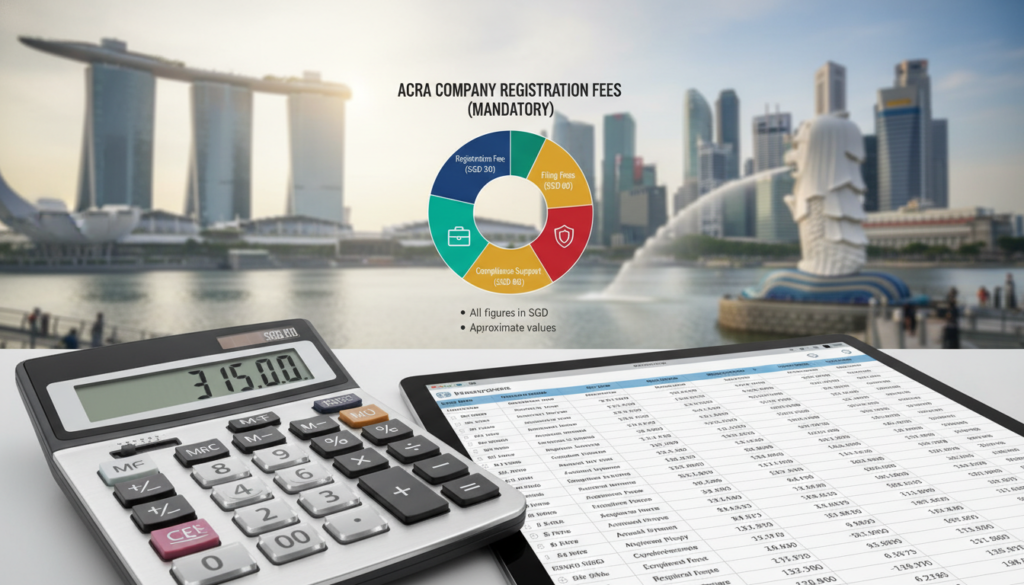
The mandatory ACRA filing totals S$315 — S$15 for name application and S$300 for registration. That figure is only the starting point.
In practice, first‑year budgets rise once statutory and compliance essentials are added. Common extras include a secretary, a registered address and, for some founders, nominee director services.
This short guide separates unavoidable government charges from optional but often needed services. It explains how packages vary, outlines one‑off setup, first‑year compliance and ongoing annual costs, and gives clear decision criteria: cost certainty, compliance risk, speed of setup and whether you prefer a DIY or managed model.
For a practical market reference and deeper cost examples, see this brief guide.
Key Takeaways
- The baseline ACRA charge is S$315; expect higher real‑world spend when compliance items are included.
- Good value means transparent inclusion of statutory items and clear add‑on pricing.
- Budget by category: one‑off setup, first‑year compliance, and ongoing annual costs.
- Compare packages on scope, not just headline price; some offers only cover the filing fee.
- Decide on DIY versus managed services based on speed, support and tolerance for compliance risk.
Why fees matter when registering a company in Singapore
Upfront price tags matter because they shape choices that affect compliance, timing and long‑term costs.
Low headline rates can lure founders, but they often only cover the ACRA name application and incorporation filing. That leaves statutory needs—secretary appointment, registered address, bookkeeping and tax support—uncovered.

What “low ACRA fees” do and don’t cover
Low ACRA fees usually mean the mandatory filing alone. Expect add‑ons for verification, nominee director or accounting setup if you want to operate legally and on time.
Typical first-year budget ranges for locals vs foreigners
DIY can cost as little as S$315 for ACRA alone. Realistic first‑year totals typically sit around S$1,500–2,500 for locals and S$3,500–4,000 for foreigners once essentials are included.
How cost certainty affects compliance and risk
Transparent pricing reduces friction: fewer vendors, clearer responsibilities and less chance of missed filings. The best commercial choice matches the buyer’s risk tolerance and time constraints, not the lowest sticker price.
Next: a detailed look at mandatory government charges, professional service components and ongoing annual obligations.
Singapore company registration fees breakdown: mandatory ACRA charges
Understanding which ACRA charges are compulsory helps you plan cashflow and timelines.
Core filing items
| Item | Charge (S$) | What it does |
|---|---|---|
| Name application | S$15 | Reserves and approves the proposed company name for the formal application. |
| Registration (incorporation) | S$300 | Completes the legal formation and issues the UEN and e‑Certificate after approval. |
The company name approval can stall if sensitive terms are used or if the case is referred for review. That affects the timeline even though the fee is fixed.
Common post‑incorporation ACRA filings to budget for
- Annual Return filing — S$60 (typical recurring item)
- Conversion — S$40; Notice of Error — S$60
- Registration of charges — S$60; Extension of time — S$200
ACRA usually issues the UEN and e‑Certificate within 1–2 working days for straightforward cases. That matters commercially: the UEN is needed on invoices, official correspondence, bank onboarding and licence applications.
Practical note: government charges are predictable. Most cost variation comes from external service layers and the time required to handle strict reporting windows.
DIY vs filing agent vs corporate service provider packages
Deciding between DIY and a managed option affects speed, paperwork and final expenses. Below is a practical guide to the three common routes and what you should check before you buy.

Cost comparison snapshot
- DIY (BizFile+) — from S$315: you handle every step and any bank account setup yourself.
- Digital platforms — from ~S$650: often bundle incorporation, a first-year secretary and limited banking support.
- Traditional firms — from ~S$800: higher touch, may charge extra for address, nominee director or accounting services.
What is usually included and common add-ons
Basic packages may only cover the core filing. Many essentials are sold separately.
- Common add-ons: registered address, nominee director, extra resolutions, expedited service.
- Services often upsold: bookkeeping, tax packages, and bank account introductions.
How to compare quotes fairly
- Confirm ACRA charges and whether a first‑year secretary is included.
- Check if a registered office is supplied and if bank account support is offered.
- Ask about annual return filings, compliance reminders and ongoing service scope.
Who each route suits
First‑time founders often prefer managed platforms for convenience and bank support.
Experienced operators may choose DIY or a minimal service from a firm to save cost.
Overseas owners typically need providers who offer local office services and bank introductions.
Essential services that drive real incorporation costs
Practical setup costs are driven less by one‑off filings and more by ongoing local support and statutory duties.
Company secretary rules are strict: a qualified company secretary who is resident must be appointed within 6 months of incorporation. A sole director cannot also act as secretary. Missing this creates regulatory risk and can delay banking or licences.
The secretary’s role is hands‑on. Typical tasks include maintaining statutory registers, preparing resolutions, issuing compliance reminders and handling annual return filing. Scope and price vary by provider; some only do filings, others offer full board support.
Registered office and core documents
All entities must keep a physical registered office address — a P.O. Box is not acceptable. Any change of address must be reported within 14 days. Providers supply accessible office facilities and mail handling as part of their packages.
| Service | Typical inclusion | Why it matters |
|---|---|---|
| Secretary support | Registers, resolutions, filings | Ensures legal compliance and timely filings |
| Registered address | Physical office, mail handling | Required for official notices and audits |
| Constitution & registers | Set-and-keep documents | Needed for governance and bank checks |
“Appointing the right secretary and keeping a proper office are not optional — they underpin day‑to‑day compliance.”
Audit triggers: an auditor must be appointed within 3 months unless exempt. Plan budgets for audit work as growth makes the audit unavoidable over the first few months.
Additional costs for foreign owners and cross-border setups
When owners are based overseas, practical steps like local director appointments and bank onboarding raise the real budget.

Why costs increase: foreigners need at least one local resident director. That adds governance, verification and ongoing oversight. Service scope and risk management become larger, so fees rise.
Local resident director and nominee options
Nominee director services commonly range from S$2,000–5,000 per year. Providers may request deposits or indemnities to cover legal risk.
What they do: attend to statutory filings and act as a local contact. What they usually don’t do: manage strategy or operational tasks unless contracted.
Employment Pass costs and timing
Budget S$105 per EP application and S$225 on issuance. Processing is often about 10 business days. Plan hires and relocations to match these timelines.
Bank account opening realities
Banks typically require stronger KYC for cross‑border structures, in‑person or virtual interviews, proof of activity and source‑of‑fund documents. This raises time and support needs for a new bank account.
Tax residency and commercial impact
Tax residency affects access to incentives and how banks perceive the group. The corporate tax rate is 17%; residency helps with startup exemptions and local credibility.
| Item | Typical cost | Lead time |
|---|---|---|
| Nominee director | S$2,000–5,000/yr (+deposit) | Immediate on engagement |
| Employment Pass | S$105 (apply) + S$225 (issuance) | ~10 business days |
| Bank account opening | No fixed fee; advisory S$300–800 | 1–4 weeks |
Practical takeaway: for foreigners, expect nominee director and enhanced bank support to be the main incremental line items when planning a realistic budget for business singapore activities.
“Prioritise clear records, a concise business model and source‑of‑fund documents to speed approvals and lower friction.”
Ongoing annual compliance costs to plan for beyond registration
Once a business is set up, regular statutory tasks become the main cost drivers each year. Plan a simple compliance calendar that tracks financial year end, maintaining registers, preparing financial statements and meeting annual submission windows.
Annual return and recurring ACRA charges
Annual return filing is the core recurring government charge (S$60). Other ACRA transactions — notice of error (S$60), registration of charges (S$60) or extension of time (S$200) — add up depending on changes during the year.
Accounting, tax filing and record-keeping obligations
Accurate bookkeeping and timely corporate tax filing are mandatory. Records must be retained for at least five years. Many firms outsource accounting to reduce compliance risk and avoid late penalties.
GST threshold and ongoing filing workload
GST registration is required once taxable turnover exceeds S$1,000,000 in a 12‑month period. Becoming GST‑registered increases filing frequency and system work, which raises accounting costs.
Typical annual cost ranges and key drivers
Lean setups often budget S$1,000–2,000 a year for basic secretary, address and accounting. Costs rise with transaction volume, payroll complexity, multi‑currency activity and audit requirements.
“Choose a provider that offers clear scopes and proactive reminders to keep ongoing compliance predictable and avoid costly panic filings.”
Budget framework: base compliance (secretary + address + annual return) plus variable layers (accounting, tax, GST, audit) tied to growth.
Conclusion
Plan your budget around predictable government charges and the common extras that make a new business operational.
Key anchors: the mandatory ACRA filing is S$315 and the recurring Annual Return is S$60. Build on those with costs for a qualified secretary, a physical registered address and, for foreign founders, nominee director or banking support.
Choose your route—DIY, digital platform or traditional firm—by weighing cost certainty, compliance confidence and cross‑border needs. Compare quotes with a consistent checklist: what’s included, first‑year cover, add‑on pricing, typical response times and who owns each compliance task.
Next steps: estimate realistic first‑year and ongoing budgets, confirm director/address/secretary requirements early, and align your incorporation approach to growth and risk. For practical address and mail handling options, consider a virtual office solution like virtual office services.
FAQ
What are the mandatory government charges when registering a company in Singapore?
What do “low ACRA fees” typically not cover?
How much should I budget for my first year if I am a local owner compared with a foreign owner?
Why does cost certainty matter for incorporation and ongoing compliance?
What common ACRA fees may arise after incorporation?
How long does approval and issuance of the UEN usually take?
What are the main cost differences between DIY BizFile+, digital platforms and traditional corporate service firms?
Which services are commonly included in incorporation packages and which are usually add-ons?
Who should choose a DIY route versus an agent or corporate service provider?
How can I compare quotes fairly across different providers?
What are typical fees for appointing a company secretary and what are the legal requirements?
What should I expect from a registered address service?
Are constitution drafting, statutory registers and annual return support usually part of the incorporation cost?
When is an auditor appointment required and how should I budget for it?
What extra costs should foreign owners expect for cross-border setups?
What are nominee director arrangements and their typical costs?
What are the likely fees and considerations for Employment Pass applications?
How much support do banks typically require for account opening and what might providers charge?
How does tax residency impact access to incentives and what costs arise from tax planning?
What ongoing ACRA charges and annual filing costs should I plan for?
What are the accounting, tax filing and record-keeping obligations and associated costs?
When must a business register for GST and what ongoing workload does that create?
What are typical annual compliance cost ranges and what influences them most?

Dean Cheong is a Singapore-based B2B growth strategist and the CEO of VOffice. He helps companies scale revenue through sharper sales execution, CRM implementation, and go-to-market strategy, backed by a strong foundation in business banking and finance from Nanyang Technological University and a track record of driving sustainable, performance-led growth.