

Can remote verification truly replace face-to-face checks when opening a corporate account, especially for foreign founders?
Video KYC Singapore business bank means a remote identity and company check used during corporate account opening. It lets digital banks and fintechs onboard firms without physical visits.
Expect faster onboarding with this method, but acceptance varies by provider and risk profile. Plan alternatives for providers that still prefer in‑person checks.
This guide is for Singapore‑incorporated companies, including foreign‑owned firms, that need an account for payments, payroll, IRAS compliance and clear financial separation.
We cover the end‑to‑end journey: readiness, document pack, foreign document prep, workflow steps, timelines, costs, activation and how to avoid rejection. Learn what banks focus on: identity, beneficial ownership, legitimacy, expected transactions and funding transparency.
Many start with a remote‑capable provider for speed, then add a traditional bank relationship for fuller corporate services. Success looks like an approved account with online access, minimal follow‑ups and operations that match the declared profile.
For a deeper procedural walk‑through, see this complete guide.
Key Takeaways
- Remote checks can speed corporate account opening, though acceptance differs across providers.
- Prepare a clear document pack and proof of beneficial ownership to reduce follow‑ups.
- Foreign documents often need certified copies or translations; plan ahead.
- Banks prioritise identity, ownership clarity and transaction expectations during onboarding.
- Start with a remote‑capable provider for quick access, then broaden relationships for full services.
What video KYC means for business bank account opening in Singapore
Live remote interviews provide a structured route to verify people, paperwork and company facts for corporate accounts.
How live verification fits KYC and AML due diligence
Remote checks support core compliance steps. They confirm identity, authority to act and document authenticity. This creates an audit trail that complements sanctions screening and beneficial ownership reviews.
When remote checks are accepted and when they are not
Many digital providers permit remote onboarding where ownership is simple and operating substance is clear. Traditional lenders often insist on in‑person meetings for higher-risk profiles or complex ownership structures.
- Typical components: ID presentation, face matching, liveness prompts and company fact confirmation.
- Triggers for in-person: complex shareholdings, regulated sectors or requests to view original documents.
- Call focus: expected transaction patterns, counterparties, jurisdictions and the purpose of account opening.
| Component | What is checked | Why it matters |
|---|---|---|
| ID & face match | Passport or national ID and live image | Confirms the person is the authorised signer |
| Document authenticity | Company extracts, resolutions, proof of address | Verifies authority and legal existence |
| Operational facts | Business model, customers, transaction patterns | Assesses risk and future monitoring needs |
| Sanctions & ownership | UBO checks and screening | Meets AML and regulatory requirements |
Note: Remote checks are part of wider onboarding and do not guarantee approval; compliance review continues after the call.
Decide if video KYC suits your corporate banking needs
Match your account choice to how you will operate, pay suppliers and receive funds.
Choosing between traditional banks and digital providers
Digital providers (for example Aspire, Airwallex, Wise Business) often let you open business accounts quickly with remote onboarding and multi-currency tools.
They suit early-stage firms that need fast access and simple cross-border payments.
When you need full corporate banking services
Traditional providers deliver deeper corporate banking services such as trade finance, credit facilities and relationship management.
These services matter for import/export, large purchase orders, working capital and letters of credit.
Multi-currency needs and transaction mapping
Holding and paying in SGD, USD and EUR reduces conversion costs and helps manage FX risk for cross-border transactions.
Map your expected countries, monthly volumes and counterparties to the provider’s limits and risk appetite.
“Start with a remote-capable account to get operating, then add a full corporate relationship as your needs grow.”

| Dimension | Digital providers / fintech | Traditional corporate banking |
|---|---|---|
| Onboarding | Remote, fast (days) | Often in-person, 4–8 weeks |
| Services | Multi-currency, payments, limits | Trade finance, credit, guarantees |
| Credibility | Good for digital suppliers and marketplaces | Preferred for large counterparties and regulated contracts |
- Assess operational reality: speed vs full-suite services.
- Open a remote-capable account to start transactions, then transition to a traditional account if you need trade finance or credit.
- Keep corporate model clear to reduce compliance friction for foreign-owned structures.
Understand the compliance baseline banks apply in Singapore today
Regulators and providers expect clear, documented answers about who controls a firm and how money flows into it.
UBO identification and shareholding transparency
Banks must be confident about the ultimate beneficial owners and how ownership is structured. Provide a simple ownership chart that shows direct and indirect holdings.
Ensure shareholders and register entries match the information on forms and statutory records. Inconsistencies trigger queries and delays.
Source of funds and source of wealth checks
For foreign-owned companies, reviewers treat funds and wealth origin as critical. They need documents that show how capital accumulated and why it was sent to the firm.
- Acceptable proof includes bank statements showing savings build-up, investment agreements, transfer confirmations.
- Parent-company resolutions or loan agreements explain capital injections and corporate transfers.
Transaction pattern assessment and industry risk profiling
Expect questions about typical counterparties, monthly volumes, average ticket sizes and the flow ratio between incoming and outgoing payments.
High-risk sectors—such as payments intermediaries, crypto/Web3 or cash-heavy models—often prompt extra reviews and additional documentary checks.
| What is checked | Why it matters | What to prepare |
|---|---|---|
| Ownership clarity | Identifies control and liability | Ownership chart, registers, UBO declarations |
| Source of funds | Shows origin of capital | Bank statements, transfer confirmations |
| Transaction profile | Assesses monitoring needs | Expected volumes, counterparty list, countries |
Timelines and follow-ups: complex, foreign-owned cases commonly take 4–8 weeks and often need staged clarifications. Plan conservatively to avoid last-minute disruption. For related procedural details, review our terms and conditions.
Get your company ready before you start the video KYC process
Prepare early to avoid avoidable delays when opening business accounts.
Begin with incorporation: incorporate with ACRA, obtain a valid UEN and secure a recent ACRA business profile extract before you apply. Banks will commonly decline to assess any application that lacks these core registration items.

Core corporate records to assemble
Prepare the constitution, registers of directors and shareholders, and a board resolution that authorises account signatories. Keep all documents current and consistent.
Digital ID and data tools to speed the process
Set up CorpPass for authorised signatory workflows where required. Enable MyInfo Business to reduce manual entry and mismatches during verification.
- Sequence: incorporate with ACRA → get UEN and extracts → start account singapore application steps.
- Recency: provide documents issued within 1–3 months to meet common requirements.
- Clean-up: match signatory names, addresses and IDs exactly across every form and attachment.
Result: a complete, company-ready pack cuts follow-ups after the live call and shortens the approval process.
Build a bank-ready document pack for directors, shareholders and ultimate beneficial owners
A neat, separated pack of company and personal paperwork reduces friction during the account review.
Company documentation to include
Company bundle: ACRA business profile, the constitution, registers of directors and shareholders, an ownership chart, and a board resolution authorising account opening and naming authorised signatories.
Personal documents for each individual
Personal bundle: passports for all directors and beneficial owners, plus recent proof of residential address. Typically, a utility bill or bank statement issued within three months is required.
Business profile evidence and narrative
Provide supporting evidence: an active website, customer or supplier contracts, invoices and a concise one‑page company summary that explains the offering, customer segments and revenue model.
- State the operational narrative: where funds come from, where they go, typical counterparties and expected transaction frequency and size.
- Submit clear, high‑quality scans with consistent file names. Avoid cropped IDs and low‑contrast images that trigger re‑submissions.
- Upload company and individual packs separately so reviewers can cross‑check control, authority and reputational risk across all connected persons.
Result: Complete, well‑labelled documentation speeds approval for a bank account and cuts the chance of follow‑up requests.
Prepare foreign-issued documentation for Singapore bank verification
When papers originate overseas, the issuing country’s authentication route determines what your submission must include.
Any identity, address or corporate documents issued outside Singapore that a provider will rely on must follow formal authentication and translation paths.
Notarisation, legalisation and Hague Apostille routes
Apostille (Hague Convention countries): a single apostille from the issuing state usually suffices for company certificates, registers and resolutions.
Consular legalisation (non‑apostille countries): documents often need notarisation, ministry certification and an embassy or consulate stamp from the receiving jurisdiction.
Commonly legalised items include incorporation certificates, registers, authorising resolutions, passports (when required) and proof‑of‑address documents.
Certified English translations for non-English documents
Any non‑English document should have a certified English translation. Providers typically expect a translator’s declaration and a recognisable stamp or signature.
Some reviewers ask that translations be notarised too. Check the recipient’s requirements before starting work to avoid rework.
“Start authentication and translation early — these steps can add days or weeks to your timeline.”
- Apply apostille or consular legalisation as required by the issuing state.
- Obtain certified English translations that preserve spellings and addresses exactly.
- Scan originals and translations so stamps and signatures remain legible.
| Document type | Typical action | Why it matters |
|---|---|---|
| Incorporation certificate | Apostille or consular legalisation | Verifies legal existence and registration |
| Registers / resolutions | Notarise then legalise | Shows authorised signatories and control |
| Passport / ID | Notarise or certified copy | Confirms identity for signatories and UBOs |
| Proof of address | Certified translation if not in English | Matches residential details on application |
Practical tips: keep original‑language documents alongside translations, ensure certification stamps are clear in scans and use identical spelling across all forms and documents. This reduces follow‑ups and shortens approval timelines.
How to implement video kyc singapore business bank workflows end-to-end
Follow a clear, repeatable workflow to reduce delays and make compliance checks predictable.
Pre-application screening and choosing the right account type
Start by matching your industry, ownership structure and transaction profile to the account type you plan to open. Digital providers typically accept simpler ownership and cross-border payment patterns. Traditional banks favour deeper operational substance and may require in‑person checks for complex ownership.
Online application submission and secure document upload
Complete the application carefully. Align every declared detail — activities, turnover, counterparties and countries — with your supporting files.
Upload best practice: label files clearly, use requested formats and include the ownership chart and board resolution early to reduce follow-ups.
Video interview preparation for authorised signatories and directors
Prepare signatories to explain the business model and confirm ownership and control. Consistent, concise answers on expected transactions cut review time.
Live liveness checks, identity matching, and document authenticity review
During the call, reviewers run liveness prompts and face‑to‑ID matching, and inspect ID security features. They cross‑check register entries, resolutions and signatory authority against the company narrative.
Post-call follow-ups, additional information requests, and response timelines
Assign one point of contact for compliance queries and respond quickly to requests for contracts, invoices or source‑of‑fund evidence. Keep an internal checklist of submitted items and outstanding requests to keep the account opening process auditable and predictable.
- Pre-screen → choose account type.
- Submit aligned application and secure uploads.
- Prepare signatories for live checks.
- Respond promptly to post‑call follow-ups.
Plan realistic timelines and operational milestones
Map your timeline from incorporation to activation so you can manage payroll and receipts without surprises.
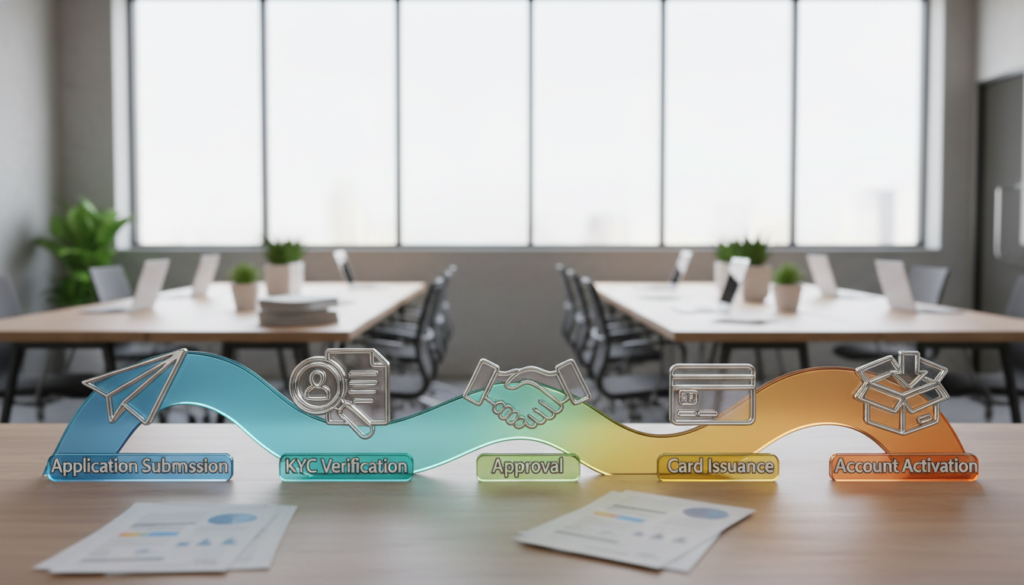
Typical approval windows
Traditional banks commonly require 4–8 weeks end-to-end. Appointment lead times often add 1–4 weeks before reviews start, so total time can extend further.
Digital providers may complete onboarding in days to 1–3 weeks for straightforward cases. Complex ownership or follow-up requests push this toward the upper end.
How appointment lead times and remote checks change the pace
Scheduling matters. Even a perfect file stalls if interview slots are fully booked. Book interviews early to avoid idle weeks.
Where remote identity checks are available, they cut travel and coordination delays. This helps non‑resident directors and overseas UBOs to verify identity faster with fewer calendar clashes.
- Incorporated and ready → document pack assembled (week 0–1).
- Submit application → schedule interview (week 1–3 for digital; 2–6 for traditional).
- Compliance review and follow-ups → approval window (days–weeks depending on complexity).
- Activation and first transactions → account operational.
Factors that extend timelines include complex ownership, higher‑risk sectors, unclear source of funds, missing translations or legalisation, and slow responses to queries.
“Start applications at least 6–8 weeks before you need the account for payroll or tax payments.”
Mitigation: arrange interim payment arrangements and avoid committing supplier dates until approval and activation are confirmed.
Budget for initial deposit, minimum balance and ongoing fees
Plan your cash buffer early: initial deposit rules and routine fees shape how quickly an account becomes usable.
Initial deposit expectations: Many corporate accounts ask for an initial deposit in the range of SGD 1,000–5,000. Some account tiers and higher‑risk profiles require larger deposits, and certain premium offerings can ask for sums up to SGD 30,000.
What drives higher thresholds
Thresholds rise with perceived risk, complex ownership, regulatory sector work and higher service tiers. Lenders often view a substantial deposit as a funding signal for foreign‑owned or newly formed firms.
Maintenance, fall‑below fees and transfer charges
Ongoing costs include monthly maintenance fees, fall‑below penalties for missing minimum balances, and international transfer or FX conversion charges. Digital providers may offer low or zero minimums but still apply per‑transaction FX fees.
Practical tips: budget a buffer for the first three months to avoid early fall‑below fees and keep operational liquidity for initial transactions. Compare fee schedules and choose the account option that fits your projected transaction mix and cash flow. For guidance on suitable providers, consult a trusted resource on setting up a business bank account.
Activate the account and set up controls for online banking operations
Approval is not the finish line — swift activation and governance setup make the account usable for day‑to‑day operations.
Activation checklist: accept the offer, confirm signatory details and collect online banking credentials. Test log‑in, set up multi‑factor authentication and verify the account is ready to receive and send funds.

Authorised signatories, user roles and maker‑checker controls
Define authorised signatories and assign user roles immediately. Create tiered permissions so only certain users can initialise payments.
Implement maker‑checker controls to require a second approver for large transfers or new payees. This reduces fraud and operational errors.
First deposit, cards and local payment rails
Make the first deposit using a traceable source and keep proof of the transfer. The bank may request this to confirm funding origin.
Order corporate cards if needed and enable local rails such as PayNow, FAST and GIRO for payroll and vendor payments. Activate each service and test one small transfer.
Day‑to‑day transactions and early monitoring
Keep transactions aligned with your declared volumes, counterparties and services. Sudden large flows to unfamiliar jurisdictions can trigger holds.
New accounts commonly face elevated monitoring for 3–6 months while activity is matched to the declared profile.
Proactively notify the bank of legitimate operational changes and document unusual inbound deposits to avoid restrictions. Gradual increases in limits follow consistent behaviour.
Reduce rejection risk by aligning your application with bank expectations
Alignment means presenting a coherent, evidence-backed story that matches what compliance teams will verify during due diligence.
Demonstrating operational substance beyond a virtual office
Show a real local presence. Use a tenancy agreement, utility invoices, staff contracts or client letters that prove activity in the jurisdiction.
Avoid virtual-office setups as sole proof of presence; they trigger enhanced review and often block approval.
Make your model specific to reduce enhanced reviews
Describe your product or service clearly, name typical customers and list sample invoices or contracts. Specificity helps underwriters match declared activity to documents.
Keep documentation current, consistent and complete
Ensure names, addresses and roles match across all documents for directors and shareholders. Submit recent extracts, certified IDs and timely proofs of address.
Handle regulated or higher‑risk sectors early
Provide licences, registrations and disclosures at application time. This reduces surprises and shortens review cycles.
Improve outcomes for non‑resident directors and foreign shareholders
Supply stronger source‑of‑fund records, clear operational links to the jurisdiction and a single compliance contact to respond fast to queries.
“A focused, consistent file reduces follow-ups and speeds approval.”
Conclusion
Treat onboarding as a project: schedule tasks, assign a point of contact and track every document.
Follow the implementation path: choose the right provider, prepare company readiness, assemble certified document packs, complete any foreign formalities, then run the live onboarding workflow end‑to‑end.
Success depends on clarity: present a concise operating model, transparent ownership and clear funding lines so reviewers can approve with minimal follow‑up.
Choose a digital route for speed and remote checks; select traditional providers when you need deeper relationship services and broader corporate support from banks.
Plan timelines realistically (traditional openings can take 4–8 weeks) and staff a single contact to respond fast to queries.
Operational rule: once the bank account singapore is live, keep transactions consistent and update records promptly. As a next step, compile one “bank‑ready” file (company + personal + transaction summary) before you apply to shortlisted banks.
FAQ
What does remote video verification mean for opening a corporate account in Singapore?
How does video verification tie into KYC and AML due diligence?
When will a bank still require physical presence instead of remote verification?
How do I choose between a traditional bank and a digital bank or fintech for remote onboarding?
When should I opt for a full corporate banking relationship rather than a simple payments account?
What documentation do banks expect to identify ultimate beneficial owners and shareholders?
What evidence of source of funds and source of wealth should I prepare for a foreign‑owned company?
What corporate records are essential before starting the remote verification process?
How can CorpPass or MyInfo Business speed up verification?
Which personal documents should directors and signatories prepare for the remote call?
What business evidence strengthens an application besides statutory documents?
How should I prepare foreign‑issued documents for verification by a Singapore bank?
What are the typical steps in an end‑to‑end remote onboarding workflow?
How should authorised signatories prepare for the live verification interview?
What are realistic timelines for account approval with traditional banks versus digital providers?
How can remote verification reduce appointment lead times?
What initial deposit and fee considerations should I budget for?
How do authorised signatory roles and maker‑checker controls get set up after approval?
What first steps should I take after account activation to avoid restrictions?
How can I reduce the risk of application rejection?
What special steps help non‑resident directors and foreign shareholders get approved?
How are transaction patterns and industry risk profiling assessed during onboarding?
Which keywords and terms should I include when discussing remote onboarding to improve clarity with banks and providers?

Dean Cheong is a Singapore-based B2B growth strategist and the CEO of VOffice. He helps companies scale revenue through sharper sales execution, CRM implementation, and go-to-market strategy, backed by a strong foundation in business banking and finance from Nanyang Technological University and a track record of driving sustainable, performance-led growth.