

Curious whether a small company should sign up for a consumption tax before it must?
This short guide helps a business owner apply correctly and avoid common pitfalls. It explains who benefits from early gst registration, what documents are needed and how to submit an application via myTax Portal. It also notes the two-year commitment that comes with choosing voluntary status.
Expect practical steps that follow IRAS rules and current practice, including a nod to upcoming digital invoicing through InvoiceNow. We focus on eligibility for companies below the S$1 million turnover mark that want input tax recovery, stronger credibility or readiness for growth.
Bear in mind that this is not just a formality. Becoming registered creates ongoing filing, invoicing, record-keeping and payment duties that will affect pricing and cash flow. Read on to plan pre-application checks and the post-approval obligations you must meet.
Key Takeaways
- Learn eligibility and pre-application checks for GST schemes.
- Follow IRAS steps to submit a myTax Portal application correctly.
- Understand the two-year commitment and its impact on cash flow.
- Prepare documents and systems for filing, invoicing and record-keeping.
- Consider input tax recovery and business credibility before applying.
Understanding GST in Singapore and when voluntary registration makes sense
Understanding when to charge consumption tax helps small firms plan pricing and cash flow.
Goods services tax is a consumption tax collected by registered sellers on local supplies of goods and services and on imports. Businesses collect the levy from customers and remit it to the Inland Revenue Authority of Singapore (IRAS).
How the tax applies in practice
Most local supplies are standard-rated and attract a 9% charge. Some exports and international services are zero-rated, which means the output tax is billed at 0% but input tax can often be reclaimed.
Compulsory versus strategic sign-up
Compulsory registration kicks in when taxable turnover exceeds S$1 million in the past 12 months or is expected to exceed that amount in the next 12 months. Businesses must act quickly—often within 30 days—to avoid late penalties.
By contrast, choosing early registration can be strategic. It makes sense when you incur significant input tax, sell to other registered firms, or plan rapid growth. Do note that early sign-up brings obligations: GIRO setup, passing the IRAS e-learning overview, possible guarantees and ongoing filing duties.
“Decide based on cash flow, customer mix and growth plans — the right choice depends on your business model.”
- Past 12 months test: looks back at actual taxable turnover.
- Next 12 months test: assesses expected contracts and sales.
Is gst voluntary registration singapore right for your business?
Before you apply, match your customer mix and supplier costs to the likely tax impact.
Deciding on early gst registration depends on who buys from you and who supplies you. B2B firms and exporters often gain the most.
Why exporters and B2B suppliers benefit
Exporters that make zero-rated supplies can keep local costs competitive. They may claim input tax on qualifying purchases while charging 0% on eligible sales.
When it can hurt margins
Consumer-facing businesses risk losing price competitiveness. If most customers cannot claim GST, you might have to absorb the charge or raise prices and lose sales.

Planning for the two-year commitment
Registrants must normally remain registered for two years. That affects pricing, contracts and cash flow timing.
| Factor | Likely benefit | Potential downside |
|---|---|---|
| Customer profile (B2B) | Clients can claim input tax; improves tender chances | Minimal |
| Customer profile (B2C) | Limited | Margin squeeze if you absorb the tax |
| Exporter / zero-rated | Can reclaim input; pricing preserved | Compliance duties to track claims |
| Compliance & admin | Professional image | Ongoing filing costs and accounting changes |
Run a simple two-year scenario model: best case, base case and worst case. Use that to judge whether the early move pays off after compliance and cash-flow effects.
Eligibility for voluntary GST registration under IRAS rules
Eligibility hinges on the types of sales and cross-border activity your company actually plans to make.
IRAS accepts several routes for early registration. Choose the path that matches your core activities and supporting documents.
Making taxable supplies
Taxable supplies include both standard-rated sales and zero-rated exports or international services. These matter because they determine whether you can reclaim input tax and must charge output tax.
Out-of-scope transactions
Certain transactions are out of scope, such as goods in transit that never enter the country. Do not count these as taxable turnover when assessing eligibility.
Exempt financial services and international supplies
Some exempt financial services still qualify as international services under IRAS rules. If so, they can support an application because they affect input tax recovery and your reporting requirements.
Overseas services and low-value imports
Where you procure overseas services or import low-value goods, input tax recovery may be partial. Expect limits and specific requirements on how much you can claim.
Showing strong intention before trading
If sales have not started, provide evidence of intention. Useful items include draft contracts, signed letters of intent, pipeline reports and operational readiness notes.
- Draft contracts or LOIs
- Projected invoices and timelines
- Supplier agreements and logistics plans
Conditions to meet before you apply for voluntary GST registration
A quick pre-application readiness check saves days of follow-up and prevents common refusals.

Completing the IRAS e-learning
One non-negotiable step is to complete and pass the IRAS “Overview of GST” e-learning course.
The director, sole proprietor, partner or another key person should finish it. IRAS requires this to confirm the company understands basic filing, invoicing and returns duties.
Setting up GIRO for payments and refunds
Set up GIRO before you submit. It is an operational requirement to handle timely payments and any refunds.
Missing GIRO often delays approval and causes cash-flow headaches for the business.
Guarantee requests and lead time
The Comptroller may ask for a guarantee in specific cases. This means arranging security and allowing extra lead time for processing.
Prepare for InvoiceNow from Nov 2025
From 1 Nov 2025, businesses must meet the e-invoicing requirement where applicable.
Assess whether your invoicing or ERP system supports InvoiceNow and plan upgrades well before the date.
- Checklist of common delays: missing e-learning certificate, no GIRO, inconsistent accounts, and lack of guarantee where needed.
- Ready means: trained personnel, active payments setup and e-invoicing plans aligned with compliance expectations.
When these requirements are met, you reduce the risk of follow-up queries and speed the online process to apply via myTax Portal.
Documents and information to prepare for GST registration
Gathering the right paperwork before you apply shortens processing time and reduces follow-up queries. A focused folder of key items helps the company demonstrate preparedness and credibility to the tax authority.
Start with the IRAS checklist
Use the IRAS GST registration document checklist (Sections A and B) as your baseline. It tells you exactly what documents to attach so you do not guess and risk delays.
Typical information IRAS will ask for
- Business activities and expected types of supplies (local goods, exported services).
- Customer profile and projected taxable turnover for the next 12 months.
- Supplier arrangements, purchase orders and key contracts.
- Financial projections, bank details and GIRO readiness for payments.
Common supporting documents that strengthen an application
Practical items include a concise business plan, signed customer or supplier agreements, sample invoices and relevant licences or permits. Also provide incorporation details and contact information for authorised personnel.
Clean accounting records make a big difference. Maintain a clear chart of accounts, separate taxable from exempt items and keep traceable transaction evidence. Well-prepared invoices with fields for tax, invoice numbering and customer details reduce rework after approval.
Organised documents cut clarification requests and speed up processing times by several days. Prepare the file once and reuse it for future applications or audits.
How to apply via IRAS myTax Portal
A well-prepared online submission reduces follow-up queries and speeds up approval from IRAS.
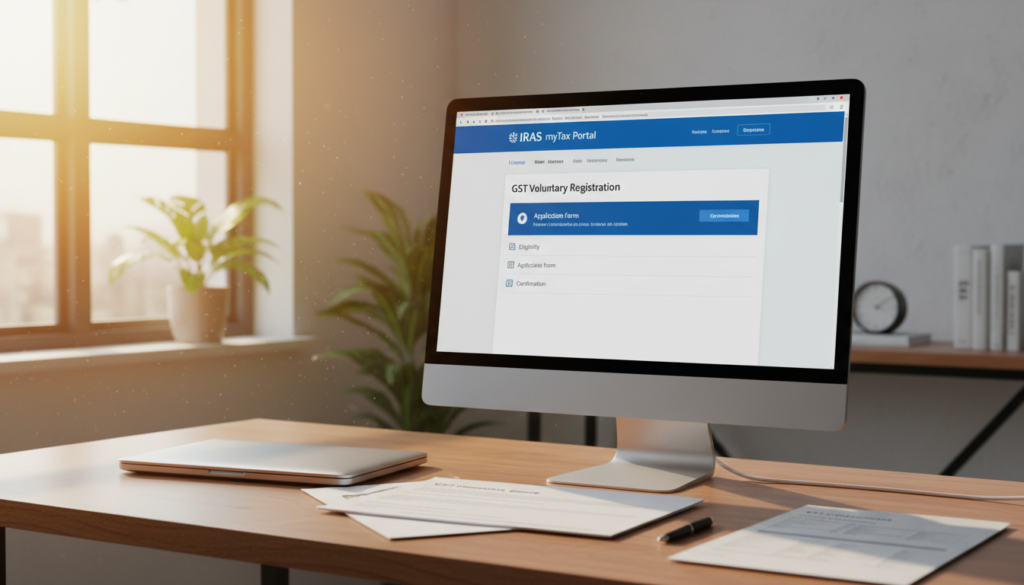
Submitting the online application and key declarations to get right
Log into myTax Portal and select the GST form under business services. The application asks for company details, UEN, projected taxable turnover and the eligibility basis you rely on.
Declare business activities accurately, state your intention to make taxable supplies and confirm you understand filing, returns and other compliance duties.
How to avoid delays by ensuring consistency across accounts and invoices
Match the legal entity name and UEN with your accounting records, invoices and contracts. Inconsistencies trigger verification requests and slow processing.
Ensure invoices show the same client names and formats your bookkeeping uses. Keep sample invoices and supplier contracts ready to attach when prompted.
Processing timelines, tracking status, and what to do if it takes longer
IRAS typically processes a complete application in about 10 working days. Missing attachments, unclear supply descriptions or mismatched figures extend the timeline.
Track progress in myTax Portal under the submission history. If more than 30 days elapse after you sent all supporting documents, raise an enquiry with IRAS to prompt a status update.
Receiving your GST registration number and effective date
When approved, IRAS sends an approval letter containing the GST registration number and the effective date. From that date, your company must charge tax on taxable supplies and begin compliant invoicing and filing.
What changes after approval as a GST-registered business
Once you receive approval, practical changes begin immediately — from pricing updates to daily accounting entries. On the effective date you become a collecting agent and must charge GST at 9% on standard-rated supplies. That applies to both goods and services that are taxable supplies.
Communicating price changes to customers
Tell customers clearly and early. Update quotations, price lists, e-commerce checkout settings and contract terms so the new 9% appears where needed.
Do not surprise clients; a clear notice prevents disputes and preserves relationships.
Issuing compliant tax invoices and timing
Issue tax invoices that include your registration number, the GST amount and a clear date. IRAS expects invoices generally within 30 days of supply.
Timely invoices protect your right to claim input and help customers reconcile payments quickly.
Output tax, input tax and day-to-day bookkeeping
Output tax is the GST you collect on sales. Input tax is what you reclaim on purchases. Record both in your ledger so they flow into the return each period.
Common pitfalls include misclassifying supplies, missing invoice details and claiming input tax without valid documents. These errors trigger queries and penalties.
“Build a simple, repeatable accounting process now rather than patchwork fixes later.”
- Tip: Align invoicing templates and accounting codes to avoid mismatches.
- Responsibility: Keep systems ready to meet filing and payment duties without last-minute fixes.
Ongoing compliance: GST returns, records, and payments
Keep a clear calendar and simple controls to meet filing deadlines, reconcile figures and avoid avoidable fines. Regular routines make compliance manageable for a small company.

Filing schedule and preparing returns
GST returns are normally filed quarterly. Filing and payments are due one month after the end of each accounting period.
Prepare figures ahead of the due date and submit returns on myTax Portal to reduce last-minute pressure.
Record-keeping and reconciliations
Keep sales invoices, purchase invoices, import/export papers, credit notes and accounting ledgers for at least five years.
Reconcile output tax collected against sales and input tax paid against purchases each period. Regular reconciliations cut audit risk and errors.
Payments, GIRO and penalties
Maintain GIRO to ensure prompt payments and faster refunds. A failed GIRO payment can trigger extra work and delays.
Late filing carries a S$200 monthly fine up to S$10,000. Late payment draws a 5% fee on the overdue amount plus further penalties if unpaid. These penalties are avoidable with a simple calendar and controls.
Two-year commitment and later options
Voluntary registrants must usually stay on for two years. Deregistration is possible later but subject to IRAS review and the company must remain compliant until approval.
Balancing benefits and costs of voluntary GST registration over the next two years
A clear two-year lens helps quantify whether input recovery outweighs extra admin.
Claiming input tax can cut effective costs when your cost base carries many taxed purchases. If capital buys, outsourced services or supplier bills show input tax, recovery often pays for software and advisory fees within months.
However, recovery is limited when most purchases are exempt or when suppliers are not registered. Forecast projected savings against recurring costs such as accounting, staff time and payments setup.
Credibility and tender readiness
Being registered improves standing with B2B customers and can be decisive for tenders where buyers need to reclaim tax. It signals maturity and eases contracting with larger customers.
Administrative burden and support
Expect tighter bookkeeping, invoice controls, staff training and audit readiness. Many businesses offset this by investing in cloud accounts and short-term advisory help.
Pricing strategy
- Pass on tax: show a 9% line item to keep margins intact and be transparent to customers.
- Absorb tax: keep prices but accept lower margin—suitable when customers are mainly private consumers.
For firms close to the turnover threshold, consider early registration to avoid constant monitoring and rushed compliance. For further guidance, review factors to consider before registering.
Conclusion
,Finish by aligning systems, people and paperwork so the business can meet ongoing duties from day one.
Practical path: confirm eligibility, satisfy IRAS pre-conditions (e‑learning, GIRO, any guarantee), prepare supporting documents and apply via myTax Portal. Implement invoicing and bookkeeping changes from the effective date.
Make the choice because it serves a clear purpose — input tax recovery, B2B readiness or growth — not as a badge. Remember you must remain registered for at least two years and keep payments, returns and records current.
Key risks to avoid include weak evidence of taxable supplies, inconsistent accounts and underestimating filing and invoicing workload.
Next steps: review turnover trajectory, map your customer mix, gather documents, set pricing and assign compliance ownership. Seek professional support if internal capacity is limited for correct classification, controls and timely returns and payments.
FAQ
How do I apply for voluntary GST registration in Singapore?
What is Goods and Services Tax and when does voluntary registration make sense?
How does voluntary registration differ from compulsory registration under the S
How do I apply for voluntary GST registration in Singapore?
Apply online through the Inland Revenue Authority of Singapore (IRAS) myTax Portal. Prepare required documents, complete the application form, declare expected taxable supplies and intended effective date, and submit. IRAS will review eligibility and may request further information before issuing a registration number and effective date.What is Goods and Services Tax and when does voluntary registration make sense?Goods and Services Tax is a consumption tax levied on taxable supplies and imports. Voluntary registration suits businesses that want to claim input tax on purchases, supply zero-rated exports, or sell primarily to other registered businesses. It can also improve credibility when tendering for contracts with larger buyers.How does voluntary registration differ from compulsory registration under the S
FAQ
How do I apply for voluntary GST registration in Singapore?
Apply online through the Inland Revenue Authority of Singapore (IRAS) myTax Portal. Prepare required documents, complete the application form, declare expected taxable supplies and intended effective date, and submit. IRAS will review eligibility and may request further information before issuing a registration number and effective date.
What is Goods and Services Tax and when does voluntary registration make sense?
Goods and Services Tax is a consumption tax levied on taxable supplies and imports. Voluntary registration suits businesses that want to claim input tax on purchases, supply zero-rated exports, or sell primarily to other registered businesses. It can also improve credibility when tendering for contracts with larger buyers.
How does voluntary registration differ from compulsory registration under the S
FAQ
How do I apply for voluntary GST registration in Singapore?
Apply online through the Inland Revenue Authority of Singapore (IRAS) myTax Portal. Prepare required documents, complete the application form, declare expected taxable supplies and intended effective date, and submit. IRAS will review eligibility and may request further information before issuing a registration number and effective date.
What is Goods and Services Tax and when does voluntary registration make sense?
Goods and Services Tax is a consumption tax levied on taxable supplies and imports. Voluntary registration suits businesses that want to claim input tax on purchases, supply zero-rated exports, or sell primarily to other registered businesses. It can also improve credibility when tendering for contracts with larger buyers.
How does voluntary registration differ from compulsory registration under the S$1 million turnover rule?
Compulsory registration applies if taxable turnover exceeds S$1 million over 12 months or is expected to do so. Voluntary registration is available for businesses below that threshold that meet IRAS eligibility and intend to make taxable supplies. Voluntary registrants must still meet ongoing filing and payment obligations.
Which business models commonly benefit from voluntary registration?
Exporters, business-to-business (B2B) suppliers and firms buying significant taxable inputs often benefit. These models recover input tax or supply zero-rated goods, reducing net cost. Service providers working with registered clients can also gain a competitive edge in tenders.
When can voluntary registration hurt my margins?
If your customers are mainly non-registered consumers, charging tax may raise final prices and reduce demand. Small retailers or businesses selling to end consumers must weigh the loss of price competitiveness against input tax recovery.
What is the two-year commitment and how does it affect planning?
Once registered, you agree to remain registered for at least two years unless IRAS permits early deregistration for valid reasons. This affects cash flow and pricing strategy because you must charge tax, file returns and meet record-keeping obligations throughout that period.
Who is eligible to register if I have not yet started making taxable supplies?
IRAS may accept applications from entities that can show a strong intention to make taxable supplies, evidenced by contracts, business plans, purchase orders or marketing arrangements. Provide clear supporting documents to demonstrate genuine intent.
What counts as taxable supplies, zero-rated supplies and out-of-scope supplies?
Taxable supplies include standard-rated and zero-rated goods and services supplied in Singapore. Zero-rated supplies include exports and certain international services. Out-of-scope supplies occur when goods or services do not enter Singapore or fall outside the tax base.
Are financial services exempt and can they qualify as international services?
Many financial services are exempt from tax, though some cross-border or international services may be treated differently. Check IRAS guidance to confirm whether specific financial transactions qualify as exempt or zero-rated international supplies.
How are imported low-value goods and overseas services treated for input tax?
Imported low-value goods and some overseas services may have partial input tax recovery depending on the rules at the time of import and whether the business is registered. Obtain up-to-date guidance and keep accurate import documentation to support claims.
What preparatory steps must I take before applying?
Complete the IRAS “Overview of GST” e-learning course if required, set up GIRO for payments and refunds, and be ready to provide guarantees if the Comptroller requests one. Prepare accounting systems and invoice processes in advance.
What is InvoiceNow and how does it affect applicants from November 2025?
InvoiceNow is an e-invoicing initiative. From November 2025 certain suppliers may need to issue compliant electronic invoices. Ensure your billing systems can meet the requirement and that invoices contain the information needed for input tax claims.
Which documents should I prepare for the application?
Use the IRAS registration checklist. Common documents include company registration details, business plans, sample invoices, contracts, licences and financial forecasts. Consistent records across accounting systems and invoices reduce processing delays.
How do I submit the application and what declarations matter?
Submit through the myTax Portal, completing declarations about expected turnover, taxable supplies and effective date. Ensure accuracy in company details, GST accounting basis and bank information to avoid queries from IRAS.
How long does registration take and how can I track the status?
Processing timelines vary. IRAS will acknowledge receipt and may request further documents. Track status via the myTax Portal and respond promptly to information requests to avoid delays. You will receive a registration number and effective date once approved.
What changes after approval as a registered business?
You must charge the applicable tax rate on taxable supplies, issue compliant tax invoices (typically within 30 days), and maintain accurate records. Adjust pricing or communicate changes to customers and update accounting systems to capture output and input tax correctly.
How do output tax and input tax work in daily bookkeeping?
Charge output tax on taxable supplies and claim input tax on qualifying business purchases. Record both amounts in your ledger, reconcile each accounting period and report net tax due or refundable on your return. Keep supporting invoices and import documents.
What are filing, payment and record-keeping obligations?
File returns for each accounting period (usually quarterly), pay net tax by the due date and keep records for at least five years. Maintain supporting documents, reconcile GIRO payments and ensure returns reflect consistent figures across systems.
What are the risks of late filing or late payment?
Late filing or payment can lead to penalties, additional charges and interest. Persistent non-compliance may attract heavier sanctions. Use reminders, automated payments and professional support to reduce the risk.
When can I deregister before the two-year period ends?
Early deregistration is possible only in specific circumstances, such as cessation of business or a permanent change that removes the need to be registered. Apply through myTax Portal and provide evidence. IRAS will assess requests case by case.
How do I claim input tax to reduce costs?
Keep valid tax invoices and import documentation, ensure purchases relate to taxable supplies, and claim input tax on your return for the period in which the tax was charged. Follow IRAS guidance on apportionment and partial claims.
What commercial benefits should I consider beyond input tax recovery?
Registration can enhance credibility, improve tender eligibility with customers who require vendors to be registered, and simplify transactions with other registered businesses. However, weigh these against administrative costs and pricing impacts.
What additional administrative work will I face after registering?
Expect greater bookkeeping discipline, system changes for invoicing and reporting, staff training, and potential need for professional accounting or tax advice. Plan for recurring compliance tasks to avoid errors and penalties.
Should I pass the tax on to customers or absorb it in my pricing?
Decide based on customer mix, competition and margin tolerance. Passing the tax can preserve margins but may reduce demand from non-registered consumers. Absorbing it protects price-sensitive sales but increases cost to your business.
million turnover rule?
Compulsory registration applies if taxable turnover exceeds S
FAQ
How do I apply for voluntary GST registration in Singapore?
Apply online through the Inland Revenue Authority of Singapore (IRAS) myTax Portal. Prepare required documents, complete the application form, declare expected taxable supplies and intended effective date, and submit. IRAS will review eligibility and may request further information before issuing a registration number and effective date.
What is Goods and Services Tax and when does voluntary registration make sense?
Goods and Services Tax is a consumption tax levied on taxable supplies and imports. Voluntary registration suits businesses that want to claim input tax on purchases, supply zero-rated exports, or sell primarily to other registered businesses. It can also improve credibility when tendering for contracts with larger buyers.
How does voluntary registration differ from compulsory registration under the S$1 million turnover rule?
Compulsory registration applies if taxable turnover exceeds S$1 million over 12 months or is expected to do so. Voluntary registration is available for businesses below that threshold that meet IRAS eligibility and intend to make taxable supplies. Voluntary registrants must still meet ongoing filing and payment obligations.
Which business models commonly benefit from voluntary registration?
Exporters, business-to-business (B2B) suppliers and firms buying significant taxable inputs often benefit. These models recover input tax or supply zero-rated goods, reducing net cost. Service providers working with registered clients can also gain a competitive edge in tenders.
When can voluntary registration hurt my margins?
If your customers are mainly non-registered consumers, charging tax may raise final prices and reduce demand. Small retailers or businesses selling to end consumers must weigh the loss of price competitiveness against input tax recovery.
What is the two-year commitment and how does it affect planning?
Once registered, you agree to remain registered for at least two years unless IRAS permits early deregistration for valid reasons. This affects cash flow and pricing strategy because you must charge tax, file returns and meet record-keeping obligations throughout that period.
Who is eligible to register if I have not yet started making taxable supplies?
IRAS may accept applications from entities that can show a strong intention to make taxable supplies, evidenced by contracts, business plans, purchase orders or marketing arrangements. Provide clear supporting documents to demonstrate genuine intent.
What counts as taxable supplies, zero-rated supplies and out-of-scope supplies?
Taxable supplies include standard-rated and zero-rated goods and services supplied in Singapore. Zero-rated supplies include exports and certain international services. Out-of-scope supplies occur when goods or services do not enter Singapore or fall outside the tax base.
Are financial services exempt and can they qualify as international services?
Many financial services are exempt from tax, though some cross-border or international services may be treated differently. Check IRAS guidance to confirm whether specific financial transactions qualify as exempt or zero-rated international supplies.
How are imported low-value goods and overseas services treated for input tax?
Imported low-value goods and some overseas services may have partial input tax recovery depending on the rules at the time of import and whether the business is registered. Obtain up-to-date guidance and keep accurate import documentation to support claims.
What preparatory steps must I take before applying?
Complete the IRAS “Overview of GST” e-learning course if required, set up GIRO for payments and refunds, and be ready to provide guarantees if the Comptroller requests one. Prepare accounting systems and invoice processes in advance.
What is InvoiceNow and how does it affect applicants from November 2025?
InvoiceNow is an e-invoicing initiative. From November 2025 certain suppliers may need to issue compliant electronic invoices. Ensure your billing systems can meet the requirement and that invoices contain the information needed for input tax claims.
Which documents should I prepare for the application?
Use the IRAS registration checklist. Common documents include company registration details, business plans, sample invoices, contracts, licences and financial forecasts. Consistent records across accounting systems and invoices reduce processing delays.
How do I submit the application and what declarations matter?
Submit through the myTax Portal, completing declarations about expected turnover, taxable supplies and effective date. Ensure accuracy in company details, GST accounting basis and bank information to avoid queries from IRAS.
How long does registration take and how can I track the status?
Processing timelines vary. IRAS will acknowledge receipt and may request further documents. Track status via the myTax Portal and respond promptly to information requests to avoid delays. You will receive a registration number and effective date once approved.
What changes after approval as a registered business?
You must charge the applicable tax rate on taxable supplies, issue compliant tax invoices (typically within 30 days), and maintain accurate records. Adjust pricing or communicate changes to customers and update accounting systems to capture output and input tax correctly.
How do output tax and input tax work in daily bookkeeping?
Charge output tax on taxable supplies and claim input tax on qualifying business purchases. Record both amounts in your ledger, reconcile each accounting period and report net tax due or refundable on your return. Keep supporting invoices and import documents.
What are filing, payment and record-keeping obligations?
File returns for each accounting period (usually quarterly), pay net tax by the due date and keep records for at least five years. Maintain supporting documents, reconcile GIRO payments and ensure returns reflect consistent figures across systems.
What are the risks of late filing or late payment?
Late filing or payment can lead to penalties, additional charges and interest. Persistent non-compliance may attract heavier sanctions. Use reminders, automated payments and professional support to reduce the risk.
When can I deregister before the two-year period ends?
Early deregistration is possible only in specific circumstances, such as cessation of business or a permanent change that removes the need to be registered. Apply through myTax Portal and provide evidence. IRAS will assess requests case by case.
How do I claim input tax to reduce costs?
Keep valid tax invoices and import documentation, ensure purchases relate to taxable supplies, and claim input tax on your return for the period in which the tax was charged. Follow IRAS guidance on apportionment and partial claims.
What commercial benefits should I consider beyond input tax recovery?
Registration can enhance credibility, improve tender eligibility with customers who require vendors to be registered, and simplify transactions with other registered businesses. However, weigh these against administrative costs and pricing impacts.
What additional administrative work will I face after registering?
Expect greater bookkeeping discipline, system changes for invoicing and reporting, staff training, and potential need for professional accounting or tax advice. Plan for recurring compliance tasks to avoid errors and penalties.
Should I pass the tax on to customers or absorb it in my pricing?
Decide based on customer mix, competition and margin tolerance. Passing the tax can preserve margins but may reduce demand from non-registered consumers. Absorbing it protects price-sensitive sales but increases cost to your business.
million over 12 months or is expected to do so. Voluntary registration is available for businesses below that threshold that meet IRAS eligibility and intend to make taxable supplies. Voluntary registrants must still meet ongoing filing and payment obligations.
Which business models commonly benefit from voluntary registration?
Exporters, business-to-business (B2B) suppliers and firms buying significant taxable inputs often benefit. These models recover input tax or supply zero-rated goods, reducing net cost. Service providers working with registered clients can also gain a competitive edge in tenders.
When can voluntary registration hurt my margins?
If your customers are mainly non-registered consumers, charging tax may raise final prices and reduce demand. Small retailers or businesses selling to end consumers must weigh the loss of price competitiveness against input tax recovery.
What is the two-year commitment and how does it affect planning?
Once registered, you agree to remain registered for at least two years unless IRAS permits early deregistration for valid reasons. This affects cash flow and pricing strategy because you must charge tax, file returns and meet record-keeping obligations throughout that period.
Who is eligible to register if I have not yet started making taxable supplies?
IRAS may accept applications from entities that can show a strong intention to make taxable supplies, evidenced by contracts, business plans, purchase orders or marketing arrangements. Provide clear supporting documents to demonstrate genuine intent.
What counts as taxable supplies, zero-rated supplies and out-of-scope supplies?
Taxable supplies include standard-rated and zero-rated goods and services supplied in Singapore. Zero-rated supplies include exports and certain international services. Out-of-scope supplies occur when goods or services do not enter Singapore or fall outside the tax base.
Are financial services exempt and can they qualify as international services?
Many financial services are exempt from tax, though some cross-border or international services may be treated differently. Check IRAS guidance to confirm whether specific financial transactions qualify as exempt or zero-rated international supplies.
How are imported low-value goods and overseas services treated for input tax?
Imported low-value goods and some overseas services may have partial input tax recovery depending on the rules at the time of import and whether the business is registered. Obtain up-to-date guidance and keep accurate import documentation to support claims.
What preparatory steps must I take before applying?
Complete the IRAS “Overview of GST” e-learning course if required, set up GIRO for payments and refunds, and be ready to provide guarantees if the Comptroller requests one. Prepare accounting systems and invoice processes in advance.
What is InvoiceNow and how does it affect applicants from November 2025?
InvoiceNow is an e-invoicing initiative. From November 2025 certain suppliers may need to issue compliant electronic invoices. Ensure your billing systems can meet the requirement and that invoices contain the information needed for input tax claims.
Which documents should I prepare for the application?
Use the IRAS registration checklist. Common documents include company registration details, business plans, sample invoices, contracts, licences and financial forecasts. Consistent records across accounting systems and invoices reduce processing delays.
How do I submit the application and what declarations matter?
Submit through the myTax Portal, completing declarations about expected turnover, taxable supplies and effective date. Ensure accuracy in company details, GST accounting basis and bank information to avoid queries from IRAS.
How long does registration take and how can I track the status?
Processing timelines vary. IRAS will acknowledge receipt and may request further documents. Track status via the myTax Portal and respond promptly to information requests to avoid delays. You will receive a registration number and effective date once approved.
What changes after approval as a registered business?
You must charge the applicable tax rate on taxable supplies, issue compliant tax invoices (typically within 30 days), and maintain accurate records. Adjust pricing or communicate changes to customers and update accounting systems to capture output and input tax correctly.
How do output tax and input tax work in daily bookkeeping?
Charge output tax on taxable supplies and claim input tax on qualifying business purchases. Record both amounts in your ledger, reconcile each accounting period and report net tax due or refundable on your return. Keep supporting invoices and import documents.
What are filing, payment and record-keeping obligations?
File returns for each accounting period (usually quarterly), pay net tax by the due date and keep records for at least five years. Maintain supporting documents, reconcile GIRO payments and ensure returns reflect consistent figures across systems.
What are the risks of late filing or late payment?
Late filing or payment can lead to penalties, additional charges and interest. Persistent non-compliance may attract heavier sanctions. Use reminders, automated payments and professional support to reduce the risk.
When can I deregister before the two-year period ends?
Early deregistration is possible only in specific circumstances, such as cessation of business or a permanent change that removes the need to be registered. Apply through myTax Portal and provide evidence. IRAS will assess requests case by case.
How do I claim input tax to reduce costs?
Keep valid tax invoices and import documentation, ensure purchases relate to taxable supplies, and claim input tax on your return for the period in which the tax was charged. Follow IRAS guidance on apportionment and partial claims.
What commercial benefits should I consider beyond input tax recovery?
Registration can enhance credibility, improve tender eligibility with customers who require vendors to be registered, and simplify transactions with other registered businesses. However, weigh these against administrative costs and pricing impacts.
What additional administrative work will I face after registering?
Expect greater bookkeeping discipline, system changes for invoicing and reporting, staff training, and potential need for professional accounting or tax advice. Plan for recurring compliance tasks to avoid errors and penalties.
Should I pass the tax on to customers or absorb it in my pricing?
Decide based on customer mix, competition and margin tolerance. Passing the tax can preserve margins but may reduce demand from non-registered consumers. Absorbing it protects price-sensitive sales but increases cost to your business.
million turnover rule?Compulsory registration applies if taxable turnover exceeds S
FAQ
How do I apply for voluntary GST registration in Singapore?
Apply online through the Inland Revenue Authority of Singapore (IRAS) myTax Portal. Prepare required documents, complete the application form, declare expected taxable supplies and intended effective date, and submit. IRAS will review eligibility and may request further information before issuing a registration number and effective date.
What is Goods and Services Tax and when does voluntary registration make sense?
Goods and Services Tax is a consumption tax levied on taxable supplies and imports. Voluntary registration suits businesses that want to claim input tax on purchases, supply zero-rated exports, or sell primarily to other registered businesses. It can also improve credibility when tendering for contracts with larger buyers.
How does voluntary registration differ from compulsory registration under the S
FAQ
How do I apply for voluntary GST registration in Singapore?
Apply online through the Inland Revenue Authority of Singapore (IRAS) myTax Portal. Prepare required documents, complete the application form, declare expected taxable supplies and intended effective date, and submit. IRAS will review eligibility and may request further information before issuing a registration number and effective date.
What is Goods and Services Tax and when does voluntary registration make sense?
Goods and Services Tax is a consumption tax levied on taxable supplies and imports. Voluntary registration suits businesses that want to claim input tax on purchases, supply zero-rated exports, or sell primarily to other registered businesses. It can also improve credibility when tendering for contracts with larger buyers.
How does voluntary registration differ from compulsory registration under the S$1 million turnover rule?
Compulsory registration applies if taxable turnover exceeds S$1 million over 12 months or is expected to do so. Voluntary registration is available for businesses below that threshold that meet IRAS eligibility and intend to make taxable supplies. Voluntary registrants must still meet ongoing filing and payment obligations.
Which business models commonly benefit from voluntary registration?
Exporters, business-to-business (B2B) suppliers and firms buying significant taxable inputs often benefit. These models recover input tax or supply zero-rated goods, reducing net cost. Service providers working with registered clients can also gain a competitive edge in tenders.
When can voluntary registration hurt my margins?
If your customers are mainly non-registered consumers, charging tax may raise final prices and reduce demand. Small retailers or businesses selling to end consumers must weigh the loss of price competitiveness against input tax recovery.
What is the two-year commitment and how does it affect planning?
Once registered, you agree to remain registered for at least two years unless IRAS permits early deregistration for valid reasons. This affects cash flow and pricing strategy because you must charge tax, file returns and meet record-keeping obligations throughout that period.
Who is eligible to register if I have not yet started making taxable supplies?
IRAS may accept applications from entities that can show a strong intention to make taxable supplies, evidenced by contracts, business plans, purchase orders or marketing arrangements. Provide clear supporting documents to demonstrate genuine intent.
What counts as taxable supplies, zero-rated supplies and out-of-scope supplies?
Taxable supplies include standard-rated and zero-rated goods and services supplied in Singapore. Zero-rated supplies include exports and certain international services. Out-of-scope supplies occur when goods or services do not enter Singapore or fall outside the tax base.
Are financial services exempt and can they qualify as international services?
Many financial services are exempt from tax, though some cross-border or international services may be treated differently. Check IRAS guidance to confirm whether specific financial transactions qualify as exempt or zero-rated international supplies.
How are imported low-value goods and overseas services treated for input tax?
Imported low-value goods and some overseas services may have partial input tax recovery depending on the rules at the time of import and whether the business is registered. Obtain up-to-date guidance and keep accurate import documentation to support claims.
What preparatory steps must I take before applying?
Complete the IRAS “Overview of GST” e-learning course if required, set up GIRO for payments and refunds, and be ready to provide guarantees if the Comptroller requests one. Prepare accounting systems and invoice processes in advance.
What is InvoiceNow and how does it affect applicants from November 2025?
InvoiceNow is an e-invoicing initiative. From November 2025 certain suppliers may need to issue compliant electronic invoices. Ensure your billing systems can meet the requirement and that invoices contain the information needed for input tax claims.
Which documents should I prepare for the application?
Use the IRAS registration checklist. Common documents include company registration details, business plans, sample invoices, contracts, licences and financial forecasts. Consistent records across accounting systems and invoices reduce processing delays.
How do I submit the application and what declarations matter?
Submit through the myTax Portal, completing declarations about expected turnover, taxable supplies and effective date. Ensure accuracy in company details, GST accounting basis and bank information to avoid queries from IRAS.
How long does registration take and how can I track the status?
Processing timelines vary. IRAS will acknowledge receipt and may request further documents. Track status via the myTax Portal and respond promptly to information requests to avoid delays. You will receive a registration number and effective date once approved.
What changes after approval as a registered business?
You must charge the applicable tax rate on taxable supplies, issue compliant tax invoices (typically within 30 days), and maintain accurate records. Adjust pricing or communicate changes to customers and update accounting systems to capture output and input tax correctly.
How do output tax and input tax work in daily bookkeeping?
Charge output tax on taxable supplies and claim input tax on qualifying business purchases. Record both amounts in your ledger, reconcile each accounting period and report net tax due or refundable on your return. Keep supporting invoices and import documents.
What are filing, payment and record-keeping obligations?
File returns for each accounting period (usually quarterly), pay net tax by the due date and keep records for at least five years. Maintain supporting documents, reconcile GIRO payments and ensure returns reflect consistent figures across systems.
What are the risks of late filing or late payment?
Late filing or payment can lead to penalties, additional charges and interest. Persistent non-compliance may attract heavier sanctions. Use reminders, automated payments and professional support to reduce the risk.
When can I deregister before the two-year period ends?
Early deregistration is possible only in specific circumstances, such as cessation of business or a permanent change that removes the need to be registered. Apply through myTax Portal and provide evidence. IRAS will assess requests case by case.
How do I claim input tax to reduce costs?
Keep valid tax invoices and import documentation, ensure purchases relate to taxable supplies, and claim input tax on your return for the period in which the tax was charged. Follow IRAS guidance on apportionment and partial claims.
What commercial benefits should I consider beyond input tax recovery?
Registration can enhance credibility, improve tender eligibility with customers who require vendors to be registered, and simplify transactions with other registered businesses. However, weigh these against administrative costs and pricing impacts.
What additional administrative work will I face after registering?
Expect greater bookkeeping discipline, system changes for invoicing and reporting, staff training, and potential need for professional accounting or tax advice. Plan for recurring compliance tasks to avoid errors and penalties.
Should I pass the tax on to customers or absorb it in my pricing?
Decide based on customer mix, competition and margin tolerance. Passing the tax can preserve margins but may reduce demand from non-registered consumers. Absorbing it protects price-sensitive sales but increases cost to your business.
million turnover rule?
Compulsory registration applies if taxable turnover exceeds S
FAQ
How do I apply for voluntary GST registration in Singapore?
Apply online through the Inland Revenue Authority of Singapore (IRAS) myTax Portal. Prepare required documents, complete the application form, declare expected taxable supplies and intended effective date, and submit. IRAS will review eligibility and may request further information before issuing a registration number and effective date.
What is Goods and Services Tax and when does voluntary registration make sense?
Goods and Services Tax is a consumption tax levied on taxable supplies and imports. Voluntary registration suits businesses that want to claim input tax on purchases, supply zero-rated exports, or sell primarily to other registered businesses. It can also improve credibility when tendering for contracts with larger buyers.
How does voluntary registration differ from compulsory registration under the S$1 million turnover rule?
Compulsory registration applies if taxable turnover exceeds S$1 million over 12 months or is expected to do so. Voluntary registration is available for businesses below that threshold that meet IRAS eligibility and intend to make taxable supplies. Voluntary registrants must still meet ongoing filing and payment obligations.
Which business models commonly benefit from voluntary registration?
Exporters, business-to-business (B2B) suppliers and firms buying significant taxable inputs often benefit. These models recover input tax or supply zero-rated goods, reducing net cost. Service providers working with registered clients can also gain a competitive edge in tenders.
When can voluntary registration hurt my margins?
If your customers are mainly non-registered consumers, charging tax may raise final prices and reduce demand. Small retailers or businesses selling to end consumers must weigh the loss of price competitiveness against input tax recovery.
What is the two-year commitment and how does it affect planning?
Once registered, you agree to remain registered for at least two years unless IRAS permits early deregistration for valid reasons. This affects cash flow and pricing strategy because you must charge tax, file returns and meet record-keeping obligations throughout that period.
Who is eligible to register if I have not yet started making taxable supplies?
IRAS may accept applications from entities that can show a strong intention to make taxable supplies, evidenced by contracts, business plans, purchase orders or marketing arrangements. Provide clear supporting documents to demonstrate genuine intent.
What counts as taxable supplies, zero-rated supplies and out-of-scope supplies?
Taxable supplies include standard-rated and zero-rated goods and services supplied in Singapore. Zero-rated supplies include exports and certain international services. Out-of-scope supplies occur when goods or services do not enter Singapore or fall outside the tax base.
Are financial services exempt and can they qualify as international services?
Many financial services are exempt from tax, though some cross-border or international services may be treated differently. Check IRAS guidance to confirm whether specific financial transactions qualify as exempt or zero-rated international supplies.
How are imported low-value goods and overseas services treated for input tax?
Imported low-value goods and some overseas services may have partial input tax recovery depending on the rules at the time of import and whether the business is registered. Obtain up-to-date guidance and keep accurate import documentation to support claims.
What preparatory steps must I take before applying?
Complete the IRAS “Overview of GST” e-learning course if required, set up GIRO for payments and refunds, and be ready to provide guarantees if the Comptroller requests one. Prepare accounting systems and invoice processes in advance.
What is InvoiceNow and how does it affect applicants from November 2025?
InvoiceNow is an e-invoicing initiative. From November 2025 certain suppliers may need to issue compliant electronic invoices. Ensure your billing systems can meet the requirement and that invoices contain the information needed for input tax claims.
Which documents should I prepare for the application?
Use the IRAS registration checklist. Common documents include company registration details, business plans, sample invoices, contracts, licences and financial forecasts. Consistent records across accounting systems and invoices reduce processing delays.
How do I submit the application and what declarations matter?
Submit through the myTax Portal, completing declarations about expected turnover, taxable supplies and effective date. Ensure accuracy in company details, GST accounting basis and bank information to avoid queries from IRAS.
How long does registration take and how can I track the status?
Processing timelines vary. IRAS will acknowledge receipt and may request further documents. Track status via the myTax Portal and respond promptly to information requests to avoid delays. You will receive a registration number and effective date once approved.
What changes after approval as a registered business?
You must charge the applicable tax rate on taxable supplies, issue compliant tax invoices (typically within 30 days), and maintain accurate records. Adjust pricing or communicate changes to customers and update accounting systems to capture output and input tax correctly.
How do output tax and input tax work in daily bookkeeping?
Charge output tax on taxable supplies and claim input tax on qualifying business purchases. Record both amounts in your ledger, reconcile each accounting period and report net tax due or refundable on your return. Keep supporting invoices and import documents.
What are filing, payment and record-keeping obligations?
File returns for each accounting period (usually quarterly), pay net tax by the due date and keep records for at least five years. Maintain supporting documents, reconcile GIRO payments and ensure returns reflect consistent figures across systems.
What are the risks of late filing or late payment?
Late filing or payment can lead to penalties, additional charges and interest. Persistent non-compliance may attract heavier sanctions. Use reminders, automated payments and professional support to reduce the risk.
When can I deregister before the two-year period ends?
Early deregistration is possible only in specific circumstances, such as cessation of business or a permanent change that removes the need to be registered. Apply through myTax Portal and provide evidence. IRAS will assess requests case by case.
How do I claim input tax to reduce costs?
Keep valid tax invoices and import documentation, ensure purchases relate to taxable supplies, and claim input tax on your return for the period in which the tax was charged. Follow IRAS guidance on apportionment and partial claims.
What commercial benefits should I consider beyond input tax recovery?
Registration can enhance credibility, improve tender eligibility with customers who require vendors to be registered, and simplify transactions with other registered businesses. However, weigh these against administrative costs and pricing impacts.
What additional administrative work will I face after registering?
Expect greater bookkeeping discipline, system changes for invoicing and reporting, staff training, and potential need for professional accounting or tax advice. Plan for recurring compliance tasks to avoid errors and penalties.
Should I pass the tax on to customers or absorb it in my pricing?
Decide based on customer mix, competition and margin tolerance. Passing the tax can preserve margins but may reduce demand from non-registered consumers. Absorbing it protects price-sensitive sales but increases cost to your business.
million over 12 months or is expected to do so. Voluntary registration is available for businesses below that threshold that meet IRAS eligibility and intend to make taxable supplies. Voluntary registrants must still meet ongoing filing and payment obligations.
Which business models commonly benefit from voluntary registration?
Exporters, business-to-business (B2B) suppliers and firms buying significant taxable inputs often benefit. These models recover input tax or supply zero-rated goods, reducing net cost. Service providers working with registered clients can also gain a competitive edge in tenders.
When can voluntary registration hurt my margins?
If your customers are mainly non-registered consumers, charging tax may raise final prices and reduce demand. Small retailers or businesses selling to end consumers must weigh the loss of price competitiveness against input tax recovery.
What is the two-year commitment and how does it affect planning?
Once registered, you agree to remain registered for at least two years unless IRAS permits early deregistration for valid reasons. This affects cash flow and pricing strategy because you must charge tax, file returns and meet record-keeping obligations throughout that period.
Who is eligible to register if I have not yet started making taxable supplies?
IRAS may accept applications from entities that can show a strong intention to make taxable supplies, evidenced by contracts, business plans, purchase orders or marketing arrangements. Provide clear supporting documents to demonstrate genuine intent.
What counts as taxable supplies, zero-rated supplies and out-of-scope supplies?
Taxable supplies include standard-rated and zero-rated goods and services supplied in Singapore. Zero-rated supplies include exports and certain international services. Out-of-scope supplies occur when goods or services do not enter Singapore or fall outside the tax base.
Are financial services exempt and can they qualify as international services?
Many financial services are exempt from tax, though some cross-border or international services may be treated differently. Check IRAS guidance to confirm whether specific financial transactions qualify as exempt or zero-rated international supplies.
How are imported low-value goods and overseas services treated for input tax?
Imported low-value goods and some overseas services may have partial input tax recovery depending on the rules at the time of import and whether the business is registered. Obtain up-to-date guidance and keep accurate import documentation to support claims.
What preparatory steps must I take before applying?
Complete the IRAS “Overview of GST” e-learning course if required, set up GIRO for payments and refunds, and be ready to provide guarantees if the Comptroller requests one. Prepare accounting systems and invoice processes in advance.
What is InvoiceNow and how does it affect applicants from November 2025?
InvoiceNow is an e-invoicing initiative. From November 2025 certain suppliers may need to issue compliant electronic invoices. Ensure your billing systems can meet the requirement and that invoices contain the information needed for input tax claims.
Which documents should I prepare for the application?
Use the IRAS registration checklist. Common documents include company registration details, business plans, sample invoices, contracts, licences and financial forecasts. Consistent records across accounting systems and invoices reduce processing delays.
How do I submit the application and what declarations matter?
Submit through the myTax Portal, completing declarations about expected turnover, taxable supplies and effective date. Ensure accuracy in company details, GST accounting basis and bank information to avoid queries from IRAS.
How long does registration take and how can I track the status?
Processing timelines vary. IRAS will acknowledge receipt and may request further documents. Track status via the myTax Portal and respond promptly to information requests to avoid delays. You will receive a registration number and effective date once approved.
What changes after approval as a registered business?
You must charge the applicable tax rate on taxable supplies, issue compliant tax invoices (typically within 30 days), and maintain accurate records. Adjust pricing or communicate changes to customers and update accounting systems to capture output and input tax correctly.
How do output tax and input tax work in daily bookkeeping?
Charge output tax on taxable supplies and claim input tax on qualifying business purchases. Record both amounts in your ledger, reconcile each accounting period and report net tax due or refundable on your return. Keep supporting invoices and import documents.
What are filing, payment and record-keeping obligations?
File returns for each accounting period (usually quarterly), pay net tax by the due date and keep records for at least five years. Maintain supporting documents, reconcile GIRO payments and ensure returns reflect consistent figures across systems.
What are the risks of late filing or late payment?
Late filing or payment can lead to penalties, additional charges and interest. Persistent non-compliance may attract heavier sanctions. Use reminders, automated payments and professional support to reduce the risk.
When can I deregister before the two-year period ends?
Early deregistration is possible only in specific circumstances, such as cessation of business or a permanent change that removes the need to be registered. Apply through myTax Portal and provide evidence. IRAS will assess requests case by case.
How do I claim input tax to reduce costs?
Keep valid tax invoices and import documentation, ensure purchases relate to taxable supplies, and claim input tax on your return for the period in which the tax was charged. Follow IRAS guidance on apportionment and partial claims.
What commercial benefits should I consider beyond input tax recovery?
Registration can enhance credibility, improve tender eligibility with customers who require vendors to be registered, and simplify transactions with other registered businesses. However, weigh these against administrative costs and pricing impacts.
What additional administrative work will I face after registering?
Expect greater bookkeeping discipline, system changes for invoicing and reporting, staff training, and potential need for professional accounting or tax advice. Plan for recurring compliance tasks to avoid errors and penalties.
Should I pass the tax on to customers or absorb it in my pricing?
Decide based on customer mix, competition and margin tolerance. Passing the tax can preserve margins but may reduce demand from non-registered consumers. Absorbing it protects price-sensitive sales but increases cost to your business.
million over 12 months or is expected to do so. Voluntary registration is available for businesses below that threshold that meet IRAS eligibility and intend to make taxable supplies. Voluntary registrants must still meet ongoing filing and payment obligations.Which business models commonly benefit from voluntary registration?Exporters, business-to-business (B2B) suppliers and firms buying significant taxable inputs often benefit. These models recover input tax or supply zero-rated goods, reducing net cost. Service providers working with registered clients can also gain a competitive edge in tenders.When can voluntary registration hurt my margins?If your customers are mainly non-registered consumers, charging tax may raise final prices and reduce demand. Small retailers or businesses selling to end consumers must weigh the loss of price competitiveness against input tax recovery.What is the two-year commitment and how does it affect planning?Once registered, you agree to remain registered for at least two years unless IRAS permits early deregistration for valid reasons. This affects cash flow and pricing strategy because you must charge tax, file returns and meet record-keeping obligations throughout that period.Who is eligible to register if I have not yet started making taxable supplies?IRAS may accept applications from entities that can show a strong intention to make taxable supplies, evidenced by contracts, business plans, purchase orders or marketing arrangements. Provide clear supporting documents to demonstrate genuine intent.What counts as taxable supplies, zero-rated supplies and out-of-scope supplies?Taxable supplies include standard-rated and zero-rated goods and services supplied in Singapore. Zero-rated supplies include exports and certain international services. Out-of-scope supplies occur when goods or services do not enter Singapore or fall outside the tax base.Are financial services exempt and can they qualify as international services?Many financial services are exempt from tax, though some cross-border or international services may be treated differently. Check IRAS guidance to confirm whether specific financial transactions qualify as exempt or zero-rated international supplies.How are imported low-value goods and overseas services treated for input tax?Imported low-value goods and some overseas services may have partial input tax recovery depending on the rules at the time of import and whether the business is registered. Obtain up-to-date guidance and keep accurate import documentation to support claims.What preparatory steps must I take before applying?Complete the IRAS “Overview of GST” e-learning course if required, set up GIRO for payments and refunds, and be ready to provide guarantees if the Comptroller requests one. Prepare accounting systems and invoice processes in advance.What is InvoiceNow and how does it affect applicants from November 2025?InvoiceNow is an e-invoicing initiative. From November 2025 certain suppliers may need to issue compliant electronic invoices. Ensure your billing systems can meet the requirement and that invoices contain the information needed for input tax claims.Which documents should I prepare for the application?Use the IRAS registration checklist. Common documents include company registration details, business plans, sample invoices, contracts, licences and financial forecasts. Consistent records across accounting systems and invoices reduce processing delays.How do I submit the application and what declarations matter?Submit through the myTax Portal, completing declarations about expected turnover, taxable supplies and effective date. Ensure accuracy in company details, GST accounting basis and bank information to avoid queries from IRAS.How long does registration take and how can I track the status?Processing timelines vary. IRAS will acknowledge receipt and may request further documents. Track status via the myTax Portal and respond promptly to information requests to avoid delays. You will receive a registration number and effective date once approved.What changes after approval as a registered business?You must charge the applicable tax rate on taxable supplies, issue compliant tax invoices (typically within 30 days), and maintain accurate records. Adjust pricing or communicate changes to customers and update accounting systems to capture output and input tax correctly.How do output tax and input tax work in daily bookkeeping?Charge output tax on taxable supplies and claim input tax on qualifying business purchases. Record both amounts in your ledger, reconcile each accounting period and report net tax due or refundable on your return. Keep supporting invoices and import documents.What are filing, payment and record-keeping obligations?File returns for each accounting period (usually quarterly), pay net tax by the due date and keep records for at least five years. Maintain supporting documents, reconcile GIRO payments and ensure returns reflect consistent figures across systems.What are the risks of late filing or late payment?Late filing or payment can lead to penalties, additional charges and interest. Persistent non-compliance may attract heavier sanctions. Use reminders, automated payments and professional support to reduce the risk.When can I deregister before the two-year period ends?Early deregistration is possible only in specific circumstances, such as cessation of business or a permanent change that removes the need to be registered. Apply through myTax Portal and provide evidence. IRAS will assess requests case by case.How do I claim input tax to reduce costs?Keep valid tax invoices and import documentation, ensure purchases relate to taxable supplies, and claim input tax on your return for the period in which the tax was charged. Follow IRAS guidance on apportionment and partial claims.What commercial benefits should I consider beyond input tax recovery?Registration can enhance credibility, improve tender eligibility with customers who require vendors to be registered, and simplify transactions with other registered businesses. However, weigh these against administrative costs and pricing impacts.What additional administrative work will I face after registering?Expect greater bookkeeping discipline, system changes for invoicing and reporting, staff training, and potential need for professional accounting or tax advice. Plan for recurring compliance tasks to avoid errors and penalties.Should I pass the tax on to customers or absorb it in my pricing?Decide based on customer mix, competition and margin tolerance. Passing the tax can preserve margins but may reduce demand from non-registered consumers. Absorbing it protects price-sensitive sales but increases cost to your business. million turnover rule?Compulsory registration applies if taxable turnover exceeds SHow do I apply for voluntary GST registration in Singapore?Apply online through the Inland Revenue Authority of Singapore (IRAS) myTax Portal. Prepare required documents, complete the application form, declare expected taxable supplies and intended effective date, and submit. IRAS will review eligibility and may request further information before issuing a registration number and effective date.What is Goods and Services Tax and when does voluntary registration make sense?Goods and Services Tax is a consumption tax levied on taxable supplies and imports. Voluntary registration suits businesses that want to claim input tax on purchases, supply zero-rated exports, or sell primarily to other registered businesses. It can also improve credibility when tendering for contracts with larger buyers.How does voluntary registration differ from compulsory registration under the S
FAQ
How do I apply for voluntary GST registration in Singapore?
Apply online through the Inland Revenue Authority of Singapore (IRAS) myTax Portal. Prepare required documents, complete the application form, declare expected taxable supplies and intended effective date, and submit. IRAS will review eligibility and may request further information before issuing a registration number and effective date.
What is Goods and Services Tax and when does voluntary registration make sense?
Goods and Services Tax is a consumption tax levied on taxable supplies and imports. Voluntary registration suits businesses that want to claim input tax on purchases, supply zero-rated exports, or sell primarily to other registered businesses. It can also improve credibility when tendering for contracts with larger buyers.
How does voluntary registration differ from compulsory registration under the S
FAQ
How do I apply for voluntary GST registration in Singapore?
Apply online through the Inland Revenue Authority of Singapore (IRAS) myTax Portal. Prepare required documents, complete the application form, declare expected taxable supplies and intended effective date, and submit. IRAS will review eligibility and may request further information before issuing a registration number and effective date.
What is Goods and Services Tax and when does voluntary registration make sense?
Goods and Services Tax is a consumption tax levied on taxable supplies and imports. Voluntary registration suits businesses that want to claim input tax on purchases, supply zero-rated exports, or sell primarily to other registered businesses. It can also improve credibility when tendering for contracts with larger buyers.
How does voluntary registration differ from compulsory registration under the S$1 million turnover rule?
Compulsory registration applies if taxable turnover exceeds S$1 million over 12 months or is expected to do so. Voluntary registration is available for businesses below that threshold that meet IRAS eligibility and intend to make taxable supplies. Voluntary registrants must still meet ongoing filing and payment obligations.
Which business models commonly benefit from voluntary registration?
Exporters, business-to-business (B2B) suppliers and firms buying significant taxable inputs often benefit. These models recover input tax or supply zero-rated goods, reducing net cost. Service providers working with registered clients can also gain a competitive edge in tenders.
When can voluntary registration hurt my margins?
If your customers are mainly non-registered consumers, charging tax may raise final prices and reduce demand. Small retailers or businesses selling to end consumers must weigh the loss of price competitiveness against input tax recovery.
What is the two-year commitment and how does it affect planning?
Once registered, you agree to remain registered for at least two years unless IRAS permits early deregistration for valid reasons. This affects cash flow and pricing strategy because you must charge tax, file returns and meet record-keeping obligations throughout that period.
Who is eligible to register if I have not yet started making taxable supplies?
IRAS may accept applications from entities that can show a strong intention to make taxable supplies, evidenced by contracts, business plans, purchase orders or marketing arrangements. Provide clear supporting documents to demonstrate genuine intent.
What counts as taxable supplies, zero-rated supplies and out-of-scope supplies?
Taxable supplies include standard-rated and zero-rated goods and services supplied in Singapore. Zero-rated supplies include exports and certain international services. Out-of-scope supplies occur when goods or services do not enter Singapore or fall outside the tax base.
Are financial services exempt and can they qualify as international services?
Many financial services are exempt from tax, though some cross-border or international services may be treated differently. Check IRAS guidance to confirm whether specific financial transactions qualify as exempt or zero-rated international supplies.
How are imported low-value goods and overseas services treated for input tax?
Imported low-value goods and some overseas services may have partial input tax recovery depending on the rules at the time of import and whether the business is registered. Obtain up-to-date guidance and keep accurate import documentation to support claims.
What preparatory steps must I take before applying?
Complete the IRAS “Overview of GST” e-learning course if required, set up GIRO for payments and refunds, and be ready to provide guarantees if the Comptroller requests one. Prepare accounting systems and invoice processes in advance.
What is InvoiceNow and how does it affect applicants from November 2025?
InvoiceNow is an e-invoicing initiative. From November 2025 certain suppliers may need to issue compliant electronic invoices. Ensure your billing systems can meet the requirement and that invoices contain the information needed for input tax claims.
Which documents should I prepare for the application?
Use the IRAS registration checklist. Common documents include company registration details, business plans, sample invoices, contracts, licences and financial forecasts. Consistent records across accounting systems and invoices reduce processing delays.
How do I submit the application and what declarations matter?
Submit through the myTax Portal, completing declarations about expected turnover, taxable supplies and effective date. Ensure accuracy in company details, GST accounting basis and bank information to avoid queries from IRAS.
How long does registration take and how can I track the status?
Processing timelines vary. IRAS will acknowledge receipt and may request further documents. Track status via the myTax Portal and respond promptly to information requests to avoid delays. You will receive a registration number and effective date once approved.
What changes after approval as a registered business?
You must charge the applicable tax rate on taxable supplies, issue compliant tax invoices (typically within 30 days), and maintain accurate records. Adjust pricing or communicate changes to customers and update accounting systems to capture output and input tax correctly.
How do output tax and input tax work in daily bookkeeping?
Charge output tax on taxable supplies and claim input tax on qualifying business purchases. Record both amounts in your ledger, reconcile each accounting period and report net tax due or refundable on your return. Keep supporting invoices and import documents.
What are filing, payment and record-keeping obligations?
File returns for each accounting period (usually quarterly), pay net tax by the due date and keep records for at least five years. Maintain supporting documents, reconcile GIRO payments and ensure returns reflect consistent figures across systems.
What are the risks of late filing or late payment?
Late filing or payment can lead to penalties, additional charges and interest. Persistent non-compliance may attract heavier sanctions. Use reminders, automated payments and professional support to reduce the risk.
When can I deregister before the two-year period ends?
Early deregistration is possible only in specific circumstances, such as cessation of business or a permanent change that removes the need to be registered. Apply through myTax Portal and provide evidence. IRAS will assess requests case by case.
How do I claim input tax to reduce costs?
Keep valid tax invoices and import documentation, ensure purchases relate to taxable supplies, and claim input tax on your return for the period in which the tax was charged. Follow IRAS guidance on apportionment and partial claims.
What commercial benefits should I consider beyond input tax recovery?
Registration can enhance credibility, improve tender eligibility with customers who require vendors to be registered, and simplify transactions with other registered businesses. However, weigh these against administrative costs and pricing impacts.
What additional administrative work will I face after registering?
Expect greater bookkeeping discipline, system changes for invoicing and reporting, staff training, and potential need for professional accounting or tax advice. Plan for recurring compliance tasks to avoid errors and penalties.
Should I pass the tax on to customers or absorb it in my pricing?
Decide based on customer mix, competition and margin tolerance. Passing the tax can preserve margins but may reduce demand from non-registered consumers. Absorbing it protects price-sensitive sales but increases cost to your business.
million turnover rule?
Compulsory registration applies if taxable turnover exceeds S
FAQ
How do I apply for voluntary GST registration in Singapore?
Apply online through the Inland Revenue Authority of Singapore (IRAS) myTax Portal. Prepare required documents, complete the application form, declare expected taxable supplies and intended effective date, and submit. IRAS will review eligibility and may request further information before issuing a registration number and effective date.
What is Goods and Services Tax and when does voluntary registration make sense?
Goods and Services Tax is a consumption tax levied on taxable supplies and imports. Voluntary registration suits businesses that want to claim input tax on purchases, supply zero-rated exports, or sell primarily to other registered businesses. It can also improve credibility when tendering for contracts with larger buyers.
How does voluntary registration differ from compulsory registration under the S$1 million turnover rule?
Compulsory registration applies if taxable turnover exceeds S$1 million over 12 months or is expected to do so. Voluntary registration is available for businesses below that threshold that meet IRAS eligibility and intend to make taxable supplies. Voluntary registrants must still meet ongoing filing and payment obligations.
Which business models commonly benefit from voluntary registration?
Exporters, business-to-business (B2B) suppliers and firms buying significant taxable inputs often benefit. These models recover input tax or supply zero-rated goods, reducing net cost. Service providers working with registered clients can also gain a competitive edge in tenders.
When can voluntary registration hurt my margins?
If your customers are mainly non-registered consumers, charging tax may raise final prices and reduce demand. Small retailers or businesses selling to end consumers must weigh the loss of price competitiveness against input tax recovery.
What is the two-year commitment and how does it affect planning?
Once registered, you agree to remain registered for at least two years unless IRAS permits early deregistration for valid reasons. This affects cash flow and pricing strategy because you must charge tax, file returns and meet record-keeping obligations throughout that period.
Who is eligible to register if I have not yet started making taxable supplies?
IRAS may accept applications from entities that can show a strong intention to make taxable supplies, evidenced by contracts, business plans, purchase orders or marketing arrangements. Provide clear supporting documents to demonstrate genuine intent.
What counts as taxable supplies, zero-rated supplies and out-of-scope supplies?
Taxable supplies include standard-rated and zero-rated goods and services supplied in Singapore. Zero-rated supplies include exports and certain international services. Out-of-scope supplies occur when goods or services do not enter Singapore or fall outside the tax base.
Are financial services exempt and can they qualify as international services?
Many financial services are exempt from tax, though some cross-border or international services may be treated differently. Check IRAS guidance to confirm whether specific financial transactions qualify as exempt or zero-rated international supplies.
How are imported low-value goods and overseas services treated for input tax?
Imported low-value goods and some overseas services may have partial input tax recovery depending on the rules at the time of import and whether the business is registered. Obtain up-to-date guidance and keep accurate import documentation to support claims.
What preparatory steps must I take before applying?
Complete the IRAS “Overview of GST” e-learning course if required, set up GIRO for payments and refunds, and be ready to provide guarantees if the Comptroller requests one. Prepare accounting systems and invoice processes in advance.
What is InvoiceNow and how does it affect applicants from November 2025?
InvoiceNow is an e-invoicing initiative. From November 2025 certain suppliers may need to issue compliant electronic invoices. Ensure your billing systems can meet the requirement and that invoices contain the information needed for input tax claims.
Which documents should I prepare for the application?
Use the IRAS registration checklist. Common documents include company registration details, business plans, sample invoices, contracts, licences and financial forecasts. Consistent records across accounting systems and invoices reduce processing delays.
How do I submit the application and what declarations matter?
Submit through the myTax Portal, completing declarations about expected turnover, taxable supplies and effective date. Ensure accuracy in company details, GST accounting basis and bank information to avoid queries from IRAS.
How long does registration take and how can I track the status?
Processing timelines vary. IRAS will acknowledge receipt and may request further documents. Track status via the myTax Portal and respond promptly to information requests to avoid delays. You will receive a registration number and effective date once approved.
What changes after approval as a registered business?
You must charge the applicable tax rate on taxable supplies, issue compliant tax invoices (typically within 30 days), and maintain accurate records. Adjust pricing or communicate changes to customers and update accounting systems to capture output and input tax correctly.
How do output tax and input tax work in daily bookkeeping?
Charge output tax on taxable supplies and claim input tax on qualifying business purchases. Record both amounts in your ledger, reconcile each accounting period and report net tax due or refundable on your return. Keep supporting invoices and import documents.
What are filing, payment and record-keeping obligations?
File returns for each accounting period (usually quarterly), pay net tax by the due date and keep records for at least five years. Maintain supporting documents, reconcile GIRO payments and ensure returns reflect consistent figures across systems.
What are the risks of late filing or late payment?
Late filing or payment can lead to penalties, additional charges and interest. Persistent non-compliance may attract heavier sanctions. Use reminders, automated payments and professional support to reduce the risk.
When can I deregister before the two-year period ends?
Early deregistration is possible only in specific circumstances, such as cessation of business or a permanent change that removes the need to be registered. Apply through myTax Portal and provide evidence. IRAS will assess requests case by case.
How do I claim input tax to reduce costs?
Keep valid tax invoices and import documentation, ensure purchases relate to taxable supplies, and claim input tax on your return for the period in which the tax was charged. Follow IRAS guidance on apportionment and partial claims.
What commercial benefits should I consider beyond input tax recovery?
Registration can enhance credibility, improve tender eligibility with customers who require vendors to be registered, and simplify transactions with other registered businesses. However, weigh these against administrative costs and pricing impacts.
What additional administrative work will I face after registering?
Expect greater bookkeeping discipline, system changes for invoicing and reporting, staff training, and potential need for professional accounting or tax advice. Plan for recurring compliance tasks to avoid errors and penalties.
Should I pass the tax on to customers or absorb it in my pricing?
Decide based on customer mix, competition and margin tolerance. Passing the tax can preserve margins but may reduce demand from non-registered consumers. Absorbing it protects price-sensitive sales but increases cost to your business.
million over 12 months or is expected to do so. Voluntary registration is available for businesses below that threshold that meet IRAS eligibility and intend to make taxable supplies. Voluntary registrants must still meet ongoing filing and payment obligations.
Which business models commonly benefit from voluntary registration?
Exporters, business-to-business (B2B) suppliers and firms buying significant taxable inputs often benefit. These models recover input tax or supply zero-rated goods, reducing net cost. Service providers working with registered clients can also gain a competitive edge in tenders.
When can voluntary registration hurt my margins?
If your customers are mainly non-registered consumers, charging tax may raise final prices and reduce demand. Small retailers or businesses selling to end consumers must weigh the loss of price competitiveness against input tax recovery.
What is the two-year commitment and how does it affect planning?
Once registered, you agree to remain registered for at least two years unless IRAS permits early deregistration for valid reasons. This affects cash flow and pricing strategy because you must charge tax, file returns and meet record-keeping obligations throughout that period.
Who is eligible to register if I have not yet started making taxable supplies?
IRAS may accept applications from entities that can show a strong intention to make taxable supplies, evidenced by contracts, business plans, purchase orders or marketing arrangements. Provide clear supporting documents to demonstrate genuine intent.
What counts as taxable supplies, zero-rated supplies and out-of-scope supplies?
Taxable supplies include standard-rated and zero-rated goods and services supplied in Singapore. Zero-rated supplies include exports and certain international services. Out-of-scope supplies occur when goods or services do not enter Singapore or fall outside the tax base.
Are financial services exempt and can they qualify as international services?
Many financial services are exempt from tax, though some cross-border or international services may be treated differently. Check IRAS guidance to confirm whether specific financial transactions qualify as exempt or zero-rated international supplies.
How are imported low-value goods and overseas services treated for input tax?
Imported low-value goods and some overseas services may have partial input tax recovery depending on the rules at the time of import and whether the business is registered. Obtain up-to-date guidance and keep accurate import documentation to support claims.
What preparatory steps must I take before applying?
Complete the IRAS “Overview of GST” e-learning course if required, set up GIRO for payments and refunds, and be ready to provide guarantees if the Comptroller requests one. Prepare accounting systems and invoice processes in advance.
What is InvoiceNow and how does it affect applicants from November 2025?
InvoiceNow is an e-invoicing initiative. From November 2025 certain suppliers may need to issue compliant electronic invoices. Ensure your billing systems can meet the requirement and that invoices contain the information needed for input tax claims.
Which documents should I prepare for the application?
Use the IRAS registration checklist. Common documents include company registration details, business plans, sample invoices, contracts, licences and financial forecasts. Consistent records across accounting systems and invoices reduce processing delays.
How do I submit the application and what declarations matter?
Submit through the myTax Portal, completing declarations about expected turnover, taxable supplies and effective date. Ensure accuracy in company details, GST accounting basis and bank information to avoid queries from IRAS.
How long does registration take and how can I track the status?
Processing timelines vary. IRAS will acknowledge receipt and may request further documents. Track status via the myTax Portal and respond promptly to information requests to avoid delays. You will receive a registration number and effective date once approved.
What changes after approval as a registered business?
You must charge the applicable tax rate on taxable supplies, issue compliant tax invoices (typically within 30 days), and maintain accurate records. Adjust pricing or communicate changes to customers and update accounting systems to capture output and input tax correctly.
How do output tax and input tax work in daily bookkeeping?
Charge output tax on taxable supplies and claim input tax on qualifying business purchases. Record both amounts in your ledger, reconcile each accounting period and report net tax due or refundable on your return. Keep supporting invoices and import documents.
What are filing, payment and record-keeping obligations?
File returns for each accounting period (usually quarterly), pay net tax by the due date and keep records for at least five years. Maintain supporting documents, reconcile GIRO payments and ensure returns reflect consistent figures across systems.
What are the risks of late filing or late payment?
Late filing or payment can lead to penalties, additional charges and interest. Persistent non-compliance may attract heavier sanctions. Use reminders, automated payments and professional support to reduce the risk.
When can I deregister before the two-year period ends?
Early deregistration is possible only in specific circumstances, such as cessation of business or a permanent change that removes the need to be registered. Apply through myTax Portal and provide evidence. IRAS will assess requests case by case.
How do I claim input tax to reduce costs?
Keep valid tax invoices and import documentation, ensure purchases relate to taxable supplies, and claim input tax on your return for the period in which the tax was charged. Follow IRAS guidance on apportionment and partial claims.
What commercial benefits should I consider beyond input tax recovery?
Registration can enhance credibility, improve tender eligibility with customers who require vendors to be registered, and simplify transactions with other registered businesses. However, weigh these against administrative costs and pricing impacts.
What additional administrative work will I face after registering?
Expect greater bookkeeping discipline, system changes for invoicing and reporting, staff training, and potential need for professional accounting or tax advice. Plan for recurring compliance tasks to avoid errors and penalties.
Should I pass the tax on to customers or absorb it in my pricing?
Decide based on customer mix, competition and margin tolerance. Passing the tax can preserve margins but may reduce demand from non-registered consumers. Absorbing it protects price-sensitive sales but increases cost to your business.
million turnover rule?Compulsory registration applies if taxable turnover exceeds S
FAQ
How do I apply for voluntary GST registration in Singapore?
Apply online through the Inland Revenue Authority of Singapore (IRAS) myTax Portal. Prepare required documents, complete the application form, declare expected taxable supplies and intended effective date, and submit. IRAS will review eligibility and may request further information before issuing a registration number and effective date.
What is Goods and Services Tax and when does voluntary registration make sense?
Goods and Services Tax is a consumption tax levied on taxable supplies and imports. Voluntary registration suits businesses that want to claim input tax on purchases, supply zero-rated exports, or sell primarily to other registered businesses. It can also improve credibility when tendering for contracts with larger buyers.
How does voluntary registration differ from compulsory registration under the S
FAQ
How do I apply for voluntary GST registration in Singapore?
Apply online through the Inland Revenue Authority of Singapore (IRAS) myTax Portal. Prepare required documents, complete the application form, declare expected taxable supplies and intended effective date, and submit. IRAS will review eligibility and may request further information before issuing a registration number and effective date.
What is Goods and Services Tax and when does voluntary registration make sense?
Goods and Services Tax is a consumption tax levied on taxable supplies and imports. Voluntary registration suits businesses that want to claim input tax on purchases, supply zero-rated exports, or sell primarily to other registered businesses. It can also improve credibility when tendering for contracts with larger buyers.
How does voluntary registration differ from compulsory registration under the S$1 million turnover rule?
Compulsory registration applies if taxable turnover exceeds S$1 million over 12 months or is expected to do so. Voluntary registration is available for businesses below that threshold that meet IRAS eligibility and intend to make taxable supplies. Voluntary registrants must still meet ongoing filing and payment obligations.
Which business models commonly benefit from voluntary registration?
Exporters, business-to-business (B2B) suppliers and firms buying significant taxable inputs often benefit. These models recover input tax or supply zero-rated goods, reducing net cost. Service providers working with registered clients can also gain a competitive edge in tenders.
When can voluntary registration hurt my margins?
If your customers are mainly non-registered consumers, charging tax may raise final prices and reduce demand. Small retailers or businesses selling to end consumers must weigh the loss of price competitiveness against input tax recovery.
What is the two-year commitment and how does it affect planning?
Once registered, you agree to remain registered for at least two years unless IRAS permits early deregistration for valid reasons. This affects cash flow and pricing strategy because you must charge tax, file returns and meet record-keeping obligations throughout that period.
Who is eligible to register if I have not yet started making taxable supplies?
IRAS may accept applications from entities that can show a strong intention to make taxable supplies, evidenced by contracts, business plans, purchase orders or marketing arrangements. Provide clear supporting documents to demonstrate genuine intent.
What counts as taxable supplies, zero-rated supplies and out-of-scope supplies?
Taxable supplies include standard-rated and zero-rated goods and services supplied in Singapore. Zero-rated supplies include exports and certain international services. Out-of-scope supplies occur when goods or services do not enter Singapore or fall outside the tax base.
Are financial services exempt and can they qualify as international services?
Many financial services are exempt from tax, though some cross-border or international services may be treated differently. Check IRAS guidance to confirm whether specific financial transactions qualify as exempt or zero-rated international supplies.
How are imported low-value goods and overseas services treated for input tax?
Imported low-value goods and some overseas services may have partial input tax recovery depending on the rules at the time of import and whether the business is registered. Obtain up-to-date guidance and keep accurate import documentation to support claims.
What preparatory steps must I take before applying?
Complete the IRAS “Overview of GST” e-learning course if required, set up GIRO for payments and refunds, and be ready to provide guarantees if the Comptroller requests one. Prepare accounting systems and invoice processes in advance.
What is InvoiceNow and how does it affect applicants from November 2025?
InvoiceNow is an e-invoicing initiative. From November 2025 certain suppliers may need to issue compliant electronic invoices. Ensure your billing systems can meet the requirement and that invoices contain the information needed for input tax claims.
Which documents should I prepare for the application?
Use the IRAS registration checklist. Common documents include company registration details, business plans, sample invoices, contracts, licences and financial forecasts. Consistent records across accounting systems and invoices reduce processing delays.
How do I submit the application and what declarations matter?
Submit through the myTax Portal, completing declarations about expected turnover, taxable supplies and effective date. Ensure accuracy in company details, GST accounting basis and bank information to avoid queries from IRAS.
How long does registration take and how can I track the status?
Processing timelines vary. IRAS will acknowledge receipt and may request further documents. Track status via the myTax Portal and respond promptly to information requests to avoid delays. You will receive a registration number and effective date once approved.
What changes after approval as a registered business?
You must charge the applicable tax rate on taxable supplies, issue compliant tax invoices (typically within 30 days), and maintain accurate records. Adjust pricing or communicate changes to customers and update accounting systems to capture output and input tax correctly.
How do output tax and input tax work in daily bookkeeping?
Charge output tax on taxable supplies and claim input tax on qualifying business purchases. Record both amounts in your ledger, reconcile each accounting period and report net tax due or refundable on your return. Keep supporting invoices and import documents.
What are filing, payment and record-keeping obligations?
File returns for each accounting period (usually quarterly), pay net tax by the due date and keep records for at least five years. Maintain supporting documents, reconcile GIRO payments and ensure returns reflect consistent figures across systems.
What are the risks of late filing or late payment?
Late filing or payment can lead to penalties, additional charges and interest. Persistent non-compliance may attract heavier sanctions. Use reminders, automated payments and professional support to reduce the risk.
When can I deregister before the two-year period ends?
Early deregistration is possible only in specific circumstances, such as cessation of business or a permanent change that removes the need to be registered. Apply through myTax Portal and provide evidence. IRAS will assess requests case by case.
How do I claim input tax to reduce costs?
Keep valid tax invoices and import documentation, ensure purchases relate to taxable supplies, and claim input tax on your return for the period in which the tax was charged. Follow IRAS guidance on apportionment and partial claims.
What commercial benefits should I consider beyond input tax recovery?
Registration can enhance credibility, improve tender eligibility with customers who require vendors to be registered, and simplify transactions with other registered businesses. However, weigh these against administrative costs and pricing impacts.
What additional administrative work will I face after registering?
Expect greater bookkeeping discipline, system changes for invoicing and reporting, staff training, and potential need for professional accounting or tax advice. Plan for recurring compliance tasks to avoid errors and penalties.
Should I pass the tax on to customers or absorb it in my pricing?
Decide based on customer mix, competition and margin tolerance. Passing the tax can preserve margins but may reduce demand from non-registered consumers. Absorbing it protects price-sensitive sales but increases cost to your business.
million turnover rule?
Compulsory registration applies if taxable turnover exceeds S
FAQ
How do I apply for voluntary GST registration in Singapore?
Apply online through the Inland Revenue Authority of Singapore (IRAS) myTax Portal. Prepare required documents, complete the application form, declare expected taxable supplies and intended effective date, and submit. IRAS will review eligibility and may request further information before issuing a registration number and effective date.
What is Goods and Services Tax and when does voluntary registration make sense?
Goods and Services Tax is a consumption tax levied on taxable supplies and imports. Voluntary registration suits businesses that want to claim input tax on purchases, supply zero-rated exports, or sell primarily to other registered businesses. It can also improve credibility when tendering for contracts with larger buyers.
How does voluntary registration differ from compulsory registration under the S$1 million turnover rule?
Compulsory registration applies if taxable turnover exceeds S$1 million over 12 months or is expected to do so. Voluntary registration is available for businesses below that threshold that meet IRAS eligibility and intend to make taxable supplies. Voluntary registrants must still meet ongoing filing and payment obligations.
Which business models commonly benefit from voluntary registration?
Exporters, business-to-business (B2B) suppliers and firms buying significant taxable inputs often benefit. These models recover input tax or supply zero-rated goods, reducing net cost. Service providers working with registered clients can also gain a competitive edge in tenders.
When can voluntary registration hurt my margins?
If your customers are mainly non-registered consumers, charging tax may raise final prices and reduce demand. Small retailers or businesses selling to end consumers must weigh the loss of price competitiveness against input tax recovery.
What is the two-year commitment and how does it affect planning?
Once registered, you agree to remain registered for at least two years unless IRAS permits early deregistration for valid reasons. This affects cash flow and pricing strategy because you must charge tax, file returns and meet record-keeping obligations throughout that period.
Who is eligible to register if I have not yet started making taxable supplies?
IRAS may accept applications from entities that can show a strong intention to make taxable supplies, evidenced by contracts, business plans, purchase orders or marketing arrangements. Provide clear supporting documents to demonstrate genuine intent.
What counts as taxable supplies, zero-rated supplies and out-of-scope supplies?
Taxable supplies include standard-rated and zero-rated goods and services supplied in Singapore. Zero-rated supplies include exports and certain international services. Out-of-scope supplies occur when goods or services do not enter Singapore or fall outside the tax base.
Are financial services exempt and can they qualify as international services?
Many financial services are exempt from tax, though some cross-border or international services may be treated differently. Check IRAS guidance to confirm whether specific financial transactions qualify as exempt or zero-rated international supplies.
How are imported low-value goods and overseas services treated for input tax?
Imported low-value goods and some overseas services may have partial input tax recovery depending on the rules at the time of import and whether the business is registered. Obtain up-to-date guidance and keep accurate import documentation to support claims.
What preparatory steps must I take before applying?
Complete the IRAS “Overview of GST” e-learning course if required, set up GIRO for payments and refunds, and be ready to provide guarantees if the Comptroller requests one. Prepare accounting systems and invoice processes in advance.
What is InvoiceNow and how does it affect applicants from November 2025?
InvoiceNow is an e-invoicing initiative. From November 2025 certain suppliers may need to issue compliant electronic invoices. Ensure your billing systems can meet the requirement and that invoices contain the information needed for input tax claims.
Which documents should I prepare for the application?
Use the IRAS registration checklist. Common documents include company registration details, business plans, sample invoices, contracts, licences and financial forecasts. Consistent records across accounting systems and invoices reduce processing delays.
How do I submit the application and what declarations matter?
Submit through the myTax Portal, completing declarations about expected turnover, taxable supplies and effective date. Ensure accuracy in company details, GST accounting basis and bank information to avoid queries from IRAS.
How long does registration take and how can I track the status?
Processing timelines vary. IRAS will acknowledge receipt and may request further documents. Track status via the myTax Portal and respond promptly to information requests to avoid delays. You will receive a registration number and effective date once approved.
What changes after approval as a registered business?
You must charge the applicable tax rate on taxable supplies, issue compliant tax invoices (typically within 30 days), and maintain accurate records. Adjust pricing or communicate changes to customers and update accounting systems to capture output and input tax correctly.
How do output tax and input tax work in daily bookkeeping?
Charge output tax on taxable supplies and claim input tax on qualifying business purchases. Record both amounts in your ledger, reconcile each accounting period and report net tax due or refundable on your return. Keep supporting invoices and import documents.
What are filing, payment and record-keeping obligations?
File returns for each accounting period (usually quarterly), pay net tax by the due date and keep records for at least five years. Maintain supporting documents, reconcile GIRO payments and ensure returns reflect consistent figures across systems.
What are the risks of late filing or late payment?
Late filing or payment can lead to penalties, additional charges and interest. Persistent non-compliance may attract heavier sanctions. Use reminders, automated payments and professional support to reduce the risk.
When can I deregister before the two-year period ends?
Early deregistration is possible only in specific circumstances, such as cessation of business or a permanent change that removes the need to be registered. Apply through myTax Portal and provide evidence. IRAS will assess requests case by case.
How do I claim input tax to reduce costs?
Keep valid tax invoices and import documentation, ensure purchases relate to taxable supplies, and claim input tax on your return for the period in which the tax was charged. Follow IRAS guidance on apportionment and partial claims.
What commercial benefits should I consider beyond input tax recovery?
Registration can enhance credibility, improve tender eligibility with customers who require vendors to be registered, and simplify transactions with other registered businesses. However, weigh these against administrative costs and pricing impacts.
What additional administrative work will I face after registering?
Expect greater bookkeeping discipline, system changes for invoicing and reporting, staff training, and potential need for professional accounting or tax advice. Plan for recurring compliance tasks to avoid errors and penalties.
Should I pass the tax on to customers or absorb it in my pricing?
Decide based on customer mix, competition and margin tolerance. Passing the tax can preserve margins but may reduce demand from non-registered consumers. Absorbing it protects price-sensitive sales but increases cost to your business.
million over 12 months or is expected to do so. Voluntary registration is available for businesses below that threshold that meet IRAS eligibility and intend to make taxable supplies. Voluntary registrants must still meet ongoing filing and payment obligations.
Which business models commonly benefit from voluntary registration?
Exporters, business-to-business (B2B) suppliers and firms buying significant taxable inputs often benefit. These models recover input tax or supply zero-rated goods, reducing net cost. Service providers working with registered clients can also gain a competitive edge in tenders.
When can voluntary registration hurt my margins?
If your customers are mainly non-registered consumers, charging tax may raise final prices and reduce demand. Small retailers or businesses selling to end consumers must weigh the loss of price competitiveness against input tax recovery.
What is the two-year commitment and how does it affect planning?
Once registered, you agree to remain registered for at least two years unless IRAS permits early deregistration for valid reasons. This affects cash flow and pricing strategy because you must charge tax, file returns and meet record-keeping obligations throughout that period.
Who is eligible to register if I have not yet started making taxable supplies?
IRAS may accept applications from entities that can show a strong intention to make taxable supplies, evidenced by contracts, business plans, purchase orders or marketing arrangements. Provide clear supporting documents to demonstrate genuine intent.
What counts as taxable supplies, zero-rated supplies and out-of-scope supplies?
Taxable supplies include standard-rated and zero-rated goods and services supplied in Singapore. Zero-rated supplies include exports and certain international services. Out-of-scope supplies occur when goods or services do not enter Singapore or fall outside the tax base.
Are financial services exempt and can they qualify as international services?
Many financial services are exempt from tax, though some cross-border or international services may be treated differently. Check IRAS guidance to confirm whether specific financial transactions qualify as exempt or zero-rated international supplies.
How are imported low-value goods and overseas services treated for input tax?
Imported low-value goods and some overseas services may have partial input tax recovery depending on the rules at the time of import and whether the business is registered. Obtain up-to-date guidance and keep accurate import documentation to support claims.
What preparatory steps must I take before applying?
Complete the IRAS “Overview of GST” e-learning course if required, set up GIRO for payments and refunds, and be ready to provide guarantees if the Comptroller requests one. Prepare accounting systems and invoice processes in advance.
What is InvoiceNow and how does it affect applicants from November 2025?
InvoiceNow is an e-invoicing initiative. From November 2025 certain suppliers may need to issue compliant electronic invoices. Ensure your billing systems can meet the requirement and that invoices contain the information needed for input tax claims.
Which documents should I prepare for the application?
Use the IRAS registration checklist. Common documents include company registration details, business plans, sample invoices, contracts, licences and financial forecasts. Consistent records across accounting systems and invoices reduce processing delays.
How do I submit the application and what declarations matter?
Submit through the myTax Portal, completing declarations about expected turnover, taxable supplies and effective date. Ensure accuracy in company details, GST accounting basis and bank information to avoid queries from IRAS.
How long does registration take and how can I track the status?
Processing timelines vary. IRAS will acknowledge receipt and may request further documents. Track status via the myTax Portal and respond promptly to information requests to avoid delays. You will receive a registration number and effective date once approved.
What changes after approval as a registered business?
You must charge the applicable tax rate on taxable supplies, issue compliant tax invoices (typically within 30 days), and maintain accurate records. Adjust pricing or communicate changes to customers and update accounting systems to capture output and input tax correctly.
How do output tax and input tax work in daily bookkeeping?
Charge output tax on taxable supplies and claim input tax on qualifying business purchases. Record both amounts in your ledger, reconcile each accounting period and report net tax due or refundable on your return. Keep supporting invoices and import documents.
What are filing, payment and record-keeping obligations?
File returns for each accounting period (usually quarterly), pay net tax by the due date and keep records for at least five years. Maintain supporting documents, reconcile GIRO payments and ensure returns reflect consistent figures across systems.
What are the risks of late filing or late payment?
Late filing or payment can lead to penalties, additional charges and interest. Persistent non-compliance may attract heavier sanctions. Use reminders, automated payments and professional support to reduce the risk.
When can I deregister before the two-year period ends?
Early deregistration is possible only in specific circumstances, such as cessation of business or a permanent change that removes the need to be registered. Apply through myTax Portal and provide evidence. IRAS will assess requests case by case.
How do I claim input tax to reduce costs?
Keep valid tax invoices and import documentation, ensure purchases relate to taxable supplies, and claim input tax on your return for the period in which the tax was charged. Follow IRAS guidance on apportionment and partial claims.
What commercial benefits should I consider beyond input tax recovery?
Registration can enhance credibility, improve tender eligibility with customers who require vendors to be registered, and simplify transactions with other registered businesses. However, weigh these against administrative costs and pricing impacts.
What additional administrative work will I face after registering?
Expect greater bookkeeping discipline, system changes for invoicing and reporting, staff training, and potential need for professional accounting or tax advice. Plan for recurring compliance tasks to avoid errors and penalties.
Should I pass the tax on to customers or absorb it in my pricing?
Decide based on customer mix, competition and margin tolerance. Passing the tax can preserve margins but may reduce demand from non-registered consumers. Absorbing it protects price-sensitive sales but increases cost to your business.
million over 12 months or is expected to do so. Voluntary registration is available for businesses below that threshold that meet IRAS eligibility and intend to make taxable supplies. Voluntary registrants must still meet ongoing filing and payment obligations.Which business models commonly benefit from voluntary registration?Exporters, business-to-business (B2B) suppliers and firms buying significant taxable inputs often benefit. These models recover input tax or supply zero-rated goods, reducing net cost. Service providers working with registered clients can also gain a competitive edge in tenders.When can voluntary registration hurt my margins?If your customers are mainly non-registered consumers, charging tax may raise final prices and reduce demand. Small retailers or businesses selling to end consumers must weigh the loss of price competitiveness against input tax recovery.What is the two-year commitment and how does it affect planning?Once registered, you agree to remain registered for at least two years unless IRAS permits early deregistration for valid reasons. This affects cash flow and pricing strategy because you must charge tax, file returns and meet record-keeping obligations throughout that period.Who is eligible to register if I have not yet started making taxable supplies?IRAS may accept applications from entities that can show a strong intention to make taxable supplies, evidenced by contracts, business plans, purchase orders or marketing arrangements. Provide clear supporting documents to demonstrate genuine intent.What counts as taxable supplies, zero-rated supplies and out-of-scope supplies?Taxable supplies include standard-rated and zero-rated goods and services supplied in Singapore. Zero-rated supplies include exports and certain international services. Out-of-scope supplies occur when goods or services do not enter Singapore or fall outside the tax base.Are financial services exempt and can they qualify as international services?Many financial services are exempt from tax, though some cross-border or international services may be treated differently. Check IRAS guidance to confirm whether specific financial transactions qualify as exempt or zero-rated international supplies.How are imported low-value goods and overseas services treated for input tax?Imported low-value goods and some overseas services may have partial input tax recovery depending on the rules at the time of import and whether the business is registered. Obtain up-to-date guidance and keep accurate import documentation to support claims.What preparatory steps must I take before applying?Complete the IRAS “Overview of GST” e-learning course if required, set up GIRO for payments and refunds, and be ready to provide guarantees if the Comptroller requests one. Prepare accounting systems and invoice processes in advance.What is InvoiceNow and how does it affect applicants from November 2025?InvoiceNow is an e-invoicing initiative. From November 2025 certain suppliers may need to issue compliant electronic invoices. Ensure your billing systems can meet the requirement and that invoices contain the information needed for input tax claims.Which documents should I prepare for the application?Use the IRAS registration checklist. Common documents include company registration details, business plans, sample invoices, contracts, licences and financial forecasts. Consistent records across accounting systems and invoices reduce processing delays.How do I submit the application and what declarations matter?Submit through the myTax Portal, completing declarations about expected turnover, taxable supplies and effective date. Ensure accuracy in company details, GST accounting basis and bank information to avoid queries from IRAS.How long does registration take and how can I track the status?Processing timelines vary. IRAS will acknowledge receipt and may request further documents. Track status via the myTax Portal and respond promptly to information requests to avoid delays. You will receive a registration number and effective date once approved.What changes after approval as a registered business?You must charge the applicable tax rate on taxable supplies, issue compliant tax invoices (typically within 30 days), and maintain accurate records. Adjust pricing or communicate changes to customers and update accounting systems to capture output and input tax correctly.How do output tax and input tax work in daily bookkeeping?Charge output tax on taxable supplies and claim input tax on qualifying business purchases. Record both amounts in your ledger, reconcile each accounting period and report net tax due or refundable on your return. Keep supporting invoices and import documents.What are filing, payment and record-keeping obligations?File returns for each accounting period (usually quarterly), pay net tax by the due date and keep records for at least five years. Maintain supporting documents, reconcile GIRO payments and ensure returns reflect consistent figures across systems.What are the risks of late filing or late payment?Late filing or payment can lead to penalties, additional charges and interest. Persistent non-compliance may attract heavier sanctions. Use reminders, automated payments and professional support to reduce the risk.When can I deregister before the two-year period ends?Early deregistration is possible only in specific circumstances, such as cessation of business or a permanent change that removes the need to be registered. Apply through myTax Portal and provide evidence. IRAS will assess requests case by case.How do I claim input tax to reduce costs?Keep valid tax invoices and import documentation, ensure purchases relate to taxable supplies, and claim input tax on your return for the period in which the tax was charged. Follow IRAS guidance on apportionment and partial claims.What commercial benefits should I consider beyond input tax recovery?Registration can enhance credibility, improve tender eligibility with customers who require vendors to be registered, and simplify transactions with other registered businesses. However, weigh these against administrative costs and pricing impacts.What additional administrative work will I face after registering?Expect greater bookkeeping discipline, system changes for invoicing and reporting, staff training, and potential need for professional accounting or tax advice. Plan for recurring compliance tasks to avoid errors and penalties.Should I pass the tax on to customers or absorb it in my pricing?Decide based on customer mix, competition and margin tolerance. Passing the tax can preserve margins but may reduce demand from non-registered consumers. Absorbing it protects price-sensitive sales but increases cost to your business. million over 12 months or is expected to do so. Voluntary registration is available for businesses below that threshold that meet IRAS eligibility and intend to make taxable supplies. Voluntary registrants must still meet ongoing filing and payment obligations.
FAQ
How do I apply for voluntary GST registration in Singapore?
Apply online through the Inland Revenue Authority of Singapore (IRAS) myTax Portal. Prepare required documents, complete the application form, declare expected taxable supplies and intended effective date, and submit. IRAS will review eligibility and may request further information before issuing a registration number and effective date.
What is Goods and Services Tax and when does voluntary registration make sense?
Goods and Services Tax is a consumption tax levied on taxable supplies and imports. Voluntary registration suits businesses that want to claim input tax on purchases, supply zero-rated exports, or sell primarily to other registered businesses. It can also improve credibility when tendering for contracts with larger buyers.
How does voluntary registration differ from compulsory registration under the S
FAQ
How do I apply for voluntary GST registration in Singapore?
Apply online through the Inland Revenue Authority of Singapore (IRAS) myTax Portal. Prepare required documents, complete the application form, declare expected taxable supplies and intended effective date, and submit. IRAS will review eligibility and may request further information before issuing a registration number and effective date.
What is Goods and Services Tax and when does voluntary registration make sense?
Goods and Services Tax is a consumption tax levied on taxable supplies and imports. Voluntary registration suits businesses that want to claim input tax on purchases, supply zero-rated exports, or sell primarily to other registered businesses. It can also improve credibility when tendering for contracts with larger buyers.
How does voluntary registration differ from compulsory registration under the S$1 million turnover rule?
Compulsory registration applies if taxable turnover exceeds S$1 million over 12 months or is expected to do so. Voluntary registration is available for businesses below that threshold that meet IRAS eligibility and intend to make taxable supplies. Voluntary registrants must still meet ongoing filing and payment obligations.
Which business models commonly benefit from voluntary registration?
Exporters, business-to-business (B2B) suppliers and firms buying significant taxable inputs often benefit. These models recover input tax or supply zero-rated goods, reducing net cost. Service providers working with registered clients can also gain a competitive edge in tenders.
When can voluntary registration hurt my margins?
If your customers are mainly non-registered consumers, charging tax may raise final prices and reduce demand. Small retailers or businesses selling to end consumers must weigh the loss of price competitiveness against input tax recovery.
What is the two-year commitment and how does it affect planning?
Once registered, you agree to remain registered for at least two years unless IRAS permits early deregistration for valid reasons. This affects cash flow and pricing strategy because you must charge tax, file returns and meet record-keeping obligations throughout that period.
Who is eligible to register if I have not yet started making taxable supplies?
IRAS may accept applications from entities that can show a strong intention to make taxable supplies, evidenced by contracts, business plans, purchase orders or marketing arrangements. Provide clear supporting documents to demonstrate genuine intent.
What counts as taxable supplies, zero-rated supplies and out-of-scope supplies?
Taxable supplies include standard-rated and zero-rated goods and services supplied in Singapore. Zero-rated supplies include exports and certain international services. Out-of-scope supplies occur when goods or services do not enter Singapore or fall outside the tax base.
Are financial services exempt and can they qualify as international services?
Many financial services are exempt from tax, though some cross-border or international services may be treated differently. Check IRAS guidance to confirm whether specific financial transactions qualify as exempt or zero-rated international supplies.
How are imported low-value goods and overseas services treated for input tax?
Imported low-value goods and some overseas services may have partial input tax recovery depending on the rules at the time of import and whether the business is registered. Obtain up-to-date guidance and keep accurate import documentation to support claims.
What preparatory steps must I take before applying?
Complete the IRAS “Overview of GST” e-learning course if required, set up GIRO for payments and refunds, and be ready to provide guarantees if the Comptroller requests one. Prepare accounting systems and invoice processes in advance.
What is InvoiceNow and how does it affect applicants from November 2025?
InvoiceNow is an e-invoicing initiative. From November 2025 certain suppliers may need to issue compliant electronic invoices. Ensure your billing systems can meet the requirement and that invoices contain the information needed for input tax claims.
Which documents should I prepare for the application?
Use the IRAS registration checklist. Common documents include company registration details, business plans, sample invoices, contracts, licences and financial forecasts. Consistent records across accounting systems and invoices reduce processing delays.
How do I submit the application and what declarations matter?
Submit through the myTax Portal, completing declarations about expected turnover, taxable supplies and effective date. Ensure accuracy in company details, GST accounting basis and bank information to avoid queries from IRAS.
How long does registration take and how can I track the status?
Processing timelines vary. IRAS will acknowledge receipt and may request further documents. Track status via the myTax Portal and respond promptly to information requests to avoid delays. You will receive a registration number and effective date once approved.
What changes after approval as a registered business?
You must charge the applicable tax rate on taxable supplies, issue compliant tax invoices (typically within 30 days), and maintain accurate records. Adjust pricing or communicate changes to customers and update accounting systems to capture output and input tax correctly.
How do output tax and input tax work in daily bookkeeping?
Charge output tax on taxable supplies and claim input tax on qualifying business purchases. Record both amounts in your ledger, reconcile each accounting period and report net tax due or refundable on your return. Keep supporting invoices and import documents.
What are filing, payment and record-keeping obligations?
File returns for each accounting period (usually quarterly), pay net tax by the due date and keep records for at least five years. Maintain supporting documents, reconcile GIRO payments and ensure returns reflect consistent figures across systems.
What are the risks of late filing or late payment?
Late filing or payment can lead to penalties, additional charges and interest. Persistent non-compliance may attract heavier sanctions. Use reminders, automated payments and professional support to reduce the risk.
When can I deregister before the two-year period ends?
Early deregistration is possible only in specific circumstances, such as cessation of business or a permanent change that removes the need to be registered. Apply through myTax Portal and provide evidence. IRAS will assess requests case by case.
How do I claim input tax to reduce costs?
Keep valid tax invoices and import documentation, ensure purchases relate to taxable supplies, and claim input tax on your return for the period in which the tax was charged. Follow IRAS guidance on apportionment and partial claims.
What commercial benefits should I consider beyond input tax recovery?
Registration can enhance credibility, improve tender eligibility with customers who require vendors to be registered, and simplify transactions with other registered businesses. However, weigh these against administrative costs and pricing impacts.
What additional administrative work will I face after registering?
Expect greater bookkeeping discipline, system changes for invoicing and reporting, staff training, and potential need for professional accounting or tax advice. Plan for recurring compliance tasks to avoid errors and penalties.
Should I pass the tax on to customers or absorb it in my pricing?
Decide based on customer mix, competition and margin tolerance. Passing the tax can preserve margins but may reduce demand from non-registered consumers. Absorbing it protects price-sensitive sales but increases cost to your business.
How do I apply for voluntary GST registration in Singapore?
Apply online through the Inland Revenue Authority of Singapore (IRAS) myTax Portal. Prepare required documents, complete the application form, declare expected taxable supplies and intended effective date, and submit. IRAS will review eligibility and may request further information before issuing a registration number and effective date.
What is Goods and Services Tax and when does voluntary registration make sense?
Goods and Services Tax is a consumption tax levied on taxable supplies and imports. Voluntary registration suits businesses that want to claim input tax on purchases, supply zero-rated exports, or sell primarily to other registered businesses. It can also improve credibility when tendering for contracts with larger buyers.
How does voluntary registration differ from compulsory registration under the S$1 million turnover rule?
Compulsory registration applies if taxable turnover exceeds S$1 million over 12 months or is expected to do so. Voluntary registration is available for businesses below that threshold that meet IRAS eligibility and intend to make taxable supplies. Voluntary registrants must still meet ongoing filing and payment obligations.
Which business models commonly benefit from voluntary registration?
Exporters, business-to-business (B2B) suppliers and firms buying significant taxable inputs often benefit. These models recover input tax or supply zero-rated goods, reducing net cost. Service providers working with registered clients can also gain a competitive edge in tenders.
When can voluntary registration hurt my margins?
If your customers are mainly non-registered consumers, charging tax may raise final prices and reduce demand. Small retailers or businesses selling to end consumers must weigh the loss of price competitiveness against input tax recovery.
What is the two-year commitment and how does it affect planning?
Once registered, you agree to remain registered for at least two years unless IRAS permits early deregistration for valid reasons. This affects cash flow and pricing strategy because you must charge tax, file returns and meet record-keeping obligations throughout that period.
Who is eligible to register if I have not yet started making taxable supplies?
IRAS may accept applications from entities that can show a strong intention to make taxable supplies, evidenced by contracts, business plans, purchase orders or marketing arrangements. Provide clear supporting documents to demonstrate genuine intent.
What counts as taxable supplies, zero-rated supplies and out-of-scope supplies?
Taxable supplies include standard-rated and zero-rated goods and services supplied in Singapore. Zero-rated supplies include exports and certain international services. Out-of-scope supplies occur when goods or services do not enter Singapore or fall outside the tax base.
Are financial services exempt and can they qualify as international services?
Many financial services are exempt from tax, though some cross-border or international services may be treated differently. Check IRAS guidance to confirm whether specific financial transactions qualify as exempt or zero-rated international supplies.
How are imported low-value goods and overseas services treated for input tax?
Imported low-value goods and some overseas services may have partial input tax recovery depending on the rules at the time of import and whether the business is registered. Obtain up-to-date guidance and keep accurate import documentation to support claims.
What preparatory steps must I take before applying?
Complete the IRAS “Overview of GST” e-learning course if required, set up GIRO for payments and refunds, and be ready to provide guarantees if the Comptroller requests one. Prepare accounting systems and invoice processes in advance.
What is InvoiceNow and how does it affect applicants from November 2025?
InvoiceNow is an e-invoicing initiative. From November 2025 certain suppliers may need to issue compliant electronic invoices. Ensure your billing systems can meet the requirement and that invoices contain the information needed for input tax claims.
Which documents should I prepare for the application?
Use the IRAS registration checklist. Common documents include company registration details, business plans, sample invoices, contracts, licences and financial forecasts. Consistent records across accounting systems and invoices reduce processing delays.
How do I submit the application and what declarations matter?
Submit through the myTax Portal, completing declarations about expected turnover, taxable supplies and effective date. Ensure accuracy in company details, GST accounting basis and bank information to avoid queries from IRAS.
How long does registration take and how can I track the status?
Processing timelines vary. IRAS will acknowledge receipt and may request further documents. Track status via the myTax Portal and respond promptly to information requests to avoid delays. You will receive a registration number and effective date once approved.
What changes after approval as a registered business?
You must charge the applicable tax rate on taxable supplies, issue compliant tax invoices (typically within 30 days), and maintain accurate records. Adjust pricing or communicate changes to customers and update accounting systems to capture output and input tax correctly.
How do output tax and input tax work in daily bookkeeping?
Charge output tax on taxable supplies and claim input tax on qualifying business purchases. Record both amounts in your ledger, reconcile each accounting period and report net tax due or refundable on your return. Keep supporting invoices and import documents.
What are filing, payment and record-keeping obligations?
File returns for each accounting period (usually quarterly), pay net tax by the due date and keep records for at least five years. Maintain supporting documents, reconcile GIRO payments and ensure returns reflect consistent figures across systems.
What are the risks of late filing or late payment?
Late filing or payment can lead to penalties, additional charges and interest. Persistent non-compliance may attract heavier sanctions. Use reminders, automated payments and professional support to reduce the risk.
When can I deregister before the two-year period ends?
Early deregistration is possible only in specific circumstances, such as cessation of business or a permanent change that removes the need to be registered. Apply through myTax Portal and provide evidence. IRAS will assess requests case by case.
How do I claim input tax to reduce costs?
Keep valid tax invoices and import documentation, ensure purchases relate to taxable supplies, and claim input tax on your return for the period in which the tax was charged. Follow IRAS guidance on apportionment and partial claims.
What commercial benefits should I consider beyond input tax recovery?
Registration can enhance credibility, improve tender eligibility with customers who require vendors to be registered, and simplify transactions with other registered businesses. However, weigh these against administrative costs and pricing impacts.
What additional administrative work will I face after registering?
Expect greater bookkeeping discipline, system changes for invoicing and reporting, staff training, and potential need for professional accounting or tax advice. Plan for recurring compliance tasks to avoid errors and penalties.
Should I pass the tax on to customers or absorb it in my pricing?
Decide based on customer mix, competition and margin tolerance. Passing the tax can preserve margins but may reduce demand from non-registered consumers. Absorbing it protects price-sensitive sales but increases cost to your business.
million turnover rule?
Compulsory registration applies if taxable turnover exceeds S
FAQ
How do I apply for voluntary GST registration in Singapore?
Apply online through the Inland Revenue Authority of Singapore (IRAS) myTax Portal. Prepare required documents, complete the application form, declare expected taxable supplies and intended effective date, and submit. IRAS will review eligibility and may request further information before issuing a registration number and effective date.
What is Goods and Services Tax and when does voluntary registration make sense?
Goods and Services Tax is a consumption tax levied on taxable supplies and imports. Voluntary registration suits businesses that want to claim input tax on purchases, supply zero-rated exports, or sell primarily to other registered businesses. It can also improve credibility when tendering for contracts with larger buyers.
How does voluntary registration differ from compulsory registration under the S$1 million turnover rule?
Compulsory registration applies if taxable turnover exceeds S$1 million over 12 months or is expected to do so. Voluntary registration is available for businesses below that threshold that meet IRAS eligibility and intend to make taxable supplies. Voluntary registrants must still meet ongoing filing and payment obligations.
Which business models commonly benefit from voluntary registration?
Exporters, business-to-business (B2B) suppliers and firms buying significant taxable inputs often benefit. These models recover input tax or supply zero-rated goods, reducing net cost. Service providers working with registered clients can also gain a competitive edge in tenders.
When can voluntary registration hurt my margins?
If your customers are mainly non-registered consumers, charging tax may raise final prices and reduce demand. Small retailers or businesses selling to end consumers must weigh the loss of price competitiveness against input tax recovery.
What is the two-year commitment and how does it affect planning?
Once registered, you agree to remain registered for at least two years unless IRAS permits early deregistration for valid reasons. This affects cash flow and pricing strategy because you must charge tax, file returns and meet record-keeping obligations throughout that period.
Who is eligible to register if I have not yet started making taxable supplies?
IRAS may accept applications from entities that can show a strong intention to make taxable supplies, evidenced by contracts, business plans, purchase orders or marketing arrangements. Provide clear supporting documents to demonstrate genuine intent.
What counts as taxable supplies, zero-rated supplies and out-of-scope supplies?
Taxable supplies include standard-rated and zero-rated goods and services supplied in Singapore. Zero-rated supplies include exports and certain international services. Out-of-scope supplies occur when goods or services do not enter Singapore or fall outside the tax base.
Are financial services exempt and can they qualify as international services?
Many financial services are exempt from tax, though some cross-border or international services may be treated differently. Check IRAS guidance to confirm whether specific financial transactions qualify as exempt or zero-rated international supplies.
How are imported low-value goods and overseas services treated for input tax?
Imported low-value goods and some overseas services may have partial input tax recovery depending on the rules at the time of import and whether the business is registered. Obtain up-to-date guidance and keep accurate import documentation to support claims.
What preparatory steps must I take before applying?
Complete the IRAS “Overview of GST” e-learning course if required, set up GIRO for payments and refunds, and be ready to provide guarantees if the Comptroller requests one. Prepare accounting systems and invoice processes in advance.
What is InvoiceNow and how does it affect applicants from November 2025?
InvoiceNow is an e-invoicing initiative. From November 2025 certain suppliers may need to issue compliant electronic invoices. Ensure your billing systems can meet the requirement and that invoices contain the information needed for input tax claims.
Which documents should I prepare for the application?
Use the IRAS registration checklist. Common documents include company registration details, business plans, sample invoices, contracts, licences and financial forecasts. Consistent records across accounting systems and invoices reduce processing delays.
How do I submit the application and what declarations matter?
Submit through the myTax Portal, completing declarations about expected turnover, taxable supplies and effective date. Ensure accuracy in company details, GST accounting basis and bank information to avoid queries from IRAS.
How long does registration take and how can I track the status?
Processing timelines vary. IRAS will acknowledge receipt and may request further documents. Track status via the myTax Portal and respond promptly to information requests to avoid delays. You will receive a registration number and effective date once approved.
What changes after approval as a registered business?
You must charge the applicable tax rate on taxable supplies, issue compliant tax invoices (typically within 30 days), and maintain accurate records. Adjust pricing or communicate changes to customers and update accounting systems to capture output and input tax correctly.
How do output tax and input tax work in daily bookkeeping?
Charge output tax on taxable supplies and claim input tax on qualifying business purchases. Record both amounts in your ledger, reconcile each accounting period and report net tax due or refundable on your return. Keep supporting invoices and import documents.
What are filing, payment and record-keeping obligations?
File returns for each accounting period (usually quarterly), pay net tax by the due date and keep records for at least five years. Maintain supporting documents, reconcile GIRO payments and ensure returns reflect consistent figures across systems.
What are the risks of late filing or late payment?
Late filing or payment can lead to penalties, additional charges and interest. Persistent non-compliance may attract heavier sanctions. Use reminders, automated payments and professional support to reduce the risk.
When can I deregister before the two-year period ends?
Early deregistration is possible only in specific circumstances, such as cessation of business or a permanent change that removes the need to be registered. Apply through myTax Portal and provide evidence. IRAS will assess requests case by case.
How do I claim input tax to reduce costs?
Keep valid tax invoices and import documentation, ensure purchases relate to taxable supplies, and claim input tax on your return for the period in which the tax was charged. Follow IRAS guidance on apportionment and partial claims.
What commercial benefits should I consider beyond input tax recovery?
Registration can enhance credibility, improve tender eligibility with customers who require vendors to be registered, and simplify transactions with other registered businesses. However, weigh these against administrative costs and pricing impacts.
What additional administrative work will I face after registering?
Expect greater bookkeeping discipline, system changes for invoicing and reporting, staff training, and potential need for professional accounting or tax advice. Plan for recurring compliance tasks to avoid errors and penalties.
Should I pass the tax on to customers or absorb it in my pricing?
Decide based on customer mix, competition and margin tolerance. Passing the tax can preserve margins but may reduce demand from non-registered consumers. Absorbing it protects price-sensitive sales but increases cost to your business.
million over 12 months or is expected to do so. Voluntary registration is available for businesses below that threshold that meet IRAS eligibility and intend to make taxable supplies. Voluntary registrants must still meet ongoing filing and payment obligations.
Which business models commonly benefit from voluntary registration?
Exporters, business-to-business (B2B) suppliers and firms buying significant taxable inputs often benefit. These models recover input tax or supply zero-rated goods, reducing net cost. Service providers working with registered clients can also gain a competitive edge in tenders.
When can voluntary registration hurt my margins?
If your customers are mainly non-registered consumers, charging tax may raise final prices and reduce demand. Small retailers or businesses selling to end consumers must weigh the loss of price competitiveness against input tax recovery.
What is the two-year commitment and how does it affect planning?
Once registered, you agree to remain registered for at least two years unless IRAS permits early deregistration for valid reasons. This affects cash flow and pricing strategy because you must charge tax, file returns and meet record-keeping obligations throughout that period.
Who is eligible to register if I have not yet started making taxable supplies?
IRAS may accept applications from entities that can show a strong intention to make taxable supplies, evidenced by contracts, business plans, purchase orders or marketing arrangements. Provide clear supporting documents to demonstrate genuine intent.
What counts as taxable supplies, zero-rated supplies and out-of-scope supplies?
Taxable supplies include standard-rated and zero-rated goods and services supplied in Singapore. Zero-rated supplies include exports and certain international services. Out-of-scope supplies occur when goods or services do not enter Singapore or fall outside the tax base.
Are financial services exempt and can they qualify as international services?
Many financial services are exempt from tax, though some cross-border or international services may be treated differently. Check IRAS guidance to confirm whether specific financial transactions qualify as exempt or zero-rated international supplies.
How are imported low-value goods and overseas services treated for input tax?
Imported low-value goods and some overseas services may have partial input tax recovery depending on the rules at the time of import and whether the business is registered. Obtain up-to-date guidance and keep accurate import documentation to support claims.
What preparatory steps must I take before applying?
Complete the IRAS “Overview of GST” e-learning course if required, set up GIRO for payments and refunds, and be ready to provide guarantees if the Comptroller requests one. Prepare accounting systems and invoice processes in advance.
What is InvoiceNow and how does it affect applicants from November 2025?
InvoiceNow is an e-invoicing initiative. From November 2025 certain suppliers may need to issue compliant electronic invoices. Ensure your billing systems can meet the requirement and that invoices contain the information needed for input tax claims.
Which documents should I prepare for the application?
Use the IRAS registration checklist. Common documents include company registration details, business plans, sample invoices, contracts, licences and financial forecasts. Consistent records across accounting systems and invoices reduce processing delays.
How do I submit the application and what declarations matter?
Submit through the myTax Portal, completing declarations about expected turnover, taxable supplies and effective date. Ensure accuracy in company details, GST accounting basis and bank information to avoid queries from IRAS.
How long does registration take and how can I track the status?
Processing timelines vary. IRAS will acknowledge receipt and may request further documents. Track status via the myTax Portal and respond promptly to information requests to avoid delays. You will receive a registration number and effective date once approved.
What changes after approval as a registered business?
You must charge the applicable tax rate on taxable supplies, issue compliant tax invoices (typically within 30 days), and maintain accurate records. Adjust pricing or communicate changes to customers and update accounting systems to capture output and input tax correctly.
How do output tax and input tax work in daily bookkeeping?
Charge output tax on taxable supplies and claim input tax on qualifying business purchases. Record both amounts in your ledger, reconcile each accounting period and report net tax due or refundable on your return. Keep supporting invoices and import documents.
What are filing, payment and record-keeping obligations?
File returns for each accounting period (usually quarterly), pay net tax by the due date and keep records for at least five years. Maintain supporting documents, reconcile GIRO payments and ensure returns reflect consistent figures across systems.
What are the risks of late filing or late payment?
Late filing or payment can lead to penalties, additional charges and interest. Persistent non-compliance may attract heavier sanctions. Use reminders, automated payments and professional support to reduce the risk.
When can I deregister before the two-year period ends?
Early deregistration is possible only in specific circumstances, such as cessation of business or a permanent change that removes the need to be registered. Apply through myTax Portal and provide evidence. IRAS will assess requests case by case.
How do I claim input tax to reduce costs?
Keep valid tax invoices and import documentation, ensure purchases relate to taxable supplies, and claim input tax on your return for the period in which the tax was charged. Follow IRAS guidance on apportionment and partial claims.
What commercial benefits should I consider beyond input tax recovery?
Registration can enhance credibility, improve tender eligibility with customers who require vendors to be registered, and simplify transactions with other registered businesses. However, weigh these against administrative costs and pricing impacts.
What additional administrative work will I face after registering?
Expect greater bookkeeping discipline, system changes for invoicing and reporting, staff training, and potential need for professional accounting or tax advice. Plan for recurring compliance tasks to avoid errors and penalties.
Should I pass the tax on to customers or absorb it in my pricing?
Decide based on customer mix, competition and margin tolerance. Passing the tax can preserve margins but may reduce demand from non-registered consumers. Absorbing it protects price-sensitive sales but increases cost to your business.
FAQ
How do I apply for voluntary GST registration in Singapore?
Apply online through the Inland Revenue Authority of Singapore (IRAS) myTax Portal. Prepare required documents, complete the application form, declare expected taxable supplies and intended effective date, and submit. IRAS will review eligibility and may request further information before issuing a registration number and effective date.
What is Goods and Services Tax and when does voluntary registration make sense?
Goods and Services Tax is a consumption tax levied on taxable supplies and imports. Voluntary registration suits businesses that want to claim input tax on purchases, supply zero-rated exports, or sell primarily to other registered businesses. It can also improve credibility when tendering for contracts with larger buyers.
How does voluntary registration differ from compulsory registration under the S
FAQ
How do I apply for voluntary GST registration in Singapore?
Apply online through the Inland Revenue Authority of Singapore (IRAS) myTax Portal. Prepare required documents, complete the application form, declare expected taxable supplies and intended effective date, and submit. IRAS will review eligibility and may request further information before issuing a registration number and effective date.
What is Goods and Services Tax and when does voluntary registration make sense?
Goods and Services Tax is a consumption tax levied on taxable supplies and imports. Voluntary registration suits businesses that want to claim input tax on purchases, supply zero-rated exports, or sell primarily to other registered businesses. It can also improve credibility when tendering for contracts with larger buyers.
How does voluntary registration differ from compulsory registration under the S$1 million turnover rule?
Compulsory registration applies if taxable turnover exceeds S$1 million over 12 months or is expected to do so. Voluntary registration is available for businesses below that threshold that meet IRAS eligibility and intend to make taxable supplies. Voluntary registrants must still meet ongoing filing and payment obligations.
Which business models commonly benefit from voluntary registration?
Exporters, business-to-business (B2B) suppliers and firms buying significant taxable inputs often benefit. These models recover input tax or supply zero-rated goods, reducing net cost. Service providers working with registered clients can also gain a competitive edge in tenders.
When can voluntary registration hurt my margins?
If your customers are mainly non-registered consumers, charging tax may raise final prices and reduce demand. Small retailers or businesses selling to end consumers must weigh the loss of price competitiveness against input tax recovery.
What is the two-year commitment and how does it affect planning?
Once registered, you agree to remain registered for at least two years unless IRAS permits early deregistration for valid reasons. This affects cash flow and pricing strategy because you must charge tax, file returns and meet record-keeping obligations throughout that period.
Who is eligible to register if I have not yet started making taxable supplies?
IRAS may accept applications from entities that can show a strong intention to make taxable supplies, evidenced by contracts, business plans, purchase orders or marketing arrangements. Provide clear supporting documents to demonstrate genuine intent.
What counts as taxable supplies, zero-rated supplies and out-of-scope supplies?
Taxable supplies include standard-rated and zero-rated goods and services supplied in Singapore. Zero-rated supplies include exports and certain international services. Out-of-scope supplies occur when goods or services do not enter Singapore or fall outside the tax base.
Are financial services exempt and can they qualify as international services?
Many financial services are exempt from tax, though some cross-border or international services may be treated differently. Check IRAS guidance to confirm whether specific financial transactions qualify as exempt or zero-rated international supplies.
How are imported low-value goods and overseas services treated for input tax?
Imported low-value goods and some overseas services may have partial input tax recovery depending on the rules at the time of import and whether the business is registered. Obtain up-to-date guidance and keep accurate import documentation to support claims.
What preparatory steps must I take before applying?
Complete the IRAS “Overview of GST” e-learning course if required, set up GIRO for payments and refunds, and be ready to provide guarantees if the Comptroller requests one. Prepare accounting systems and invoice processes in advance.
What is InvoiceNow and how does it affect applicants from November 2025?
InvoiceNow is an e-invoicing initiative. From November 2025 certain suppliers may need to issue compliant electronic invoices. Ensure your billing systems can meet the requirement and that invoices contain the information needed for input tax claims.
Which documents should I prepare for the application?
Use the IRAS registration checklist. Common documents include company registration details, business plans, sample invoices, contracts, licences and financial forecasts. Consistent records across accounting systems and invoices reduce processing delays.
How do I submit the application and what declarations matter?
Submit through the myTax Portal, completing declarations about expected turnover, taxable supplies and effective date. Ensure accuracy in company details, GST accounting basis and bank information to avoid queries from IRAS.
How long does registration take and how can I track the status?
Processing timelines vary. IRAS will acknowledge receipt and may request further documents. Track status via the myTax Portal and respond promptly to information requests to avoid delays. You will receive a registration number and effective date once approved.
What changes after approval as a registered business?
You must charge the applicable tax rate on taxable supplies, issue compliant tax invoices (typically within 30 days), and maintain accurate records. Adjust pricing or communicate changes to customers and update accounting systems to capture output and input tax correctly.
How do output tax and input tax work in daily bookkeeping?
Charge output tax on taxable supplies and claim input tax on qualifying business purchases. Record both amounts in your ledger, reconcile each accounting period and report net tax due or refundable on your return. Keep supporting invoices and import documents.
What are filing, payment and record-keeping obligations?
File returns for each accounting period (usually quarterly), pay net tax by the due date and keep records for at least five years. Maintain supporting documents, reconcile GIRO payments and ensure returns reflect consistent figures across systems.
What are the risks of late filing or late payment?
Late filing or payment can lead to penalties, additional charges and interest. Persistent non-compliance may attract heavier sanctions. Use reminders, automated payments and professional support to reduce the risk.
When can I deregister before the two-year period ends?
Early deregistration is possible only in specific circumstances, such as cessation of business or a permanent change that removes the need to be registered. Apply through myTax Portal and provide evidence. IRAS will assess requests case by case.
How do I claim input tax to reduce costs?
Keep valid tax invoices and import documentation, ensure purchases relate to taxable supplies, and claim input tax on your return for the period in which the tax was charged. Follow IRAS guidance on apportionment and partial claims.
What commercial benefits should I consider beyond input tax recovery?
Registration can enhance credibility, improve tender eligibility with customers who require vendors to be registered, and simplify transactions with other registered businesses. However, weigh these against administrative costs and pricing impacts.
What additional administrative work will I face after registering?
Expect greater bookkeeping discipline, system changes for invoicing and reporting, staff training, and potential need for professional accounting or tax advice. Plan for recurring compliance tasks to avoid errors and penalties.
Should I pass the tax on to customers or absorb it in my pricing?
Decide based on customer mix, competition and margin tolerance. Passing the tax can preserve margins but may reduce demand from non-registered consumers. Absorbing it protects price-sensitive sales but increases cost to your business.
How do I apply for voluntary GST registration in Singapore?
Apply online through the Inland Revenue Authority of Singapore (IRAS) myTax Portal. Prepare required documents, complete the application form, declare expected taxable supplies and intended effective date, and submit. IRAS will review eligibility and may request further information before issuing a registration number and effective date.
What is Goods and Services Tax and when does voluntary registration make sense?
Goods and Services Tax is a consumption tax levied on taxable supplies and imports. Voluntary registration suits businesses that want to claim input tax on purchases, supply zero-rated exports, or sell primarily to other registered businesses. It can also improve credibility when tendering for contracts with larger buyers.
How does voluntary registration differ from compulsory registration under the S$1 million turnover rule?
Compulsory registration applies if taxable turnover exceeds S$1 million over 12 months or is expected to do so. Voluntary registration is available for businesses below that threshold that meet IRAS eligibility and intend to make taxable supplies. Voluntary registrants must still meet ongoing filing and payment obligations.
Which business models commonly benefit from voluntary registration?
Exporters, business-to-business (B2B) suppliers and firms buying significant taxable inputs often benefit. These models recover input tax or supply zero-rated goods, reducing net cost. Service providers working with registered clients can also gain a competitive edge in tenders.
When can voluntary registration hurt my margins?
If your customers are mainly non-registered consumers, charging tax may raise final prices and reduce demand. Small retailers or businesses selling to end consumers must weigh the loss of price competitiveness against input tax recovery.
What is the two-year commitment and how does it affect planning?
Once registered, you agree to remain registered for at least two years unless IRAS permits early deregistration for valid reasons. This affects cash flow and pricing strategy because you must charge tax, file returns and meet record-keeping obligations throughout that period.
Who is eligible to register if I have not yet started making taxable supplies?
IRAS may accept applications from entities that can show a strong intention to make taxable supplies, evidenced by contracts, business plans, purchase orders or marketing arrangements. Provide clear supporting documents to demonstrate genuine intent.
What counts as taxable supplies, zero-rated supplies and out-of-scope supplies?
Taxable supplies include standard-rated and zero-rated goods and services supplied in Singapore. Zero-rated supplies include exports and certain international services. Out-of-scope supplies occur when goods or services do not enter Singapore or fall outside the tax base.
Are financial services exempt and can they qualify as international services?
Many financial services are exempt from tax, though some cross-border or international services may be treated differently. Check IRAS guidance to confirm whether specific financial transactions qualify as exempt or zero-rated international supplies.
How are imported low-value goods and overseas services treated for input tax?
Imported low-value goods and some overseas services may have partial input tax recovery depending on the rules at the time of import and whether the business is registered. Obtain up-to-date guidance and keep accurate import documentation to support claims.
What preparatory steps must I take before applying?
Complete the IRAS “Overview of GST” e-learning course if required, set up GIRO for payments and refunds, and be ready to provide guarantees if the Comptroller requests one. Prepare accounting systems and invoice processes in advance.
What is InvoiceNow and how does it affect applicants from November 2025?
InvoiceNow is an e-invoicing initiative. From November 2025 certain suppliers may need to issue compliant electronic invoices. Ensure your billing systems can meet the requirement and that invoices contain the information needed for input tax claims.
Which documents should I prepare for the application?
Use the IRAS registration checklist. Common documents include company registration details, business plans, sample invoices, contracts, licences and financial forecasts. Consistent records across accounting systems and invoices reduce processing delays.
How do I submit the application and what declarations matter?
Submit through the myTax Portal, completing declarations about expected turnover, taxable supplies and effective date. Ensure accuracy in company details, GST accounting basis and bank information to avoid queries from IRAS.
How long does registration take and how can I track the status?
Processing timelines vary. IRAS will acknowledge receipt and may request further documents. Track status via the myTax Portal and respond promptly to information requests to avoid delays. You will receive a registration number and effective date once approved.
What changes after approval as a registered business?
You must charge the applicable tax rate on taxable supplies, issue compliant tax invoices (typically within 30 days), and maintain accurate records. Adjust pricing or communicate changes to customers and update accounting systems to capture output and input tax correctly.
How do output tax and input tax work in daily bookkeeping?
Charge output tax on taxable supplies and claim input tax on qualifying business purchases. Record both amounts in your ledger, reconcile each accounting period and report net tax due or refundable on your return. Keep supporting invoices and import documents.
What are filing, payment and record-keeping obligations?
File returns for each accounting period (usually quarterly), pay net tax by the due date and keep records for at least five years. Maintain supporting documents, reconcile GIRO payments and ensure returns reflect consistent figures across systems.
What are the risks of late filing or late payment?
Late filing or payment can lead to penalties, additional charges and interest. Persistent non-compliance may attract heavier sanctions. Use reminders, automated payments and professional support to reduce the risk.
When can I deregister before the two-year period ends?
Early deregistration is possible only in specific circumstances, such as cessation of business or a permanent change that removes the need to be registered. Apply through myTax Portal and provide evidence. IRAS will assess requests case by case.
How do I claim input tax to reduce costs?
Keep valid tax invoices and import documentation, ensure purchases relate to taxable supplies, and claim input tax on your return for the period in which the tax was charged. Follow IRAS guidance on apportionment and partial claims.
What commercial benefits should I consider beyond input tax recovery?
Registration can enhance credibility, improve tender eligibility with customers who require vendors to be registered, and simplify transactions with other registered businesses. However, weigh these against administrative costs and pricing impacts.
What additional administrative work will I face after registering?
Expect greater bookkeeping discipline, system changes for invoicing and reporting, staff training, and potential need for professional accounting or tax advice. Plan for recurring compliance tasks to avoid errors and penalties.
Should I pass the tax on to customers or absorb it in my pricing?
Decide based on customer mix, competition and margin tolerance. Passing the tax can preserve margins but may reduce demand from non-registered consumers. Absorbing it protects price-sensitive sales but increases cost to your business.
million turnover rule?
Compulsory registration applies if taxable turnover exceeds S
FAQ
How do I apply for voluntary GST registration in Singapore?
Apply online through the Inland Revenue Authority of Singapore (IRAS) myTax Portal. Prepare required documents, complete the application form, declare expected taxable supplies and intended effective date, and submit. IRAS will review eligibility and may request further information before issuing a registration number and effective date.
What is Goods and Services Tax and when does voluntary registration make sense?
Goods and Services Tax is a consumption tax levied on taxable supplies and imports. Voluntary registration suits businesses that want to claim input tax on purchases, supply zero-rated exports, or sell primarily to other registered businesses. It can also improve credibility when tendering for contracts with larger buyers.
How does voluntary registration differ from compulsory registration under the S$1 million turnover rule?
Compulsory registration applies if taxable turnover exceeds S$1 million over 12 months or is expected to do so. Voluntary registration is available for businesses below that threshold that meet IRAS eligibility and intend to make taxable supplies. Voluntary registrants must still meet ongoing filing and payment obligations.
Which business models commonly benefit from voluntary registration?
Exporters, business-to-business (B2B) suppliers and firms buying significant taxable inputs often benefit. These models recover input tax or supply zero-rated goods, reducing net cost. Service providers working with registered clients can also gain a competitive edge in tenders.
When can voluntary registration hurt my margins?
If your customers are mainly non-registered consumers, charging tax may raise final prices and reduce demand. Small retailers or businesses selling to end consumers must weigh the loss of price competitiveness against input tax recovery.
What is the two-year commitment and how does it affect planning?
Once registered, you agree to remain registered for at least two years unless IRAS permits early deregistration for valid reasons. This affects cash flow and pricing strategy because you must charge tax, file returns and meet record-keeping obligations throughout that period.
Who is eligible to register if I have not yet started making taxable supplies?
IRAS may accept applications from entities that can show a strong intention to make taxable supplies, evidenced by contracts, business plans, purchase orders or marketing arrangements. Provide clear supporting documents to demonstrate genuine intent.
What counts as taxable supplies, zero-rated supplies and out-of-scope supplies?
Taxable supplies include standard-rated and zero-rated goods and services supplied in Singapore. Zero-rated supplies include exports and certain international services. Out-of-scope supplies occur when goods or services do not enter Singapore or fall outside the tax base.
Are financial services exempt and can they qualify as international services?
Many financial services are exempt from tax, though some cross-border or international services may be treated differently. Check IRAS guidance to confirm whether specific financial transactions qualify as exempt or zero-rated international supplies.
How are imported low-value goods and overseas services treated for input tax?
Imported low-value goods and some overseas services may have partial input tax recovery depending on the rules at the time of import and whether the business is registered. Obtain up-to-date guidance and keep accurate import documentation to support claims.
What preparatory steps must I take before applying?
Complete the IRAS “Overview of GST” e-learning course if required, set up GIRO for payments and refunds, and be ready to provide guarantees if the Comptroller requests one. Prepare accounting systems and invoice processes in advance.
What is InvoiceNow and how does it affect applicants from November 2025?
InvoiceNow is an e-invoicing initiative. From November 2025 certain suppliers may need to issue compliant electronic invoices. Ensure your billing systems can meet the requirement and that invoices contain the information needed for input tax claims.
Which documents should I prepare for the application?
Use the IRAS registration checklist. Common documents include company registration details, business plans, sample invoices, contracts, licences and financial forecasts. Consistent records across accounting systems and invoices reduce processing delays.
How do I submit the application and what declarations matter?
Submit through the myTax Portal, completing declarations about expected turnover, taxable supplies and effective date. Ensure accuracy in company details, GST accounting basis and bank information to avoid queries from IRAS.
How long does registration take and how can I track the status?
Processing timelines vary. IRAS will acknowledge receipt and may request further documents. Track status via the myTax Portal and respond promptly to information requests to avoid delays. You will receive a registration number and effective date once approved.
What changes after approval as a registered business?
You must charge the applicable tax rate on taxable supplies, issue compliant tax invoices (typically within 30 days), and maintain accurate records. Adjust pricing or communicate changes to customers and update accounting systems to capture output and input tax correctly.
How do output tax and input tax work in daily bookkeeping?
Charge output tax on taxable supplies and claim input tax on qualifying business purchases. Record both amounts in your ledger, reconcile each accounting period and report net tax due or refundable on your return. Keep supporting invoices and import documents.
What are filing, payment and record-keeping obligations?
File returns for each accounting period (usually quarterly), pay net tax by the due date and keep records for at least five years. Maintain supporting documents, reconcile GIRO payments and ensure returns reflect consistent figures across systems.
What are the risks of late filing or late payment?
Late filing or payment can lead to penalties, additional charges and interest. Persistent non-compliance may attract heavier sanctions. Use reminders, automated payments and professional support to reduce the risk.
When can I deregister before the two-year period ends?
Early deregistration is possible only in specific circumstances, such as cessation of business or a permanent change that removes the need to be registered. Apply through myTax Portal and provide evidence. IRAS will assess requests case by case.
How do I claim input tax to reduce costs?
Keep valid tax invoices and import documentation, ensure purchases relate to taxable supplies, and claim input tax on your return for the period in which the tax was charged. Follow IRAS guidance on apportionment and partial claims.
What commercial benefits should I consider beyond input tax recovery?
Registration can enhance credibility, improve tender eligibility with customers who require vendors to be registered, and simplify transactions with other registered businesses. However, weigh these against administrative costs and pricing impacts.
What additional administrative work will I face after registering?
Expect greater bookkeeping discipline, system changes for invoicing and reporting, staff training, and potential need for professional accounting or tax advice. Plan for recurring compliance tasks to avoid errors and penalties.
Should I pass the tax on to customers or absorb it in my pricing?
Decide based on customer mix, competition and margin tolerance. Passing the tax can preserve margins but may reduce demand from non-registered consumers. Absorbing it protects price-sensitive sales but increases cost to your business.
million over 12 months or is expected to do so. Voluntary registration is available for businesses below that threshold that meet IRAS eligibility and intend to make taxable supplies. Voluntary registrants must still meet ongoing filing and payment obligations.
Which business models commonly benefit from voluntary registration?
Exporters, business-to-business (B2B) suppliers and firms buying significant taxable inputs often benefit. These models recover input tax or supply zero-rated goods, reducing net cost. Service providers working with registered clients can also gain a competitive edge in tenders.
When can voluntary registration hurt my margins?
If your customers are mainly non-registered consumers, charging tax may raise final prices and reduce demand. Small retailers or businesses selling to end consumers must weigh the loss of price competitiveness against input tax recovery.
What is the two-year commitment and how does it affect planning?
Once registered, you agree to remain registered for at least two years unless IRAS permits early deregistration for valid reasons. This affects cash flow and pricing strategy because you must charge tax, file returns and meet record-keeping obligations throughout that period.
Who is eligible to register if I have not yet started making taxable supplies?
IRAS may accept applications from entities that can show a strong intention to make taxable supplies, evidenced by contracts, business plans, purchase orders or marketing arrangements. Provide clear supporting documents to demonstrate genuine intent.
What counts as taxable supplies, zero-rated supplies and out-of-scope supplies?
Taxable supplies include standard-rated and zero-rated goods and services supplied in Singapore. Zero-rated supplies include exports and certain international services. Out-of-scope supplies occur when goods or services do not enter Singapore or fall outside the tax base.
Are financial services exempt and can they qualify as international services?
Many financial services are exempt from tax, though some cross-border or international services may be treated differently. Check IRAS guidance to confirm whether specific financial transactions qualify as exempt or zero-rated international supplies.
How are imported low-value goods and overseas services treated for input tax?
Imported low-value goods and some overseas services may have partial input tax recovery depending on the rules at the time of import and whether the business is registered. Obtain up-to-date guidance and keep accurate import documentation to support claims.
What preparatory steps must I take before applying?
Complete the IRAS “Overview of GST” e-learning course if required, set up GIRO for payments and refunds, and be ready to provide guarantees if the Comptroller requests one. Prepare accounting systems and invoice processes in advance.
What is InvoiceNow and how does it affect applicants from November 2025?
InvoiceNow is an e-invoicing initiative. From November 2025 certain suppliers may need to issue compliant electronic invoices. Ensure your billing systems can meet the requirement and that invoices contain the information needed for input tax claims.
Which documents should I prepare for the application?
Use the IRAS registration checklist. Common documents include company registration details, business plans, sample invoices, contracts, licences and financial forecasts. Consistent records across accounting systems and invoices reduce processing delays.
How do I submit the application and what declarations matter?
Submit through the myTax Portal, completing declarations about expected turnover, taxable supplies and effective date. Ensure accuracy in company details, GST accounting basis and bank information to avoid queries from IRAS.
How long does registration take and how can I track the status?
Processing timelines vary. IRAS will acknowledge receipt and may request further documents. Track status via the myTax Portal and respond promptly to information requests to avoid delays. You will receive a registration number and effective date once approved.
What changes after approval as a registered business?
You must charge the applicable tax rate on taxable supplies, issue compliant tax invoices (typically within 30 days), and maintain accurate records. Adjust pricing or communicate changes to customers and update accounting systems to capture output and input tax correctly.
How do output tax and input tax work in daily bookkeeping?
Charge output tax on taxable supplies and claim input tax on qualifying business purchases. Record both amounts in your ledger, reconcile each accounting period and report net tax due or refundable on your return. Keep supporting invoices and import documents.
What are filing, payment and record-keeping obligations?
File returns for each accounting period (usually quarterly), pay net tax by the due date and keep records for at least five years. Maintain supporting documents, reconcile GIRO payments and ensure returns reflect consistent figures across systems.
What are the risks of late filing or late payment?
Late filing or payment can lead to penalties, additional charges and interest. Persistent non-compliance may attract heavier sanctions. Use reminders, automated payments and professional support to reduce the risk.
When can I deregister before the two-year period ends?
Early deregistration is possible only in specific circumstances, such as cessation of business or a permanent change that removes the need to be registered. Apply through myTax Portal and provide evidence. IRAS will assess requests case by case.
How do I claim input tax to reduce costs?
Keep valid tax invoices and import documentation, ensure purchases relate to taxable supplies, and claim input tax on your return for the period in which the tax was charged. Follow IRAS guidance on apportionment and partial claims.
What commercial benefits should I consider beyond input tax recovery?
Registration can enhance credibility, improve tender eligibility with customers who require vendors to be registered, and simplify transactions with other registered businesses. However, weigh these against administrative costs and pricing impacts.
What additional administrative work will I face after registering?
Expect greater bookkeeping discipline, system changes for invoicing and reporting, staff training, and potential need for professional accounting or tax advice. Plan for recurring compliance tasks to avoid errors and penalties.
Should I pass the tax on to customers or absorb it in my pricing?
Decide based on customer mix, competition and margin tolerance. Passing the tax can preserve margins but may reduce demand from non-registered consumers. Absorbing it protects price-sensitive sales but increases cost to your business.
FAQ
How do I apply for voluntary GST registration in Singapore?
Apply online through the Inland Revenue Authority of Singapore (IRAS) myTax Portal. Prepare required documents, complete the application form, declare expected taxable supplies and intended effective date, and submit. IRAS will review eligibility and may request further information before issuing a registration number and effective date.
What is Goods and Services Tax and when does voluntary registration make sense?
Goods and Services Tax is a consumption tax levied on taxable supplies and imports. Voluntary registration suits businesses that want to claim input tax on purchases, supply zero-rated exports, or sell primarily to other registered businesses. It can also improve credibility when tendering for contracts with larger buyers.
How does voluntary registration differ from compulsory registration under the S
FAQ
How do I apply for voluntary GST registration in Singapore?
Apply online through the Inland Revenue Authority of Singapore (IRAS) myTax Portal. Prepare required documents, complete the application form, declare expected taxable supplies and intended effective date, and submit. IRAS will review eligibility and may request further information before issuing a registration number and effective date.
What is Goods and Services Tax and when does voluntary registration make sense?
Goods and Services Tax is a consumption tax levied on taxable supplies and imports. Voluntary registration suits businesses that want to claim input tax on purchases, supply zero-rated exports, or sell primarily to other registered businesses. It can also improve credibility when tendering for contracts with larger buyers.
How does voluntary registration differ from compulsory registration under the S$1 million turnover rule?
Compulsory registration applies if taxable turnover exceeds S$1 million over 12 months or is expected to do so. Voluntary registration is available for businesses below that threshold that meet IRAS eligibility and intend to make taxable supplies. Voluntary registrants must still meet ongoing filing and payment obligations.
Which business models commonly benefit from voluntary registration?
Exporters, business-to-business (B2B) suppliers and firms buying significant taxable inputs often benefit. These models recover input tax or supply zero-rated goods, reducing net cost. Service providers working with registered clients can also gain a competitive edge in tenders.
When can voluntary registration hurt my margins?
If your customers are mainly non-registered consumers, charging tax may raise final prices and reduce demand. Small retailers or businesses selling to end consumers must weigh the loss of price competitiveness against input tax recovery.
What is the two-year commitment and how does it affect planning?
Once registered, you agree to remain registered for at least two years unless IRAS permits early deregistration for valid reasons. This affects cash flow and pricing strategy because you must charge tax, file returns and meet record-keeping obligations throughout that period.
Who is eligible to register if I have not yet started making taxable supplies?
IRAS may accept applications from entities that can show a strong intention to make taxable supplies, evidenced by contracts, business plans, purchase orders or marketing arrangements. Provide clear supporting documents to demonstrate genuine intent.
What counts as taxable supplies, zero-rated supplies and out-of-scope supplies?
Taxable supplies include standard-rated and zero-rated goods and services supplied in Singapore. Zero-rated supplies include exports and certain international services. Out-of-scope supplies occur when goods or services do not enter Singapore or fall outside the tax base.
Are financial services exempt and can they qualify as international services?
Many financial services are exempt from tax, though some cross-border or international services may be treated differently. Check IRAS guidance to confirm whether specific financial transactions qualify as exempt or zero-rated international supplies.
How are imported low-value goods and overseas services treated for input tax?
Imported low-value goods and some overseas services may have partial input tax recovery depending on the rules at the time of import and whether the business is registered. Obtain up-to-date guidance and keep accurate import documentation to support claims.
What preparatory steps must I take before applying?
Complete the IRAS “Overview of GST” e-learning course if required, set up GIRO for payments and refunds, and be ready to provide guarantees if the Comptroller requests one. Prepare accounting systems and invoice processes in advance.
What is InvoiceNow and how does it affect applicants from November 2025?
InvoiceNow is an e-invoicing initiative. From November 2025 certain suppliers may need to issue compliant electronic invoices. Ensure your billing systems can meet the requirement and that invoices contain the information needed for input tax claims.
Which documents should I prepare for the application?
Use the IRAS registration checklist. Common documents include company registration details, business plans, sample invoices, contracts, licences and financial forecasts. Consistent records across accounting systems and invoices reduce processing delays.
How do I submit the application and what declarations matter?
Submit through the myTax Portal, completing declarations about expected turnover, taxable supplies and effective date. Ensure accuracy in company details, GST accounting basis and bank information to avoid queries from IRAS.
How long does registration take and how can I track the status?
Processing timelines vary. IRAS will acknowledge receipt and may request further documents. Track status via the myTax Portal and respond promptly to information requests to avoid delays. You will receive a registration number and effective date once approved.
What changes after approval as a registered business?
You must charge the applicable tax rate on taxable supplies, issue compliant tax invoices (typically within 30 days), and maintain accurate records. Adjust pricing or communicate changes to customers and update accounting systems to capture output and input tax correctly.
How do output tax and input tax work in daily bookkeeping?
Charge output tax on taxable supplies and claim input tax on qualifying business purchases. Record both amounts in your ledger, reconcile each accounting period and report net tax due or refundable on your return. Keep supporting invoices and import documents.
What are filing, payment and record-keeping obligations?
File returns for each accounting period (usually quarterly), pay net tax by the due date and keep records for at least five years. Maintain supporting documents, reconcile GIRO payments and ensure returns reflect consistent figures across systems.
What are the risks of late filing or late payment?
Late filing or payment can lead to penalties, additional charges and interest. Persistent non-compliance may attract heavier sanctions. Use reminders, automated payments and professional support to reduce the risk.
When can I deregister before the two-year period ends?
Early deregistration is possible only in specific circumstances, such as cessation of business or a permanent change that removes the need to be registered. Apply through myTax Portal and provide evidence. IRAS will assess requests case by case.
How do I claim input tax to reduce costs?
Keep valid tax invoices and import documentation, ensure purchases relate to taxable supplies, and claim input tax on your return for the period in which the tax was charged. Follow IRAS guidance on apportionment and partial claims.
What commercial benefits should I consider beyond input tax recovery?
Registration can enhance credibility, improve tender eligibility with customers who require vendors to be registered, and simplify transactions with other registered businesses. However, weigh these against administrative costs and pricing impacts.
What additional administrative work will I face after registering?
Expect greater bookkeeping discipline, system changes for invoicing and reporting, staff training, and potential need for professional accounting or tax advice. Plan for recurring compliance tasks to avoid errors and penalties.
Should I pass the tax on to customers or absorb it in my pricing?
Decide based on customer mix, competition and margin tolerance. Passing the tax can preserve margins but may reduce demand from non-registered consumers. Absorbing it protects price-sensitive sales but increases cost to your business.
How do I apply for voluntary GST registration in Singapore?
Apply online through the Inland Revenue Authority of Singapore (IRAS) myTax Portal. Prepare required documents, complete the application form, declare expected taxable supplies and intended effective date, and submit. IRAS will review eligibility and may request further information before issuing a registration number and effective date.
What is Goods and Services Tax and when does voluntary registration make sense?
Goods and Services Tax is a consumption tax levied on taxable supplies and imports. Voluntary registration suits businesses that want to claim input tax on purchases, supply zero-rated exports, or sell primarily to other registered businesses. It can also improve credibility when tendering for contracts with larger buyers.
How does voluntary registration differ from compulsory registration under the S$1 million turnover rule?
Compulsory registration applies if taxable turnover exceeds S$1 million over 12 months or is expected to do so. Voluntary registration is available for businesses below that threshold that meet IRAS eligibility and intend to make taxable supplies. Voluntary registrants must still meet ongoing filing and payment obligations.
Which business models commonly benefit from voluntary registration?
Exporters, business-to-business (B2B) suppliers and firms buying significant taxable inputs often benefit. These models recover input tax or supply zero-rated goods, reducing net cost. Service providers working with registered clients can also gain a competitive edge in tenders.
When can voluntary registration hurt my margins?
If your customers are mainly non-registered consumers, charging tax may raise final prices and reduce demand. Small retailers or businesses selling to end consumers must weigh the loss of price competitiveness against input tax recovery.
What is the two-year commitment and how does it affect planning?
Once registered, you agree to remain registered for at least two years unless IRAS permits early deregistration for valid reasons. This affects cash flow and pricing strategy because you must charge tax, file returns and meet record-keeping obligations throughout that period.
Who is eligible to register if I have not yet started making taxable supplies?
IRAS may accept applications from entities that can show a strong intention to make taxable supplies, evidenced by contracts, business plans, purchase orders or marketing arrangements. Provide clear supporting documents to demonstrate genuine intent.
What counts as taxable supplies, zero-rated supplies and out-of-scope supplies?
Taxable supplies include standard-rated and zero-rated goods and services supplied in Singapore. Zero-rated supplies include exports and certain international services. Out-of-scope supplies occur when goods or services do not enter Singapore or fall outside the tax base.
Are financial services exempt and can they qualify as international services?
Many financial services are exempt from tax, though some cross-border or international services may be treated differently. Check IRAS guidance to confirm whether specific financial transactions qualify as exempt or zero-rated international supplies.
How are imported low-value goods and overseas services treated for input tax?
Imported low-value goods and some overseas services may have partial input tax recovery depending on the rules at the time of import and whether the business is registered. Obtain up-to-date guidance and keep accurate import documentation to support claims.
What preparatory steps must I take before applying?
Complete the IRAS “Overview of GST” e-learning course if required, set up GIRO for payments and refunds, and be ready to provide guarantees if the Comptroller requests one. Prepare accounting systems and invoice processes in advance.
What is InvoiceNow and how does it affect applicants from November 2025?
InvoiceNow is an e-invoicing initiative. From November 2025 certain suppliers may need to issue compliant electronic invoices. Ensure your billing systems can meet the requirement and that invoices contain the information needed for input tax claims.
Which documents should I prepare for the application?
Use the IRAS registration checklist. Common documents include company registration details, business plans, sample invoices, contracts, licences and financial forecasts. Consistent records across accounting systems and invoices reduce processing delays.
How do I submit the application and what declarations matter?
Submit through the myTax Portal, completing declarations about expected turnover, taxable supplies and effective date. Ensure accuracy in company details, GST accounting basis and bank information to avoid queries from IRAS.
How long does registration take and how can I track the status?
Processing timelines vary. IRAS will acknowledge receipt and may request further documents. Track status via the myTax Portal and respond promptly to information requests to avoid delays. You will receive a registration number and effective date once approved.
What changes after approval as a registered business?
You must charge the applicable tax rate on taxable supplies, issue compliant tax invoices (typically within 30 days), and maintain accurate records. Adjust pricing or communicate changes to customers and update accounting systems to capture output and input tax correctly.
How do output tax and input tax work in daily bookkeeping?
Charge output tax on taxable supplies and claim input tax on qualifying business purchases. Record both amounts in your ledger, reconcile each accounting period and report net tax due or refundable on your return. Keep supporting invoices and import documents.
What are filing, payment and record-keeping obligations?
File returns for each accounting period (usually quarterly), pay net tax by the due date and keep records for at least five years. Maintain supporting documents, reconcile GIRO payments and ensure returns reflect consistent figures across systems.
What are the risks of late filing or late payment?
Late filing or payment can lead to penalties, additional charges and interest. Persistent non-compliance may attract heavier sanctions. Use reminders, automated payments and professional support to reduce the risk.
When can I deregister before the two-year period ends?
Early deregistration is possible only in specific circumstances, such as cessation of business or a permanent change that removes the need to be registered. Apply through myTax Portal and provide evidence. IRAS will assess requests case by case.
How do I claim input tax to reduce costs?
Keep valid tax invoices and import documentation, ensure purchases relate to taxable supplies, and claim input tax on your return for the period in which the tax was charged. Follow IRAS guidance on apportionment and partial claims.
What commercial benefits should I consider beyond input tax recovery?
Registration can enhance credibility, improve tender eligibility with customers who require vendors to be registered, and simplify transactions with other registered businesses. However, weigh these against administrative costs and pricing impacts.
What additional administrative work will I face after registering?
Expect greater bookkeeping discipline, system changes for invoicing and reporting, staff training, and potential need for professional accounting or tax advice. Plan for recurring compliance tasks to avoid errors and penalties.
Should I pass the tax on to customers or absorb it in my pricing?
Decide based on customer mix, competition and margin tolerance. Passing the tax can preserve margins but may reduce demand from non-registered consumers. Absorbing it protects price-sensitive sales but increases cost to your business.
million turnover rule?
Compulsory registration applies if taxable turnover exceeds S
FAQ
How do I apply for voluntary GST registration in Singapore?
Apply online through the Inland Revenue Authority of Singapore (IRAS) myTax Portal. Prepare required documents, complete the application form, declare expected taxable supplies and intended effective date, and submit. IRAS will review eligibility and may request further information before issuing a registration number and effective date.
What is Goods and Services Tax and when does voluntary registration make sense?
Goods and Services Tax is a consumption tax levied on taxable supplies and imports. Voluntary registration suits businesses that want to claim input tax on purchases, supply zero-rated exports, or sell primarily to other registered businesses. It can also improve credibility when tendering for contracts with larger buyers.
How does voluntary registration differ from compulsory registration under the S$1 million turnover rule?
Compulsory registration applies if taxable turnover exceeds S$1 million over 12 months or is expected to do so. Voluntary registration is available for businesses below that threshold that meet IRAS eligibility and intend to make taxable supplies. Voluntary registrants must still meet ongoing filing and payment obligations.
Which business models commonly benefit from voluntary registration?
Exporters, business-to-business (B2B) suppliers and firms buying significant taxable inputs often benefit. These models recover input tax or supply zero-rated goods, reducing net cost. Service providers working with registered clients can also gain a competitive edge in tenders.
When can voluntary registration hurt my margins?
If your customers are mainly non-registered consumers, charging tax may raise final prices and reduce demand. Small retailers or businesses selling to end consumers must weigh the loss of price competitiveness against input tax recovery.
What is the two-year commitment and how does it affect planning?
Once registered, you agree to remain registered for at least two years unless IRAS permits early deregistration for valid reasons. This affects cash flow and pricing strategy because you must charge tax, file returns and meet record-keeping obligations throughout that period.
Who is eligible to register if I have not yet started making taxable supplies?
IRAS may accept applications from entities that can show a strong intention to make taxable supplies, evidenced by contracts, business plans, purchase orders or marketing arrangements. Provide clear supporting documents to demonstrate genuine intent.
What counts as taxable supplies, zero-rated supplies and out-of-scope supplies?
Taxable supplies include standard-rated and zero-rated goods and services supplied in Singapore. Zero-rated supplies include exports and certain international services. Out-of-scope supplies occur when goods or services do not enter Singapore or fall outside the tax base.
Are financial services exempt and can they qualify as international services?
Many financial services are exempt from tax, though some cross-border or international services may be treated differently. Check IRAS guidance to confirm whether specific financial transactions qualify as exempt or zero-rated international supplies.
How are imported low-value goods and overseas services treated for input tax?
Imported low-value goods and some overseas services may have partial input tax recovery depending on the rules at the time of import and whether the business is registered. Obtain up-to-date guidance and keep accurate import documentation to support claims.
What preparatory steps must I take before applying?
Complete the IRAS “Overview of GST” e-learning course if required, set up GIRO for payments and refunds, and be ready to provide guarantees if the Comptroller requests one. Prepare accounting systems and invoice processes in advance.
What is InvoiceNow and how does it affect applicants from November 2025?
InvoiceNow is an e-invoicing initiative. From November 2025 certain suppliers may need to issue compliant electronic invoices. Ensure your billing systems can meet the requirement and that invoices contain the information needed for input tax claims.
Which documents should I prepare for the application?
Use the IRAS registration checklist. Common documents include company registration details, business plans, sample invoices, contracts, licences and financial forecasts. Consistent records across accounting systems and invoices reduce processing delays.
How do I submit the application and what declarations matter?
Submit through the myTax Portal, completing declarations about expected turnover, taxable supplies and effective date. Ensure accuracy in company details, GST accounting basis and bank information to avoid queries from IRAS.
How long does registration take and how can I track the status?
Processing timelines vary. IRAS will acknowledge receipt and may request further documents. Track status via the myTax Portal and respond promptly to information requests to avoid delays. You will receive a registration number and effective date once approved.
What changes after approval as a registered business?
You must charge the applicable tax rate on taxable supplies, issue compliant tax invoices (typically within 30 days), and maintain accurate records. Adjust pricing or communicate changes to customers and update accounting systems to capture output and input tax correctly.
How do output tax and input tax work in daily bookkeeping?
Charge output tax on taxable supplies and claim input tax on qualifying business purchases. Record both amounts in your ledger, reconcile each accounting period and report net tax due or refundable on your return. Keep supporting invoices and import documents.
What are filing, payment and record-keeping obligations?
File returns for each accounting period (usually quarterly), pay net tax by the due date and keep records for at least five years. Maintain supporting documents, reconcile GIRO payments and ensure returns reflect consistent figures across systems.
What are the risks of late filing or late payment?
Late filing or payment can lead to penalties, additional charges and interest. Persistent non-compliance may attract heavier sanctions. Use reminders, automated payments and professional support to reduce the risk.
When can I deregister before the two-year period ends?
Early deregistration is possible only in specific circumstances, such as cessation of business or a permanent change that removes the need to be registered. Apply through myTax Portal and provide evidence. IRAS will assess requests case by case.
How do I claim input tax to reduce costs?
Keep valid tax invoices and import documentation, ensure purchases relate to taxable supplies, and claim input tax on your return for the period in which the tax was charged. Follow IRAS guidance on apportionment and partial claims.
What commercial benefits should I consider beyond input tax recovery?
Registration can enhance credibility, improve tender eligibility with customers who require vendors to be registered, and simplify transactions with other registered businesses. However, weigh these against administrative costs and pricing impacts.
What additional administrative work will I face after registering?
Expect greater bookkeeping discipline, system changes for invoicing and reporting, staff training, and potential need for professional accounting or tax advice. Plan for recurring compliance tasks to avoid errors and penalties.
Should I pass the tax on to customers or absorb it in my pricing?
Decide based on customer mix, competition and margin tolerance. Passing the tax can preserve margins but may reduce demand from non-registered consumers. Absorbing it protects price-sensitive sales but increases cost to your business.
million over 12 months or is expected to do so. Voluntary registration is available for businesses below that threshold that meet IRAS eligibility and intend to make taxable supplies. Voluntary registrants must still meet ongoing filing and payment obligations.
Which business models commonly benefit from voluntary registration?
Exporters, business-to-business (B2B) suppliers and firms buying significant taxable inputs often benefit. These models recover input tax or supply zero-rated goods, reducing net cost. Service providers working with registered clients can also gain a competitive edge in tenders.
When can voluntary registration hurt my margins?
If your customers are mainly non-registered consumers, charging tax may raise final prices and reduce demand. Small retailers or businesses selling to end consumers must weigh the loss of price competitiveness against input tax recovery.
What is the two-year commitment and how does it affect planning?
Once registered, you agree to remain registered for at least two years unless IRAS permits early deregistration for valid reasons. This affects cash flow and pricing strategy because you must charge tax, file returns and meet record-keeping obligations throughout that period.
Who is eligible to register if I have not yet started making taxable supplies?
IRAS may accept applications from entities that can show a strong intention to make taxable supplies, evidenced by contracts, business plans, purchase orders or marketing arrangements. Provide clear supporting documents to demonstrate genuine intent.
What counts as taxable supplies, zero-rated supplies and out-of-scope supplies?
Taxable supplies include standard-rated and zero-rated goods and services supplied in Singapore. Zero-rated supplies include exports and certain international services. Out-of-scope supplies occur when goods or services do not enter Singapore or fall outside the tax base.
Are financial services exempt and can they qualify as international services?
Many financial services are exempt from tax, though some cross-border or international services may be treated differently. Check IRAS guidance to confirm whether specific financial transactions qualify as exempt or zero-rated international supplies.
How are imported low-value goods and overseas services treated for input tax?
Imported low-value goods and some overseas services may have partial input tax recovery depending on the rules at the time of import and whether the business is registered. Obtain up-to-date guidance and keep accurate import documentation to support claims.
What preparatory steps must I take before applying?
Complete the IRAS “Overview of GST” e-learning course if required, set up GIRO for payments and refunds, and be ready to provide guarantees if the Comptroller requests one. Prepare accounting systems and invoice processes in advance.
What is InvoiceNow and how does it affect applicants from November 2025?
InvoiceNow is an e-invoicing initiative. From November 2025 certain suppliers may need to issue compliant electronic invoices. Ensure your billing systems can meet the requirement and that invoices contain the information needed for input tax claims.
Which documents should I prepare for the application?
Use the IRAS registration checklist. Common documents include company registration details, business plans, sample invoices, contracts, licences and financial forecasts. Consistent records across accounting systems and invoices reduce processing delays.
How do I submit the application and what declarations matter?
Submit through the myTax Portal, completing declarations about expected turnover, taxable supplies and effective date. Ensure accuracy in company details, GST accounting basis and bank information to avoid queries from IRAS.
How long does registration take and how can I track the status?
Processing timelines vary. IRAS will acknowledge receipt and may request further documents. Track status via the myTax Portal and respond promptly to information requests to avoid delays. You will receive a registration number and effective date once approved.
What changes after approval as a registered business?
You must charge the applicable tax rate on taxable supplies, issue compliant tax invoices (typically within 30 days), and maintain accurate records. Adjust pricing or communicate changes to customers and update accounting systems to capture output and input tax correctly.
How do output tax and input tax work in daily bookkeeping?
Charge output tax on taxable supplies and claim input tax on qualifying business purchases. Record both amounts in your ledger, reconcile each accounting period and report net tax due or refundable on your return. Keep supporting invoices and import documents.
What are filing, payment and record-keeping obligations?
File returns for each accounting period (usually quarterly), pay net tax by the due date and keep records for at least five years. Maintain supporting documents, reconcile GIRO payments and ensure returns reflect consistent figures across systems.
What are the risks of late filing or late payment?
Late filing or payment can lead to penalties, additional charges and interest. Persistent non-compliance may attract heavier sanctions. Use reminders, automated payments and professional support to reduce the risk.
When can I deregister before the two-year period ends?
Early deregistration is possible only in specific circumstances, such as cessation of business or a permanent change that removes the need to be registered. Apply through myTax Portal and provide evidence. IRAS will assess requests case by case.
How do I claim input tax to reduce costs?
Keep valid tax invoices and import documentation, ensure purchases relate to taxable supplies, and claim input tax on your return for the period in which the tax was charged. Follow IRAS guidance on apportionment and partial claims.
What commercial benefits should I consider beyond input tax recovery?
Registration can enhance credibility, improve tender eligibility with customers who require vendors to be registered, and simplify transactions with other registered businesses. However, weigh these against administrative costs and pricing impacts.
What additional administrative work will I face after registering?
Expect greater bookkeeping discipline, system changes for invoicing and reporting, staff training, and potential need for professional accounting or tax advice. Plan for recurring compliance tasks to avoid errors and penalties.
Should I pass the tax on to customers or absorb it in my pricing?
Decide based on customer mix, competition and margin tolerance. Passing the tax can preserve margins but may reduce demand from non-registered consumers. Absorbing it protects price-sensitive sales but increases cost to your business.
FAQ
How do I apply for voluntary GST registration in Singapore?
Apply online through the Inland Revenue Authority of Singapore (IRAS) myTax Portal. Prepare required documents, complete the application form, declare expected taxable supplies and intended effective date, and submit. IRAS will review eligibility and may request further information before issuing a registration number and effective date.
What is Goods and Services Tax and when does voluntary registration make sense?
Goods and Services Tax is a consumption tax levied on taxable supplies and imports. Voluntary registration suits businesses that want to claim input tax on purchases, supply zero-rated exports, or sell primarily to other registered businesses. It can also improve credibility when tendering for contracts with larger buyers.
How does voluntary registration differ from compulsory registration under the S
FAQ
How do I apply for voluntary GST registration in Singapore?
Apply online through the Inland Revenue Authority of Singapore (IRAS) myTax Portal. Prepare required documents, complete the application form, declare expected taxable supplies and intended effective date, and submit. IRAS will review eligibility and may request further information before issuing a registration number and effective date.
What is Goods and Services Tax and when does voluntary registration make sense?
Goods and Services Tax is a consumption tax levied on taxable supplies and imports. Voluntary registration suits businesses that want to claim input tax on purchases, supply zero-rated exports, or sell primarily to other registered businesses. It can also improve credibility when tendering for contracts with larger buyers.
How does voluntary registration differ from compulsory registration under the S$1 million turnover rule?
Compulsory registration applies if taxable turnover exceeds S$1 million over 12 months or is expected to do so. Voluntary registration is available for businesses below that threshold that meet IRAS eligibility and intend to make taxable supplies. Voluntary registrants must still meet ongoing filing and payment obligations.
Which business models commonly benefit from voluntary registration?
Exporters, business-to-business (B2B) suppliers and firms buying significant taxable inputs often benefit. These models recover input tax or supply zero-rated goods, reducing net cost. Service providers working with registered clients can also gain a competitive edge in tenders.
When can voluntary registration hurt my margins?
If your customers are mainly non-registered consumers, charging tax may raise final prices and reduce demand. Small retailers or businesses selling to end consumers must weigh the loss of price competitiveness against input tax recovery.
What is the two-year commitment and how does it affect planning?
Once registered, you agree to remain registered for at least two years unless IRAS permits early deregistration for valid reasons. This affects cash flow and pricing strategy because you must charge tax, file returns and meet record-keeping obligations throughout that period.
Who is eligible to register if I have not yet started making taxable supplies?
IRAS may accept applications from entities that can show a strong intention to make taxable supplies, evidenced by contracts, business plans, purchase orders or marketing arrangements. Provide clear supporting documents to demonstrate genuine intent.
What counts as taxable supplies, zero-rated supplies and out-of-scope supplies?
Taxable supplies include standard-rated and zero-rated goods and services supplied in Singapore. Zero-rated supplies include exports and certain international services. Out-of-scope supplies occur when goods or services do not enter Singapore or fall outside the tax base.
Are financial services exempt and can they qualify as international services?
Many financial services are exempt from tax, though some cross-border or international services may be treated differently. Check IRAS guidance to confirm whether specific financial transactions qualify as exempt or zero-rated international supplies.
How are imported low-value goods and overseas services treated for input tax?
Imported low-value goods and some overseas services may have partial input tax recovery depending on the rules at the time of import and whether the business is registered. Obtain up-to-date guidance and keep accurate import documentation to support claims.
What preparatory steps must I take before applying?
Complete the IRAS “Overview of GST” e-learning course if required, set up GIRO for payments and refunds, and be ready to provide guarantees if the Comptroller requests one. Prepare accounting systems and invoice processes in advance.
What is InvoiceNow and how does it affect applicants from November 2025?
InvoiceNow is an e-invoicing initiative. From November 2025 certain suppliers may need to issue compliant electronic invoices. Ensure your billing systems can meet the requirement and that invoices contain the information needed for input tax claims.
Which documents should I prepare for the application?
Use the IRAS registration checklist. Common documents include company registration details, business plans, sample invoices, contracts, licences and financial forecasts. Consistent records across accounting systems and invoices reduce processing delays.
How do I submit the application and what declarations matter?
Submit through the myTax Portal, completing declarations about expected turnover, taxable supplies and effective date. Ensure accuracy in company details, GST accounting basis and bank information to avoid queries from IRAS.
How long does registration take and how can I track the status?
Processing timelines vary. IRAS will acknowledge receipt and may request further documents. Track status via the myTax Portal and respond promptly to information requests to avoid delays. You will receive a registration number and effective date once approved.
What changes after approval as a registered business?
You must charge the applicable tax rate on taxable supplies, issue compliant tax invoices (typically within 30 days), and maintain accurate records. Adjust pricing or communicate changes to customers and update accounting systems to capture output and input tax correctly.
How do output tax and input tax work in daily bookkeeping?
Charge output tax on taxable supplies and claim input tax on qualifying business purchases. Record both amounts in your ledger, reconcile each accounting period and report net tax due or refundable on your return. Keep supporting invoices and import documents.
What are filing, payment and record-keeping obligations?
File returns for each accounting period (usually quarterly), pay net tax by the due date and keep records for at least five years. Maintain supporting documents, reconcile GIRO payments and ensure returns reflect consistent figures across systems.
What are the risks of late filing or late payment?
Late filing or payment can lead to penalties, additional charges and interest. Persistent non-compliance may attract heavier sanctions. Use reminders, automated payments and professional support to reduce the risk.
When can I deregister before the two-year period ends?
Early deregistration is possible only in specific circumstances, such as cessation of business or a permanent change that removes the need to be registered. Apply through myTax Portal and provide evidence. IRAS will assess requests case by case.
How do I claim input tax to reduce costs?
Keep valid tax invoices and import documentation, ensure purchases relate to taxable supplies, and claim input tax on your return for the period in which the tax was charged. Follow IRAS guidance on apportionment and partial claims.
What commercial benefits should I consider beyond input tax recovery?
Registration can enhance credibility, improve tender eligibility with customers who require vendors to be registered, and simplify transactions with other registered businesses. However, weigh these against administrative costs and pricing impacts.
What additional administrative work will I face after registering?
Expect greater bookkeeping discipline, system changes for invoicing and reporting, staff training, and potential need for professional accounting or tax advice. Plan for recurring compliance tasks to avoid errors and penalties.
Should I pass the tax on to customers or absorb it in my pricing?
Decide based on customer mix, competition and margin tolerance. Passing the tax can preserve margins but may reduce demand from non-registered consumers. Absorbing it protects price-sensitive sales but increases cost to your business.
How do I apply for voluntary GST registration in Singapore?
Apply online through the Inland Revenue Authority of Singapore (IRAS) myTax Portal. Prepare required documents, complete the application form, declare expected taxable supplies and intended effective date, and submit. IRAS will review eligibility and may request further information before issuing a registration number and effective date.
What is Goods and Services Tax and when does voluntary registration make sense?
Goods and Services Tax is a consumption tax levied on taxable supplies and imports. Voluntary registration suits businesses that want to claim input tax on purchases, supply zero-rated exports, or sell primarily to other registered businesses. It can also improve credibility when tendering for contracts with larger buyers.
How does voluntary registration differ from compulsory registration under the S$1 million turnover rule?
Compulsory registration applies if taxable turnover exceeds S$1 million over 12 months or is expected to do so. Voluntary registration is available for businesses below that threshold that meet IRAS eligibility and intend to make taxable supplies. Voluntary registrants must still meet ongoing filing and payment obligations.
Which business models commonly benefit from voluntary registration?
Exporters, business-to-business (B2B) suppliers and firms buying significant taxable inputs often benefit. These models recover input tax or supply zero-rated goods, reducing net cost. Service providers working with registered clients can also gain a competitive edge in tenders.
When can voluntary registration hurt my margins?
If your customers are mainly non-registered consumers, charging tax may raise final prices and reduce demand. Small retailers or businesses selling to end consumers must weigh the loss of price competitiveness against input tax recovery.
What is the two-year commitment and how does it affect planning?
Once registered, you agree to remain registered for at least two years unless IRAS permits early deregistration for valid reasons. This affects cash flow and pricing strategy because you must charge tax, file returns and meet record-keeping obligations throughout that period.
Who is eligible to register if I have not yet started making taxable supplies?
IRAS may accept applications from entities that can show a strong intention to make taxable supplies, evidenced by contracts, business plans, purchase orders or marketing arrangements. Provide clear supporting documents to demonstrate genuine intent.
What counts as taxable supplies, zero-rated supplies and out-of-scope supplies?
Taxable supplies include standard-rated and zero-rated goods and services supplied in Singapore. Zero-rated supplies include exports and certain international services. Out-of-scope supplies occur when goods or services do not enter Singapore or fall outside the tax base.
Are financial services exempt and can they qualify as international services?
Many financial services are exempt from tax, though some cross-border or international services may be treated differently. Check IRAS guidance to confirm whether specific financial transactions qualify as exempt or zero-rated international supplies.
How are imported low-value goods and overseas services treated for input tax?
Imported low-value goods and some overseas services may have partial input tax recovery depending on the rules at the time of import and whether the business is registered. Obtain up-to-date guidance and keep accurate import documentation to support claims.
What preparatory steps must I take before applying?
Complete the IRAS “Overview of GST” e-learning course if required, set up GIRO for payments and refunds, and be ready to provide guarantees if the Comptroller requests one. Prepare accounting systems and invoice processes in advance.
What is InvoiceNow and how does it affect applicants from November 2025?
InvoiceNow is an e-invoicing initiative. From November 2025 certain suppliers may need to issue compliant electronic invoices. Ensure your billing systems can meet the requirement and that invoices contain the information needed for input tax claims.
Which documents should I prepare for the application?
Use the IRAS registration checklist. Common documents include company registration details, business plans, sample invoices, contracts, licences and financial forecasts. Consistent records across accounting systems and invoices reduce processing delays.
How do I submit the application and what declarations matter?
Submit through the myTax Portal, completing declarations about expected turnover, taxable supplies and effective date. Ensure accuracy in company details, GST accounting basis and bank information to avoid queries from IRAS.
How long does registration take and how can I track the status?
Processing timelines vary. IRAS will acknowledge receipt and may request further documents. Track status via the myTax Portal and respond promptly to information requests to avoid delays. You will receive a registration number and effective date once approved.
What changes after approval as a registered business?
You must charge the applicable tax rate on taxable supplies, issue compliant tax invoices (typically within 30 days), and maintain accurate records. Adjust pricing or communicate changes to customers and update accounting systems to capture output and input tax correctly.
How do output tax and input tax work in daily bookkeeping?
Charge output tax on taxable supplies and claim input tax on qualifying business purchases. Record both amounts in your ledger, reconcile each accounting period and report net tax due or refundable on your return. Keep supporting invoices and import documents.
What are filing, payment and record-keeping obligations?
File returns for each accounting period (usually quarterly), pay net tax by the due date and keep records for at least five years. Maintain supporting documents, reconcile GIRO payments and ensure returns reflect consistent figures across systems.
What are the risks of late filing or late payment?
Late filing or payment can lead to penalties, additional charges and interest. Persistent non-compliance may attract heavier sanctions. Use reminders, automated payments and professional support to reduce the risk.
When can I deregister before the two-year period ends?
Early deregistration is possible only in specific circumstances, such as cessation of business or a permanent change that removes the need to be registered. Apply through myTax Portal and provide evidence. IRAS will assess requests case by case.
How do I claim input tax to reduce costs?
Keep valid tax invoices and import documentation, ensure purchases relate to taxable supplies, and claim input tax on your return for the period in which the tax was charged. Follow IRAS guidance on apportionment and partial claims.
What commercial benefits should I consider beyond input tax recovery?
Registration can enhance credibility, improve tender eligibility with customers who require vendors to be registered, and simplify transactions with other registered businesses. However, weigh these against administrative costs and pricing impacts.
What additional administrative work will I face after registering?
Expect greater bookkeeping discipline, system changes for invoicing and reporting, staff training, and potential need for professional accounting or tax advice. Plan for recurring compliance tasks to avoid errors and penalties.
Should I pass the tax on to customers or absorb it in my pricing?
Decide based on customer mix, competition and margin tolerance. Passing the tax can preserve margins but may reduce demand from non-registered consumers. Absorbing it protects price-sensitive sales but increases cost to your business.
million turnover rule?
Compulsory registration applies if taxable turnover exceeds S
FAQ
How do I apply for voluntary GST registration in Singapore?
Apply online through the Inland Revenue Authority of Singapore (IRAS) myTax Portal. Prepare required documents, complete the application form, declare expected taxable supplies and intended effective date, and submit. IRAS will review eligibility and may request further information before issuing a registration number and effective date.
What is Goods and Services Tax and when does voluntary registration make sense?
Goods and Services Tax is a consumption tax levied on taxable supplies and imports. Voluntary registration suits businesses that want to claim input tax on purchases, supply zero-rated exports, or sell primarily to other registered businesses. It can also improve credibility when tendering for contracts with larger buyers.
How does voluntary registration differ from compulsory registration under the S$1 million turnover rule?
Compulsory registration applies if taxable turnover exceeds S$1 million over 12 months or is expected to do so. Voluntary registration is available for businesses below that threshold that meet IRAS eligibility and intend to make taxable supplies. Voluntary registrants must still meet ongoing filing and payment obligations.
Which business models commonly benefit from voluntary registration?
Exporters, business-to-business (B2B) suppliers and firms buying significant taxable inputs often benefit. These models recover input tax or supply zero-rated goods, reducing net cost. Service providers working with registered clients can also gain a competitive edge in tenders.
When can voluntary registration hurt my margins?
If your customers are mainly non-registered consumers, charging tax may raise final prices and reduce demand. Small retailers or businesses selling to end consumers must weigh the loss of price competitiveness against input tax recovery.
What is the two-year commitment and how does it affect planning?
Once registered, you agree to remain registered for at least two years unless IRAS permits early deregistration for valid reasons. This affects cash flow and pricing strategy because you must charge tax, file returns and meet record-keeping obligations throughout that period.
Who is eligible to register if I have not yet started making taxable supplies?
IRAS may accept applications from entities that can show a strong intention to make taxable supplies, evidenced by contracts, business plans, purchase orders or marketing arrangements. Provide clear supporting documents to demonstrate genuine intent.
What counts as taxable supplies, zero-rated supplies and out-of-scope supplies?
Taxable supplies include standard-rated and zero-rated goods and services supplied in Singapore. Zero-rated supplies include exports and certain international services. Out-of-scope supplies occur when goods or services do not enter Singapore or fall outside the tax base.
Are financial services exempt and can they qualify as international services?
Many financial services are exempt from tax, though some cross-border or international services may be treated differently. Check IRAS guidance to confirm whether specific financial transactions qualify as exempt or zero-rated international supplies.
How are imported low-value goods and overseas services treated for input tax?
Imported low-value goods and some overseas services may have partial input tax recovery depending on the rules at the time of import and whether the business is registered. Obtain up-to-date guidance and keep accurate import documentation to support claims.
What preparatory steps must I take before applying?
Complete the IRAS “Overview of GST” e-learning course if required, set up GIRO for payments and refunds, and be ready to provide guarantees if the Comptroller requests one. Prepare accounting systems and invoice processes in advance.
What is InvoiceNow and how does it affect applicants from November 2025?
InvoiceNow is an e-invoicing initiative. From November 2025 certain suppliers may need to issue compliant electronic invoices. Ensure your billing systems can meet the requirement and that invoices contain the information needed for input tax claims.
Which documents should I prepare for the application?
Use the IRAS registration checklist. Common documents include company registration details, business plans, sample invoices, contracts, licences and financial forecasts. Consistent records across accounting systems and invoices reduce processing delays.
How do I submit the application and what declarations matter?
Submit through the myTax Portal, completing declarations about expected turnover, taxable supplies and effective date. Ensure accuracy in company details, GST accounting basis and bank information to avoid queries from IRAS.
How long does registration take and how can I track the status?
Processing timelines vary. IRAS will acknowledge receipt and may request further documents. Track status via the myTax Portal and respond promptly to information requests to avoid delays. You will receive a registration number and effective date once approved.
What changes after approval as a registered business?
You must charge the applicable tax rate on taxable supplies, issue compliant tax invoices (typically within 30 days), and maintain accurate records. Adjust pricing or communicate changes to customers and update accounting systems to capture output and input tax correctly.
How do output tax and input tax work in daily bookkeeping?
Charge output tax on taxable supplies and claim input tax on qualifying business purchases. Record both amounts in your ledger, reconcile each accounting period and report net tax due or refundable on your return. Keep supporting invoices and import documents.
What are filing, payment and record-keeping obligations?
File returns for each accounting period (usually quarterly), pay net tax by the due date and keep records for at least five years. Maintain supporting documents, reconcile GIRO payments and ensure returns reflect consistent figures across systems.
What are the risks of late filing or late payment?
Late filing or payment can lead to penalties, additional charges and interest. Persistent non-compliance may attract heavier sanctions. Use reminders, automated payments and professional support to reduce the risk.
When can I deregister before the two-year period ends?
Early deregistration is possible only in specific circumstances, such as cessation of business or a permanent change that removes the need to be registered. Apply through myTax Portal and provide evidence. IRAS will assess requests case by case.
How do I claim input tax to reduce costs?
Keep valid tax invoices and import documentation, ensure purchases relate to taxable supplies, and claim input tax on your return for the period in which the tax was charged. Follow IRAS guidance on apportionment and partial claims.
What commercial benefits should I consider beyond input tax recovery?
Registration can enhance credibility, improve tender eligibility with customers who require vendors to be registered, and simplify transactions with other registered businesses. However, weigh these against administrative costs and pricing impacts.
What additional administrative work will I face after registering?
Expect greater bookkeeping discipline, system changes for invoicing and reporting, staff training, and potential need for professional accounting or tax advice. Plan for recurring compliance tasks to avoid errors and penalties.
Should I pass the tax on to customers or absorb it in my pricing?
Decide based on customer mix, competition and margin tolerance. Passing the tax can preserve margins but may reduce demand from non-registered consumers. Absorbing it protects price-sensitive sales but increases cost to your business.
million over 12 months or is expected to do so. Voluntary registration is available for businesses below that threshold that meet IRAS eligibility and intend to make taxable supplies. Voluntary registrants must still meet ongoing filing and payment obligations.
Which business models commonly benefit from voluntary registration?
Exporters, business-to-business (B2B) suppliers and firms buying significant taxable inputs often benefit. These models recover input tax or supply zero-rated goods, reducing net cost. Service providers working with registered clients can also gain a competitive edge in tenders.
When can voluntary registration hurt my margins?
If your customers are mainly non-registered consumers, charging tax may raise final prices and reduce demand. Small retailers or businesses selling to end consumers must weigh the loss of price competitiveness against input tax recovery.
What is the two-year commitment and how does it affect planning?
Once registered, you agree to remain registered for at least two years unless IRAS permits early deregistration for valid reasons. This affects cash flow and pricing strategy because you must charge tax, file returns and meet record-keeping obligations throughout that period.
Who is eligible to register if I have not yet started making taxable supplies?
IRAS may accept applications from entities that can show a strong intention to make taxable supplies, evidenced by contracts, business plans, purchase orders or marketing arrangements. Provide clear supporting documents to demonstrate genuine intent.
What counts as taxable supplies, zero-rated supplies and out-of-scope supplies?
Taxable supplies include standard-rated and zero-rated goods and services supplied in Singapore. Zero-rated supplies include exports and certain international services. Out-of-scope supplies occur when goods or services do not enter Singapore or fall outside the tax base.
Are financial services exempt and can they qualify as international services?
Many financial services are exempt from tax, though some cross-border or international services may be treated differently. Check IRAS guidance to confirm whether specific financial transactions qualify as exempt or zero-rated international supplies.
How are imported low-value goods and overseas services treated for input tax?
Imported low-value goods and some overseas services may have partial input tax recovery depending on the rules at the time of import and whether the business is registered. Obtain up-to-date guidance and keep accurate import documentation to support claims.
What preparatory steps must I take before applying?
Complete the IRAS “Overview of GST” e-learning course if required, set up GIRO for payments and refunds, and be ready to provide guarantees if the Comptroller requests one. Prepare accounting systems and invoice processes in advance.
What is InvoiceNow and how does it affect applicants from November 2025?
InvoiceNow is an e-invoicing initiative. From November 2025 certain suppliers may need to issue compliant electronic invoices. Ensure your billing systems can meet the requirement and that invoices contain the information needed for input tax claims.
Which documents should I prepare for the application?
Use the IRAS registration checklist. Common documents include company registration details, business plans, sample invoices, contracts, licences and financial forecasts. Consistent records across accounting systems and invoices reduce processing delays.
How do I submit the application and what declarations matter?
Submit through the myTax Portal, completing declarations about expected turnover, taxable supplies and effective date. Ensure accuracy in company details, GST accounting basis and bank information to avoid queries from IRAS.
How long does registration take and how can I track the status?
Processing timelines vary. IRAS will acknowledge receipt and may request further documents. Track status via the myTax Portal and respond promptly to information requests to avoid delays. You will receive a registration number and effective date once approved.
What changes after approval as a registered business?
You must charge the applicable tax rate on taxable supplies, issue compliant tax invoices (typically within 30 days), and maintain accurate records. Adjust pricing or communicate changes to customers and update accounting systems to capture output and input tax correctly.
How do output tax and input tax work in daily bookkeeping?
Charge output tax on taxable supplies and claim input tax on qualifying business purchases. Record both amounts in your ledger, reconcile each accounting period and report net tax due or refundable on your return. Keep supporting invoices and import documents.
What are filing, payment and record-keeping obligations?
File returns for each accounting period (usually quarterly), pay net tax by the due date and keep records for at least five years. Maintain supporting documents, reconcile GIRO payments and ensure returns reflect consistent figures across systems.
What are the risks of late filing or late payment?
Late filing or payment can lead to penalties, additional charges and interest. Persistent non-compliance may attract heavier sanctions. Use reminders, automated payments and professional support to reduce the risk.
When can I deregister before the two-year period ends?
Early deregistration is possible only in specific circumstances, such as cessation of business or a permanent change that removes the need to be registered. Apply through myTax Portal and provide evidence. IRAS will assess requests case by case.
How do I claim input tax to reduce costs?
Keep valid tax invoices and import documentation, ensure purchases relate to taxable supplies, and claim input tax on your return for the period in which the tax was charged. Follow IRAS guidance on apportionment and partial claims.
What commercial benefits should I consider beyond input tax recovery?
Registration can enhance credibility, improve tender eligibility with customers who require vendors to be registered, and simplify transactions with other registered businesses. However, weigh these against administrative costs and pricing impacts.
What additional administrative work will I face after registering?
Expect greater bookkeeping discipline, system changes for invoicing and reporting, staff training, and potential need for professional accounting or tax advice. Plan for recurring compliance tasks to avoid errors and penalties.
Should I pass the tax on to customers or absorb it in my pricing?
Decide based on customer mix, competition and margin tolerance. Passing the tax can preserve margins but may reduce demand from non-registered consumers. Absorbing it protects price-sensitive sales but increases cost to your business.
Which business models commonly benefit from voluntary registration?
When can voluntary registration hurt my margins?
What is the two-year commitment and how does it affect planning?
Who is eligible to register if I have not yet started making taxable supplies?
What counts as taxable supplies, zero-rated supplies and out-of-scope supplies?
Are financial services exempt and can they qualify as international services?
How are imported low-value goods and overseas services treated for input tax?
What preparatory steps must I take before applying?
What is InvoiceNow and how does it affect applicants from November 2025?
Which documents should I prepare for the application?
How do I submit the application and what declarations matter?
How long does registration take and how can I track the status?
What changes after approval as a registered business?
How do output tax and input tax work in daily bookkeeping?
What are filing, payment and record-keeping obligations?
What are the risks of late filing or late payment?
When can I deregister before the two-year period ends?
How do I claim input tax to reduce costs?
What commercial benefits should I consider beyond input tax recovery?
What additional administrative work will I face after registering?
Should I pass the tax on to customers or absorb it in my pricing?

Dean Cheong is a Singapore-based B2B growth strategist and the CEO of VOffice. He helps companies scale revenue through sharper sales execution, CRM implementation, and go-to-market strategy, backed by a strong foundation in business banking and finance from Nanyang Technological University and a track record of driving sustainable, performance-led growth.