

Curious how a reputable regional hub can reshape your global business plans? This guide gives a clear, practical roadmap to set up an offshore company with a compliant, efficient structure that fits present-day rules and real risks.
What you will achieve: a step-by-step plan covering setup, tax, compliance and banking so you can choose the right entity and avoid mistakes that may trigger local tax exposure.
We explain that an offshore company is defined by where management and activity happen, not only where it is incorporated. The guide treats this jurisdiction as a regulated, credible option — not a secrecy tool.
Main benefits include stronger credibility, access to ASEAN markets, robust governance and sensible tax efficiency under territorial principles. The walkthrough suits foreign founders, investors and operators who expect KYC and reporting as part of the process.
Expect sections on eligibility signals and tax exemptions, checklist prep, BizFile+ filing via an agent, post‑incorporation licences and bank readiness.
Key Takeaways
- Follow a step-by-step process to minimise accidental tax exposure.
- Understand where management happens is as important as place of incorporation.
- Regulatory compliance, KYC and reporting are integral to a lawful setup.
- Benefits include market access, credibility and prudent tax outcomes.
- Prepare documents, engage an agent for BizFile+ filing and plan banking early.
What an offshore company in Singapore is and how it works
An entity’s tax profile depends largely on where its directors and owners actually run the business day to day.
Offshore vs onshore: The term describes where control and routine decisions happen, not legality or secrecy. For many foreign owners, the key question is where board meetings, contracts and supervision take place.

Territorial tax basis and source of income
Singapore applies a territorial approach. Only income sourced in the jurisdiction or foreign income remitted back is generally at risk of local tax and reporting.
Eligibility signals for tax exemptions
Typical indicators that support an exempt position include no business activities in Singapore during the financial year, management and staff executing contracts outside the country, and profits not earned or brought into Singapore. These are signals, not guarantees.
Compliance first: Companies here face robust KYC and due diligence. Claims about tax exemptions must match the facts on the ground, especially where control, footprint and decision‑making are concerned.
Myth-buster: Such entities are often legitimate tools for cross‑border trade, IP holding and regional expansion—not automatic routes to evasion.
When an offshore company structure using singapore makes sense
A clear trigger for relocation is when access to ASEAN customers and partners becomes central to growth. Firms often weigh market reach, logistics and legal predictability together when they decide to set offshore in the region.

Market expansion and practical reach
Use this approach when you plan a regional HQ, need a credible contracting entity for Asia‑Pacific deals, or expect to scale across ASEAN. Singapore’s location gives fast access to customers, suppliers and major transport links.
Holding assets and investment planning
Holding shares in local subsidiaries, keeping cash or portfolio assets and planning long‑term income are common use‑cases. Investors value the lack of capital gains tax on qualifying disposals and the transparent investment regime.
IP protection and investor readiness
Positioning IP ownership, licensing and commercialisation in a jurisdiction with robust legal protection helps enforce rights and attract funding. Sophisticated investors prefer transparent rule‑of‑law settings when they assess risk and perform due diligence.
When it is not a fit
If you will trade locally, employ staff in the market or sign contracts there, the profile may shift into local tax and compliance territory. Check facts on the ground before you proceed — and for practical next steps, see how to set up an offshore.
Choosing the right entity and structure for offshore company incorporation
Choosing the right legal form shapes liability, tax exposure and how partners view your regional presence.
This is a strategic choice. The selected entity will affect compliance work, access to banking and how third parties contract with you.
Private Limited (Pte Ltd): the common option
Pte Ltd is the default for many founders. It offers a separate legal identity, limited liability and flexible ownership—often up to 100% foreign shareholding where requirements are met.
Branch office versus subsidiary
A branch shares legal identity with its overseas parent and may expose the parent to liabilities. It suits firms wanting continuity of the parent brand.
A subsidiary is a locally incorporated entity. Liability is ring‑fenced and this form works better for fundraising or joint ventures.
Representative office and LLP notes
A representative office supports market research and non‑revenue activities only. It is not suitable for full commercial operations.
An LLP fits professional services and partnership‑style operations. It gives flexibility but still needs registration and ongoing obligations.
Decision checklist to set offshore company
- Planned activities and revenue model
- Where contracts will be signed and executed
- Staffing and local resident director needs
- Banking, licences and compliance requirements
Singapore offshore company incorporation checklist: what you must prepare
Timely name approval and ready KYC documents cut delays and keep the registration on track.
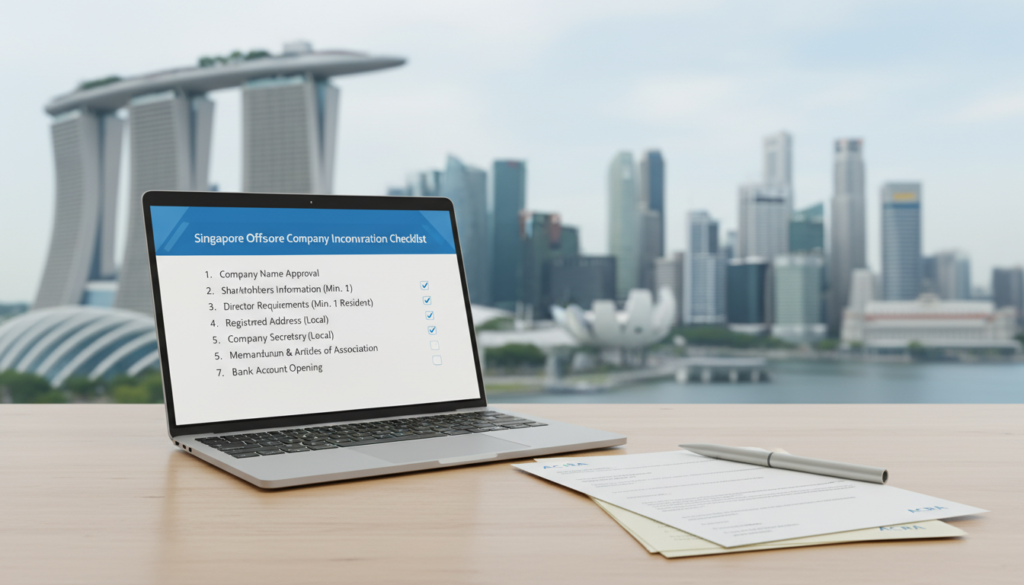
Key preparations: check ACRA name rules early — the name must be unique, not misleading or offensive, and not conflict with government marks. Early clearance speeds the registration process.
Directors
At least one local resident director is mandatory. Directors must be natural persons, usually aged 18 or over.
Nominee director services are common when founders are overseas, but ensure this fits your governance and compliance needs.
Shareholders and secretary
One to fifty shareholders are allowed. Individuals or corporate bodies may hold shares and foreign ownership is typically permitted.
A company secretary must be appointed within six months. A sole director/shareholder cannot serve as secretary.
Capital, address and documents
Paid‑up capital of S$1 is acceptable. A local registered address is required; PO boxes are not allowed.
Collect passports, proof of residential address and corporate shareholder details for KYC. Banks and service providers may ask for further supporting documents.
Practical tip: foreign founders should engage a registered filing agent to complete the government filing process and reduce back‑and‑forth.
How to set up an offshore company in Singapore step-by-step
Follow a clear, ordered process to move from planning to operation with minimal delays.
Step 1 — Confirm activities and SIC code. Precisely describe your business activities. Banks, licensing bodies and tax reviews hinge on the declared scope. Choose the correct Singapore Standard Industrial Classification (SIC) code to avoid extra review or licensing friction.
Step 2 — Prepare incorporation inputs. Gather validated documents for directors, shareholders, the local registered address and paid‑up capital. Have scanned passports, proof of address and corporate documents ready so a filing agent can submit cleanly.
Step 3 — File via BizFile+ through a registered agent. Overseas founders must use a registered filing agent to submit the online incorporation. Approval typically arrives in one to two working days once the government filing is in order.
Step 4 — Receive UEN and company profile. After approval you get a Unique Entity Number (UEN) and an official profile. These identifiers are used for banking, contracts, invoices and any regulatory registrations.
Step 5 — Post‑incorporation readiness and licences. Apply for sector permits before trading (for example F&B, financial services or import/export). Consider GST registration where your turnover meets the threshold.
Step 6 — Operational set-up. Put bookkeeping, invoicing and internal controls in place. Plan a corporate bank account application early; banks will ask about business substance, counterparties and expected transaction flows.
| Step | Action | Typical timing |
|---|---|---|
| 1 | Confirm activities & select SIC code | 1–3 days |
| 2 | Prepare documents (directors, shareholders, address) | 2–7 days |
| 3 | File incorporation via BizFile+ through agent | 1–2 days |
| 4 | Receive UEN and official profile | Immediate on approval |
| 5 | Obtain licences/permits and consider GST | Varies by licence: days to months |
| 6 | Open corporate bank account & implement operations | 1–6 weeks |

Timing note: incorporation alone is fast, but licences and banking often define the actual go‑live date. Plan the post‑incorporation tasks early to avoid surprises.
Tax, exemptions and reporting: what offshore company owners must know
Practical tax choices turn on facts: where contracts are signed, where income is received and where directors make decisions. These details, not labels, drive tax outcomes for regional entities.
Corporate tax basics and partial relief
The headline corporate rate is 17%, applied to chargeable income after allowable deductions. Partial exemptions and incentives can lower effective tax, so pre‑filing modelling matters.
Chargeable income means taxable profits after expenses and reliefs. Use local deductions and incentives when facts support them.
Territorial rules and GST triggers
Income sourced in the country is subject to tax. Foreign-sourced income often stays outside local tax unless it is received or remitted locally.
GST registration is required when expected annual taxable turnover exceeds S$1,000,000. Sales to domestic customers or local supplies can trigger GST even for an entity that seeks an offshore position.
DTAs, dividends and documentation
Over 80 double tax agreements offer relief and reduce withholding on dividends, interest and royalties. Treaty benefits require residency evidence and proper paperwork.
Dividends follow a single-tier system: most distributions are tax-free in shareholders’ hands after corporate tax is paid, aiding cashflow predictability.
“Keep records that prove where business activity occurs; good documentation is the strongest defence in a tax review.”
Reporting, recent changes and risk control
Annual corporate tax filings are required even when exemptions are claimed. Maintain contemporaneous records to support positions on source and substance.
From 1 January 2024, rules address certain foreign-sourced disposal gains received locally, with stricter compliance for multinational groups. Align contracting, governance and cash flows to reduce audit risk.
| Topic | Key fact | Trigger | Owner action |
|---|---|---|---|
| Corporate tax | 17% headline rate | Chargeable income in the jurisdiction | Model effective rate using exemptions |
| GST | S$1,000,000 threshold | Taxable turnover from local supplies | Monitor sales & register if reached |
| DTAs | 80+ agreements | Cross-border payments | Collect residency & treaty forms |
| Dividends | Single-tier system | Distributions by resident firms | Plan cashflow; no extra shareholder tax |
Banking, operations and credibility for offshore companies in Singapore
Strong banking ties often determine whether a regional business is perceived as credible by partners and payment platforms.
What banks typically request for a corporate bank account
Banks usually ask for the certificate and UEN, constitutional documents, IDs for directors and shareholders, and proof of address.
Expect to supply a business plan, forecasted transaction volumes and key counterparty details. These items speed onboarding and reduce follow-up queries.
Remote opening and practical limits
Some providers allow remote account opening, but expect enhanced due diligence. High‑risk sectors often require in‑person verification and extra paperwork.
Compliance, operations and market access
Financial institutions apply strict KYC/AML checks. Prepare clear evidence of source of funds, trading patterns and commercial rationale to avoid delays.
Operational tip: align invoicing, contracts and payment flows with declared activities to prevent account restrictions.
“A bank in a respected financial centre gives counterparties confidence and smoother multi‑currency settlement.”
Singapore’s robust governance and deep financial services ecosystem strengthen trust and regional access. But beware of form without substance: mismatched activity and banking can create compliance risk.
Conclusion
End with a short, practical summary to help you prepare for registration and day‑one operations.
Start by choosing the right entity and confirming activities, SIC code and name approval. Complete incorporation and registration through ACRA, then arrange banking and licences before you trade.
Keep the main decision principle front of mind: align management, activities and income with your intended tax position to avoid local exposure.
Non‑negotiables: appoint at least one local resident director, a company secretary, and a valid registered address (no PO Box). Keep robust documents to meet KYC and compliance checks.
Remember the tax headlines: 17% corporate rate, GST thresholds and DTAs matter. For a concise action list to set offshore company, see set offshore company.
Maintain annual filings, five‑year record retention and periodic reviews so the arrangement stays fit for purpose and credible with investors and partners.
FAQ
What is an offshore company in Singapore and how does it work?
How does “offshore” differ from onshore for foreign owners and management?
Why does Singapore’s territorial tax basis matter for tax exemptions?
What signals suggest a business may qualify for tax exemption status?
When does setting up an entity in Singapore make strategic sense?
Is a Private Limited Company (Pte Ltd) the usual choice for incorporation?
How do branch offices and subsidiaries differ in liability and operations?
When is a representative office appropriate?
Are LLPs a viable alternative for professional partnerships?
What does ACRA name approval involve?
What are the director requirements, including resident director rules?
What are the shareholder rules and foreign ownership limits?
When must a company appoint a company secretary?
What are the paid-up capital and registered address rules?
FAQ
What is an offshore company in Singapore and how does it work?
An entity incorporated in Singapore operates under local law but can derive many payments from abroad. It gains a Unique Entity Number (UEN), must register with ACRA and file statutory records, and can benefit from territorial tax rules where foreign-sourced income may be exempt if certain conditions are met. Directors and shareholders manage activities, while licences determine permitted operations.
How does “offshore” differ from onshore for foreign owners and management?
The key difference lies in where income is sourced and where control is exercised. If management and control occur outside Singapore and income arises overseas, tax reliefs often apply. Conversely, local management, contracts performed in Singapore or sales to local customers can create domestic tax exposure and compliance obligations.
Why does Singapore’s territorial tax basis matter for tax exemptions?
Singapore taxes income remitted from abroad only in limited cases. When income originates overseas and is not received in Singapore, or qualifying foreign-sourced income is remitted under exemption criteria, the effective tax burden can be reduced. The source and nature of receipts therefore determine entitlement to relief.
What signals suggest a business may qualify for tax exemption status?
Indicators include major sales and services delivered from other jurisdictions, board meetings and decision-making held offshore, limited or no local employees, and foreign-sourced revenue streams. Proper documentation showing the overseas origin of income and substance helps support an exemption claim.
When does setting up an entity in Singapore make strategic sense?
Establishing a presence suits firms expanding into ASEAN and Asia-Pacific, holding assets like real estate or securities, protecting intellectual property, or seeking a reputable jurisdiction for investment and cross-border trading. Singapore’s connectivity and legal framework support regional growth plans.
Is a Private Limited Company (Pte Ltd) the usual choice for incorporation?
Yes. A Private Limited vehicle provides limited liability, a clear legal identity and widespread recognition by banks and investors. It is typically used when owners want shareholder protection, straightforward governance and access to corporate bank accounts.
How do branch offices and subsidiaries differ in liability and operations?
A branch is an extension of a foreign parent and carries the parent’s liability. A subsidiary is a separate legal entity incorporated locally and generally limits liability to its own assets. Choice depends on risk appetite, tax planning and regulatory needs.
When is a representative office appropriate?
A representative office suits early-stage market research or promotional work without revenue-generating activities. It cannot invoice local clients and has limited lifespan, so it usually precedes full registration if commercial operations follow.
Are LLPs a viable alternative for professional partnerships?
Limited Liability Partnerships can work for service professionals who prefer partnership tax treatment with some liability protection. They suit firms where partners require flexibility and pass-through benefits, but regulatory and licensing requirements may apply.
What does ACRA name approval involve?
Name approval checks that the proposed name is not identical to an existing entity, not undesirable or offensive, and complies with naming rules. Reserved words or regulated terms may need additional clearances from relevant ministries or regulators.
What are the director requirements, including resident director rules?
Every locally incorporated entity must appoint at least one resident director who is ordinarily resident in Singapore. Nominee directors can be engaged, but substance requirements and fiduciary duties remain, so genuine oversight and compliance are essential.
What are the shareholder rules and foreign ownership limits?
Singapore allows full foreign ownership for most private limited entities. A minimum of one shareholder and a maximum of 50 applies for private companies. Specific sectors may restrict foreign participation and need ministerial approval.
When must a company appoint a company secretary?
A company must appoint a qualified company secretary within six months of incorporation. The secretary handles statutory filings, minutes and ensures compliance with corporate governance obligations.
What are the paid-up capital and registered address rules?
There is no substantial minimum paid-up capital for most incorporations beyond the nominal S
FAQ
What is an offshore company in Singapore and how does it work?
An entity incorporated in Singapore operates under local law but can derive many payments from abroad. It gains a Unique Entity Number (UEN), must register with ACRA and file statutory records, and can benefit from territorial tax rules where foreign-sourced income may be exempt if certain conditions are met. Directors and shareholders manage activities, while licences determine permitted operations.
How does “offshore” differ from onshore for foreign owners and management?
The key difference lies in where income is sourced and where control is exercised. If management and control occur outside Singapore and income arises overseas, tax reliefs often apply. Conversely, local management, contracts performed in Singapore or sales to local customers can create domestic tax exposure and compliance obligations.
Why does Singapore’s territorial tax basis matter for tax exemptions?
Singapore taxes income remitted from abroad only in limited cases. When income originates overseas and is not received in Singapore, or qualifying foreign-sourced income is remitted under exemption criteria, the effective tax burden can be reduced. The source and nature of receipts therefore determine entitlement to relief.
What signals suggest a business may qualify for tax exemption status?
Indicators include major sales and services delivered from other jurisdictions, board meetings and decision-making held offshore, limited or no local employees, and foreign-sourced revenue streams. Proper documentation showing the overseas origin of income and substance helps support an exemption claim.
When does setting up an entity in Singapore make strategic sense?
Establishing a presence suits firms expanding into ASEAN and Asia-Pacific, holding assets like real estate or securities, protecting intellectual property, or seeking a reputable jurisdiction for investment and cross-border trading. Singapore’s connectivity and legal framework support regional growth plans.
Is a Private Limited Company (Pte Ltd) the usual choice for incorporation?
Yes. A Private Limited vehicle provides limited liability, a clear legal identity and widespread recognition by banks and investors. It is typically used when owners want shareholder protection, straightforward governance and access to corporate bank accounts.
How do branch offices and subsidiaries differ in liability and operations?
A branch is an extension of a foreign parent and carries the parent’s liability. A subsidiary is a separate legal entity incorporated locally and generally limits liability to its own assets. Choice depends on risk appetite, tax planning and regulatory needs.
When is a representative office appropriate?
A representative office suits early-stage market research or promotional work without revenue-generating activities. It cannot invoice local clients and has limited lifespan, so it usually precedes full registration if commercial operations follow.
Are LLPs a viable alternative for professional partnerships?
Limited Liability Partnerships can work for service professionals who prefer partnership tax treatment with some liability protection. They suit firms where partners require flexibility and pass-through benefits, but regulatory and licensing requirements may apply.
What does ACRA name approval involve?
Name approval checks that the proposed name is not identical to an existing entity, not undesirable or offensive, and complies with naming rules. Reserved words or regulated terms may need additional clearances from relevant ministries or regulators.
What are the director requirements, including resident director rules?
Every locally incorporated entity must appoint at least one resident director who is ordinarily resident in Singapore. Nominee directors can be engaged, but substance requirements and fiduciary duties remain, so genuine oversight and compliance are essential.
What are the shareholder rules and foreign ownership limits?
Singapore allows full foreign ownership for most private limited entities. A minimum of one shareholder and a maximum of 50 applies for private companies. Specific sectors may restrict foreign participation and need ministerial approval.
When must a company appoint a company secretary?
A company must appoint a qualified company secretary within six months of incorporation. The secretary handles statutory filings, minutes and ensures compliance with corporate governance obligations.
What are the paid-up capital and registered address rules?
There is no substantial minimum paid-up capital for most incorporations beyond the nominal S$1 share, but certain licences may demand higher capital. A registered local address is required for service of notices; PO Boxes are not accepted as the registered office.
Which documents are typically required for KYC and due diligence?
Standard documents include certified passports for individual shareholders and directors, proof of residential address, corporate certificates and memoranda for corporate shareholders, and details of beneficial owners. Banks and regulators will request additional information on source of funds and business plans.
How do you confirm the correct business activity code (SIC) before filing?
Review your primary economic activity and select the corresponding Singapore Standard Industrial Classification (SSIC) code. Accurate classification ensures proper licences and helps avoid regulatory delays during BizFile+ submission through an authorised filing agent.
What happens after filing incorporation online via BizFile+?
After the filing agent submits documents, the Accounting and Corporate Regulatory Authority issues the UEN and company profile on successful approval. You then proceed with opening bank accounts, applying for licences and preparing to commence operations.
What post‑incorporation licences or permits might be required?
Requirements depend on activities—financial services, education, e-commerce, food and healthcare all need sector-specific licences. Check with the relevant regulator early to avoid non-compliance and to obtain operational readiness.
How does corporate tax work and what is the headline rate?
The headline corporate income tax rate is 17%. Partial and tiered exemptions, tax incentives and start-up schemes can reduce effective tax. Eligibility depends on income source, substance and qualifying conditions under Singapore law.
When must a business register for GST and how does it affect foreign-sourced income?
GST registration is mandatory when taxable supplies exceed the S$1 million threshold or when you opt in voluntarily. Supplies performed in Singapore or consumed locally trigger GST obligations, while foreign-sourced receipts are treated differently under the regime.
How do Double Taxation Agreements help cross-border transactions?
Singapore has an extensive DTA network that reduces withholding tax on dividends, interest and royalties and clarifies residency rules. Treaties help prevent double taxation and support efficient international flows when correctly applied.
How are dividends taxed under Singapore’s system?
Singapore operates a single-tier corporate tax system: tax paid by the entity is final, and dividends paid to shareholders are generally tax-exempt in the hands of recipients. This simplifies repatriation of profits.
What recent tax changes should owners monitor, such as on foreign-sourced disposal gains?
Legislative updates can affect treatment of foreign-sourced income and disposal gains. Owners should monitor Inland Revenue Authority of Singapore (IRAS) guidance and consult tax advisers to adapt to changes in exemptions and reporting rules.
What do banks typically request when opening a corporate bank account?
Banks require certified KYC documents for directors, shareholders and ultimate beneficial owners, a clear business plan, proof of activities, and evidence of expected account flows. Some banks also seek interviews and references to satisfy risk assessments.
Can accounts be opened remotely, and what are the limitations?
Some banks permit remote onboarding but often require in-person verification for high-risk profiles. Remote opening can face tighter scrutiny, longer timelines and additional documentary demands, limiting immediacy for operational needs.
How does Singapore’s reputation and regulatory environment boost credibility?
Strong governance, robust financial regulation and a well‑developed legal system enhance investor confidence. A local presence signals commitment, improves access to banks and professional service providers, and strengthens commercial standing in the region.
share, but certain licences may demand higher capital. A registered local address is required for service of notices; PO Boxes are not accepted as the registered office.
Which documents are typically required for KYC and due diligence?
Standard documents include certified passports for individual shareholders and directors, proof of residential address, corporate certificates and memoranda for corporate shareholders, and details of beneficial owners. Banks and regulators will request additional information on source of funds and business plans.
How do you confirm the correct business activity code (SIC) before filing?
Review your primary economic activity and select the corresponding Singapore Standard Industrial Classification (SSIC) code. Accurate classification ensures proper licences and helps avoid regulatory delays during BizFile+ submission through an authorised filing agent.
What happens after filing incorporation online via BizFile+?
After the filing agent submits documents, the Accounting and Corporate Regulatory Authority issues the UEN and company profile on successful approval. You then proceed with opening bank accounts, applying for licences and preparing to commence operations.
What post‑incorporation licences or permits might be required?
Requirements depend on activities—financial services, education, e-commerce, food and healthcare all need sector-specific licences. Check with the relevant regulator early to avoid non-compliance and to obtain operational readiness.
How does corporate tax work and what is the headline rate?
The headline corporate income tax rate is 17%. Partial and tiered exemptions, tax incentives and start-up schemes can reduce effective tax. Eligibility depends on income source, substance and qualifying conditions under Singapore law.
When must a business register for GST and how does it affect foreign-sourced income?
GST registration is mandatory when taxable supplies exceed the S
FAQ
What is an offshore company in Singapore and how does it work?
An entity incorporated in Singapore operates under local law but can derive many payments from abroad. It gains a Unique Entity Number (UEN), must register with ACRA and file statutory records, and can benefit from territorial tax rules where foreign-sourced income may be exempt if certain conditions are met. Directors and shareholders manage activities, while licences determine permitted operations.
How does “offshore” differ from onshore for foreign owners and management?
The key difference lies in where income is sourced and where control is exercised. If management and control occur outside Singapore and income arises overseas, tax reliefs often apply. Conversely, local management, contracts performed in Singapore or sales to local customers can create domestic tax exposure and compliance obligations.
Why does Singapore’s territorial tax basis matter for tax exemptions?
Singapore taxes income remitted from abroad only in limited cases. When income originates overseas and is not received in Singapore, or qualifying foreign-sourced income is remitted under exemption criteria, the effective tax burden can be reduced. The source and nature of receipts therefore determine entitlement to relief.
What signals suggest a business may qualify for tax exemption status?
Indicators include major sales and services delivered from other jurisdictions, board meetings and decision-making held offshore, limited or no local employees, and foreign-sourced revenue streams. Proper documentation showing the overseas origin of income and substance helps support an exemption claim.
When does setting up an entity in Singapore make strategic sense?
Establishing a presence suits firms expanding into ASEAN and Asia-Pacific, holding assets like real estate or securities, protecting intellectual property, or seeking a reputable jurisdiction for investment and cross-border trading. Singapore’s connectivity and legal framework support regional growth plans.
Is a Private Limited Company (Pte Ltd) the usual choice for incorporation?
Yes. A Private Limited vehicle provides limited liability, a clear legal identity and widespread recognition by banks and investors. It is typically used when owners want shareholder protection, straightforward governance and access to corporate bank accounts.
How do branch offices and subsidiaries differ in liability and operations?
A branch is an extension of a foreign parent and carries the parent’s liability. A subsidiary is a separate legal entity incorporated locally and generally limits liability to its own assets. Choice depends on risk appetite, tax planning and regulatory needs.
When is a representative office appropriate?
A representative office suits early-stage market research or promotional work without revenue-generating activities. It cannot invoice local clients and has limited lifespan, so it usually precedes full registration if commercial operations follow.
Are LLPs a viable alternative for professional partnerships?
Limited Liability Partnerships can work for service professionals who prefer partnership tax treatment with some liability protection. They suit firms where partners require flexibility and pass-through benefits, but regulatory and licensing requirements may apply.
What does ACRA name approval involve?
Name approval checks that the proposed name is not identical to an existing entity, not undesirable or offensive, and complies with naming rules. Reserved words or regulated terms may need additional clearances from relevant ministries or regulators.
What are the director requirements, including resident director rules?
Every locally incorporated entity must appoint at least one resident director who is ordinarily resident in Singapore. Nominee directors can be engaged, but substance requirements and fiduciary duties remain, so genuine oversight and compliance are essential.
What are the shareholder rules and foreign ownership limits?
Singapore allows full foreign ownership for most private limited entities. A minimum of one shareholder and a maximum of 50 applies for private companies. Specific sectors may restrict foreign participation and need ministerial approval.
When must a company appoint a company secretary?
A company must appoint a qualified company secretary within six months of incorporation. The secretary handles statutory filings, minutes and ensures compliance with corporate governance obligations.
What are the paid-up capital and registered address rules?
There is no substantial minimum paid-up capital for most incorporations beyond the nominal S$1 share, but certain licences may demand higher capital. A registered local address is required for service of notices; PO Boxes are not accepted as the registered office.
Which documents are typically required for KYC and due diligence?
Standard documents include certified passports for individual shareholders and directors, proof of residential address, corporate certificates and memoranda for corporate shareholders, and details of beneficial owners. Banks and regulators will request additional information on source of funds and business plans.
How do you confirm the correct business activity code (SIC) before filing?
Review your primary economic activity and select the corresponding Singapore Standard Industrial Classification (SSIC) code. Accurate classification ensures proper licences and helps avoid regulatory delays during BizFile+ submission through an authorised filing agent.
What happens after filing incorporation online via BizFile+?
After the filing agent submits documents, the Accounting and Corporate Regulatory Authority issues the UEN and company profile on successful approval. You then proceed with opening bank accounts, applying for licences and preparing to commence operations.
What post‑incorporation licences or permits might be required?
Requirements depend on activities—financial services, education, e-commerce, food and healthcare all need sector-specific licences. Check with the relevant regulator early to avoid non-compliance and to obtain operational readiness.
How does corporate tax work and what is the headline rate?
The headline corporate income tax rate is 17%. Partial and tiered exemptions, tax incentives and start-up schemes can reduce effective tax. Eligibility depends on income source, substance and qualifying conditions under Singapore law.
When must a business register for GST and how does it affect foreign-sourced income?
GST registration is mandatory when taxable supplies exceed the S$1 million threshold or when you opt in voluntarily. Supplies performed in Singapore or consumed locally trigger GST obligations, while foreign-sourced receipts are treated differently under the regime.
How do Double Taxation Agreements help cross-border transactions?
Singapore has an extensive DTA network that reduces withholding tax on dividends, interest and royalties and clarifies residency rules. Treaties help prevent double taxation and support efficient international flows when correctly applied.
How are dividends taxed under Singapore’s system?
Singapore operates a single-tier corporate tax system: tax paid by the entity is final, and dividends paid to shareholders are generally tax-exempt in the hands of recipients. This simplifies repatriation of profits.
What recent tax changes should owners monitor, such as on foreign-sourced disposal gains?
Legislative updates can affect treatment of foreign-sourced income and disposal gains. Owners should monitor Inland Revenue Authority of Singapore (IRAS) guidance and consult tax advisers to adapt to changes in exemptions and reporting rules.
What do banks typically request when opening a corporate bank account?
Banks require certified KYC documents for directors, shareholders and ultimate beneficial owners, a clear business plan, proof of activities, and evidence of expected account flows. Some banks also seek interviews and references to satisfy risk assessments.
Can accounts be opened remotely, and what are the limitations?
Some banks permit remote onboarding but often require in-person verification for high-risk profiles. Remote opening can face tighter scrutiny, longer timelines and additional documentary demands, limiting immediacy for operational needs.
How does Singapore’s reputation and regulatory environment boost credibility?
Strong governance, robust financial regulation and a well‑developed legal system enhance investor confidence. A local presence signals commitment, improves access to banks and professional service providers, and strengthens commercial standing in the region.
million threshold or when you opt in voluntarily. Supplies performed in Singapore or consumed locally trigger GST obligations, while foreign-sourced receipts are treated differently under the regime.
How do Double Taxation Agreements help cross-border transactions?
Singapore has an extensive DTA network that reduces withholding tax on dividends, interest and royalties and clarifies residency rules. Treaties help prevent double taxation and support efficient international flows when correctly applied.
How are dividends taxed under Singapore’s system?
Singapore operates a single-tier corporate tax system: tax paid by the entity is final, and dividends paid to shareholders are generally tax-exempt in the hands of recipients. This simplifies repatriation of profits.
What recent tax changes should owners monitor, such as on foreign-sourced disposal gains?
Legislative updates can affect treatment of foreign-sourced income and disposal gains. Owners should monitor Inland Revenue Authority of Singapore (IRAS) guidance and consult tax advisers to adapt to changes in exemptions and reporting rules.
What do banks typically request when opening a corporate bank account?
Banks require certified KYC documents for directors, shareholders and ultimate beneficial owners, a clear business plan, proof of activities, and evidence of expected account flows. Some banks also seek interviews and references to satisfy risk assessments.
Can accounts be opened remotely, and what are the limitations?
Some banks permit remote onboarding but often require in-person verification for high-risk profiles. Remote opening can face tighter scrutiny, longer timelines and additional documentary demands, limiting immediacy for operational needs.
How does Singapore’s reputation and regulatory environment boost credibility?
Strong governance, robust financial regulation and a well‑developed legal system enhance investor confidence. A local presence signals commitment, improves access to banks and professional service providers, and strengthens commercial standing in the region.
FAQ
What is an offshore company in Singapore and how does it work?
An entity incorporated in Singapore operates under local law but can derive many payments from abroad. It gains a Unique Entity Number (UEN), must register with ACRA and file statutory records, and can benefit from territorial tax rules where foreign-sourced income may be exempt if certain conditions are met. Directors and shareholders manage activities, while licences determine permitted operations.
How does “offshore” differ from onshore for foreign owners and management?
The key difference lies in where income is sourced and where control is exercised. If management and control occur outside Singapore and income arises overseas, tax reliefs often apply. Conversely, local management, contracts performed in Singapore or sales to local customers can create domestic tax exposure and compliance obligations.
Why does Singapore’s territorial tax basis matter for tax exemptions?
Singapore taxes income remitted from abroad only in limited cases. When income originates overseas and is not received in Singapore, or qualifying foreign-sourced income is remitted under exemption criteria, the effective tax burden can be reduced. The source and nature of receipts therefore determine entitlement to relief.
What signals suggest a business may qualify for tax exemption status?
Indicators include major sales and services delivered from other jurisdictions, board meetings and decision-making held offshore, limited or no local employees, and foreign-sourced revenue streams. Proper documentation showing the overseas origin of income and substance helps support an exemption claim.
When does setting up an entity in Singapore make strategic sense?
Establishing a presence suits firms expanding into ASEAN and Asia-Pacific, holding assets like real estate or securities, protecting intellectual property, or seeking a reputable jurisdiction for investment and cross-border trading. Singapore’s connectivity and legal framework support regional growth plans.
Is a Private Limited Company (Pte Ltd) the usual choice for incorporation?
Yes. A Private Limited vehicle provides limited liability, a clear legal identity and widespread recognition by banks and investors. It is typically used when owners want shareholder protection, straightforward governance and access to corporate bank accounts.
How do branch offices and subsidiaries differ in liability and operations?
A branch is an extension of a foreign parent and carries the parent’s liability. A subsidiary is a separate legal entity incorporated locally and generally limits liability to its own assets. Choice depends on risk appetite, tax planning and regulatory needs.
When is a representative office appropriate?
A representative office suits early-stage market research or promotional work without revenue-generating activities. It cannot invoice local clients and has limited lifespan, so it usually precedes full registration if commercial operations follow.
Are LLPs a viable alternative for professional partnerships?
Limited Liability Partnerships can work for service professionals who prefer partnership tax treatment with some liability protection. They suit firms where partners require flexibility and pass-through benefits, but regulatory and licensing requirements may apply.
What does ACRA name approval involve?
Name approval checks that the proposed name is not identical to an existing entity, not undesirable or offensive, and complies with naming rules. Reserved words or regulated terms may need additional clearances from relevant ministries or regulators.
What are the director requirements, including resident director rules?
Every locally incorporated entity must appoint at least one resident director who is ordinarily resident in Singapore. Nominee directors can be engaged, but substance requirements and fiduciary duties remain, so genuine oversight and compliance are essential.
What are the shareholder rules and foreign ownership limits?
Singapore allows full foreign ownership for most private limited entities. A minimum of one shareholder and a maximum of 50 applies for private companies. Specific sectors may restrict foreign participation and need ministerial approval.
When must a company appoint a company secretary?
A company must appoint a qualified company secretary within six months of incorporation. The secretary handles statutory filings, minutes and ensures compliance with corporate governance obligations.
What are the paid-up capital and registered address rules?
There is no substantial minimum paid-up capital for most incorporations beyond the nominal S
FAQ
What is an offshore company in Singapore and how does it work?
An entity incorporated in Singapore operates under local law but can derive many payments from abroad. It gains a Unique Entity Number (UEN), must register with ACRA and file statutory records, and can benefit from territorial tax rules where foreign-sourced income may be exempt if certain conditions are met. Directors and shareholders manage activities, while licences determine permitted operations.
How does “offshore” differ from onshore for foreign owners and management?
The key difference lies in where income is sourced and where control is exercised. If management and control occur outside Singapore and income arises overseas, tax reliefs often apply. Conversely, local management, contracts performed in Singapore or sales to local customers can create domestic tax exposure and compliance obligations.
Why does Singapore’s territorial tax basis matter for tax exemptions?
Singapore taxes income remitted from abroad only in limited cases. When income originates overseas and is not received in Singapore, or qualifying foreign-sourced income is remitted under exemption criteria, the effective tax burden can be reduced. The source and nature of receipts therefore determine entitlement to relief.
What signals suggest a business may qualify for tax exemption status?
Indicators include major sales and services delivered from other jurisdictions, board meetings and decision-making held offshore, limited or no local employees, and foreign-sourced revenue streams. Proper documentation showing the overseas origin of income and substance helps support an exemption claim.
When does setting up an entity in Singapore make strategic sense?
Establishing a presence suits firms expanding into ASEAN and Asia-Pacific, holding assets like real estate or securities, protecting intellectual property, or seeking a reputable jurisdiction for investment and cross-border trading. Singapore’s connectivity and legal framework support regional growth plans.
Is a Private Limited Company (Pte Ltd) the usual choice for incorporation?
Yes. A Private Limited vehicle provides limited liability, a clear legal identity and widespread recognition by banks and investors. It is typically used when owners want shareholder protection, straightforward governance and access to corporate bank accounts.
How do branch offices and subsidiaries differ in liability and operations?
A branch is an extension of a foreign parent and carries the parent’s liability. A subsidiary is a separate legal entity incorporated locally and generally limits liability to its own assets. Choice depends on risk appetite, tax planning and regulatory needs.
When is a representative office appropriate?
A representative office suits early-stage market research or promotional work without revenue-generating activities. It cannot invoice local clients and has limited lifespan, so it usually precedes full registration if commercial operations follow.
Are LLPs a viable alternative for professional partnerships?
Limited Liability Partnerships can work for service professionals who prefer partnership tax treatment with some liability protection. They suit firms where partners require flexibility and pass-through benefits, but regulatory and licensing requirements may apply.
What does ACRA name approval involve?
Name approval checks that the proposed name is not identical to an existing entity, not undesirable or offensive, and complies with naming rules. Reserved words or regulated terms may need additional clearances from relevant ministries or regulators.
What are the director requirements, including resident director rules?
Every locally incorporated entity must appoint at least one resident director who is ordinarily resident in Singapore. Nominee directors can be engaged, but substance requirements and fiduciary duties remain, so genuine oversight and compliance are essential.
What are the shareholder rules and foreign ownership limits?
Singapore allows full foreign ownership for most private limited entities. A minimum of one shareholder and a maximum of 50 applies for private companies. Specific sectors may restrict foreign participation and need ministerial approval.
When must a company appoint a company secretary?
A company must appoint a qualified company secretary within six months of incorporation. The secretary handles statutory filings, minutes and ensures compliance with corporate governance obligations.
What are the paid-up capital and registered address rules?
There is no substantial minimum paid-up capital for most incorporations beyond the nominal S$1 share, but certain licences may demand higher capital. A registered local address is required for service of notices; PO Boxes are not accepted as the registered office.
Which documents are typically required for KYC and due diligence?
Standard documents include certified passports for individual shareholders and directors, proof of residential address, corporate certificates and memoranda for corporate shareholders, and details of beneficial owners. Banks and regulators will request additional information on source of funds and business plans.
How do you confirm the correct business activity code (SIC) before filing?
Review your primary economic activity and select the corresponding Singapore Standard Industrial Classification (SSIC) code. Accurate classification ensures proper licences and helps avoid regulatory delays during BizFile+ submission through an authorised filing agent.
What happens after filing incorporation online via BizFile+?
After the filing agent submits documents, the Accounting and Corporate Regulatory Authority issues the UEN and company profile on successful approval. You then proceed with opening bank accounts, applying for licences and preparing to commence operations.
What post‑incorporation licences or permits might be required?
Requirements depend on activities—financial services, education, e-commerce, food and healthcare all need sector-specific licences. Check with the relevant regulator early to avoid non-compliance and to obtain operational readiness.
How does corporate tax work and what is the headline rate?
The headline corporate income tax rate is 17%. Partial and tiered exemptions, tax incentives and start-up schemes can reduce effective tax. Eligibility depends on income source, substance and qualifying conditions under Singapore law.
When must a business register for GST and how does it affect foreign-sourced income?
GST registration is mandatory when taxable supplies exceed the S$1 million threshold or when you opt in voluntarily. Supplies performed in Singapore or consumed locally trigger GST obligations, while foreign-sourced receipts are treated differently under the regime.
How do Double Taxation Agreements help cross-border transactions?
Singapore has an extensive DTA network that reduces withholding tax on dividends, interest and royalties and clarifies residency rules. Treaties help prevent double taxation and support efficient international flows when correctly applied.
How are dividends taxed under Singapore’s system?
Singapore operates a single-tier corporate tax system: tax paid by the entity is final, and dividends paid to shareholders are generally tax-exempt in the hands of recipients. This simplifies repatriation of profits.
What recent tax changes should owners monitor, such as on foreign-sourced disposal gains?
Legislative updates can affect treatment of foreign-sourced income and disposal gains. Owners should monitor Inland Revenue Authority of Singapore (IRAS) guidance and consult tax advisers to adapt to changes in exemptions and reporting rules.
What do banks typically request when opening a corporate bank account?
Banks require certified KYC documents for directors, shareholders and ultimate beneficial owners, a clear business plan, proof of activities, and evidence of expected account flows. Some banks also seek interviews and references to satisfy risk assessments.
Can accounts be opened remotely, and what are the limitations?
Some banks permit remote onboarding but often require in-person verification for high-risk profiles. Remote opening can face tighter scrutiny, longer timelines and additional documentary demands, limiting immediacy for operational needs.
How does Singapore’s reputation and regulatory environment boost credibility?
Strong governance, robust financial regulation and a well‑developed legal system enhance investor confidence. A local presence signals commitment, improves access to banks and professional service providers, and strengthens commercial standing in the region.
share, but certain licences may demand higher capital. A registered local address is required for service of notices; PO Boxes are not accepted as the registered office.
Which documents are typically required for KYC and due diligence?
Standard documents include certified passports for individual shareholders and directors, proof of residential address, corporate certificates and memoranda for corporate shareholders, and details of beneficial owners. Banks and regulators will request additional information on source of funds and business plans.
How do you confirm the correct business activity code (SIC) before filing?
Review your primary economic activity and select the corresponding Singapore Standard Industrial Classification (SSIC) code. Accurate classification ensures proper licences and helps avoid regulatory delays during BizFile+ submission through an authorised filing agent.
What happens after filing incorporation online via BizFile+?
After the filing agent submits documents, the Accounting and Corporate Regulatory Authority issues the UEN and company profile on successful approval. You then proceed with opening bank accounts, applying for licences and preparing to commence operations.
What post‑incorporation licences or permits might be required?
Requirements depend on activities—financial services, education, e-commerce, food and healthcare all need sector-specific licences. Check with the relevant regulator early to avoid non-compliance and to obtain operational readiness.
How does corporate tax work and what is the headline rate?
The headline corporate income tax rate is 17%. Partial and tiered exemptions, tax incentives and start-up schemes can reduce effective tax. Eligibility depends on income source, substance and qualifying conditions under Singapore law.
When must a business register for GST and how does it affect foreign-sourced income?
GST registration is mandatory when taxable supplies exceed the S
FAQ
What is an offshore company in Singapore and how does it work?
An entity incorporated in Singapore operates under local law but can derive many payments from abroad. It gains a Unique Entity Number (UEN), must register with ACRA and file statutory records, and can benefit from territorial tax rules where foreign-sourced income may be exempt if certain conditions are met. Directors and shareholders manage activities, while licences determine permitted operations.
How does “offshore” differ from onshore for foreign owners and management?
The key difference lies in where income is sourced and where control is exercised. If management and control occur outside Singapore and income arises overseas, tax reliefs often apply. Conversely, local management, contracts performed in Singapore or sales to local customers can create domestic tax exposure and compliance obligations.
Why does Singapore’s territorial tax basis matter for tax exemptions?
Singapore taxes income remitted from abroad only in limited cases. When income originates overseas and is not received in Singapore, or qualifying foreign-sourced income is remitted under exemption criteria, the effective tax burden can be reduced. The source and nature of receipts therefore determine entitlement to relief.
What signals suggest a business may qualify for tax exemption status?
Indicators include major sales and services delivered from other jurisdictions, board meetings and decision-making held offshore, limited or no local employees, and foreign-sourced revenue streams. Proper documentation showing the overseas origin of income and substance helps support an exemption claim.
When does setting up an entity in Singapore make strategic sense?
Establishing a presence suits firms expanding into ASEAN and Asia-Pacific, holding assets like real estate or securities, protecting intellectual property, or seeking a reputable jurisdiction for investment and cross-border trading. Singapore’s connectivity and legal framework support regional growth plans.
Is a Private Limited Company (Pte Ltd) the usual choice for incorporation?
Yes. A Private Limited vehicle provides limited liability, a clear legal identity and widespread recognition by banks and investors. It is typically used when owners want shareholder protection, straightforward governance and access to corporate bank accounts.
How do branch offices and subsidiaries differ in liability and operations?
A branch is an extension of a foreign parent and carries the parent’s liability. A subsidiary is a separate legal entity incorporated locally and generally limits liability to its own assets. Choice depends on risk appetite, tax planning and regulatory needs.
When is a representative office appropriate?
A representative office suits early-stage market research or promotional work without revenue-generating activities. It cannot invoice local clients and has limited lifespan, so it usually precedes full registration if commercial operations follow.
Are LLPs a viable alternative for professional partnerships?
Limited Liability Partnerships can work for service professionals who prefer partnership tax treatment with some liability protection. They suit firms where partners require flexibility and pass-through benefits, but regulatory and licensing requirements may apply.
What does ACRA name approval involve?
Name approval checks that the proposed name is not identical to an existing entity, not undesirable or offensive, and complies with naming rules. Reserved words or regulated terms may need additional clearances from relevant ministries or regulators.
What are the director requirements, including resident director rules?
Every locally incorporated entity must appoint at least one resident director who is ordinarily resident in Singapore. Nominee directors can be engaged, but substance requirements and fiduciary duties remain, so genuine oversight and compliance are essential.
What are the shareholder rules and foreign ownership limits?
Singapore allows full foreign ownership for most private limited entities. A minimum of one shareholder and a maximum of 50 applies for private companies. Specific sectors may restrict foreign participation and need ministerial approval.
When must a company appoint a company secretary?
A company must appoint a qualified company secretary within six months of incorporation. The secretary handles statutory filings, minutes and ensures compliance with corporate governance obligations.
What are the paid-up capital and registered address rules?
There is no substantial minimum paid-up capital for most incorporations beyond the nominal S$1 share, but certain licences may demand higher capital. A registered local address is required for service of notices; PO Boxes are not accepted as the registered office.
Which documents are typically required for KYC and due diligence?
Standard documents include certified passports for individual shareholders and directors, proof of residential address, corporate certificates and memoranda for corporate shareholders, and details of beneficial owners. Banks and regulators will request additional information on source of funds and business plans.
How do you confirm the correct business activity code (SIC) before filing?
Review your primary economic activity and select the corresponding Singapore Standard Industrial Classification (SSIC) code. Accurate classification ensures proper licences and helps avoid regulatory delays during BizFile+ submission through an authorised filing agent.
What happens after filing incorporation online via BizFile+?
After the filing agent submits documents, the Accounting and Corporate Regulatory Authority issues the UEN and company profile on successful approval. You then proceed with opening bank accounts, applying for licences and preparing to commence operations.
What post‑incorporation licences or permits might be required?
Requirements depend on activities—financial services, education, e-commerce, food and healthcare all need sector-specific licences. Check with the relevant regulator early to avoid non-compliance and to obtain operational readiness.
How does corporate tax work and what is the headline rate?
The headline corporate income tax rate is 17%. Partial and tiered exemptions, tax incentives and start-up schemes can reduce effective tax. Eligibility depends on income source, substance and qualifying conditions under Singapore law.
When must a business register for GST and how does it affect foreign-sourced income?
GST registration is mandatory when taxable supplies exceed the S$1 million threshold or when you opt in voluntarily. Supplies performed in Singapore or consumed locally trigger GST obligations, while foreign-sourced receipts are treated differently under the regime.
How do Double Taxation Agreements help cross-border transactions?
Singapore has an extensive DTA network that reduces withholding tax on dividends, interest and royalties and clarifies residency rules. Treaties help prevent double taxation and support efficient international flows when correctly applied.
How are dividends taxed under Singapore’s system?
Singapore operates a single-tier corporate tax system: tax paid by the entity is final, and dividends paid to shareholders are generally tax-exempt in the hands of recipients. This simplifies repatriation of profits.
What recent tax changes should owners monitor, such as on foreign-sourced disposal gains?
Legislative updates can affect treatment of foreign-sourced income and disposal gains. Owners should monitor Inland Revenue Authority of Singapore (IRAS) guidance and consult tax advisers to adapt to changes in exemptions and reporting rules.
What do banks typically request when opening a corporate bank account?
Banks require certified KYC documents for directors, shareholders and ultimate beneficial owners, a clear business plan, proof of activities, and evidence of expected account flows. Some banks also seek interviews and references to satisfy risk assessments.
Can accounts be opened remotely, and what are the limitations?
Some banks permit remote onboarding but often require in-person verification for high-risk profiles. Remote opening can face tighter scrutiny, longer timelines and additional documentary demands, limiting immediacy for operational needs.
How does Singapore’s reputation and regulatory environment boost credibility?
Strong governance, robust financial regulation and a well‑developed legal system enhance investor confidence. A local presence signals commitment, improves access to banks and professional service providers, and strengthens commercial standing in the region.
million threshold or when you opt in voluntarily. Supplies performed in Singapore or consumed locally trigger GST obligations, while foreign-sourced receipts are treated differently under the regime.
How do Double Taxation Agreements help cross-border transactions?
Singapore has an extensive DTA network that reduces withholding tax on dividends, interest and royalties and clarifies residency rules. Treaties help prevent double taxation and support efficient international flows when correctly applied.
How are dividends taxed under Singapore’s system?
Singapore operates a single-tier corporate tax system: tax paid by the entity is final, and dividends paid to shareholders are generally tax-exempt in the hands of recipients. This simplifies repatriation of profits.
What recent tax changes should owners monitor, such as on foreign-sourced disposal gains?
Legislative updates can affect treatment of foreign-sourced income and disposal gains. Owners should monitor Inland Revenue Authority of Singapore (IRAS) guidance and consult tax advisers to adapt to changes in exemptions and reporting rules.
What do banks typically request when opening a corporate bank account?
Banks require certified KYC documents for directors, shareholders and ultimate beneficial owners, a clear business plan, proof of activities, and evidence of expected account flows. Some banks also seek interviews and references to satisfy risk assessments.
Can accounts be opened remotely, and what are the limitations?
Some banks permit remote onboarding but often require in-person verification for high-risk profiles. Remote opening can face tighter scrutiny, longer timelines and additional documentary demands, limiting immediacy for operational needs.
How does Singapore’s reputation and regulatory environment boost credibility?
Strong governance, robust financial regulation and a well‑developed legal system enhance investor confidence. A local presence signals commitment, improves access to banks and professional service providers, and strengthens commercial standing in the region.
Which documents are typically required for KYC and due diligence?
How do you confirm the correct business activity code (SIC) before filing?
What happens after filing incorporation online via BizFile+?
What post‑incorporation licences or permits might be required?
How does corporate tax work and what is the headline rate?
When must a business register for GST and how does it affect foreign-sourced income?
FAQ
What is an offshore company in Singapore and how does it work?
An entity incorporated in Singapore operates under local law but can derive many payments from abroad. It gains a Unique Entity Number (UEN), must register with ACRA and file statutory records, and can benefit from territorial tax rules where foreign-sourced income may be exempt if certain conditions are met. Directors and shareholders manage activities, while licences determine permitted operations.
How does “offshore” differ from onshore for foreign owners and management?
The key difference lies in where income is sourced and where control is exercised. If management and control occur outside Singapore and income arises overseas, tax reliefs often apply. Conversely, local management, contracts performed in Singapore or sales to local customers can create domestic tax exposure and compliance obligations.
Why does Singapore’s territorial tax basis matter for tax exemptions?
Singapore taxes income remitted from abroad only in limited cases. When income originates overseas and is not received in Singapore, or qualifying foreign-sourced income is remitted under exemption criteria, the effective tax burden can be reduced. The source and nature of receipts therefore determine entitlement to relief.
What signals suggest a business may qualify for tax exemption status?
Indicators include major sales and services delivered from other jurisdictions, board meetings and decision-making held offshore, limited or no local employees, and foreign-sourced revenue streams. Proper documentation showing the overseas origin of income and substance helps support an exemption claim.
When does setting up an entity in Singapore make strategic sense?
Establishing a presence suits firms expanding into ASEAN and Asia-Pacific, holding assets like real estate or securities, protecting intellectual property, or seeking a reputable jurisdiction for investment and cross-border trading. Singapore’s connectivity and legal framework support regional growth plans.
Is a Private Limited Company (Pte Ltd) the usual choice for incorporation?
Yes. A Private Limited vehicle provides limited liability, a clear legal identity and widespread recognition by banks and investors. It is typically used when owners want shareholder protection, straightforward governance and access to corporate bank accounts.
How do branch offices and subsidiaries differ in liability and operations?
A branch is an extension of a foreign parent and carries the parent’s liability. A subsidiary is a separate legal entity incorporated locally and generally limits liability to its own assets. Choice depends on risk appetite, tax planning and regulatory needs.
When is a representative office appropriate?
A representative office suits early-stage market research or promotional work without revenue-generating activities. It cannot invoice local clients and has limited lifespan, so it usually precedes full registration if commercial operations follow.
Are LLPs a viable alternative for professional partnerships?
Limited Liability Partnerships can work for service professionals who prefer partnership tax treatment with some liability protection. They suit firms where partners require flexibility and pass-through benefits, but regulatory and licensing requirements may apply.
What does ACRA name approval involve?
Name approval checks that the proposed name is not identical to an existing entity, not undesirable or offensive, and complies with naming rules. Reserved words or regulated terms may need additional clearances from relevant ministries or regulators.
What are the director requirements, including resident director rules?
Every locally incorporated entity must appoint at least one resident director who is ordinarily resident in Singapore. Nominee directors can be engaged, but substance requirements and fiduciary duties remain, so genuine oversight and compliance are essential.
What are the shareholder rules and foreign ownership limits?
Singapore allows full foreign ownership for most private limited entities. A minimum of one shareholder and a maximum of 50 applies for private companies. Specific sectors may restrict foreign participation and need ministerial approval.
When must a company appoint a company secretary?
A company must appoint a qualified company secretary within six months of incorporation. The secretary handles statutory filings, minutes and ensures compliance with corporate governance obligations.
What are the paid-up capital and registered address rules?
There is no substantial minimum paid-up capital for most incorporations beyond the nominal S
FAQ
What is an offshore company in Singapore and how does it work?
An entity incorporated in Singapore operates under local law but can derive many payments from abroad. It gains a Unique Entity Number (UEN), must register with ACRA and file statutory records, and can benefit from territorial tax rules where foreign-sourced income may be exempt if certain conditions are met. Directors and shareholders manage activities, while licences determine permitted operations.
How does “offshore” differ from onshore for foreign owners and management?
The key difference lies in where income is sourced and where control is exercised. If management and control occur outside Singapore and income arises overseas, tax reliefs often apply. Conversely, local management, contracts performed in Singapore or sales to local customers can create domestic tax exposure and compliance obligations.
Why does Singapore’s territorial tax basis matter for tax exemptions?
Singapore taxes income remitted from abroad only in limited cases. When income originates overseas and is not received in Singapore, or qualifying foreign-sourced income is remitted under exemption criteria, the effective tax burden can be reduced. The source and nature of receipts therefore determine entitlement to relief.
What signals suggest a business may qualify for tax exemption status?
Indicators include major sales and services delivered from other jurisdictions, board meetings and decision-making held offshore, limited or no local employees, and foreign-sourced revenue streams. Proper documentation showing the overseas origin of income and substance helps support an exemption claim.
When does setting up an entity in Singapore make strategic sense?
Establishing a presence suits firms expanding into ASEAN and Asia-Pacific, holding assets like real estate or securities, protecting intellectual property, or seeking a reputable jurisdiction for investment and cross-border trading. Singapore’s connectivity and legal framework support regional growth plans.
Is a Private Limited Company (Pte Ltd) the usual choice for incorporation?
Yes. A Private Limited vehicle provides limited liability, a clear legal identity and widespread recognition by banks and investors. It is typically used when owners want shareholder protection, straightforward governance and access to corporate bank accounts.
How do branch offices and subsidiaries differ in liability and operations?
A branch is an extension of a foreign parent and carries the parent’s liability. A subsidiary is a separate legal entity incorporated locally and generally limits liability to its own assets. Choice depends on risk appetite, tax planning and regulatory needs.
When is a representative office appropriate?
A representative office suits early-stage market research or promotional work without revenue-generating activities. It cannot invoice local clients and has limited lifespan, so it usually precedes full registration if commercial operations follow.
Are LLPs a viable alternative for professional partnerships?
Limited Liability Partnerships can work for service professionals who prefer partnership tax treatment with some liability protection. They suit firms where partners require flexibility and pass-through benefits, but regulatory and licensing requirements may apply.
What does ACRA name approval involve?
Name approval checks that the proposed name is not identical to an existing entity, not undesirable or offensive, and complies with naming rules. Reserved words or regulated terms may need additional clearances from relevant ministries or regulators.
What are the director requirements, including resident director rules?
Every locally incorporated entity must appoint at least one resident director who is ordinarily resident in Singapore. Nominee directors can be engaged, but substance requirements and fiduciary duties remain, so genuine oversight and compliance are essential.
What are the shareholder rules and foreign ownership limits?
Singapore allows full foreign ownership for most private limited entities. A minimum of one shareholder and a maximum of 50 applies for private companies. Specific sectors may restrict foreign participation and need ministerial approval.
When must a company appoint a company secretary?
A company must appoint a qualified company secretary within six months of incorporation. The secretary handles statutory filings, minutes and ensures compliance with corporate governance obligations.
What are the paid-up capital and registered address rules?
There is no substantial minimum paid-up capital for most incorporations beyond the nominal S$1 share, but certain licences may demand higher capital. A registered local address is required for service of notices; PO Boxes are not accepted as the registered office.
Which documents are typically required for KYC and due diligence?
Standard documents include certified passports for individual shareholders and directors, proof of residential address, corporate certificates and memoranda for corporate shareholders, and details of beneficial owners. Banks and regulators will request additional information on source of funds and business plans.
How do you confirm the correct business activity code (SIC) before filing?
Review your primary economic activity and select the corresponding Singapore Standard Industrial Classification (SSIC) code. Accurate classification ensures proper licences and helps avoid regulatory delays during BizFile+ submission through an authorised filing agent.
What happens after filing incorporation online via BizFile+?
After the filing agent submits documents, the Accounting and Corporate Regulatory Authority issues the UEN and company profile on successful approval. You then proceed with opening bank accounts, applying for licences and preparing to commence operations.
What post‑incorporation licences or permits might be required?
Requirements depend on activities—financial services, education, e-commerce, food and healthcare all need sector-specific licences. Check with the relevant regulator early to avoid non-compliance and to obtain operational readiness.
How does corporate tax work and what is the headline rate?
The headline corporate income tax rate is 17%. Partial and tiered exemptions, tax incentives and start-up schemes can reduce effective tax. Eligibility depends on income source, substance and qualifying conditions under Singapore law.
When must a business register for GST and how does it affect foreign-sourced income?
GST registration is mandatory when taxable supplies exceed the S$1 million threshold or when you opt in voluntarily. Supplies performed in Singapore or consumed locally trigger GST obligations, while foreign-sourced receipts are treated differently under the regime.
How do Double Taxation Agreements help cross-border transactions?
Singapore has an extensive DTA network that reduces withholding tax on dividends, interest and royalties and clarifies residency rules. Treaties help prevent double taxation and support efficient international flows when correctly applied.
How are dividends taxed under Singapore’s system?
Singapore operates a single-tier corporate tax system: tax paid by the entity is final, and dividends paid to shareholders are generally tax-exempt in the hands of recipients. This simplifies repatriation of profits.
What recent tax changes should owners monitor, such as on foreign-sourced disposal gains?
Legislative updates can affect treatment of foreign-sourced income and disposal gains. Owners should monitor Inland Revenue Authority of Singapore (IRAS) guidance and consult tax advisers to adapt to changes in exemptions and reporting rules.
What do banks typically request when opening a corporate bank account?
Banks require certified KYC documents for directors, shareholders and ultimate beneficial owners, a clear business plan, proof of activities, and evidence of expected account flows. Some banks also seek interviews and references to satisfy risk assessments.
Can accounts be opened remotely, and what are the limitations?
Some banks permit remote onboarding but often require in-person verification for high-risk profiles. Remote opening can face tighter scrutiny, longer timelines and additional documentary demands, limiting immediacy for operational needs.
How does Singapore’s reputation and regulatory environment boost credibility?
Strong governance, robust financial regulation and a well‑developed legal system enhance investor confidence. A local presence signals commitment, improves access to banks and professional service providers, and strengthens commercial standing in the region.
share, but certain licences may demand higher capital. A registered local address is required for service of notices; PO Boxes are not accepted as the registered office.
Which documents are typically required for KYC and due diligence?
Standard documents include certified passports for individual shareholders and directors, proof of residential address, corporate certificates and memoranda for corporate shareholders, and details of beneficial owners. Banks and regulators will request additional information on source of funds and business plans.
How do you confirm the correct business activity code (SIC) before filing?
Review your primary economic activity and select the corresponding Singapore Standard Industrial Classification (SSIC) code. Accurate classification ensures proper licences and helps avoid regulatory delays during BizFile+ submission through an authorised filing agent.
What happens after filing incorporation online via BizFile+?
After the filing agent submits documents, the Accounting and Corporate Regulatory Authority issues the UEN and company profile on successful approval. You then proceed with opening bank accounts, applying for licences and preparing to commence operations.
What post‑incorporation licences or permits might be required?
Requirements depend on activities—financial services, education, e-commerce, food and healthcare all need sector-specific licences. Check with the relevant regulator early to avoid non-compliance and to obtain operational readiness.
How does corporate tax work and what is the headline rate?
The headline corporate income tax rate is 17%. Partial and tiered exemptions, tax incentives and start-up schemes can reduce effective tax. Eligibility depends on income source, substance and qualifying conditions under Singapore law.
When must a business register for GST and how does it affect foreign-sourced income?
GST registration is mandatory when taxable supplies exceed the S
FAQ
What is an offshore company in Singapore and how does it work?
An entity incorporated in Singapore operates under local law but can derive many payments from abroad. It gains a Unique Entity Number (UEN), must register with ACRA and file statutory records, and can benefit from territorial tax rules where foreign-sourced income may be exempt if certain conditions are met. Directors and shareholders manage activities, while licences determine permitted operations.
How does “offshore” differ from onshore for foreign owners and management?
The key difference lies in where income is sourced and where control is exercised. If management and control occur outside Singapore and income arises overseas, tax reliefs often apply. Conversely, local management, contracts performed in Singapore or sales to local customers can create domestic tax exposure and compliance obligations.
Why does Singapore’s territorial tax basis matter for tax exemptions?
Singapore taxes income remitted from abroad only in limited cases. When income originates overseas and is not received in Singapore, or qualifying foreign-sourced income is remitted under exemption criteria, the effective tax burden can be reduced. The source and nature of receipts therefore determine entitlement to relief.
What signals suggest a business may qualify for tax exemption status?
Indicators include major sales and services delivered from other jurisdictions, board meetings and decision-making held offshore, limited or no local employees, and foreign-sourced revenue streams. Proper documentation showing the overseas origin of income and substance helps support an exemption claim.
When does setting up an entity in Singapore make strategic sense?
Establishing a presence suits firms expanding into ASEAN and Asia-Pacific, holding assets like real estate or securities, protecting intellectual property, or seeking a reputable jurisdiction for investment and cross-border trading. Singapore’s connectivity and legal framework support regional growth plans.
Is a Private Limited Company (Pte Ltd) the usual choice for incorporation?
Yes. A Private Limited vehicle provides limited liability, a clear legal identity and widespread recognition by banks and investors. It is typically used when owners want shareholder protection, straightforward governance and access to corporate bank accounts.
How do branch offices and subsidiaries differ in liability and operations?
A branch is an extension of a foreign parent and carries the parent’s liability. A subsidiary is a separate legal entity incorporated locally and generally limits liability to its own assets. Choice depends on risk appetite, tax planning and regulatory needs.
When is a representative office appropriate?
A representative office suits early-stage market research or promotional work without revenue-generating activities. It cannot invoice local clients and has limited lifespan, so it usually precedes full registration if commercial operations follow.
Are LLPs a viable alternative for professional partnerships?
Limited Liability Partnerships can work for service professionals who prefer partnership tax treatment with some liability protection. They suit firms where partners require flexibility and pass-through benefits, but regulatory and licensing requirements may apply.
What does ACRA name approval involve?
Name approval checks that the proposed name is not identical to an existing entity, not undesirable or offensive, and complies with naming rules. Reserved words or regulated terms may need additional clearances from relevant ministries or regulators.
What are the director requirements, including resident director rules?
Every locally incorporated entity must appoint at least one resident director who is ordinarily resident in Singapore. Nominee directors can be engaged, but substance requirements and fiduciary duties remain, so genuine oversight and compliance are essential.
What are the shareholder rules and foreign ownership limits?
Singapore allows full foreign ownership for most private limited entities. A minimum of one shareholder and a maximum of 50 applies for private companies. Specific sectors may restrict foreign participation and need ministerial approval.
When must a company appoint a company secretary?
A company must appoint a qualified company secretary within six months of incorporation. The secretary handles statutory filings, minutes and ensures compliance with corporate governance obligations.
What are the paid-up capital and registered address rules?
There is no substantial minimum paid-up capital for most incorporations beyond the nominal S$1 share, but certain licences may demand higher capital. A registered local address is required for service of notices; PO Boxes are not accepted as the registered office.
Which documents are typically required for KYC and due diligence?
Standard documents include certified passports for individual shareholders and directors, proof of residential address, corporate certificates and memoranda for corporate shareholders, and details of beneficial owners. Banks and regulators will request additional information on source of funds and business plans.
How do you confirm the correct business activity code (SIC) before filing?
Review your primary economic activity and select the corresponding Singapore Standard Industrial Classification (SSIC) code. Accurate classification ensures proper licences and helps avoid regulatory delays during BizFile+ submission through an authorised filing agent.
What happens after filing incorporation online via BizFile+?
After the filing agent submits documents, the Accounting and Corporate Regulatory Authority issues the UEN and company profile on successful approval. You then proceed with opening bank accounts, applying for licences and preparing to commence operations.
What post‑incorporation licences or permits might be required?
Requirements depend on activities—financial services, education, e-commerce, food and healthcare all need sector-specific licences. Check with the relevant regulator early to avoid non-compliance and to obtain operational readiness.
How does corporate tax work and what is the headline rate?
The headline corporate income tax rate is 17%. Partial and tiered exemptions, tax incentives and start-up schemes can reduce effective tax. Eligibility depends on income source, substance and qualifying conditions under Singapore law.
When must a business register for GST and how does it affect foreign-sourced income?
GST registration is mandatory when taxable supplies exceed the S$1 million threshold or when you opt in voluntarily. Supplies performed in Singapore or consumed locally trigger GST obligations, while foreign-sourced receipts are treated differently under the regime.
How do Double Taxation Agreements help cross-border transactions?
Singapore has an extensive DTA network that reduces withholding tax on dividends, interest and royalties and clarifies residency rules. Treaties help prevent double taxation and support efficient international flows when correctly applied.
How are dividends taxed under Singapore’s system?
Singapore operates a single-tier corporate tax system: tax paid by the entity is final, and dividends paid to shareholders are generally tax-exempt in the hands of recipients. This simplifies repatriation of profits.
What recent tax changes should owners monitor, such as on foreign-sourced disposal gains?
Legislative updates can affect treatment of foreign-sourced income and disposal gains. Owners should monitor Inland Revenue Authority of Singapore (IRAS) guidance and consult tax advisers to adapt to changes in exemptions and reporting rules.
What do banks typically request when opening a corporate bank account?
Banks require certified KYC documents for directors, shareholders and ultimate beneficial owners, a clear business plan, proof of activities, and evidence of expected account flows. Some banks also seek interviews and references to satisfy risk assessments.
Can accounts be opened remotely, and what are the limitations?
Some banks permit remote onboarding but often require in-person verification for high-risk profiles. Remote opening can face tighter scrutiny, longer timelines and additional documentary demands, limiting immediacy for operational needs.
How does Singapore’s reputation and regulatory environment boost credibility?
Strong governance, robust financial regulation and a well‑developed legal system enhance investor confidence. A local presence signals commitment, improves access to banks and professional service providers, and strengthens commercial standing in the region.
million threshold or when you opt in voluntarily. Supplies performed in Singapore or consumed locally trigger GST obligations, while foreign-sourced receipts are treated differently under the regime.
How do Double Taxation Agreements help cross-border transactions?
Singapore has an extensive DTA network that reduces withholding tax on dividends, interest and royalties and clarifies residency rules. Treaties help prevent double taxation and support efficient international flows when correctly applied.
How are dividends taxed under Singapore’s system?
Singapore operates a single-tier corporate tax system: tax paid by the entity is final, and dividends paid to shareholders are generally tax-exempt in the hands of recipients. This simplifies repatriation of profits.
What recent tax changes should owners monitor, such as on foreign-sourced disposal gains?
Legislative updates can affect treatment of foreign-sourced income and disposal gains. Owners should monitor Inland Revenue Authority of Singapore (IRAS) guidance and consult tax advisers to adapt to changes in exemptions and reporting rules.
What do banks typically request when opening a corporate bank account?
Banks require certified KYC documents for directors, shareholders and ultimate beneficial owners, a clear business plan, proof of activities, and evidence of expected account flows. Some banks also seek interviews and references to satisfy risk assessments.
Can accounts be opened remotely, and what are the limitations?
Some banks permit remote onboarding but often require in-person verification for high-risk profiles. Remote opening can face tighter scrutiny, longer timelines and additional documentary demands, limiting immediacy for operational needs.
How does Singapore’s reputation and regulatory environment boost credibility?
Strong governance, robust financial regulation and a well‑developed legal system enhance investor confidence. A local presence signals commitment, improves access to banks and professional service providers, and strengthens commercial standing in the region.
FAQ
What is an offshore company in Singapore and how does it work?
An entity incorporated in Singapore operates under local law but can derive many payments from abroad. It gains a Unique Entity Number (UEN), must register with ACRA and file statutory records, and can benefit from territorial tax rules where foreign-sourced income may be exempt if certain conditions are met. Directors and shareholders manage activities, while licences determine permitted operations.
How does “offshore” differ from onshore for foreign owners and management?
The key difference lies in where income is sourced and where control is exercised. If management and control occur outside Singapore and income arises overseas, tax reliefs often apply. Conversely, local management, contracts performed in Singapore or sales to local customers can create domestic tax exposure and compliance obligations.
Why does Singapore’s territorial tax basis matter for tax exemptions?
Singapore taxes income remitted from abroad only in limited cases. When income originates overseas and is not received in Singapore, or qualifying foreign-sourced income is remitted under exemption criteria, the effective tax burden can be reduced. The source and nature of receipts therefore determine entitlement to relief.
What signals suggest a business may qualify for tax exemption status?
Indicators include major sales and services delivered from other jurisdictions, board meetings and decision-making held offshore, limited or no local employees, and foreign-sourced revenue streams. Proper documentation showing the overseas origin of income and substance helps support an exemption claim.
When does setting up an entity in Singapore make strategic sense?
Establishing a presence suits firms expanding into ASEAN and Asia-Pacific, holding assets like real estate or securities, protecting intellectual property, or seeking a reputable jurisdiction for investment and cross-border trading. Singapore’s connectivity and legal framework support regional growth plans.
Is a Private Limited Company (Pte Ltd) the usual choice for incorporation?
Yes. A Private Limited vehicle provides limited liability, a clear legal identity and widespread recognition by banks and investors. It is typically used when owners want shareholder protection, straightforward governance and access to corporate bank accounts.
How do branch offices and subsidiaries differ in liability and operations?
A branch is an extension of a foreign parent and carries the parent’s liability. A subsidiary is a separate legal entity incorporated locally and generally limits liability to its own assets. Choice depends on risk appetite, tax planning and regulatory needs.
When is a representative office appropriate?
A representative office suits early-stage market research or promotional work without revenue-generating activities. It cannot invoice local clients and has limited lifespan, so it usually precedes full registration if commercial operations follow.
Are LLPs a viable alternative for professional partnerships?
Limited Liability Partnerships can work for service professionals who prefer partnership tax treatment with some liability protection. They suit firms where partners require flexibility and pass-through benefits, but regulatory and licensing requirements may apply.
What does ACRA name approval involve?
Name approval checks that the proposed name is not identical to an existing entity, not undesirable or offensive, and complies with naming rules. Reserved words or regulated terms may need additional clearances from relevant ministries or regulators.
What are the director requirements, including resident director rules?
Every locally incorporated entity must appoint at least one resident director who is ordinarily resident in Singapore. Nominee directors can be engaged, but substance requirements and fiduciary duties remain, so genuine oversight and compliance are essential.
What are the shareholder rules and foreign ownership limits?
Singapore allows full foreign ownership for most private limited entities. A minimum of one shareholder and a maximum of 50 applies for private companies. Specific sectors may restrict foreign participation and need ministerial approval.
When must a company appoint a company secretary?
A company must appoint a qualified company secretary within six months of incorporation. The secretary handles statutory filings, minutes and ensures compliance with corporate governance obligations.
What are the paid-up capital and registered address rules?
There is no substantial minimum paid-up capital for most incorporations beyond the nominal S
FAQ
What is an offshore company in Singapore and how does it work?
An entity incorporated in Singapore operates under local law but can derive many payments from abroad. It gains a Unique Entity Number (UEN), must register with ACRA and file statutory records, and can benefit from territorial tax rules where foreign-sourced income may be exempt if certain conditions are met. Directors and shareholders manage activities, while licences determine permitted operations.
How does “offshore” differ from onshore for foreign owners and management?
The key difference lies in where income is sourced and where control is exercised. If management and control occur outside Singapore and income arises overseas, tax reliefs often apply. Conversely, local management, contracts performed in Singapore or sales to local customers can create domestic tax exposure and compliance obligations.
Why does Singapore’s territorial tax basis matter for tax exemptions?
Singapore taxes income remitted from abroad only in limited cases. When income originates overseas and is not received in Singapore, or qualifying foreign-sourced income is remitted under exemption criteria, the effective tax burden can be reduced. The source and nature of receipts therefore determine entitlement to relief.
What signals suggest a business may qualify for tax exemption status?
Indicators include major sales and services delivered from other jurisdictions, board meetings and decision-making held offshore, limited or no local employees, and foreign-sourced revenue streams. Proper documentation showing the overseas origin of income and substance helps support an exemption claim.
When does setting up an entity in Singapore make strategic sense?
Establishing a presence suits firms expanding into ASEAN and Asia-Pacific, holding assets like real estate or securities, protecting intellectual property, or seeking a reputable jurisdiction for investment and cross-border trading. Singapore’s connectivity and legal framework support regional growth plans.
Is a Private Limited Company (Pte Ltd) the usual choice for incorporation?
Yes. A Private Limited vehicle provides limited liability, a clear legal identity and widespread recognition by banks and investors. It is typically used when owners want shareholder protection, straightforward governance and access to corporate bank accounts.
How do branch offices and subsidiaries differ in liability and operations?
A branch is an extension of a foreign parent and carries the parent’s liability. A subsidiary is a separate legal entity incorporated locally and generally limits liability to its own assets. Choice depends on risk appetite, tax planning and regulatory needs.
When is a representative office appropriate?
A representative office suits early-stage market research or promotional work without revenue-generating activities. It cannot invoice local clients and has limited lifespan, so it usually precedes full registration if commercial operations follow.
Are LLPs a viable alternative for professional partnerships?
Limited Liability Partnerships can work for service professionals who prefer partnership tax treatment with some liability protection. They suit firms where partners require flexibility and pass-through benefits, but regulatory and licensing requirements may apply.
What does ACRA name approval involve?
Name approval checks that the proposed name is not identical to an existing entity, not undesirable or offensive, and complies with naming rules. Reserved words or regulated terms may need additional clearances from relevant ministries or regulators.
What are the director requirements, including resident director rules?
Every locally incorporated entity must appoint at least one resident director who is ordinarily resident in Singapore. Nominee directors can be engaged, but substance requirements and fiduciary duties remain, so genuine oversight and compliance are essential.
What are the shareholder rules and foreign ownership limits?
Singapore allows full foreign ownership for most private limited entities. A minimum of one shareholder and a maximum of 50 applies for private companies. Specific sectors may restrict foreign participation and need ministerial approval.
When must a company appoint a company secretary?
A company must appoint a qualified company secretary within six months of incorporation. The secretary handles statutory filings, minutes and ensures compliance with corporate governance obligations.
What are the paid-up capital and registered address rules?
There is no substantial minimum paid-up capital for most incorporations beyond the nominal S$1 share, but certain licences may demand higher capital. A registered local address is required for service of notices; PO Boxes are not accepted as the registered office.
Which documents are typically required for KYC and due diligence?
Standard documents include certified passports for individual shareholders and directors, proof of residential address, corporate certificates and memoranda for corporate shareholders, and details of beneficial owners. Banks and regulators will request additional information on source of funds and business plans.
How do you confirm the correct business activity code (SIC) before filing?
Review your primary economic activity and select the corresponding Singapore Standard Industrial Classification (SSIC) code. Accurate classification ensures proper licences and helps avoid regulatory delays during BizFile+ submission through an authorised filing agent.
What happens after filing incorporation online via BizFile+?
After the filing agent submits documents, the Accounting and Corporate Regulatory Authority issues the UEN and company profile on successful approval. You then proceed with opening bank accounts, applying for licences and preparing to commence operations.
What post‑incorporation licences or permits might be required?
Requirements depend on activities—financial services, education, e-commerce, food and healthcare all need sector-specific licences. Check with the relevant regulator early to avoid non-compliance and to obtain operational readiness.
How does corporate tax work and what is the headline rate?
The headline corporate income tax rate is 17%. Partial and tiered exemptions, tax incentives and start-up schemes can reduce effective tax. Eligibility depends on income source, substance and qualifying conditions under Singapore law.
When must a business register for GST and how does it affect foreign-sourced income?
GST registration is mandatory when taxable supplies exceed the S$1 million threshold or when you opt in voluntarily. Supplies performed in Singapore or consumed locally trigger GST obligations, while foreign-sourced receipts are treated differently under the regime.
How do Double Taxation Agreements help cross-border transactions?
Singapore has an extensive DTA network that reduces withholding tax on dividends, interest and royalties and clarifies residency rules. Treaties help prevent double taxation and support efficient international flows when correctly applied.
How are dividends taxed under Singapore’s system?
Singapore operates a single-tier corporate tax system: tax paid by the entity is final, and dividends paid to shareholders are generally tax-exempt in the hands of recipients. This simplifies repatriation of profits.
What recent tax changes should owners monitor, such as on foreign-sourced disposal gains?
Legislative updates can affect treatment of foreign-sourced income and disposal gains. Owners should monitor Inland Revenue Authority of Singapore (IRAS) guidance and consult tax advisers to adapt to changes in exemptions and reporting rules.
What do banks typically request when opening a corporate bank account?
Banks require certified KYC documents for directors, shareholders and ultimate beneficial owners, a clear business plan, proof of activities, and evidence of expected account flows. Some banks also seek interviews and references to satisfy risk assessments.
Can accounts be opened remotely, and what are the limitations?
Some banks permit remote onboarding but often require in-person verification for high-risk profiles. Remote opening can face tighter scrutiny, longer timelines and additional documentary demands, limiting immediacy for operational needs.
How does Singapore’s reputation and regulatory environment boost credibility?
Strong governance, robust financial regulation and a well‑developed legal system enhance investor confidence. A local presence signals commitment, improves access to banks and professional service providers, and strengthens commercial standing in the region.
share, but certain licences may demand higher capital. A registered local address is required for service of notices; PO Boxes are not accepted as the registered office.
Which documents are typically required for KYC and due diligence?
Standard documents include certified passports for individual shareholders and directors, proof of residential address, corporate certificates and memoranda for corporate shareholders, and details of beneficial owners. Banks and regulators will request additional information on source of funds and business plans.
How do you confirm the correct business activity code (SIC) before filing?
Review your primary economic activity and select the corresponding Singapore Standard Industrial Classification (SSIC) code. Accurate classification ensures proper licences and helps avoid regulatory delays during BizFile+ submission through an authorised filing agent.
What happens after filing incorporation online via BizFile+?
After the filing agent submits documents, the Accounting and Corporate Regulatory Authority issues the UEN and company profile on successful approval. You then proceed with opening bank accounts, applying for licences and preparing to commence operations.
What post‑incorporation licences or permits might be required?
Requirements depend on activities—financial services, education, e-commerce, food and healthcare all need sector-specific licences. Check with the relevant regulator early to avoid non-compliance and to obtain operational readiness.
How does corporate tax work and what is the headline rate?
The headline corporate income tax rate is 17%. Partial and tiered exemptions, tax incentives and start-up schemes can reduce effective tax. Eligibility depends on income source, substance and qualifying conditions under Singapore law.
When must a business register for GST and how does it affect foreign-sourced income?
GST registration is mandatory when taxable supplies exceed the S
FAQ
What is an offshore company in Singapore and how does it work?
An entity incorporated in Singapore operates under local law but can derive many payments from abroad. It gains a Unique Entity Number (UEN), must register with ACRA and file statutory records, and can benefit from territorial tax rules where foreign-sourced income may be exempt if certain conditions are met. Directors and shareholders manage activities, while licences determine permitted operations.
How does “offshore” differ from onshore for foreign owners and management?
The key difference lies in where income is sourced and where control is exercised. If management and control occur outside Singapore and income arises overseas, tax reliefs often apply. Conversely, local management, contracts performed in Singapore or sales to local customers can create domestic tax exposure and compliance obligations.
Why does Singapore’s territorial tax basis matter for tax exemptions?
Singapore taxes income remitted from abroad only in limited cases. When income originates overseas and is not received in Singapore, or qualifying foreign-sourced income is remitted under exemption criteria, the effective tax burden can be reduced. The source and nature of receipts therefore determine entitlement to relief.
What signals suggest a business may qualify for tax exemption status?
Indicators include major sales and services delivered from other jurisdictions, board meetings and decision-making held offshore, limited or no local employees, and foreign-sourced revenue streams. Proper documentation showing the overseas origin of income and substance helps support an exemption claim.
When does setting up an entity in Singapore make strategic sense?
Establishing a presence suits firms expanding into ASEAN and Asia-Pacific, holding assets like real estate or securities, protecting intellectual property, or seeking a reputable jurisdiction for investment and cross-border trading. Singapore’s connectivity and legal framework support regional growth plans.
Is a Private Limited Company (Pte Ltd) the usual choice for incorporation?
Yes. A Private Limited vehicle provides limited liability, a clear legal identity and widespread recognition by banks and investors. It is typically used when owners want shareholder protection, straightforward governance and access to corporate bank accounts.
How do branch offices and subsidiaries differ in liability and operations?
A branch is an extension of a foreign parent and carries the parent’s liability. A subsidiary is a separate legal entity incorporated locally and generally limits liability to its own assets. Choice depends on risk appetite, tax planning and regulatory needs.
When is a representative office appropriate?
A representative office suits early-stage market research or promotional work without revenue-generating activities. It cannot invoice local clients and has limited lifespan, so it usually precedes full registration if commercial operations follow.
Are LLPs a viable alternative for professional partnerships?
Limited Liability Partnerships can work for service professionals who prefer partnership tax treatment with some liability protection. They suit firms where partners require flexibility and pass-through benefits, but regulatory and licensing requirements may apply.
What does ACRA name approval involve?
Name approval checks that the proposed name is not identical to an existing entity, not undesirable or offensive, and complies with naming rules. Reserved words or regulated terms may need additional clearances from relevant ministries or regulators.
What are the director requirements, including resident director rules?
Every locally incorporated entity must appoint at least one resident director who is ordinarily resident in Singapore. Nominee directors can be engaged, but substance requirements and fiduciary duties remain, so genuine oversight and compliance are essential.
What are the shareholder rules and foreign ownership limits?
Singapore allows full foreign ownership for most private limited entities. A minimum of one shareholder and a maximum of 50 applies for private companies. Specific sectors may restrict foreign participation and need ministerial approval.
When must a company appoint a company secretary?
A company must appoint a qualified company secretary within six months of incorporation. The secretary handles statutory filings, minutes and ensures compliance with corporate governance obligations.
What are the paid-up capital and registered address rules?
There is no substantial minimum paid-up capital for most incorporations beyond the nominal S$1 share, but certain licences may demand higher capital. A registered local address is required for service of notices; PO Boxes are not accepted as the registered office.
Which documents are typically required for KYC and due diligence?
Standard documents include certified passports for individual shareholders and directors, proof of residential address, corporate certificates and memoranda for corporate shareholders, and details of beneficial owners. Banks and regulators will request additional information on source of funds and business plans.
How do you confirm the correct business activity code (SIC) before filing?
Review your primary economic activity and select the corresponding Singapore Standard Industrial Classification (SSIC) code. Accurate classification ensures proper licences and helps avoid regulatory delays during BizFile+ submission through an authorised filing agent.
What happens after filing incorporation online via BizFile+?
After the filing agent submits documents, the Accounting and Corporate Regulatory Authority issues the UEN and company profile on successful approval. You then proceed with opening bank accounts, applying for licences and preparing to commence operations.
What post‑incorporation licences or permits might be required?
Requirements depend on activities—financial services, education, e-commerce, food and healthcare all need sector-specific licences. Check with the relevant regulator early to avoid non-compliance and to obtain operational readiness.
How does corporate tax work and what is the headline rate?
The headline corporate income tax rate is 17%. Partial and tiered exemptions, tax incentives and start-up schemes can reduce effective tax. Eligibility depends on income source, substance and qualifying conditions under Singapore law.
When must a business register for GST and how does it affect foreign-sourced income?
GST registration is mandatory when taxable supplies exceed the S$1 million threshold or when you opt in voluntarily. Supplies performed in Singapore or consumed locally trigger GST obligations, while foreign-sourced receipts are treated differently under the regime.
How do Double Taxation Agreements help cross-border transactions?
Singapore has an extensive DTA network that reduces withholding tax on dividends, interest and royalties and clarifies residency rules. Treaties help prevent double taxation and support efficient international flows when correctly applied.
How are dividends taxed under Singapore’s system?
Singapore operates a single-tier corporate tax system: tax paid by the entity is final, and dividends paid to shareholders are generally tax-exempt in the hands of recipients. This simplifies repatriation of profits.
What recent tax changes should owners monitor, such as on foreign-sourced disposal gains?
Legislative updates can affect treatment of foreign-sourced income and disposal gains. Owners should monitor Inland Revenue Authority of Singapore (IRAS) guidance and consult tax advisers to adapt to changes in exemptions and reporting rules.
What do banks typically request when opening a corporate bank account?
Banks require certified KYC documents for directors, shareholders and ultimate beneficial owners, a clear business plan, proof of activities, and evidence of expected account flows. Some banks also seek interviews and references to satisfy risk assessments.
Can accounts be opened remotely, and what are the limitations?
Some banks permit remote onboarding but often require in-person verification for high-risk profiles. Remote opening can face tighter scrutiny, longer timelines and additional documentary demands, limiting immediacy for operational needs.
How does Singapore’s reputation and regulatory environment boost credibility?
Strong governance, robust financial regulation and a well‑developed legal system enhance investor confidence. A local presence signals commitment, improves access to banks and professional service providers, and strengthens commercial standing in the region.
million threshold or when you opt in voluntarily. Supplies performed in Singapore or consumed locally trigger GST obligations, while foreign-sourced receipts are treated differently under the regime.
How do Double Taxation Agreements help cross-border transactions?
Singapore has an extensive DTA network that reduces withholding tax on dividends, interest and royalties and clarifies residency rules. Treaties help prevent double taxation and support efficient international flows when correctly applied.
How are dividends taxed under Singapore’s system?
Singapore operates a single-tier corporate tax system: tax paid by the entity is final, and dividends paid to shareholders are generally tax-exempt in the hands of recipients. This simplifies repatriation of profits.
What recent tax changes should owners monitor, such as on foreign-sourced disposal gains?
Legislative updates can affect treatment of foreign-sourced income and disposal gains. Owners should monitor Inland Revenue Authority of Singapore (IRAS) guidance and consult tax advisers to adapt to changes in exemptions and reporting rules.
What do banks typically request when opening a corporate bank account?
Banks require certified KYC documents for directors, shareholders and ultimate beneficial owners, a clear business plan, proof of activities, and evidence of expected account flows. Some banks also seek interviews and references to satisfy risk assessments.
Can accounts be opened remotely, and what are the limitations?
Some banks permit remote onboarding but often require in-person verification for high-risk profiles. Remote opening can face tighter scrutiny, longer timelines and additional documentary demands, limiting immediacy for operational needs.
How does Singapore’s reputation and regulatory environment boost credibility?
Strong governance, robust financial regulation and a well‑developed legal system enhance investor confidence. A local presence signals commitment, improves access to banks and professional service providers, and strengthens commercial standing in the region.
How do Double Taxation Agreements help cross-border transactions?
How are dividends taxed under Singapore’s system?
What recent tax changes should owners monitor, such as on foreign-sourced disposal gains?
What do banks typically request when opening a corporate bank account?
Can accounts be opened remotely, and what are the limitations?
How does Singapore’s reputation and regulatory environment boost credibility?

Dean Cheong is a Singapore-based B2B growth strategist and the CEO of VOffice. He helps companies scale revenue through sharper sales execution, CRM implementation, and go-to-market strategy, backed by a strong foundation in business banking and finance from Nanyang Technological University and a track record of driving sustainable, performance-led growth.