
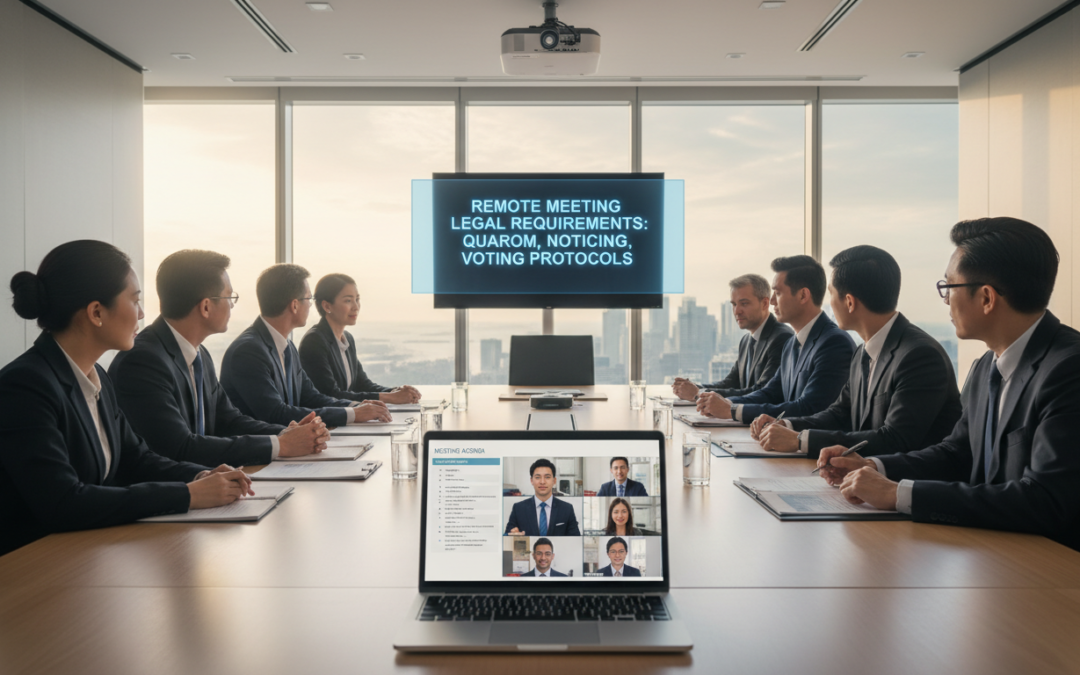
How can a company ensure decisions made via video or audio calls stand up to scrutiny?
From 1 July 2023, amendments to the Companies Act made fully virtual and hybrid formats mainstream. Directors may now participate by video or audio, and electronic proxy instructions are accepted. This change replaces temporary COVID-era measures that were due to lapse.
This section explains what remote board meetings mean in practice and why governance teams must treat them as formal, auditable corporate actions. The core objective is clear: run meetings so that director duties are upheld and records—minutes, resolutions and filings—are compliant and defensible.
We set out the practical steps to prepare, run and record meetings: pre-meeting checks on constitution and decision type, secure technology, proper notice and papers, orderly voting and complete post-meeting records. The company secretary plays a central role in co-ordinating logistics and keeping an audit trail investors, banks and regulators can rely on.
Key Takeaways
- Virtual and hybrid formats are now permanent options under the Companies Act.
- Treat online participation as formal corporate action; keep auditable records.
- Prepare with checks on constitution, notice, secure setup and voting processes.
- Common risks include poor attendance verification and unclear voting records.
- The company secretary is essential for compliance and documentation.
What Singapore law allows for virtual and hybrid meetings after the Companies Act changes
The Companies Act was updated with effect from 1 July 2023. These amendments give statutory backing for companies to hold fully virtual or mixed-format meetings. The change replaces the temporary pandemic provisions and removes prior uncertainty about online participation.
Operational effect: directors may attend and participate electronically and electronic proxy instructions must be accepted. That does not relax governance obligations: firms still need proper quorum, accurate minutes and clear record of votes.
Virtual versus hybrid formats
Virtual meetings involve all participants joining electronically. Hybrid meetings mix in-person attendance with electronic participation. Hybrid formats often suit sensitive strategy sessions or where some directors prefer face-to-face interaction.
End of temporary COVID-era measures
With the temporary regime ended, companies must align practice with the updated law and their constitution. Ensure the chosen format preserves shareholder rights and information access, protects voting integrity and maintains a reliable audit trail.
- Update internal playbooks and templates.
- Select compliant technology that supports electronic proxies and secure voting.
- Standardise notice, resolution and minute formats to protect transparent decision-making.
Remote board meetings singapore legal requirements to check before you schedule
A quick pre-meeting review prevents procedural errors that could later void decisions.
Pre-meeting checklist
- Confirm the company constitution: quorum, notice periods, allowed electronic methods and written resolution rules.
- Classify the event correctly: is it a meeting of directors or a shareholders’ general meeting?
- Map the decision to authority under Section 157A and decide whether a board resolution is required.
- Check voting thresholds — ordinary resolution (simple majority) or special resolution (typically 75%).
- Plan sequencing where board approval and shareholder consent are both needed.
Why the constitution matters
The constitution may set different notice windows and sign-off processes. It can also prescribe whether written resolutions are valid and how they must circulate.
Classify correctly: directors or shareholders?
Confusing the two leads to wrong notice rules, the wrong voting thresholds and improper records. Make classification explicit in the agenda and papers.
Decisions that must be documented
Under Section 157A, directors manage the business, so material decisions should be captured as formal resolutions.
| Decision | Typical Authoriser | Action |
|---|---|---|
| Issue of shares | Board and may need shareholder approval | Board resolution; seek shareholder consent if constitution or law requires |
| Opening bank accounts | Directors | Board resolution naming signatories |
| Appointment of senior officers | Directors | Board resolution and updated company records |
| Amendment to constitution | Shareholders | Special resolution (≈75% threshold) |
Use a simple workflow: map the matter → confirm whether directors or shareholders decide → choose the meeting or written route → prepare notices, packs and voting mechanics. For added guidance on shareholder procedures and validity of virtual sessions, see virtual shareholder meetings guidance.

Choosing the right remote meeting method for the decision you need to make
Choosing the right format for a corporate decision starts with matching the issue to the forum where it can be debated and recorded clearly.

Board meeting vs written directors’ resolution
Board meetings work best for contentious matters, strategic transactions and approvals that need live challenge or management Q&A. Use a live session when the outcome depends on discussion or when investors expect robust oversight.
Written directors’ resolutions suit routine approvals with clear parameters, such as renewing standard contracts or administrative changes. They save time and are appropriate when directors can sign without substantive debate.
Ordinary and special voting thresholds
Ordinary resolutions usually pass with more than 50% of votes cast. Special resolutions generally require at least 75% and apply to major changes, for example altering the constitution, changing the company name, reducing capital or winding up.
Common resolutions and escalation triggers
| Decision | Typical Authoriser | When to escalate |
|---|---|---|
| Open bank account / signatories | Board | Standard |
| Allotment of shares | Board / Shareholders | Affects ownership; may need shareholder consent |
| Change registered address | Board | Routine |
- Confirm authority level for the matter.
- Check whether shareholder approval is needed (ordinary resolution or special resolution).
- Select meeting or written route based on complexity and urgency.
- Prepare clear resolution wording and an evidence bundle.
Governance outcome: picking the right method reduces compliance risk, gives clarity to banks and investors, and protects directors by evidencing proper approval.
Setting up the virtual meeting for compliance, access and shareholder rights
A compliant meeting starts long before the agenda — it begins with a secure platform and clear access rules.
Selecting secure electronic means that support real-time participation
Choose a platform that offers unique links, waiting rooms and role controls. Limit screen sharing and enable host authentication to protect confidential discussions.
Ensuring attendees can observe proceedings by audio and video, with an audio-only fallback
Provide synchronous audio and video so people can follow speakers and reduce disputes about what was said.
Keep an audio-only option (telephone dial-in) for resilience where data or bandwidth fail.

Identity verification and attendance checks by the company secretary
The secretary should lead pre-registration, match names and emails to the directors’ list, call the roll and log join and leave times.
Data protection and confidentiality controls for sensitive documents
Store packs encrypted, restrict downloads, watermark files and schedule secure disposal after retention periods. Remind attendees at the opening that unauthorised recording is prohibited and record any permitted capture with storage rules documented.
| Control | Why it matters | Practical step | Outcome |
|---|---|---|---|
| Access controls | Prevents unauthorised entry | Unique links, waiting room | Protected discussions |
| Audio/video + fallback | Ensures contemporaneous observation | Webcast + telephone line | Reliable participation |
| Identity checks | Supports quorum and minutes | Pre-registration + roll call | Defensible attendance record |
| Document protection | Safeguards sensitive information | Encryption, watermarking, retention policy | Controlled distribution |
Notice, agenda and document circulation for remote meetings
A properly drafted notice, punctual distribution and secure documents reduce risk and protect decisions.
What to include in the notice
Essential items: the clear date and exact time, time zone where relevant, platform details, access links and any pre-registration steps.
Also state how proxy forms and voting instructions should be submitted, how questions may be raised and the cut-off times for each action.
Distributing packs and financial statements
Send board packs and financial statements via a secure portal or encrypted email. Use version control so directors see the current documents.
Section 387B permits sending annual reports and statements electronically to shareholders; confirm authorised addresses first.
Timelines, late papers and due process
Set firm circulation deadlines for agendas, questions and amendments. Treat late papers as exceptional and record reasons if they are tabled.
Using email correctly
Send notices to notified addresses and retain delivery evidence. Log what was sent and when in the company records.
| Item | What to include | Practical step |
|---|---|---|
| Notice | Date, time, platform details, links | Template notice with time zone and access steps |
| Agenda | Linked resolutions and required authority | Align agenda items with proposed wording |
| Documents | Board packs, financial statements, supporting papers | Secure portal, encryption, version control |
| Deadlines | Cut-off for questions, amendments, proxies | Publish cut-off times and enforce consistently |
Governance reminder: consistent notice and document circulation supports defensible decision-making. Corporate services can help by standardising templates, tracking timeframes and providing secure distribution services for the company.

Running the meeting: quorum, voting, questions and decision capture
A well-run meeting starts with an orderly roll call and a visible record of who is present.
Establishing quorum and recording presence
Start-up run‑of‑show:
- Chair opens, confirms the agenda and declares the time.
- Secretary conducts roll call and verifies identities.
- Chair acknowledges those present and confirms quorum.
Record the number present and log join/leave times. If shareholders attend electronically, treat attendance as personal presence if verified and acknowledged.
Voting, proxy instructions and accepted mechanics
Use fitted voting methods for the item and the constitution. Options include verbal confirmation with recorded totals, platform polling or show‑of‑hands equivalents.
Allow electronic proxy submissions, validate instructions and apply them exactly when votes are taken. Where electronic voting is not permitted by the constitution, use proxy appointment instead.
Handling questions and the chair’s role
Manage questions by queue, time slot and relevance. Ensure substantive matters are answered on the record and included in the minutes.
The chair must keep order, give fair turns to speakers and ensure each resolution is proposed, debated and put to vote. Build a clear audit trail: note what was decided, how votes were cast and why the decision was reached.
Contingencies and minute integrity
If connectivity fails, pause and restore quorum before continuing. Document any disruption, the number affected and the action taken. The secretary should keep labelled supporting documents and an evidence log for future inspection.
After the meeting: minutes, resolutions and statutory record-keeping in Singapore
After the meeting closes, accurate records turn spoken decisions into enforceable corporate documents. Produce draft minutes and signed resolutions promptly so actions are traceable to a meeting date and to the directors who authorised them.
How to draft minutes that accurately reflect directors’ decisions and discussions
Record the meeting date, attendees, quorum confirmation and any conflicts of interest. Summarise key discussion points at a high level; avoid verbatim reports.
End each item with the precise outcome and the exact wording of the resolution. Keep a clear log of join and leave times for attendance evidence.
Structuring resolutions with clear “IT IS RESOLVED THAT” wording
Begin each resolution with “IT IS RESOLVED THAT …” followed by the action, named authorisations, signing powers, monetary limits and an effective date. Store the signed version with supporting documents.
Retention, ACRA filings and the secretary’s role
Maintain a compliant minute book and retain minutes and resolutions for at least five years to meet common governance expectations. Typical ACRA filings often must be lodged within 14 days for director appointments or resignations, registered address changes, constitutional amendments and allotment returns.
| Action | Filing | Typical timeline |
|---|---|---|
| Director change | Notification to ACRA | 14 days |
| Address change | Update register and notify ACRA | 14 days |
| Constitution amendment | File special resolution | 14 days |
The company secretary provides templates, document control and deadline tracking. Link each filing to the signed resolution, the board pack and any supporting information so audits, banks and due diligence run smoothly.
Quality-control checklist
- Confirm each decision appears consistently in minutes, resolutions and registers.
- Attach signed resolutions to filing evidence and board papers.
- Log filing dates and retain copies of completed forms and documents.
Conclusion
Clear process and record-keeping make electronic forums reliable for business decisions.
Since 1 July 2023, companies may use fully virtual and hybrid formats lawfully when they follow disciplined procedures. Treat every meeting as a formal corporate act: confirm the constitution, classify the event correctly and record votes and outcomes precisely.
Good process is protection. Use a secure platform, verify attendance, confirm quorum, adopt a clear voting method and capture questions and answers on the record. Produce signed minutes and resolutions and store documents with version control.
The company secretary can simplify coordination, templates and statutory timelines. Consistent governance and tidy records reduce disputes, support directors’ duties and strengthen credibility with banks, investors and counterparties.
FAQ
What change to the Companies Act took effect on 1 July 2023 and how does it affect virtual and hybrid meetings?
When should I choose an electronic meeting versus a hybrid format?
How do the end of COVID‑era temporary measures affect current practice?
What must I check in the company constitution before scheduling an electronic meeting?
How can I tell whether a gathering is a directors’ meeting or a shareholders’ general meeting?
What decisions must be recorded as directors’ resolutions under Section 157A?
When are shareholder approvals or special resolutions required?
When is a written directors’ resolution preferable to an electronic meeting?
What voting thresholds apply to ordinary versus special resolutions?
What typical board decisions commonly require formal resolutions in Singapore companies?
How do I select a secure electronic means that supports real‑time participation?
Are audio‑only options acceptable for attendees who cannot use video?
What identity verification and attendance checks should the company secretary perform?
What data protection measures are needed for sensitive board materials?
What must be included in the notice for an electronic meeting?
How should I distribute board packs and financial statements electronically?
How do I manage late papers and cut‑offs without undermining due process?
What are best practice rules for using email for notices and document delivery?
How is quorum established and recorded for attendees joining electronically?
What voting methods are acceptable and when is electronic voting permitted?
How should questions be handled to ensure they are addressed on the record?
What is the chair’s role in virtual or hybrid meetings?
How should minutes be drafted to reflect electronic participation accurately?
What wording should board resolutions contain to be effective?
What are retention expectations for minutes and resolutions?
Which ACRA filings can be triggered by board decisions and what are typical timelines?
How can a company secretary support compliance with electronic meeting practices?

Dean Cheong is a Singapore-based B2B growth strategist and the CEO of VOffice. He helps companies scale revenue through sharper sales execution, CRM implementation, and go-to-market strategy, backed by a strong foundation in business banking and finance from Nanyang Technological University and a track record of driving sustainable, performance-led growth.