
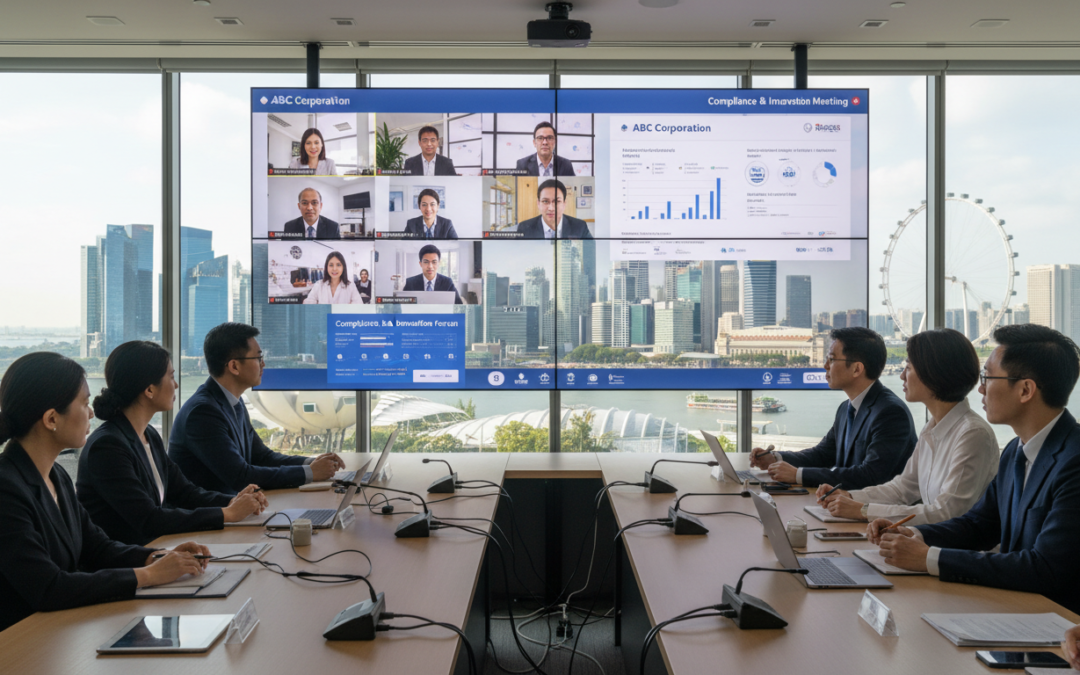
Can a fully online meeting truly protect shareholder rights while meeting legal requirements?
The landscape changed from 1 July 2023 when the Companies Act introduced a statutory framework that allows fully online or hybrid general meetings. This article is a practical, Singapore-focused how-to guide for directors, company secretaries and in‑house legal and finance teams.
Expect clear steps on constitution checks, notice timing, proxy workflows and technology standards that support auditable voting and robust identity controls.
We explain what counts as a hybrid or fully online annual general meeting, and why the rules now extend beyond logistics into protecting shareholders, preserving rights, and keeping reliable records.
Follow the step‑by‑step structure here to build a compliant meeting plan tailored for private companies, public companies and SGX‑listed issuers, alongside the RegCo guidance for listed entities.
Key Takeaways
- New law (from July 2023) permits online and hybrid general meetings under set rules.
- Compliance means correct notice periods, identity controls and auditable voting.
- Directors and company officers must check constitutions and proxy procedures.
- Technology choices should support records, participation and question channels.
- Guidance applies to private, public and listed companies with specific expectations for listed issuers.
Understand the post-2023 legal framework for virtual and hybrid general meetings in Singapore
Since 1 July 2023, the Companies Act replaced temporary COVID orders with a permanent framework that expressly permits meetings to be held in-person, in hybrid mode, or solely by electronic means.
What changed under the amendment
The law now confirms that general meetings may be conducted at a physical place, in a virtual hybrid format, or entirely by electronic means. Boards must accept proxy instructions submitted electronically and may hold board meetings in mixed or electronic formats, unless the company constitution says otherwise.
“The statutory change turns emergency arrangements into a lasting legal option for companies and their stakeholders.”
Which meeting types are covered
- Annual general, extraordinary and statutory meetings
- Class meetings and amalgamation approval meetings
- Certain Court-directed meetings under sections 182 and 210
When the constitution can exclude electronic-only meetings
Companies incorporated before 1 July 2023 are subject to the default framework unless their constitution was validly amended on or after that date to exclude electronic-only meetings. New companies may include an exclusion at incorporation or later.
Practical next steps
| Action | Why it matters | Who |
|---|---|---|
| Check constitution wording | Determines whether electronic-only formats are available | Directors & company secretary |
| Document board decision on format | Ensures notice and access details match chosen arrangements | Board |
| Confirm proxy and notice procedures | Meets Companies Act and any applicable regulations | Company secretary |

Check whether your company must hold an AGM and confirm statutory timelines
Start by confirming whether your company must hold its annual meeting and which statutory timetable applies. This decision affects notice timing, proxy cut‑offs and platform testing.
Key deadlines at a glance
- Listed companies: hold the meeting within 4 months after the financial year end.
- Non‑listed companies: hold the meeting within 6 months after the financial year end.
- Private company exemption: instead of a meeting, you may send financial statements to members within 5 months after year end.
Use this simple decision tree: is the company listed? If yes, apply the 4‑month rule. If not, check if it is a private company electing the exemption.
Safeguards that override the exemption
- A member can require a meeting by notice no later than 14 days before the end of the sixth month after year end.
- If a member or the auditor requests an AGM within 14 days after statements are sent, the company must convene the meeting.
“Directors should minute the timeline assessment and the basis for relying on any exemption.”

Practical planning tip: work backwards from the statutory end date to set board approval, notice issuance, proxy deadlines and technology tests. Record the decision and the information relied on for good governance.
Virtual AGM Singapore compliance checklist for notices, agenda and resolutions
Notices are the backbone of a lawful meeting; get the details right and you avoid procedural challenge.
- What the notice must state — include the date, time and place, the full agenda, proxy appointment details and whether a special resolution is proposed.
- Describing the place — for hybrid or fully electronic meetings spell out any physical venue and give exact access steps for online participants (URL, meeting ID, authentication method and helpdesk contact).
- Notice periods — allow at least 14 days for ordinary resolutions and at least 21 days for special resolutions. Build in extra buffer days to allow for delivery or IT issues and record dispatch details.
- Using electronic means — send notices by email when addresses are held, and also publish on the company website so members can retrieve documents. Confirm that members can access attachments and provide a contact for access problems.
- Drafting the agenda — list financial statements, auditor items and any other key matters clearly. State the form of each resolution and refer to supporting information hosted on the website.
Practical control: include a clear note on how questions will be handled and how voting operates, and keep an auditable trail of dispatch and access records.
“Accurate notices and accessible information protect shareholders and make meetings robust and defensible.”

Protect shareholders’ rights in a virtual AGM using the Companies Act default rules
Good meeting management starts with a plan that preserves shareholders’ rights when people participate by electronic means.
Attendance and quorum counting
Attendees who join by electronic means count towards quorum under the Companies Act. Directors should capture system logs, attendance reports and timestamped access records.
Practical step: record a single source of truth—an attendance export that shows name, member status and timestamp.
Being heard in real time
“Being heard” means members can ask questions and make representations synchronously. Use live audio, moderated Q&A or real‑time chat that the chair monitors.
Directors must set the channel and publicise it in the notice so members know how to speak or submit questions.
Managing who speaks on resolutions
Run an orderly queue with time limits and clear turn-taking. The chair should apply rules consistently and record any procedural rulings.
This reduces cross-talk and helps ensure fair engagement for every person who wishes to speak on a resolution.
Voting and identity verification
Members may vote by electronic means; systems must log each vote and link it to an authenticated person or proxy.
Show of hands: permitted electronically only when identity verification meets prescribed methods or a director‑determined approach.
Laying and inspection of documents
Financial statements, the auditor’s report and registers may be laid on a website during the meeting. Provide a live link or helpdesk contact for access issues.
Record any access failures and offer alternative inspection methods to protect members’ rights.
“Design meeting arrangements so digitisation never dilutes the statutory rights of shareholders and members.”
| Issue | Default rule | Practical control |
|---|---|---|
| Quorum | Electronic attendees count | Exported attendance log with timestamps |
| Right to be heard | Synchronous communication required | Live audio + moderated Q&A; chair monitors |
| Voting | Electronic voting allowed | Authenticated voting flow and auditable trail |
| Show of hands | Permitted if person identified | Prescribed verification or director‑approved method |
| Document inspection | Website access permitted | Live link, helpdesk and backup inspection option |
Set up compliant proxy and voting workflows (including electronic proxy instructions)
A clear proxy and voting workflow protects shareholders and keeps the meeting process defensible.
Start with the notice. Spell out the accepted form for a proxy instrument and the electronic means for submission. State cut‑off times, permitted file formats and any platform-specific steps so members can follow the process without guesswork.
Operationalise submissions by issuing acknowledgements, running validation checks and securely storing proxy data. Keep simple receipts that show sender, time and the form submitted.

Support split votes and accurate capture
Allow split votes where necessary, especially for nominee or institutional holdings. Design the form to accept per‑resolution instructions and block ambiguous entries.
Use real‑time validation to spot mismatches and prompt submitters to correct entries before final acceptance.
Closing windows, audit trails and scrutineer checks
Define when voting opens and when it closes, and explain how late changes are handled. Require the chair to announce closure to avoid disputes.
Maintain an auditable trail: timestamped vote records, logs linking voter identity to eligibility, and a record of exceptions for invalid ballots.
“Accurate logs and scrutineer reports make challenges easier to resolve and preserve trust in the process.”
- Prepare scrutineer packs showing validation rules, vote exports and exception lists.
- Ensure reports can demonstrate how each proxy form translated to recorded votes.
- Retain data securely to meet record‑keeping requirements and enable post‑meeting reviews.
Choose virtual meeting technology that meets SGX RegCo expectations and market standards
Technology selection should balance functionality, resilience and data protection to meet regulator and market expectations.
Regulatory alignment: SGX‑listed companies remain subject to RegCo requirements and updated practice notes. Review the SGX practice note 7.5 when assessing vendors and features.
Minimum capabilities: ensure live engagement and live voting are available for every meeting format. The platform must let participants change votes until close and export scrutineer-ready reports.
Registration, validation and attendance controls
Choose systems that authenticate shareholders, prevent duplicate logins and create timestamped attendance logs suitable for quorum records.
Q&A, resilience and support
Provide text-based Q&A for remote attendees and optional audio/video channels. Publish live technical support contacts in advance and test recovery procedures.
Security and PDPA considerations
Apply data minimisation, role‑based access and vendor due diligence. Store personal data securely and document handling policies to protect shareholders and directors.
“Pick a platform that turns market guidance into practical controls — reliable voting, clear attendance evidence and secure data handling.”
Conclusion
A robust end‑to‑end approach makes meetings predictable and defensible for companies and members.
Start by checking the constitution and whether the Companies Act requires an annual general meeting within the statutory time. Then draft the notice, set the place and time, and publish key materials on the website.
Put processes in place so shareholders can ask questions, vote and inspect documents. Run proxy and voting flows with auditable logs and choose technology that supports clear participation and record keeping.
Final checklist mindset: every means of participation should be testable, recorded and explained before the meeting ends. Use this article as a repeatable template to reduce last‑minute risk and show evidence if a resolution is challenged.
FAQ
What changed under the Companies, Business Trusts and Other Bodies (Miscellaneous Amendments) Act regarding electronic general meetings?
Which types of general meetings can be held fully online or in a hybrid format?
When can a company constitution prevent a fully electronic meeting?
Which companies are required to hold an annual general meeting and what are the timelines?
Are private companies exempt from holding an AGM and what must they do instead?
What circumstances still trigger an obligation to convene an AGM despite exemptions?
What must the notice of a general meeting include when using electronic facilities?
What are the notice periods for ordinary and special resolutions?
Can companies send meeting notices by email or publish them on a website?
What should be included in the agenda for an annual general meeting conducted electronically?
How is attendance and quorum determined when members join by electronic means?
How can companies enable members to be heard during electronic meetings?
How are speaking rights and orderly engagement managed in an online meeting?
What voting methods are acceptable for electronic meetings?
How should documents be made available for inspection during an electronic meeting?
Can proxy instruments be submitted electronically?
How should split votes and proxy instructions be handled in an electronic environment?
What are best practice steps for closing voting windows and ensuring an accurate audit trail?
What additional requirements apply to SGX‑listed companies regarding meeting platforms?
What minimum features should meeting technology provide to meet market expectations?
How should companies authenticate and validate registered attendees?
Are text‑based Q&A options sufficient for members who wish to ask questions?
What contingency and recovery provisions should be communicated to participants?
What security and data protection measures are required under the Personal Data Protection Act 2012?

Dean Cheong is a Singapore-based B2B growth strategist and the CEO of VOffice. He helps companies scale revenue through sharper sales execution, CRM implementation, and go-to-market strategy, backed by a strong foundation in business banking and finance from Nanyang Technological University and a track record of driving sustainable, performance-led growth.