

This guide helps directors and incorporators who need a credible business address in Singapore without leasing full-time premises.
We explain what a mail-handling and phone-answering service can deliver, and what it cannot. You will learn how an ACRA-registered address works and which services support governance, statutory correspondence and bank or auditor checks.
The core decision is practical: pick a provider that balances compliance, service depth, reliability and total cost while preserving director privacy. By the end you will be able to compare contract terms, service levels and likely expenses.
Later sections include factual snapshots of Servcorp, VOffice, Straits Virtual Office and SnapMail to speed shortlist building. Practical checklists will show how to update ACRA records and business communications, plus a suggested implementation plan and comparison criteria.
Key Takeaways
- Suitable for Singapore-incorporated holding entities and overseas-managed structures seeking a compliant address.
- Compare compliance fit, service depth, provider reliability, contract terms and total costs.
- Understand ACRA registered address rules and what services are mandatory versus optional.
- Look for reliable mail handling, phone support and meeting-room access to satisfy counterparties.
- Provider snapshots (Servcorp, VOffice, Straits Virtual Office, SnapMail) speed shortlist building.
- Follow the checklist and implementation plan to update ACRA details and business communications.
For a practical provider overview and local options, see service listings.
Why holding companies in Singapore are choosing virtual offices now
High rents and a strong shift to hybrid work have reshaped how directors manage premises. Over 70% of the local workforce favours remote work, so many structures no longer require daily office use. They still, however, need a credible street address for statutory mail, bank checks and counterparties.
High office costs and the shift to remote work
With persistent rental pressures, paying for full-time desk space is often uneconomical. Decision-makers now favour flexible monthly arrangements that cover an address, mail handling and occasional meeting rooms.
What “commercial intent” buyers typically need
- Compliance confirmation: that the address meets ACRA rules and can receive statutory letters.
- Clear mail process: prompt alerts, escalation for urgent items and reliable forwarding.
- Transparent fees: predictable monthly charges with stated extras for scanning or meetings.
- Responsiveness: quick support so banks and auditors have no cause for concern.
| Trigger | Typical need | Success metric |
|---|---|---|
| New incorporation | Registered address + onboarding | Zero missed statutory letters |
| Restructure or move | Seamless address change | Clean governance records |
| Cost reduction | Monthly plan with mail/phone | No friction with banks or auditors |
Decision framework: prioritise compliance first, then operational fit (mail, phone, meeting access), then location and total cost of ownership.
What a virtual office in Singapore actually is (and what it is not)
A clear business address does more than receive mail; it underpins governance and credibility.
This service provides a stable, professional address plus operational layers such as mail handling and receptionist support. It is designed to meet statutory needs and reassure banks, auditors and counterparties.

How it differs from coworking and serviced suites
Virtual addresses focus on compliance and communications rather than daily desk use. Coworking spaces supply hot desks and a community; serviced suites give dedicated offices and fuller facilities.
Typical inclusions and common add-ons
- Usually included: registered address, mail receipt, notification alerts, basic forwarding and receptionist greetings.
- Often optional: mail scanning, extended storage, dedicated phone number and meeting room credits.
- Access note: many plans include limited lounge hours or pay-as-you-go meeting rooms; check credits and booking rules.
| Model | Primary use | Typical access |
|---|---|---|
| Address service | Compliance & correspondence | Mail handling, limited room credits |
| Coworking | Daily desk use & networking | Hot desks, communal rooms |
| Serviced suite | Dedicated office and teams | Full building access, fixed rooms |
Watch out: some suppliers sell mailbox-first offers that lack public accessibility and may fail ACRA tests. Use the rest of this guide to filter governance-ready providers from minimal mailbox services.
virtual office singapore for holding company: what to prioritise
A reliable business address lowers risk and keeps statutory mail flowing. Use a provider that can serve as an ACRA-registered address and support everyday correspondence without confusion.
Registered office vs correspondence address
The registered office is a legal requirement and must accept official notices. A separate correspondence address may be used for operational mail to simplify routing and reduce exposure of sensitive records.
Privacy for directors and stakeholders
Using a dedicated business address keeps directors’ home addresses off public filings. This reduces unwanted visits and spam while preserving personal privacy for stakeholders.
Credibility with banks, auditors and clients
Consistent stationery and a professional call-answering service signal good governance. Prompt handling of statutory mail reassures banks and auditors during checks.
Governance-friendly admin support
Expect logged inbound items, timely notifications, secure storage and an audit trail for statutory letters. Clear escalation rules matter when time-sensitive notices arrive.
- ACRA compliance
- Reliable receipt of government correspondence
- Escalation and notification processes
- Brand location and optional amenities
| Aspect | Registered office | Correspondence address |
|---|---|---|
| Primary role | Legal contact for ACRA | Operational mail and client post |
| Privacy benefit | Keeps directors’ homes off records | Reduces public exposure of internal contacts |
| Admin expectations | Secure receipt, logged audit trail | Fast forwarding, scanning on request |
ACRA compliance for a registered office address in Singapore
Registered address rules are non-negotiable. Directors must choose an address that meets ACRA’s requirements and that can withstand scrutiny from banks and auditors.
Physical address requirements and why a P.O. Box does not qualify
Non-negotiable: a real street address. ACRA requires a physical address, not a P.O. Box. This means a location with a street number and premises that can receive statutory letters and notices.
In practice, when buying a virtual office address you should verify the provider lists a street-level address with building name and unit number. A mailbox alone will fail ACRA checks.
Public accessibility and minimum hours during normal business hours
Access matters: the address must be open to the public for at least three hours during normal business hours. This rule exists so service-of-notices can be completed without delay.
Confirm the provider’s published hours and how they log visitor access. If the site closes entirely during the day, it will not meet the minimum hours requirement.
Choosing a provider that can reliably receive government correspondence
Operational markers of reliability:
- Staffed reception during published hours.
- Documented receipt with timestamps.
- Prompt notification to directors by email or phone.
- Secure short-term storage and clear escalation paths.
“A defensible registered address combines a real street location, public access and documented handling of statutory mail.”
Before payment ask for written confirmation that the provider’s address is suitable for ACRA registration and request a sample receipt or process note. Also check there is a named contact for urgent escalation.
| Requirement | What to check | Why it matters |
|---|---|---|
| Physical street address | Building name, unit number, street | ACRA will not accept a P.O. Box |
| Public accessibility | Published hours showing ≥3 hours/day | Allows formal service-of-notices |
| Receipt & logging | Timestamped records and notifications | Proves timely handling for banks/auditors |

For full details on the statutory rules, review ACRA guidance on registered addresses at registered office address.
Core virtual office services to compare in any package
Reliable receipt, tracking and forwarding turn an address into a governance tool. Directors need services that log arrivals, alert recipients fast and store sensitive items securely.
Mail handling and storage policies
Check whether the provider timestamps every item and keeps a searchable log. Confirm storage limits, free retention days and fees for longer holding periods.
Mail forwarding options: local and overseas schedules
Compare weekly versus on-demand forwarding. Weekly shipments cut costs; on-demand is faster but can be pricier. Note which courier partners are used for overseas forwarding.
Mail opening, scanning, and secure disposal
Allow opening and scanning only with written authorisation. Ask about redaction options and certified destruction for sensitive records.
Notifications and tracking so you never miss statutory letters
Time-stamped alerts and a user portal give an audit trail. This is vital when auditors or banks request proof of receipt.
Parcels, cheques, and special handling
Ensure separate handling rules for parcels and cheques. Cheques should be logged, locked and sent with expedited tracking or collected in person under ID checks.
Minimum viable package: a compliant address, prompt alerts, secure short-term storage and predictable forwarding options.
| Decision criterion | What to expect | Why it matters | Typical provider practice |
|---|---|---|---|
| Receipt logging | Timestamped entry, photo or reference | Proves statutory letters were received | Portal + email alerts within hours |
| Storage policy | Free retention days and fees beyond | Avoid surprise charges and lost items | 7–30 days free; paid monthly storage |
| Forwarding model | Weekly, on-demand or scheduled | Balancing cost and speed for overseas directors | Weekly standard, courier paid optionally |
| Opening & scanning | Authorisation, secure scan, redaction | Allows remote directors to act promptly | Scans emailed; originals held or forwarded |
“Clear logging and fast alerts reduce governance risk and keep auditors satisfied.”
Phone number and receptionist options that protect your brand
A single missed call can trigger compliance headaches when auditors or banks need verification. Holding entities must choose phone handling that signals competence to regulators and clients.
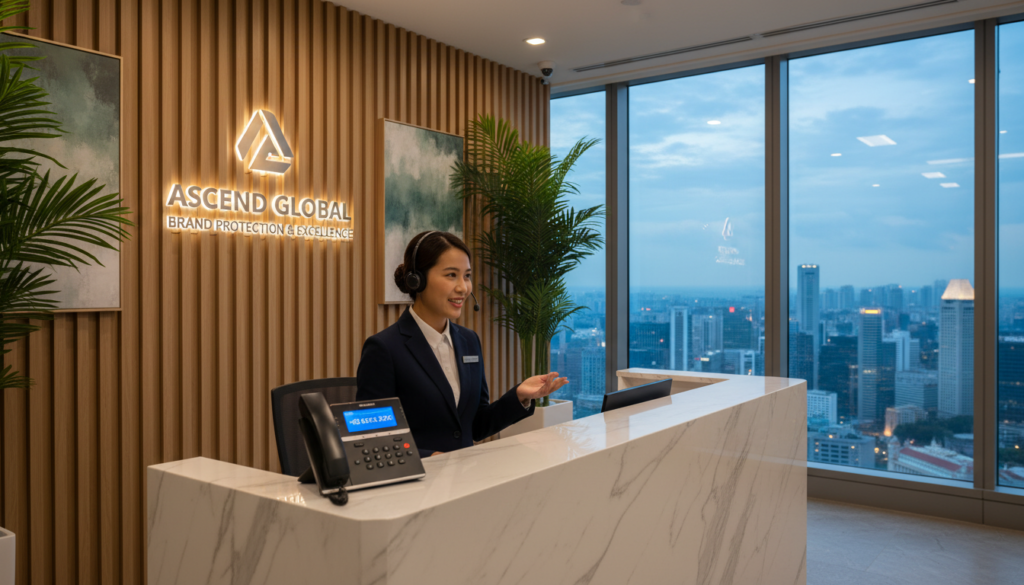
Dedicated line vs shared lines
Dedicated phone number projects professionalism. It reduces misrouting and keeps messages tied to your brand.
Shared lines are cheaper but risk generic greetings and crossed messages. That can erode confidence during a bank or auditor check.
Live receptionist vs automated answering
Live receptionist gives a human touch and can escalate urgent queries. A recorded greeting is consistent but less reassuring to callers with time-sensitive matters.
Choose live support if you expect frequent inbound calls. Automated answering with prompt callback works when calls are infrequent.
Call forwarding, charges and coverage hours
- Check per-minute forwarding rates and international forwarding options.
- Confirm after-hours coverage and weekend handling.
- Ask whether voicemail-to-email and message logging are included in standard services.
- When to pay for receptionist coverage: frequent external checks or high-profile clients.
- When voicemail is enough: low inbound volume with a policy for rapid callbacks.
| Feature | Impact | What to check |
|---|---|---|
| Call forwarding | Continuity of contact | Rates, international support, minutes charged |
| Receptionist | Perceived professionalism | Script quality, escalation contacts, training |
| Coverage hours | Availability for urgent verification | Published hours, after-hours fees |
Operational checks: define call scripts, named escalation contacts and reporting so directors can audit handling if disputes arise. Also review meeting-room or ad-hoc workspace options via serviced office rent when you need face-to-face meetings.
“Consistent, documented call handling turns a simple phone line into a governance asset.”
Meeting rooms, office space, and ad-hoc access: what you’re really paying for
When you book a room, you aren’t just hiring space — you buy credibility, reception support and technical reliability.
Value for holding structures is about occasional but high-stakes meetings: bank verifications, auditor sessions and document signings. These events need a quiet, professional room with reliable staff and AV equipment.
Inclusions vs pay-as-you-go: included meeting rooms look attractive but check booking rules, peak-hour limits and blackout periods. An hourly rate may cost more per session but offers flexibility when availability is tight.
What to inspect in each room
- Capacity and table layout to suit board or signing needs.
- Privacy and soundproofing to protect confidentiality.
- Screen, HDMI, conference camera and reliable Wi‑Fi.
- Reception support, visitor registration and refreshment options.
Coworking lounges and short-term access
Some providers include limited lounge hours or coworking spaces. These are useful when directors visit for several days and need desk space between meetings.
What you’re truly paying for: prime location, a professional reception, and operational readiness that removes friction during critical meetings.
Due diligence questions
- Booking lead times and how peak slots are prioritised.
- Cancellation fees and last-minute amendment policies.
- Visitor registration process and ID checks on arrival.
- Ability to escalate or secure alternate rooms at short notice.
| Feature | Included hours | Pay-as-you-go rate | What to verify |
|---|---|---|---|
| Boardroom | 2–6 hours/month | SGD 60–150/hr | Soundproofing, seating, AV |
| Small meeting room | Few credits or none | SGD 30–80/hr | Privacy, screen, whiteboard |
| Coworking lounge access | Limited hours | Daily pass rates | Quiet zones, booking priority |
| Reception & support | Included (varies) | Usually included with room hire | Visitor handling, refreshments |
Business address Singapore: choosing the right location for your holding company
Picking a business address is as much about perception as it is about postal logistics. Location affects how banks, auditors and clients read your governance and credibility. Choose where an address sits to reduce friction during checks.
CBD prestige vs value locations
Addresses in Marina Bay Financial Centre and CapitaGreen signal premium substance and can smooth bank or regulator queries. Suntec City is a recognised commercial hub and offers a mid-point between cost and recognition.
Lower-cost locations can suit entities with strong governance processes. If statutory records, mail handling and named escalation are robust, a value address will often suffice.
Practical trade-offs: prestige, budget and convenience
Balance three factors: prestige to reassure counterparties; budget to control recurring costs; and convenience for directors who collect mail or hold meetings.
- Prestige: reduces verification friction with finance-adjacent groups.
- Budget: saves where walk-ins are rare and governance is tight.
- Convenience: proximity to MRT and parking matters for ad-hoc visits.
Digital and document consistency
List the same office address across your website, invoices and statutory filings. Consistency builds trust and reduces questions from banks and clients.
| Location type | Signal | When to pick |
|---|---|---|
| Marina Bay / CapitaGreen | High prestige | Regulated counterparties, frequent meetings |
| Suntec City / Suntec Tower | Recognised commercial hub | Balanced cost and credibility |
| Value locations | Cost-efficient | Minimal walk-ins, strong governance processes |
Costs, contracts, and billing: how to compare like-for-like
Convert every plan into an all‑in monthly cost before comparing providers. Take the headline fee, add expected charges for mail forwarding, scanning, storage beyond free days, and extra meeting room hours. This gives a realistic monthly figure you can compare side-by-side.
Contract flexibility matters. Month-to-month options (Servcorp and some SnapMail tiers) suit transitional phases or restructures. Annual billing (VOffice, Straits) often cuts the monthly price but ties you in. Choose based on how stable your setup will be.
Hidden fees to audit
- Mail forwarding: per-shipment and courier surcharges can climb if you forward often.
- Storage: free retention days vary; check fees once the threshold is passed.
- Scanning and handling: per-page or per-item rates add up if directors rely on scans.
- Meeting room hours: extras beyond inclusions are usually hourly and peak‑priced.
Budget, mid-tier and premium options
Budget services cover basic compliance and a registered address. Mid-tier plans add dependable mail workflows and modest meeting credits. Premium tiers include receptionist support, dedicated numbers and frequent meeting-room access.
“Cheap plans can be costly if forwarding and scanning are essential for overseas directors.”
Simple cost scenario (use as a quick worksheet): estimate letters per month, parcels per month, number of forwards, and meeting room hours. Multiply each by the provider’s fee and add to the base monthly rate to get your expected all-in month cost.
| Plan type | Typical billing | When to pick |
|---|---|---|
| Month-to-month | Flexible month billing | Transitional phases, short-term projects |
| Annual | Discounted per month | Stable entities seeking lower costs |
| Long-term prepaid | 1–36 months options (SnapMail) | Prepaid certainty and longer savings |
Provider comparison snapshot: the most established virtual offices in Singapore
A compact vendor snapshot speeds shortlisting when governance, credibility and administrative reliability matter most.

Servcorp — Premium positioning with four prime addresses (Marina Bay Financial Centre, CapitaGreen, The Metropolis, Suntec Tower Three). Plans range SGD 128–600 with month, 6‑ and 12‑month options. Includes mail and courier handling, a dedicated phone number with live receptionist and global lounge access that supports directors travelling between jurisdictions.
VOffice — Very low annual pricing (SGD 57 / 97 / 197 per year). Simple online sign‑up, mail alerts and self‑collection. Higher tiers add forwarding credits and meeting room hours. Claims 9,000+ clients since 2014, making it a budget‑friendly business address option.
Straits Virtual Office — Suntec City location with 12‑month plans from SGD 13.99–45.99 per month. Offers email notifications, optional dedicated phone line and call forwarding. Add‑ons include scanning and cheque deposit; meeting rooms available at about SGD 20/hour.
SnapMail — Mailbox‑first service aimed at parcel and mail handling. Plans roughly SGD 6–40 per month depending on term. Six self‑collection points and a 30‑day money‑back guarantee lower switching risk for mail‑heavy businesses.
| Provider | Price headline | Key strengths | Notable add‑ons |
|---|---|---|---|
| Servcorp | SGD 128–600 | Prestige addresses, receptionist, lounge access | Dedicated phone, meeting rooms |
| VOffice | SGD 57/97/197 p.a. | Low cost, mail alerts, easy signup | Forwarding credits, meeting hours |
| Straits Virtual Office | SGD 13.99–45.99 p/m | Suntec City address, phone options | Scanning, cheque deposit, meeting room hire |
| SnapMail | SGD 6–40 p/m | Parcel strength, multiple collection points | 30‑day refund, flexible terms |
Note: this snapshot helps shortlist by credibility, compliance readiness and admin reliability. It does not replace due diligence: confirm ACRA suitability, response times and the provider’s documented handling processes before committing to a business address.
Who each provider is best for (based on typical holding company needs)
Match practical needs—meeting frequency, mail volume and escalation paths—to the supplier features before committing. Below are concise use cases to help you choose a provider without overbuying.
Best for prestige and frequent meeting room use
Servcorp suits directors who hold regular bank, auditor or investor meetings. Its receptionist service, dedicated phone and premium meeting rooms reduce friction during high‑stakes sessions.
Best for cost‑sensitive structures needing a compliant office address
VOffice fits entities that primarily need an address for ACRA, predictable mail alerts and low recurring fees. Minimal meeting needs and simple mail forwarding are covered.
Best for foreign‑owned or overseas‑managed entities
Straits Virtual Office works well when scanning, scheduled forwarding and phone options matter more than daily workspace. Clear escalation paths and affordable forwarding keep auditors and banks satisfied.
Best for mail‑heavy operations and parcel handling
SnapMail is ideal when parcels, frequent couriers and cheques require robust handling, multiple collection points and tight logging. Choose this if mail volume drives your operational need.
“Pick the provider that mirrors your operating model: stable long‑term holding, transitional restructuring or active investment management.”
- Decide which mix of meeting rooms, mail handling and forwarding you need.
- Shortlist by the use case above and avoid paying for unused extras.
Due diligence checklist before you buy a virtual office service
A focused checklist helps you prove an address will meet statutory and practical needs.
Prove the address is ACRA‑usable
Confirm the location is a street address (not a P.O. Box) and has published public access hours of at least three per day.
Request written confirmation that government correspondence is accepted and logged with timestamps.
Verify reliability and responsiveness
Check recent reviews and shadow support channels: send an email, a WhatsApp message and place a call to measure response time.
Test onboarding and operational processes
Run a trial: note how items appear in the portal, whether notifications are clear, and if escalation paths for urgent statutory mail are documented.
Operational risk controls and upgrade paths
Ask about identity checks for collection, rules for opening or scanning mail, and secure disposal procedures.
Plan growth: confirm options to add phone answering, meeting credits, higher forwarding frequency or upgrade to serviced space if needs change.
| Check | Proof to request | Why it matters |
|---|---|---|
| ACRA usability | Written address confirmation & hours | Ensures legal acceptance |
| Mail handling | Sample receipt log & notification SLA | Proves timely handling |
| Support reliability | Response timestamps from real tests | Shows vendor responsiveness |
| Security controls | ID collection rules, scanning authorisations | Protects sensitive records |
Practical test wins over promises: small trials reveal whether the service will support statutory success.
How to choose the right package and get set up smoothly
Start by mapping your daily workflows to services that reduce friction and risk. That simple exercise makes it easier to pick a plan that balances compliance and operational need.
Match services to real operational needs
Begin with compliance: confirm the address can be used as your registered address and will be accepted by the bank and regulators.
Then choose services based on usage: low mail volume needs basic receipt and alerts; frequent inbound parcels need robust logging and collection points.
Prioritise phone answering if external calls are common, and add meeting rooms when directors require face-to-face verification or signings.
Align access hours with director availability
Check published access hours and confirm what happens outside those windows. Ask whether urgent statutory mail is logged and escalated immediately.
If directors travel often, favour predictable scanning and scheduled forwarding. If directors are local, choose longer access hours and easy self-collection.
Tip: insist on a named escalation contact and clear SLA for urgent items.
Implementation plan and go‑live checklist
Practical steps:
- Update ACRA registered address and any business address on statutory records.
- Refresh stationery, invoices and website contact blocks to show the new office address.
- Notify banks and key correspondents of the new correspondence address and provide a contact name.
Operational setup: define who receives notifications, who may approve mail opening, where scans are stored and retention periods for physical mail.
- Run a short trial week to confirm alerts and forwarding work as expected.
- Verify access hours with director calendars and adjust credits or add-ons as needed.
- Do a go‑live readiness check: confirm ACRA update, bank acceptance, portal access and that no statutory mail was missed in transition.
Ready check: one successful logged statutory item and a confirmed bank acceptance are the best proof your new address setup is operating correctly.
Conclusion
The best outcome pairs compliance certainty with predictable monthly costs and straightforward escalation paths.
Prioritise compliance and reliability first, then match the service level to how your business actually operates. A trusted virtual office reduces fixed costs while keeping a credible address, provided the provider accepts and processes official mail reliably.
Shortlist by location fit, mail workflow robustness, phone handling when needed, and meeting access only if it will be used. Compare all-in costs, not headline rates, since forwarding, scanning and room hours change totals.
Next step: use the due diligence checklist, request written confirmations and choose a provider you can trust for long‑term governance success.
FAQ
What is a virtual office address and can it be used for ACRA registration?
Can a holding structure use a correspondence address instead of a registered office?
How do mail handling and mail forwarding work?
Will using an address affect director privacy and public records?
Do banks and auditors accept a business address from a service provider?
What meeting room and ad-hoc access should I expect?
Are receptionist and phone options included, and how do they protect brand image?
How do providers handle parcels, cheques and time-sensitive items?
What are the common hidden fees to watch for?
How should I choose a location for a holding group address?
What service levels suit different holding company needs?
How do I verify a provider’s reliability before buying?
Can I upgrade services as my business grows?

Dean Cheong is a Singapore-based B2B growth strategist and the CEO of VOffice. He helps companies scale revenue through sharper sales execution, CRM implementation, and go-to-market strategy, backed by a strong foundation in business banking and finance from Nanyang Technological University and a track record of driving sustainable, performance-led growth.