
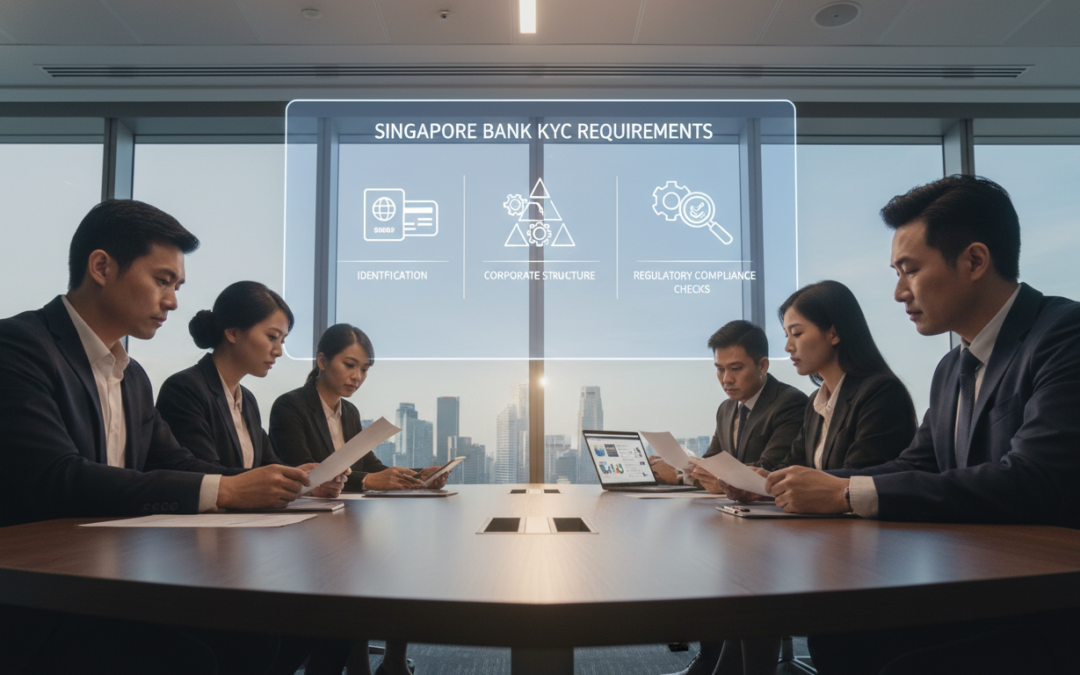
Curious why two similar firms face very different onboarding checks? The answer lies in a risk-led process that looks beyond forms. This guide explains how banks assess corporate clients and why that affects speed, follow-ups and acceptance.
KYC is the practical framework used to verify and monitor corporate customers during onboarding and throughout the relationship. It forms the first line of defence in anti-money laundering and counter‑terrorist financing compliance.
This Ultimate Guide is written for SMEs, startups, holding entities, regional HQs and foreign-owned accounts. You will learn about the regulatory landscape, document checklists, beneficial ownership, source of funds, ongoing monitoring and digital verification tools.
Expect clear steps: prepare a document pack, map ownership, and match your expected transactions to your business model. Banks ask for corporate papers, controller details and funding evidence to meet rules and manage risk.
Key Takeaways
- KYC is an ongoing, risk-based verification process, not a single paperwork task.
- Prepare documents, ownership charts and transaction profiles before applying.
- Regulatory drivers include MAS and international FATF standards.
- Two firms in the same sector may face different levels of scrutiny.
- Digital IDs and CorpPass can speed up onboarding when used correctly.
Why KYC matters for companies banking in Singapore’s AML/CFT environment
Strong identity and control checks are central to preventing illicit money flows. These checks establish who a legal entity is, who controls it, and whether its transactions match the stated business profile.
How this supports anti-money laundering and counter‑terrorism financing
How KYC supports anti-money laundering and counter‑terrorism financing controls
Verification helps detect layering through complex ownership and rapid movement of money. Banks use this information to spot patterns that suggest laundering or financing of illicit activity.
Key risks being reduced: fraud, misuse and reputational harm
Beyond compliance, institutions worry about fraud and wider financial crimes. Misused accounts, hidden controllers or inconsistent records increase operational risk and can trigger public enforcement.
What enforcement signals mean for businesses today
Regulatory actions show real consequences: MAS ordered Falcon Private Bank’s closure in October 2016 after failures linked to 1MDB flows. Similar penalties and licence revocations underline that weak governance can lead to severe outcomes.
- KYC is not a box‑ticking exercise; it ties to ongoing transaction monitoring and escalation.
- Higher‑risk profiles lead to longer onboarding and more frequent document requests.
- Clear explanations of operations, counterparties and expected flows reduce friction.
| Control aim | What is checked | Business impact |
|---|---|---|
| Identity | Corporate documents, UBOs, directors | Smoother onboarding when records match filings |
| Activity fit | Business model, expected flows, counterparties | Fewer follow-ups and fewer transaction holds |
| Ongoing monitoring | Transaction patterns, alerts, periodic reviews | Early detection of laundering, fraud and other crimes |
Regulatory landscape and who enforces KYC in Singapore
Regulators and supervisors in the city-state set strict guardrails that shape how firms prove identity and ownership.
Monetary Authority expectations
Monetary Authority oversight drives AML and compliance standards across the financial sector. Institutions must show risk‑based due diligence, robust customer identification and ongoing monitoring.
FATF influence on local practice
Membership in the FATF since 1992 keeps local regulations aligned with global norms. With 37 of 40 recommendations assessed as compliant or largely compliant, local practices mirror world benchmarks and demand consistent due diligence outcomes.
Other regulators and affected sectors
ACRA and the Council of the Law Society extend KYC duties to corporate service providers and legal services. This means verification is common beyond traditional financial services.
Core legal pillars
The Corruption, Drug Trafficking and Other Serious Crimes (Confiscation of Benefits) Act (CDSA) forms the main anti‑money‑laundering law. Firms must evidence identification, verification and transaction monitoring to meet legal tests.

| Enforcer | Primary focus | What firms feel |
|---|---|---|
| Monetary Authority Singapore | Risk‑based AML controls, CDD | Frequent document requests and ownership scrutiny |
| ACRA | Corporate service provider oversight | Proof of authorised persons and filings |
| Council of the Law Society | Legal sector compliance | Enhanced checks on trust and nominee arrangements |
Practical takeaway: align internal records, authorised signatories and ownership disclosures before engaging regulated services to reduce delays and friction.
singapore bank kyc requirements for companies: what banks typically request at onboarding
Onboarding starts with clear company facts and a simple account narrative that ties identity to activity.
Company identification and verification
Provide a concise business profile, nature of business and day‑to‑day operations. Banks cross‑check this information against filings and public registries.
Key people checks
Directors, authorised signatories and controlling individuals are verified. Institutions reconcile submitted IDs and addresses with corporate records.
Beneficial owners and ownership structure
Identify UBOs and show ownership diagrams, including indirect holdings and control rights. Transparency on owners reduces AML risk.
Common supporting documents
Prepare board resolutions, constitutional documents and proof of address. Certified copies by a lawyer or notary may be requested.
Source of funds and source of wealth
Verification can include contracts, invoices, capital injection details and bank statements. These show that incoming money matches declared activities.
Practical onboarding steps
- Phone and address checks; consented employment confirmation where relevant.
- Bank statement verification and an initial cheque deposit to validate funding origin.
- Certified ID documents and a consistent narrative of expected transactions.
“Prepare a clear activity summary: volume, counterparties, jurisdictions and currencies.”
| Check | Usual evidence | Why it matters |
|---|---|---|
| Identity | Constitutional docs, registry extracts | Simplifies verification and speeds onboarding |
| People | IDs, proof of address, employment info | Confirms authorised controllers and reduces fraud |
| Funds | Contracts, invoices, bank statements, cheque | Shows legitimate source and business fit |

Customer due diligence and risk-based assessment in the banking KYC process
A practical risk assessment starts by mapping who the customer is and how the business actually moves money. This initial map sets the scope of checks and helps assign a risk score that drives further action.
CDD fundamentals: identity, activity, expected transactions and profiling
Customer due diligence means verifying identity, documenting core business activities and stating expected transactions. Banks use that information to create a risk profile and decide the depth of scrutiny.

Screening and routine checks
Institutions run watchlist and sanctions screening, plus automated name and PEP checks. Adverse matches or missing documentation raise friction and trigger follow-up queries under AML and cft controls.
Enhanced due diligence for higher-risk relationships
Higher-risk customers—including politically exposed persons—face enhanced due diligence. Enhanced checks often mean more documentary evidence, deeper ownership tracing and tighter verification of fund flows.
Red flags that trigger deeper checks
- Complex or opaque ownership structures that hide controllers.
- Transactions that do not fit declared activities or show sudden spikes.
- Inconsistent ID information or unexplained cross‑border counterparties.
Practical tip: supply a clear transaction rationale, maintain transparent structure charts and be ready to explain counterparties. A well-documented file reduces perceived risk and speeds onboarding.
Remember: CDD is a living process. Banks update profiles when activities, control or transaction patterns change to meet compliance and guard against financial crimes and fraud.
Ongoing monitoring, periodic reviews and trigger events after account opening
Post‑opening reviews let institutions spot new risks and verify that operations remain consistent. Ongoing monitoring watches transactions against expected patterns and raises alerts when behaviour changes.

Transaction monitoring and screening to detect suspicious activities
Monitoring runs continuously. Systems look for unusual volumes, spikes, circular flows and mismatched counterparties. Scenario‑based alerts prompt follow‑up questions and documentary checks if activity seems inconsistent.
Time-based reviews and periodic refresh cycles
Periodic reviews happen on a time basis that reflects risk. Higher‑risk relationships face shorter review cycles. Lower‑risk customers see less frequent refreshes, but all files are updated when information ages.
Trigger events that prompt immediate reviews
Immediate reviews follow key changes: new owners, shifts in control, altered operations, expired or updated documents, or any sudden rise in perceived risk. These events can lead to deeper due diligence.
Record-keeping and reporting
Maintain clear records of submitted information, decisions and escalation notes. Banks keep audit trails; firms should too to support continuity and compliance.
Practical checklist: update ownership registers, refresh authorised signatory lists, keep board resolutions accessible, and retain evidence for unusual transactions.
Digital KYC and verification in Singapore: Singpass, Myinfo and remote onboarding
Remote verification options shorten turnaround by supplying pre‑verified attributes directly from government sources.
Accepted electronic approaches and when they apply
Digital KYC here means using electronic verification, live video checks and third‑party reliance models to prove identity and control. These methods cut time while keeping regulatory oversight active.
MAS has endorsed a range of approaches: secure API lookups, certified identity providers and supervised video interviews. Firms choose the method that matches risk and customer type.
Singpass, Myinfo and Myinfo Business in practice
Singpass links to Myinfo to give pre‑verified personal and business data. This reduces manual entry and lowers follow‑up queries.
Myinfo Business can return verified company attributes and some ownership details, streamlining submission of corporate facts and beneficial ownership evidence.
CorpPass and access controls
CorpPass governs who can act on a firm’s behalf. It helps confirm authorised signatories during onboarding and later account changes.
Balancing speed with compliance
Faster onboarding must not erode compliance. Firms should secure consent, validate data quality and keep fallbacks ready if APIs fail.
Practical steps: ensure directors hold Singpass and CorpPass access, align internal records before consent pulls, and keep certified documents as backups. When in doubt, consider third‑party service reliance under MAS guidance and review eKYC practices here: eKYC practices.
Sector-specific considerations for companies: banks, payment services and cross-border risk
Different sectors face distinct scrutiny because product risk, customer speed and cross-border links change how due diligence is applied.
How the Payment Services Act shapes obligations
The Payment Services Act (PSA), effective January 2020, licences and regulates payment providers. Covered services include domestic and international transfers, merchant acquisition, e‑money issuance, account services and digital payment token (DPT) services.
Why digital payment token services carry higher AML risk
DPT activities often increase velocity and pseudonymity. Regulators expect stronger screening, tighter transaction monitoring and documented controls across the customer lifecycle.
Operationally, that means enhanced onboarding checks, continuous transaction analytics and clear escalation rules for suspicious flows.
Recent PSA amendments and what to update
Amendments introduced on 2 April 2024 and expanded from 4 April 2024 add scope and oversight. User security standards for DPT providers take effect from 4 October 2024.
Firms should update onboarding scripts, tighten authentication, and document incident and security processes to meet new obligations.
Cross-border transactions and corporate linkage checks
Cross-border flows raise sanctions and counterparty risk. Institutions trace corporate linkage to detect indirect exposure via partners, suppliers or beneficial owners.
Practical mitigation: map key corridors, explain counterparty commercial rationale, keep treasury records and run sanctions-aware procurement checks.
Practical takeaway: payments and fintech businesses often face deeper governance questions. Clear controls, evidence of monitoring and prompt answers to queries reduce delays in onboarding and ongoing reviews.
| Sector | Main AML focus | Action companies must take |
|---|---|---|
| Traditional financial services | Identity, ownership verification | Maintain registry extracts, authorised signatory lists |
| Payment services & fintech | Transaction velocity, onboarding controls | Strengthen screening, real‑time monitoring, authentication |
| Digital payment token services | Pseudonymity, cross‑border token flows | Implement enhanced CDD, user security standards, audit trails |
Conclusion
A practical, end‑to‑end approach helps firms move from one‑off checks to living due diligence.
KYC is a continuous process: onboarding, risk‑based due diligence and ongoing monitoring together prevent money laundering, fraud and wider financial crimes. Clear information and timely documents reduce friction and protect services, customers and reputation.
Company action plan: prepare core documents early, map beneficial ownership, align expected transactions to your business model, and keep verification evidence accessible. Assign internal owners to maintain records and answer queries promptly.
Regulations evolve. Review readiness before renewals, expansions or new product launches and build a standard KYC pack (constitution, ownership chart, source of funds/wealth narrative and operating profile) to cut delays when engaging singapore bank kyc requirements for companies.
FAQ
What is the purpose of customer due diligence in Singapore’s AML/CFT framework?
Who enforces anti-money laundering standards and expectations for financial institutions?
What information do firms usually need to provide at account opening?
How are beneficial owners identified and verified?
When is enhanced due diligence applied?
How do banks monitor accounts after onboarding?
What qualifies as a trigger event that requires KYC refresh?
Which digital tools are accepted for electronic verification and remote onboarding?
How does SingPass, MyInfo or CorpPass help corporate verification?
What documents commonly support source of funds and source of wealth checks?
How do payment service obligations differ from those for traditional financial institutions?
What are common red flags that should prompt deeper investigation?
How long must firms retain KYC records and what should those records include?
How are international sanctions and cross-border exposure managed during due diligence?
What practical steps can companies take to speed up onboarding while meeting compliance expectations?
How do firms demonstrate ongoing compliance with AML obligations?

Dean Cheong is a Singapore-based B2B growth strategist and the CEO of VOffice. He helps companies scale revenue through sharper sales execution, CRM implementation, and go-to-market strategy, backed by a strong foundation in business banking and finance from Nanyang Technological University and a track record of driving sustainable, performance-led growth.