
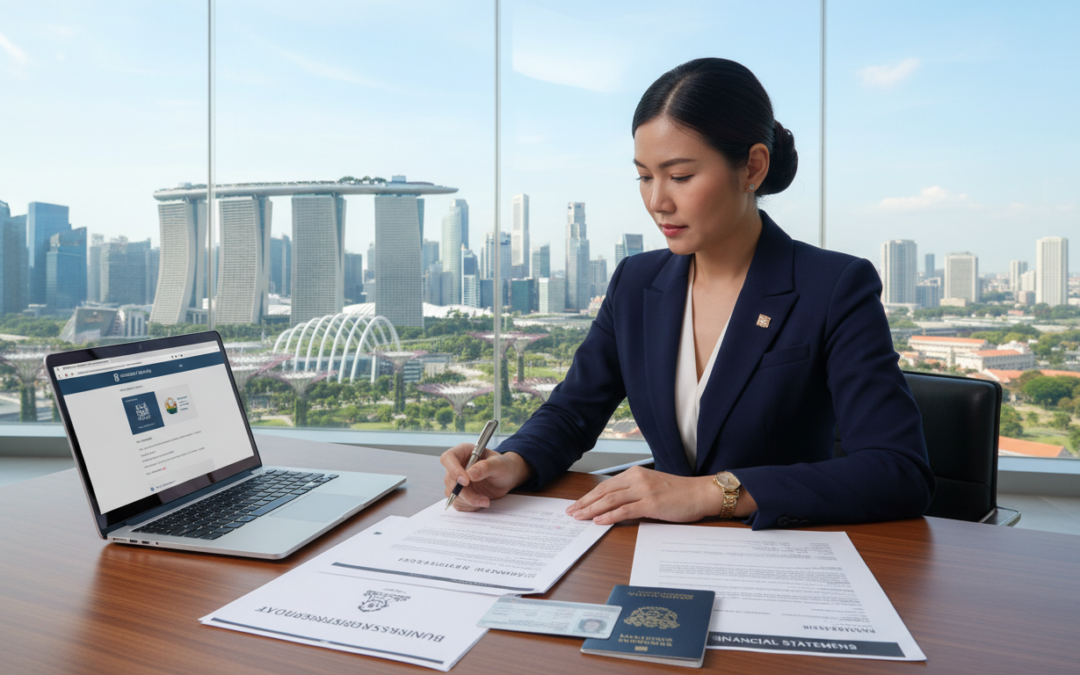
Curious: can one clear a strict MAS review and open a corporate account in days, or should founders expect weeks of checks?
This guide explains what “singapore business bank account requirements” means in practice today. It outlines MAS-driven due diligence, the typical documents banks and digital providers request, and how your company structure shapes the process.
Banks such as UOB describe the process as straightforward, yet all applications remain subject to MAS AML/KYC checks. Knowing what to prepare—ACRA/UEN proof, board resolution, ID and address proof, and proof of registered address—speeds approval.
Who this helps: founders local and overseas who want clear steps, realistic timeframes and tips to pick between legacy banks and digital providers. For a step‑by‑step walkthrough and document checklist, see our practical guide on how to open a business bank account in.
Key Takeaways
- MAS checks and certified documents are central to approval.
- Prepare ACRA/UEN, board resolution and ID proofs in advance.
- Processing times vary with ownership complexity and risk.
- Choose between traditional banks and digital providers based on needs.
- Practical preparation reduces delays and improves governance.
Why a business bank account matters in Singapore
Start early: opening a proper bank account as soon as money flows into your firm reduces reconciliation errors and creates a clean audit trail.
Keeping transactions separate makes accounting and tax filings simpler. It avoids mixed-purpose payments that complicate claims and audits. Clear records help substantiate deductions and cut time at year end.
Credibility for lenders and grants
A professional banking setup shows lenders and grant bodies that you manage cash responsibly. Regular, well-categorised activity strengthens loan applications and supports tax-related claims.
Day-to-day operations
Use a dedicated account to accept customer payments, pay suppliers and run payroll. Services such as GIRO, cards and online transfers streamline routine tasks and reduce manual work.
| Purpose | Benefit | Common features |
|---|---|---|
| Reconciliation | Cleaner bookkeeping; faster audits | Clear statements; transaction tagging |
| Credibility | Better chances for loans and grants | Regular activity; professional statements |
| Operations | Smoother customer and supplier payments | Payroll support; online transfers; cards |
Modern business banking tools also give visibility into cash flow. That visibility aids budgeting and forecasting as transaction volume grows day by day.
Who can open a bank account Singapore for business
Start by checking the basics: your company must be registered with ACRA and hold a valid UEN before most providers will accept an application.

ACRA registration and UEN: the baseline requirement
Proof of registration is non‑negotiable. Banks and digital providers request the ACRA extract or official profile to verify incorporation details and UEN.
Authorised roles: director, shareholder, or approved account signatory
Applications typically come from a director, a shareholder, or an authorised signatory. “Authorised” usually means a board resolution and a signing mandate that the bank can record.
Confirm signatory arrangements early so the right individuals can supply ID and attend any verification steps.
Foreign-owned companies: common constraints with traditional banks
Traditional banks often apply extra checks for foreign-owned firms. They may ask for a local director, in‑person verification, or further proof of activity and ownership.
Digital providers can ease remote opening for overseas founders, but they still follow MAS due diligence. Prepare clear company details, ownership structure and a concise summary of activities to speed the process.
- Have incorporation documents and ownership breakdown ready.
- Provide a plain description of what the company does and the markets it serves.
- Decide who will sign and verify identity before starting the opening.
Singapore business bank account requirements: what banks assess under MAS rules
Regulators expect banks to map a firm’s activities and cash flows before any facility is activated. That expectation drives a short but thorough review. Providers must gather clear, consistent information to satisfy AML/KYC standards.

Business profile and nature of operations
Understanding your business means describing what you sell, where customers are based and which markets you serve. Banks ask why you will use an account singapore and what services you need.
Directors and beneficial owners
Prepare ID, roles and ownership splits for each director and beneficial owner. Banks want to know who controls the company and who will operate the corporate bank account day to day.
Source of funds and expected activity
Explain initial capital origins, funding routes and typical transaction flows. Clear details on counterparties and countries of interaction speed review and cut follow-up questions.
Verification meetings
Some providers still require in-person checks to witness signatures and confirm identity. Expect follow-up queries as a normal part of the process; swift, accurate answers reduce delays.
For terms on identification and consent during opening, see the service terms.
Documents you’ll typically need for a corporate bank account in Singapore
A tidy document bundle speeds checks and cuts the number of follow‑up queries. Below is a compact checklist grouped by company, governance and individuals to guide your account opening.
Company documents
Core proofs: Certificate of Incorporation or an ACRA business profile to verify legal registration and UEN. Providers will accept equivalent registration records for overseas entities.
Also include recent statutory filings and the company’s business description to show intended use of the account.
Governance and mandates
Supply the Memorandum and Articles of Association in English and a board resolution that names authorised signatories.
Show signing limits and mandate structure so the corporate bank can record who may operate and sign for accounts.
Personal ID and address
Provide passport or NRIC copies for directors, beneficial owners and signatories. Add recent proof of residential address (utility bill or bank statement).
Documents must be legible, dated and consistent with company records to avoid extra checks.
Complex ownership
Multi‑layer holdings, overseas holding companies or trusts trigger deeper verification. Expect requests for shareholder charts, certified documents and explanations of control.
Keep names, addresses and identifiers consistent across all paperwork. Accuracy reduces rework and shortens the review process.
- Company: Certificate of Incorporation / ACRA profile, statutory filings
- Governance: MAA (English), board resolution, mandate
- Individuals: passport/NRIC, proof of address (recent)
How to open a business bank account in Singapore
You can choose a fully digital opening or a face‑to‑face visit; each route has distinct steps and timelines.

Submitting online versus visiting a branch
Online flows let you complete forms, upload PDFs and submit in minutes. Providers such as Sleek use a guided request path and require no branch visit. OCBC offers Singpass-enabled openings that can issue an instant account number after successful checks.
Branch routes often include an in‑person meeting to verify identity and witness signatures. UOB may arrange this step and will confirm approval once due diligence is complete.
Completing forms and verification
Match company names, UEN, addresses and signatory details exactly to your documents. Accurate entries prevent follow-up queries and shorten the review step.
Signing, approval and setup
When a meeting is required, officers verify ID, witness signatures and explain access and card options. After approval you receive account numbers, online access and onboarding instructions.
- Step 1: Choose online or branch.
- Step 2: Complete forms and upload documents.
- Step 3: Attend verification if requested; receive access and details on approval.
Timeframes and what can slow down your account opening
How long your application takes depends mostly on paperwork readiness and ownership complexity.
Typical processing times across providers
Digital providers often move fastest when documents are complete. Some report approvals in a few days.
Traditional banks commonly need more time. Expect up to two weeks for standard cases, and longer for complex structures.
Common delay triggers
Missing or expired documents are the top cause of hold‑ups. Mismatched names or addresses also prompt checks.
Unclear trade activity or high‑risk countries trigger extra scrutiny. Incomplete beneficial ownership details slow progress too.
What due diligence follow-ups look like
Banks may request source‑of‑fund evidence, invoices or contracts, and details of counterparties. They often ask for a short operations summary.
Foreign ownership and layered holdings require verification of control. This can add days or weeks while providers validate documents.
Practical steps to keep time low
- Prepare a concise business summary that explains revenue sources and transaction flows.
- Assemble a clean document pack: recent IDs, proofs of address, and certified company records.
- Reply promptly to queries; fast responses reduce overall processing time.
- For common structuring gaps that delay activation, see a short guide on structuring gaps and fixes.
| Provider type | Typical time | Common delay causes |
|---|---|---|
| Digital providers | 2–7 days | Missing scans; unclear business description |
| Traditional banks | 1–2 weeks (or longer) | Complex ownership; in‑person verification |
| Complex/foreign ownership | Several weeks | Layered entities; need for certified documents |
Choosing the right business banking provider for your company
Think of a banking partner as a toolkit: choose the set of services that fits how you trade and grow.
Initial minimum deposit and why ranges differ
Expect wide variation. Some providers ask for S$500–S$30,000 as an initial deposit. OCBC’s Business Growth Account, for example, lists S$1,000.
Minimum average monthly balance and ongoing fees
Many plans impose a minimum average monthly balance. Falling below it often triggers a monthly charge. A low nominal fee can become costly if cash cycles are uneven.
Digital tools, integrations and cash flow insights
Choose providers with dashboards that show inflows and outflows, multi‑account visibility and Xero or ERP integrations. These tools turn daily data into usable cash flow insights.
“Features and fees matter more than brand when you scale.”
Traditional vs digital for overseas founders
Traditional banks may need in‑person verification or a local rep. Digital providers often allow online opening from overseas, subject to AML/KYC checks.
- Map needs to features: transactions, currencies, cards, approvals, integrations.
- Compare true cost: monthly fees, fall‑below charges, transfer costs and FX margins.
- Plan for growth: pick providers and workflows that scale with customers and staff.
For a related practical setup—consider local serviced office options when planning access and presence: serviced office options.
Conclusion
Treat opening a corporate facility as a short project: plan, gather documents and respond quickly to compliance queries.
Key takeaway: MAS-aligned AML/KYC checks drive every successful bank account outcome. Be ready with clear company information, ACRA/UEN proof, ID for directors and signatories, and a simple note on source of funds.
Choose your provider by weighing digital access versus traditional support. Match services to how your company trades and grows, and keep accounting and tax records tidy to strengthen credibility with customers and partners.
Next step: pick a digital-first or branch route, follow the step-by-step process and reply fast to follow-up questions to reduce turnaround on account opening.
FAQ
What is the baseline legal step to open a corporate bank account in Singapore?
Who is authorised to apply for an account on behalf of the company?
What commercial information do banks assess when reviewing an application?
Which personal documents are usually required from directors and beneficial owners?
Which company documents must I prepare for submission?
How do complex ownership structures affect the process?
Can I apply online or must I visit a branch in person?
What are the typical processing times for opening a corporate account?
What common issues cause delays during due diligence?
How much is usually required as an initial deposit or minimum balance?
What fees and ongoing charges should I expect?
Are there specialised banking tools that help manage cash flow?
How do banks verify source of funds and expected activity?
Do foreign-owned firms face additional constraints when opening an account?
What steps ensure a smooth application and faster approval?
How long will I wait to receive account details after approval?

Dean Cheong is a Singapore-based B2B growth strategist and the CEO of VOffice. He helps companies scale revenue through sharper sales execution, CRM implementation, and go-to-market strategy, backed by a strong foundation in business banking and finance from Nanyang Technological University and a track record of driving sustainable, performance-led growth.