
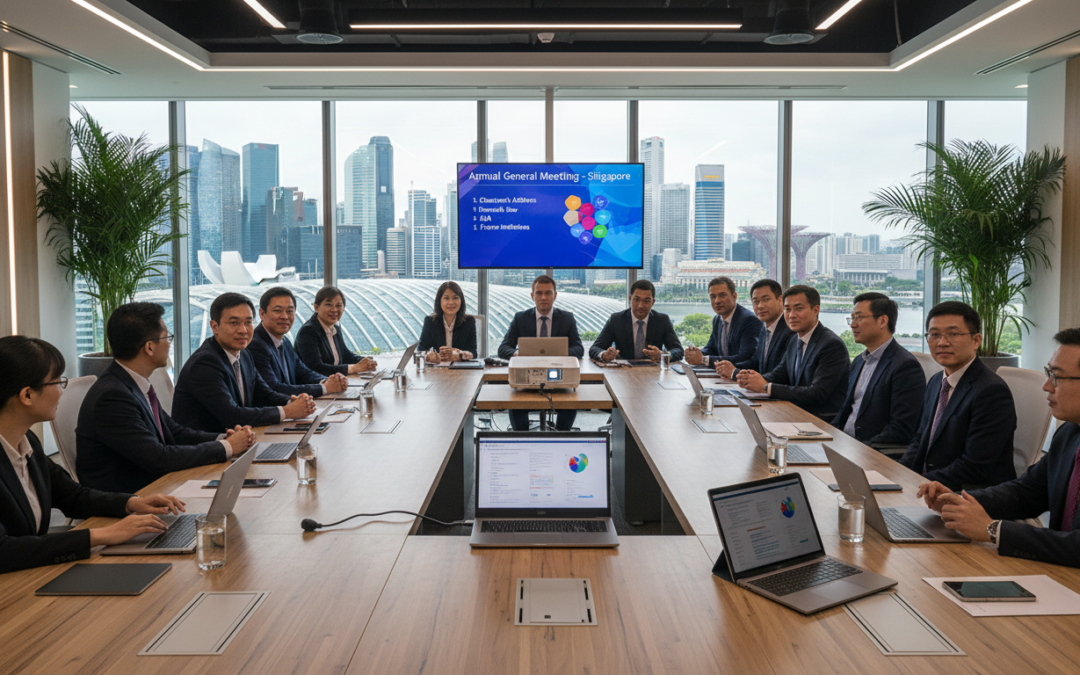
Could a statutory change rewrite how companies hold their key yearly gatherings?
The Companies, Business Trusts and Other Bodies (Miscellaneous Amendments) Act took effect on 1 July 2023. It amended the Companies Act 1967 to allow technology-enabled formats. This guide explains the baseline expectations and practical steps for a compliant meeting.
We define what hybrid and fully online formats meant after the change. The guide helps private limited and public companies in Singapore decide whether a physical, hybrid or fully digital option suits their governance and operational needs.
This is a practical how‑to focused on the Companies Act baseline. It highlights where listed issuers must also follow Singapore Exchange regulations and related legislation.
Compliance choices should protect shareholder rights and boost transparency. Later sections cover notices, voting, identity checks and contingency planning so boards can preserve trust and good governance.
Key Takeaways
- Statutory changes from 1 July 2023 permit technology-enabled general meetings under the Companies Act.
- Decisions affect both private and public companies incorporated in Singapore.
- Follow Companies Act requirements and, if listed, additional exchange obligations.
- Prioritise shareholder rights, robust identity verification and contingency plans.
- Practical steps include reviewing the constitution, sending valid notices and enabling voting and questions.
Why virtual and hybrid AGMs matter in Singapore now
The pandemic forced rapid change in how corporate gatherings operate. Emergency orders from April 2020 allowed remote attendance when in‑person access was limited.

From temporary fixes to a permanent framework
Initially, temporary orders kept business running during lockdown. Those stop-gap measures applied in 2020 and 2021 to help companies comply with public health limits.
On 1 July 2023 the Companies Act amendments established a lasting statutory framework. The law now permits hybrid and fully virtual formats and supports clearer digital procedures.
Practical changes and benefits
The Amendment Act enabled remote general participation, strengthened proxy submission channels, and clarified online attendance at board level.
For companies, the changes cut venue costs, eased coordination across time zones and improved resilience when travel or disruption occurs.
For shareholders, the options can widen access, boost engagement when well run, and improve governance and transparency through reliable voting and clearer speaking protocols.
Balancing access with interaction
Early remote gatherings sometimes reduced live interaction. That led regulators and market practice to focus on better information flow, live engagement and robust voting mechanisms.
virtual meetings agm singapore rules under the Companies Act
A clear statutory baseline now governs how companies choose a meeting structure.
On 1 July 2023 the Companies Act amendments came into force and created default permission for eligible company meetings to use technology.
Who is covered and how the constitution fits in
The framework applies to companies incorporated locally. It operates automatically unless a company’s constitution limits the option.
Available formats: a simple selector
Physical meetings remain valid where a venue is used. Hybrid formats combine a physical place with online participation. Fully virtual gatherings rely solely on technology.

Legal caveat and governance considerations
Fully virtual gatherings may be excluded by an order published in the Gazette, so companies needed to verify the latest position when planning their format.
- Choice of format affects quorum counts, shareholder communications and voting mechanics.
- Boards should treat format selection as a governance decision, not just an operational option.
- Listed issuers must also follow SGX RegCo guidance and related regulations.
| Format | Venue | Typical effect on quorum |
|---|---|---|
| Physical | Single designated venue | Traditional counting applies |
| Hybrid | Venue + online access | Includes remote participants where permitted |
| Fully virtual | No physical place | Depends on technology and Gazette status |
Which company meetings can be held virtually or in a hybrid format
A company’s choice of format must reflect the meeting’s purpose, the members involved and the need to preserve voting integrity.
Annual general and extraordinary general gatherings fall squarely within the permitted scope. These allow routine approvals and urgent corporate action to proceed without requiring every person to be physically present.
Statutory meetings and meetings of a class of members also qualify. These sessions often involve defined groups and benefit where shareholders are geographically dispersed.

Court-ordered and amalgamation meetings
Under section 182 and section 210, the Court may order a meeting and direct its format. Where the Court so directs, the format may be partially or fully technology-enabled.
General meetings for amalgamation approvals are high-stakes votes. Clear document access, robust question procedures and properly recorded resolutions are essential for these matters.
- AGMs/EGMs — routine approvals and ad‑hoc corporate decisions
- Statutory/class meetings — defined member groups, dispersed shareholders
- Court-ordered (s182/s210) — format as directed by the Court
- Amalgamation approvals — critical votes needing full transparency
| Meeting type | Typical use-case | Format permitted | Key compliance point |
|---|---|---|---|
| Annual general | Financial statements, director elections | Hybrid or fully remote | Ensure voting and Q&A channels |
| Extraordinary general | Urgent corporate resolutions | Hybrid or fully remote | Timely notices and proxies |
| Class/statutory meetings | Group-specific rights and approvals | Hybrid or fully remote | Member verification and records |
| Court-ordered / amalgamation | Court directions or merger approvals | As directed by the Court or constitution | Document access and precise recording |
Check if your company must hold an AGM and the key deadlines
First, establish whether your entity must assemble shareholders under statutory timelines following the financial year end.
Listed vs non-listed timelines after year-end
Listed companies normally had to hold annual general gatherings within four months of the financial year end.
Non-listed companies had up to six months to convene their annual general meeting.
What typically happens at an annual general meeting
Directors present the financial statements and reports for the year. Shareholders get the chance to ask questions on performance and operations.
Votes on director elections, dividends and auditor appointments follow with formal recording of resolutions.
Private company exemption and safeguards
Since August 2018 qualifying private companies could avoid a formal annual general meeting by sending financial statements to members within five months after year‑end.
Safeguards preserved accountability: a member could demand an annual general by notice no later than 14 days before the end of the sixth month, obliging directors to call the meeting within six months.
Additionally, if a member or the auditor requested a meeting within 14 days after statements were sent, the company had to hold one despite relying on the exemption.
Compliance note: Directors should document decisions, keep members informed and retain records that demonstrate accountability to shareholders.
| Entity type | Deadline after year-end | Exemption trigger |
|---|---|---|
| Listed company | 4 months | None — must hold annual general |
| Non-listed company | 6 months | None — must hold annual general |
| Private company (exemption) | Send accounts within 5 months | Members/auditor can require meeting (14‑day windows) |
For practical guidance on meeting formats and statutory changes, see the note that allows companies and trusts to adopt technology-enabled annual gatherings: allow companies and trusts to adopt virtual annual.
Confirm your constitution position and board decisions before choosing the meeting format
Before selecting a format, directors should check whether the constitution permits participation by technology. That simple step sets the legal baseline for any plan.

When no constitution amendment is required
In most cases, companies incorporated before 1 July 2023 did not need to change the constitution to run partially or fully virtual hybrid meetings. The statutory framework operated as the default.
How a constitution can exclude the framework
A constitution can be amended on or after 1 July 2023 to exclude the new framework. Where that occurs, the company must follow the document’s limits instead of the statutory default.
Board and committee attendance
The amendments also clarified that virtual attendance at board or committee sessions is not prohibited, subject to the constitution. This supports continuity of governance and prompt decisions.
- Confirm whether the constitution has an exclusion clause.
- Note incorporation timing — new entities may opt out at formation.
- Record the board’s choice of format, technology and contingency steps for future compliance.
Keep minutes and written approvals so the company can show it acted in good faith and met basic compliance expectations.
How to send compliant notice and meeting information to shareholders
Clear, timely notice protects shareholder rights and underpins lawful decision-making. Use the notice as both a legal step and a fairness mechanism so all shareholders receive core meeting information in good time.
What the notice must include
Every communication should state the date, time and place. If access will be by technology, explain how access details will be provided. Attach the full agenda and mark any special resolutions clearly.
Also explain proxy appointment rights and how to submit a proxy. Add technical joining instructions, Q&A submission routes and voting methods so shareholders can participate without friction.
Notice periods and delivery methods
Plan backwards from the meeting date. Ordinary resolutions need at least 14 days’ notice. Special resolutions require at least 21 days.
| Resolution type | Minimum notice | Action |
|---|---|---|
| Ordinary | 14 days | Circulate agenda and proxy form |
| Special | 21 days | Highlight and explain effects |
Electronic notices in practice
- Use email and company website publication as recognised routes.
- Fax and other electronic channels were also permitted under the amendments.
- For listed issuers, exceed minimum standards: clarity, accessibility and fuller information reduce dispute risk.
Run the meeting: attendance, quorum, questions, documents and voting
Runbooks that set clear steps for the chair and secretary keep meetings orderly and defensible. Follow a short checklist to open the meeting, verify access, and record attendance across physical and online channels.
Practical runbook for the chair and company secretary
- Open the meeting, announce format and confirm quorum count in real time.
- Verify each person’s identity using the prescribed methods and log access times.
- Explain question and speaking procedures and the proxy voting process.
- Run votes, confirm outcomes and announce results before closing the meeting.
Quorum and attendance handling
A person joining by electronic means counts towards quorum under the default framework. Keep an audit trail showing who joined and when.
Update the attendance list live and ensure an independent record is available after the meeting.
Questions, speaking rights and communication
Members must be able to ask questions and speak on a resolution using synchronous communication channels chosen by directors.
Allow brief live interventions and a moderated Q&A queue so the flow remains orderly.
Proxy and voting workflows
Accept proxy instruments by the electronic methods set out in the notice. Record proxy appointments and reflect them in electronic totals.
Use electronic voting as the primary option. Show-of-hands is permitted only when identity verification controls are in place.
Documents, auditor’s report and inspection
Read key auditor comments via synchronous communication if required. Provide registers, statements and inspection documents on a website or by the method approved by ordinary resolution.
Contingency and listed-issuer expectations
Technical disruption does not automatically void a meeting, but plan contingencies. For listed issuers, adopt real-time electronic communication, live voting and consider pre-meeting information sessions for complex issues.
Conclusion
Companies can design modern attendance processes that preserve voting integrity and shareholder access.
Practical takeaway: since 1 July 2023 firms gained a clearer statutory route to run agms and other general gatherings while protecting member rights.
Follow a simple sequence: confirm statutory deadlines, check your constitution, issue a clear notice, and run robust attendance, Q&A, voting and document controls.
Treat format design as a governance choice, not only a technology buy. Good execution shapes confidence and sound decisions and creates an opportunity to improve engagement and transparency.
For complex items or listed issuers, consider external company secretarial, legal and platform services and consult SGX guidance: practical note on general gatherings.
FAQ
What is the scope of the post‑2023 statutory framework for general meetings?
When did the new meeting options take effect and who must comply?
Which types of meetings can be held electronically or in a hybrid format?
Does a company need to amend its constitution to hold an electronic or hybrid general meeting?
How should companies notify members about an electronic or hybrid meeting?
What are the notice periods for ordinary and special resolutions?
How is quorum counted where participants join remotely?
How can shareholders ask questions and be heard during an electronic meeting?
What voting methods are permitted for meetings held electronically or in hybrid form?
Can private companies still be exempt from holding AGMs?
What documents must be made available at an electronic general meeting?
How can a company ensure secure and reliable electronic participation and voting?
Are there circumstances where fully electronic meetings may be prohibited?
What steps should a board take before deciding on the meeting format?
How should companies handle proxies and electronic proxy instructions?
What are best practice steps to support shareholder engagement before an electronic meeting?

Dean Cheong is a Singapore-based B2B growth strategist and the CEO of VOffice. He helps companies scale revenue through sharper sales execution, CRM implementation, and go-to-market strategy, backed by a strong foundation in business banking and finance from Nanyang Technological University and a track record of driving sustainable, performance-led growth.