

Could missing one simple turnover check cost your business thousands in penalties?
This practical how-to guide explains what triggers GST registration and how to act fast when the S$1 million turnover mark is met. We focus on clear, compliance-first steps so decision-makers can move with confidence.
You will learn how taxable turnover is measured, the two ways liability is assessed — past performance and expected future receipts — and why timing matters for meeting deadlines.
The process is manageable when you track turnover regularly and keep precise records. This guide shows how to calculate taxable sales, spot trigger events early, meet filing timelines and complete the online application without jargon.
Key Takeaways
- Understand the S$1 million measure and how it affects your business.
- Learn the two liability tests and when each applies.
- Track turnover consistently to avoid late fees or penalties.
- Prepare documentation so the online application is smooth.
- Act quickly once a trigger event is identified to stay compliant.
Understanding GST in Singapore and why registration matters
A clear view of what counts as taxable turnover is the foundation of timely compliance and accurate reporting.
The consumption tax is a broad-based levy on most local sales of goods and services. Businesses that sell locally must charge the tax on standard-rated supplies and report it separately from income tax.
Supply categories and how they differ
Supplies fall into four operational groups. Knowing which group applies determines whether you charge the tax and whether the sale adds to your taxable turnover.
| Supply type | Treatment | Effect on input recovery |
|---|---|---|
| Standard-rated | Tax charged on local sales of goods and services | Full input tax claim possible |
| Zero-rated | No tax charged (exports and certain international services) | Input tax claim possible |
| Exempt | No tax charged (financial, some leases) | Input tax recovery restricted |
| Out-of-scope | Outside the system entirely | No input tax claim |
Compliance, input tax and the registration number
Registration enables correct charging, systematic reporting and the right to reclaim eligible input tax on business purchases.
“Classifying supplies correctly protects both your pricing and your ability to recover costs.”
The identifying number issued on approval (commonly the business UEN) appears on invoices, credit notes, contracts and during onboarding with other registered customers.
singapore gst registration threshold and how to calculate taxable turnover
A clear method for totalling taxable sales helps businesses spot when compulsory enrolment becomes unavoidable.
The S$1 million taxable turnover rule and who it applies to
Mandatory registration arises when a person’s annual taxable turnover exceeds S$1 million. “Person” covers an individual, company, partnership, association or trust that makes taxable supplies in the country.

What counts as taxable supplies when measuring turnover
To calculate turnover, add the value of standard-rated and zero-rated taxable supplies over the relevant test period. Use sales invoices and ledgers so figures are auditable.
What to exclude from the calculation
Exclude exempt supplies and out-of-scope supplies. These do not form part of taxable supplies and would otherwise overstate the turnover used for the test.
Using a calendar year and tracking turnover across accounting periods
The value of taxable supplies is computed on a calendar year basis for the registration test. Even if a company uses a different accounting period, reconcile your sales to the calendar year to check liability.
Set up internal reports that map sales lines to GST categories. Misclassifying zero-rated or standard supplies can change whether gst registration is required, so reconcile regularly to reduce risk.
When your liability to register arises and key timing triggers
Liability to enrol can start from past sales or from reasonable expectations about future income.

Retrospective view — past 12 months and the calendar year test
One route to liability is retrospective. If taxable turnover in a calendar year exceeded S$1 million, the business must register.
Track sales by category so the calendar year total is auditable. Even uneven growth can still trigger a compulsory registration date.
Prospective view — expecting to exceed the threshold
Liability also arises when there are reasonable grounds to believe taxable supplies in the next 12 months will exceed S$1 million.
Reasonable grounds include documented forecasts, signed contracts or firm quotations and up-to-date management accounts.
Common real-world triggers and why the exact date matters
- Contract signed that locks in taxable supplies — the date of signing starts the clock.
- Quotation accepted by a customer — when acceptance is firm, it can create reasonable grounds.
- Rapid increase in orders or a new product line that materially raises expected turnover.
Practical tip: Keep dated evidence—forecasts, pipelines and agreements—to show why you believed future value would exceed S$1 million. This helps when you must register for GST or to explain timing to the tax authority.
| Trigger | Evidence | Action required |
|---|---|---|
| Past calendar year turnover > S$1M | Audited sales ledger | Apply and set effective date |
| Signed contract for future taxable supplies | Fully executed agreement | Prepare to register from contract date |
| Accepted quotation or surge in orders | Dated acceptance, sales reports | Document forecasts and monitor monthly |
GST registration deadlines and effective registration dates
Timely filings set the effective date when GST starts applying to your invoices.
Apply within 30 days once liability arises. You must submit the gst registration application within 30 days of the date liability starts. Missing this window can increase exposure to gst due and penalties.
Retrospective annual deadline
If taxable turnover in a calendar year exceeds the limit, file by 30 January of the next year. The effective date for most retrospective cases is 1 March. Diarise this annual cycle so your finance team reconciles sales and acts on time.
Prospective examples and “next months” assessment
Prospective liability is forward‑looking over the next 12 months and must be supported by evidence, not guesswork.
- Contract signed 1 July → apply by 31 July; effective date 1 August.
- Quotation accepted 2 September → apply by 2 October; effective date 3 October.
- Growth projection triggers on 14 February → apply by 14 February; effective date 15 February.
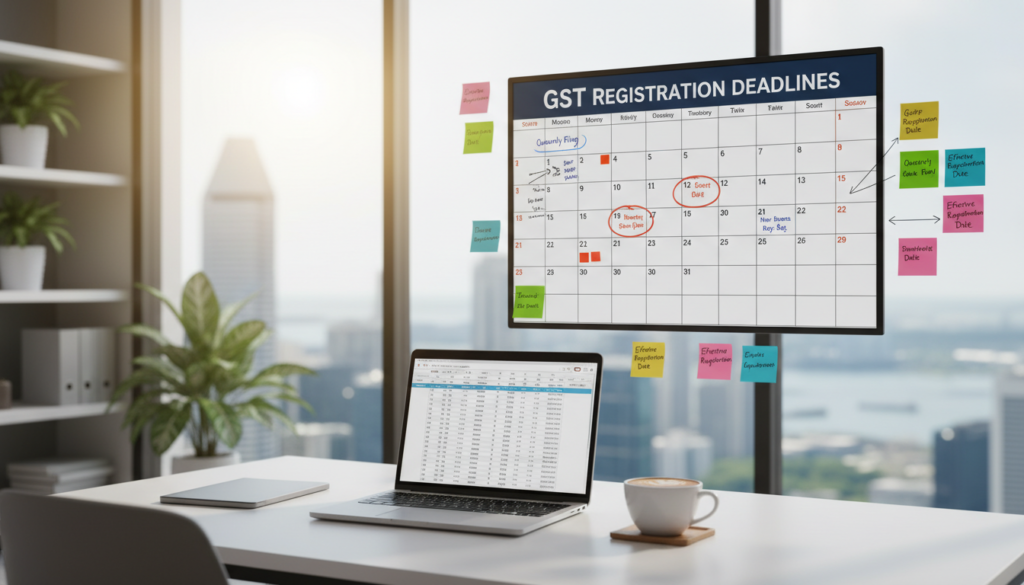
| Trigger | Deadline | Effective date |
|---|---|---|
| Past calendar year exceedance | 30 January | 1 March |
| Contract or firm order | 30 days from trigger | Next day or start of following month |
| Forecasted growth | 30 days from established date | Following day |
Effective dates matter for pricing, invoicing and which period transactions fall into. Act promptly to limit back‑dated tax liabilities and align internal reporting period controls.
How to register GST with IRAS step by step
Begin by collecting clear, dated proof of sales and contracts so the submission stands up to a review.

Preparing details and supporting documents
Before you start, compile a short checklist of essentials. This saves time and reduces follow‑ups.
- Entity details: UEN, business name, contact persons and authorised signatories.
- Turnover evidence: financial statements, sales summaries and workings showing taxable supplies.
- Supporting documents: contracts, accepted quotations and bank details for payment set‑up.
Submitting the application via myTax Portal
Apply online using the IRAS myTax Portal with SingPass or CorpPass. Ensure the person filing has the correct access level.
Complete the electronic form, attach the documents listed above and double‑check contact and effective dates before sending.
After submission: review, approval and receiving your number
IRAS will review the file and may request clarifications. Respond quickly to any queries to speed approval.
“Each registered person is issued an identifying number that is used as the registration number.”
Once approved, you receive the registration number and onboarding instructions. Update customer master data and supplier records immediately.
System set‑up checklist and ongoing compliance
- Configure invoices to display the correct rate and the registration number.
- Update price lists, quotations and customer communications to show tax-inclusive or exclusive pricing as relevant.
- Align accounting flows so returns can be prepared quarterly and records are retained for at least five years.
Voluntary registration and when it makes sense for your business
Voluntary registration is a strategic option for businesses that remain below the S$1 million test but see clear commercial benefits.
Why some businesses choose voluntary registration
Voluntary registration lets a company claim input tax on eligible purchases. This can improve margins where most sales are taxable rather than exempt.
In B2B markets, being registered can speed onboarding and match procurement expectations. It also signals financial maturity to larger customers.
Obligations and operational impact
Once you register, you must meet ongoing compliance duties: file periodic returns, keep accurate records and apply GST consistently across each period.
“Voluntary registration should be treated like mandatory enrolment—systems, controls and documentation must be in place from day one.”
| Benefit | What it means | Operational note |
|---|---|---|
| Claim input tax | Recover GST on qualifying purchases | Requires valid tax invoices and correct apportionment |
| Commercial credibility | Easier deals with registered buyers | Update quotes and invoices to show tax treatment |
| Ongoing duties | Returns, records, compliance | Need accounting maturity and monthly/quarterly controls |
Decide by weighing likely input recovery against the cost of compliance. If your input profile supports a claim gst strategy and your systems can handle returns, voluntary registration may pay off.
Penalties and common mistakes that lead to late or incorrect GST registration
Missing the deadline can turn a bookkeeping oversight into a significant cash liability.
Failure to register on time can leave a business legally liable for the gst due from the date liability began. Even if you did not charge customers, you may still owe the tax, which cuts directly into margin.
What penalties and sanctions apply
Consequences include a 10% penalty on the gst due from the effective date. Authorities may also impose late payment penalties (for example about 5% at their discretion), fines up to S$10,000 and, in serious cases, prosecution and imprisonment.
Frequent mistakes that trigger action
- Miscalculating taxable supplies or misclassifying sales and zero-rated items.
- Missing the 30‑day window or misunderstanding the effective date for liability.
- Poor record-keeping that prevents clear proof of turnover and dates.
- Issuing invoices showing GST while not yet registered — a high‑risk offence.
Prevention and early correction
Implement monthly turnover dashboards, written threshold workings and a compliance calendar tied to each period. If you suspect an error, quantify exposure quickly and regularise registration and returns to reduce further penalties and interest.
“Act fast: early correction can limit additional charges and shows good faith in compliance.”
Conclusion
Close with a few practical rules that make decisions about GST simple and defensible.
Start by mapping supply types and measuring taxable sales against the S$1 million test. Then decide whether liability is retrospective or prospective and act within the required timelines.
Collect evidence early, such as contracts, sales reports and forecasts. Good documentation makes it straightforward to register gst or to explain your position to the inland revenue authority.
Once approved, use the gst registration number consistently on invoices and customer documents. Treat GST as an operational issue—pricing, contracts, accounting periods and records must align.
Keep classifications of goods, services and supplies disciplined each period. A structured approach lowers risk and keeps your company audit‑ready as volumes and complexity rise.
FAQ
What does GST cover for goods and services and why does registration matter?
What are standard-rated, zero-rated, exempt and out-of-scope supplies?
How does registering support input tax claims?
What is a registration number and where is it used?
Who must register when the S
What does GST cover for goods and services and why does registration matter?
Goods and services tax applies to most taxable supplies of goods and services made by businesses. Registration matters because once a business meets the compulsory registration conditions it must charge tax on taxable supplies, file returns and may claim input tax on purchases. Registering also helps with commercial credibility and ensures compliance with the Inland Revenue Authority of Singapore.What are standard-rated, zero-rated, exempt and out-of-scope supplies?Standard-rated supplies are taxed at the prevailing rate and must carry tax on invoices. Zero-rated supplies are taxable but charged at 0%, allowing the business to claim input tax. Exempt supplies are not taxable and do not permit input tax recovery. Out-of-scope transactions fall entirely outside the tax system, such as supplies made outside the jurisdiction. Correctly classifying supplies affects tax due and input tax claims.How does registering support input tax claims?When registered, a business may claim input tax on taxable purchases used to make taxable supplies, subject to documentation and apportionment rules. Proper invoices, accounting records and timely returns are required to substantiate claims to the revenue authority.What is a registration number and where is it used?The registration number is a unique identifier issued by the Inland Revenue Authority when a business is registered for tax. It must appear on tax invoices, returns and correspondence. Customers and suppliers use it to verify the business’s tax status and to support input tax recovery.Who must register when the S
FAQ
What does GST cover for goods and services and why does registration matter?
Goods and services tax applies to most taxable supplies of goods and services made by businesses. Registration matters because once a business meets the compulsory registration conditions it must charge tax on taxable supplies, file returns and may claim input tax on purchases. Registering also helps with commercial credibility and ensures compliance with the Inland Revenue Authority of Singapore.
What are standard-rated, zero-rated, exempt and out-of-scope supplies?
Standard-rated supplies are taxed at the prevailing rate and must carry tax on invoices. Zero-rated supplies are taxable but charged at 0%, allowing the business to claim input tax. Exempt supplies are not taxable and do not permit input tax recovery. Out-of-scope transactions fall entirely outside the tax system, such as supplies made outside the jurisdiction. Correctly classifying supplies affects tax due and input tax claims.
How does registering support input tax claims?
When registered, a business may claim input tax on taxable purchases used to make taxable supplies, subject to documentation and apportionment rules. Proper invoices, accounting records and timely returns are required to substantiate claims to the revenue authority.
What is a registration number and where is it used?
The registration number is a unique identifier issued by the Inland Revenue Authority when a business is registered for tax. It must appear on tax invoices, returns and correspondence. Customers and suppliers use it to verify the business’s tax status and to support input tax recovery.
Who must register when the S
FAQ
What does GST cover for goods and services and why does registration matter?
Goods and services tax applies to most taxable supplies of goods and services made by businesses. Registration matters because once a business meets the compulsory registration conditions it must charge tax on taxable supplies, file returns and may claim input tax on purchases. Registering also helps with commercial credibility and ensures compliance with the Inland Revenue Authority of Singapore.
What are standard-rated, zero-rated, exempt and out-of-scope supplies?
Standard-rated supplies are taxed at the prevailing rate and must carry tax on invoices. Zero-rated supplies are taxable but charged at 0%, allowing the business to claim input tax. Exempt supplies are not taxable and do not permit input tax recovery. Out-of-scope transactions fall entirely outside the tax system, such as supplies made outside the jurisdiction. Correctly classifying supplies affects tax due and input tax claims.
How does registering support input tax claims?
When registered, a business may claim input tax on taxable purchases used to make taxable supplies, subject to documentation and apportionment rules. Proper invoices, accounting records and timely returns are required to substantiate claims to the revenue authority.
What is a registration number and where is it used?
The registration number is a unique identifier issued by the Inland Revenue Authority when a business is registered for tax. It must appear on tax invoices, returns and correspondence. Customers and suppliers use it to verify the business’s tax status and to support input tax recovery.
Who must register when the S$1 million turnover rule applies?
Businesses must register if their taxable turnover exceeds S$1 million in the past 12 months or is expected to exceed that amount in the next 12 months. The rule applies to sole traders, partnerships and companies making taxable supplies of goods or services in the jurisdiction.
What counts as taxable supplies when measuring turnover?
Taxable supplies include standard-rated and zero-rated sales of goods and services made in the course of business. They exclude exempt and out-of-scope supplies. When measuring turnover, use the value of taxable supplies before tax and after discounts, following guidance from the revenue authority.
What should be excluded from the turnover calculation?
Exclude exempt supplies, out-of-scope transactions, capital items not supplied in the course of business and non-taxable government grants where specified. Make sure to remove sales taxes and contributions not regarded as part of taxable turnover under local rules.
How do I track turnover across accounting periods and use a calendar year?
Track taxable receipts by accounting period and aggregate them for the past 12 months or project them for the next 12 months. Some businesses find it easiest to monitor on a rolling monthly basis or to use a calendar year as a checkpoint to identify if the registration liability has been met.
When does the liability to register arise retrospectively?
A retrospective liability arises if taxable turnover in the past 12 months already exceeded the threshold. In such cases, you must apply within the statutory deadline and the effective date of registration will be backdated to when the liability began, as determined by the Inland Revenue Authority.
When does a prospective view trigger registration?
A prospective view triggers registration if you reasonably expect taxable turnover to exceed the threshold in the next 12 months. Reasonable expectation may be supported by contracts, accepted quotations or clear sales forecasts that show imminent growth beyond the limit.
What real-world events can trigger a prospective liability?
Examples include signed contracts, long-term purchase orders, accepted quotations that commit capacity and rapid, sustained increases in sales. These events strengthen the case that turnover will exceed the threshold and create an obligation to register.
What are the deadlines for applying once the liability arises?
You must apply within 30 days from the date your liability to register arises. Missing this deadline can lead to retrospective assessment, claims for unpaid tax and potential penalties. Always note the specific dates used by the revenue authority when calculating the 30‑day window.
How does the retrospective deadline and the 30 January rule work?
If you became liable during the previous year but did not register, there is typically a retrospective application mechanism with a deadline such as 30 January for an effective date of 1 March. Check the current procedural guidance from the Inland Revenue Authority to confirm exact dates and conditions.
How is the “next months” window assessed for prospective registration?
The authority examines your expected turnover over the following 12 months. They will consider the timing of contracts, billing schedules and industry seasonality. Use conservative, evidence-backed projections to support your application and be ready to explain assumptions.
What documents and evidence should I prepare before applying?
Prepare company or business registration details, accounting records, bank statements, sales ledgers, contracts, invoices and forecasts showing turnover projections. Evidence demonstrating past receipts and future commitments will support either retrospective or prospective registration.
How do I submit an application via the myTax Portal?
Submit the application online using a secure login such as SingPass or CorpPass. Complete the required forms, attach supporting documents and declare the effective date of registration. The portal guides applicants through each step and confirms receipt.
What happens after submission and how long until I receive the registration number?
The authority processes applications and may request clarifications. Processing times vary; once approved you will receive a registration number and onboarding instructions. Expect to update billing systems and inform customers promptly.
What system changes are needed after registration?
Update accounting systems to charge the correct tax rate, issue compliant tax invoices showing the registration number, and adjust pricing if necessary. Train staff on tax-inclusive or tax-exclusive pricing and set up procedures for filing periodic returns and keeping records.
When should a business consider voluntary registration?
Businesses below the compulsory threshold may opt to register voluntarily to claim input tax on purchases, improve credibility with clients and streamline cross-border trade. Voluntary registration is beneficial when input tax recovery outweighs compliance costs.
What ongoing obligations follow voluntary registration?
Voluntarily registered businesses must file returns on time, maintain records, charge tax on taxable supplies and meet the same compliance requirements as compulsory registrants. Failure to comply can result in penalties and loss of input tax claims.
What are the penalties for late or incorrect registration?
Penalties can include payment of tax that should have been collected, interest on unpaid amounts and additional penalties such as a percentage surcharge. In serious cases, fines and prosecution may apply. The Inland Revenue Authority publishes detailed penalty regimes.
What common mistakes lead to late or incorrect registration?
Mistakes include miscalculating taxable turnover, failing to monitor rapid growth, missing filing deadlines and keeping poor records. These errors can cause under‑registration, retrospective liabilities and costly corrections.
What are special risk areas to watch for?
Risk areas include issuing invoices showing tax while not yet registered, incorrectly classifying supplies, failing to apportion input tax for mixed-use items and improper documentation. Regular reviews of invoicing and record-keeping reduce exposure.
Can I charge tax before I receive my registration number?
You should not charge tax until your registration is effective. Charging tax while unregistered can create liabilities and breaches. If your registration is backdated, you may need to account for tax on past supplies; seek guidance from the authority or a tax adviser.
million turnover rule applies?
Businesses must register if their taxable turnover exceeds S
FAQ
What does GST cover for goods and services and why does registration matter?
Goods and services tax applies to most taxable supplies of goods and services made by businesses. Registration matters because once a business meets the compulsory registration conditions it must charge tax on taxable supplies, file returns and may claim input tax on purchases. Registering also helps with commercial credibility and ensures compliance with the Inland Revenue Authority of Singapore.
What are standard-rated, zero-rated, exempt and out-of-scope supplies?
Standard-rated supplies are taxed at the prevailing rate and must carry tax on invoices. Zero-rated supplies are taxable but charged at 0%, allowing the business to claim input tax. Exempt supplies are not taxable and do not permit input tax recovery. Out-of-scope transactions fall entirely outside the tax system, such as supplies made outside the jurisdiction. Correctly classifying supplies affects tax due and input tax claims.
How does registering support input tax claims?
When registered, a business may claim input tax on taxable purchases used to make taxable supplies, subject to documentation and apportionment rules. Proper invoices, accounting records and timely returns are required to substantiate claims to the revenue authority.
What is a registration number and where is it used?
The registration number is a unique identifier issued by the Inland Revenue Authority when a business is registered for tax. It must appear on tax invoices, returns and correspondence. Customers and suppliers use it to verify the business’s tax status and to support input tax recovery.
Who must register when the S$1 million turnover rule applies?
Businesses must register if their taxable turnover exceeds S$1 million in the past 12 months or is expected to exceed that amount in the next 12 months. The rule applies to sole traders, partnerships and companies making taxable supplies of goods or services in the jurisdiction.
What counts as taxable supplies when measuring turnover?
Taxable supplies include standard-rated and zero-rated sales of goods and services made in the course of business. They exclude exempt and out-of-scope supplies. When measuring turnover, use the value of taxable supplies before tax and after discounts, following guidance from the revenue authority.
What should be excluded from the turnover calculation?
Exclude exempt supplies, out-of-scope transactions, capital items not supplied in the course of business and non-taxable government grants where specified. Make sure to remove sales taxes and contributions not regarded as part of taxable turnover under local rules.
How do I track turnover across accounting periods and use a calendar year?
Track taxable receipts by accounting period and aggregate them for the past 12 months or project them for the next 12 months. Some businesses find it easiest to monitor on a rolling monthly basis or to use a calendar year as a checkpoint to identify if the registration liability has been met.
When does the liability to register arise retrospectively?
A retrospective liability arises if taxable turnover in the past 12 months already exceeded the threshold. In such cases, you must apply within the statutory deadline and the effective date of registration will be backdated to when the liability began, as determined by the Inland Revenue Authority.
When does a prospective view trigger registration?
A prospective view triggers registration if you reasonably expect taxable turnover to exceed the threshold in the next 12 months. Reasonable expectation may be supported by contracts, accepted quotations or clear sales forecasts that show imminent growth beyond the limit.
What real-world events can trigger a prospective liability?
Examples include signed contracts, long-term purchase orders, accepted quotations that commit capacity and rapid, sustained increases in sales. These events strengthen the case that turnover will exceed the threshold and create an obligation to register.
What are the deadlines for applying once the liability arises?
You must apply within 30 days from the date your liability to register arises. Missing this deadline can lead to retrospective assessment, claims for unpaid tax and potential penalties. Always note the specific dates used by the revenue authority when calculating the 30‑day window.
How does the retrospective deadline and the 30 January rule work?
If you became liable during the previous year but did not register, there is typically a retrospective application mechanism with a deadline such as 30 January for an effective date of 1 March. Check the current procedural guidance from the Inland Revenue Authority to confirm exact dates and conditions.
How is the “next months” window assessed for prospective registration?
The authority examines your expected turnover over the following 12 months. They will consider the timing of contracts, billing schedules and industry seasonality. Use conservative, evidence-backed projections to support your application and be ready to explain assumptions.
What documents and evidence should I prepare before applying?
Prepare company or business registration details, accounting records, bank statements, sales ledgers, contracts, invoices and forecasts showing turnover projections. Evidence demonstrating past receipts and future commitments will support either retrospective or prospective registration.
How do I submit an application via the myTax Portal?
Submit the application online using a secure login such as SingPass or CorpPass. Complete the required forms, attach supporting documents and declare the effective date of registration. The portal guides applicants through each step and confirms receipt.
What happens after submission and how long until I receive the registration number?
The authority processes applications and may request clarifications. Processing times vary; once approved you will receive a registration number and onboarding instructions. Expect to update billing systems and inform customers promptly.
What system changes are needed after registration?
Update accounting systems to charge the correct tax rate, issue compliant tax invoices showing the registration number, and adjust pricing if necessary. Train staff on tax-inclusive or tax-exclusive pricing and set up procedures for filing periodic returns and keeping records.
When should a business consider voluntary registration?
Businesses below the compulsory threshold may opt to register voluntarily to claim input tax on purchases, improve credibility with clients and streamline cross-border trade. Voluntary registration is beneficial when input tax recovery outweighs compliance costs.
What ongoing obligations follow voluntary registration?
Voluntarily registered businesses must file returns on time, maintain records, charge tax on taxable supplies and meet the same compliance requirements as compulsory registrants. Failure to comply can result in penalties and loss of input tax claims.
What are the penalties for late or incorrect registration?
Penalties can include payment of tax that should have been collected, interest on unpaid amounts and additional penalties such as a percentage surcharge. In serious cases, fines and prosecution may apply. The Inland Revenue Authority publishes detailed penalty regimes.
What common mistakes lead to late or incorrect registration?
Mistakes include miscalculating taxable turnover, failing to monitor rapid growth, missing filing deadlines and keeping poor records. These errors can cause under‑registration, retrospective liabilities and costly corrections.
What are special risk areas to watch for?
Risk areas include issuing invoices showing tax while not yet registered, incorrectly classifying supplies, failing to apportion input tax for mixed-use items and improper documentation. Regular reviews of invoicing and record-keeping reduce exposure.
Can I charge tax before I receive my registration number?
You should not charge tax until your registration is effective. Charging tax while unregistered can create liabilities and breaches. If your registration is backdated, you may need to account for tax on past supplies; seek guidance from the authority or a tax adviser.
million in the past 12 months or is expected to exceed that amount in the next 12 months. The rule applies to sole traders, partnerships and companies making taxable supplies of goods or services in the jurisdiction.
What counts as taxable supplies when measuring turnover?
Taxable supplies include standard-rated and zero-rated sales of goods and services made in the course of business. They exclude exempt and out-of-scope supplies. When measuring turnover, use the value of taxable supplies before tax and after discounts, following guidance from the revenue authority.
What should be excluded from the turnover calculation?
Exclude exempt supplies, out-of-scope transactions, capital items not supplied in the course of business and non-taxable government grants where specified. Make sure to remove sales taxes and contributions not regarded as part of taxable turnover under local rules.
How do I track turnover across accounting periods and use a calendar year?
Track taxable receipts by accounting period and aggregate them for the past 12 months or project them for the next 12 months. Some businesses find it easiest to monitor on a rolling monthly basis or to use a calendar year as a checkpoint to identify if the registration liability has been met.
When does the liability to register arise retrospectively?
A retrospective liability arises if taxable turnover in the past 12 months already exceeded the threshold. In such cases, you must apply within the statutory deadline and the effective date of registration will be backdated to when the liability began, as determined by the Inland Revenue Authority.
When does a prospective view trigger registration?
A prospective view triggers registration if you reasonably expect taxable turnover to exceed the threshold in the next 12 months. Reasonable expectation may be supported by contracts, accepted quotations or clear sales forecasts that show imminent growth beyond the limit.
What real-world events can trigger a prospective liability?
Examples include signed contracts, long-term purchase orders, accepted quotations that commit capacity and rapid, sustained increases in sales. These events strengthen the case that turnover will exceed the threshold and create an obligation to register.
What are the deadlines for applying once the liability arises?
You must apply within 30 days from the date your liability to register arises. Missing this deadline can lead to retrospective assessment, claims for unpaid tax and potential penalties. Always note the specific dates used by the revenue authority when calculating the 30‑day window.
How does the retrospective deadline and the 30 January rule work?
If you became liable during the previous year but did not register, there is typically a retrospective application mechanism with a deadline such as 30 January for an effective date of 1 March. Check the current procedural guidance from the Inland Revenue Authority to confirm exact dates and conditions.
How is the “next months” window assessed for prospective registration?
The authority examines your expected turnover over the following 12 months. They will consider the timing of contracts, billing schedules and industry seasonality. Use conservative, evidence-backed projections to support your application and be ready to explain assumptions.
What documents and evidence should I prepare before applying?
Prepare company or business registration details, accounting records, bank statements, sales ledgers, contracts, invoices and forecasts showing turnover projections. Evidence demonstrating past receipts and future commitments will support either retrospective or prospective registration.
How do I submit an application via the myTax Portal?
Submit the application online using a secure login such as SingPass or CorpPass. Complete the required forms, attach supporting documents and declare the effective date of registration. The portal guides applicants through each step and confirms receipt.
What happens after submission and how long until I receive the registration number?
The authority processes applications and may request clarifications. Processing times vary; once approved you will receive a registration number and onboarding instructions. Expect to update billing systems and inform customers promptly.
What system changes are needed after registration?
Update accounting systems to charge the correct tax rate, issue compliant tax invoices showing the registration number, and adjust pricing if necessary. Train staff on tax-inclusive or tax-exclusive pricing and set up procedures for filing periodic returns and keeping records.
When should a business consider voluntary registration?
Businesses below the compulsory threshold may opt to register voluntarily to claim input tax on purchases, improve credibility with clients and streamline cross-border trade. Voluntary registration is beneficial when input tax recovery outweighs compliance costs.
What ongoing obligations follow voluntary registration?
Voluntarily registered businesses must file returns on time, maintain records, charge tax on taxable supplies and meet the same compliance requirements as compulsory registrants. Failure to comply can result in penalties and loss of input tax claims.
What are the penalties for late or incorrect registration?
Penalties can include payment of tax that should have been collected, interest on unpaid amounts and additional penalties such as a percentage surcharge. In serious cases, fines and prosecution may apply. The Inland Revenue Authority publishes detailed penalty regimes.
What common mistakes lead to late or incorrect registration?
Mistakes include miscalculating taxable turnover, failing to monitor rapid growth, missing filing deadlines and keeping poor records. These errors can cause under‑registration, retrospective liabilities and costly corrections.
What are special risk areas to watch for?
Risk areas include issuing invoices showing tax while not yet registered, incorrectly classifying supplies, failing to apportion input tax for mixed-use items and improper documentation. Regular reviews of invoicing and record-keeping reduce exposure.
Can I charge tax before I receive my registration number?
You should not charge tax until your registration is effective. Charging tax while unregistered can create liabilities and breaches. If your registration is backdated, you may need to account for tax on past supplies; seek guidance from the authority or a tax adviser.
million turnover rule applies?Businesses must register if their taxable turnover exceeds S
FAQ
What does GST cover for goods and services and why does registration matter?
Goods and services tax applies to most taxable supplies of goods and services made by businesses. Registration matters because once a business meets the compulsory registration conditions it must charge tax on taxable supplies, file returns and may claim input tax on purchases. Registering also helps with commercial credibility and ensures compliance with the Inland Revenue Authority of Singapore.
What are standard-rated, zero-rated, exempt and out-of-scope supplies?
Standard-rated supplies are taxed at the prevailing rate and must carry tax on invoices. Zero-rated supplies are taxable but charged at 0%, allowing the business to claim input tax. Exempt supplies are not taxable and do not permit input tax recovery. Out-of-scope transactions fall entirely outside the tax system, such as supplies made outside the jurisdiction. Correctly classifying supplies affects tax due and input tax claims.
How does registering support input tax claims?
When registered, a business may claim input tax on taxable purchases used to make taxable supplies, subject to documentation and apportionment rules. Proper invoices, accounting records and timely returns are required to substantiate claims to the revenue authority.
What is a registration number and where is it used?
The registration number is a unique identifier issued by the Inland Revenue Authority when a business is registered for tax. It must appear on tax invoices, returns and correspondence. Customers and suppliers use it to verify the business’s tax status and to support input tax recovery.
Who must register when the S
FAQ
What does GST cover for goods and services and why does registration matter?
Goods and services tax applies to most taxable supplies of goods and services made by businesses. Registration matters because once a business meets the compulsory registration conditions it must charge tax on taxable supplies, file returns and may claim input tax on purchases. Registering also helps with commercial credibility and ensures compliance with the Inland Revenue Authority of Singapore.
What are standard-rated, zero-rated, exempt and out-of-scope supplies?
Standard-rated supplies are taxed at the prevailing rate and must carry tax on invoices. Zero-rated supplies are taxable but charged at 0%, allowing the business to claim input tax. Exempt supplies are not taxable and do not permit input tax recovery. Out-of-scope transactions fall entirely outside the tax system, such as supplies made outside the jurisdiction. Correctly classifying supplies affects tax due and input tax claims.
How does registering support input tax claims?
When registered, a business may claim input tax on taxable purchases used to make taxable supplies, subject to documentation and apportionment rules. Proper invoices, accounting records and timely returns are required to substantiate claims to the revenue authority.
What is a registration number and where is it used?
The registration number is a unique identifier issued by the Inland Revenue Authority when a business is registered for tax. It must appear on tax invoices, returns and correspondence. Customers and suppliers use it to verify the business’s tax status and to support input tax recovery.
Who must register when the S$1 million turnover rule applies?
Businesses must register if their taxable turnover exceeds S$1 million in the past 12 months or is expected to exceed that amount in the next 12 months. The rule applies to sole traders, partnerships and companies making taxable supplies of goods or services in the jurisdiction.
What counts as taxable supplies when measuring turnover?
Taxable supplies include standard-rated and zero-rated sales of goods and services made in the course of business. They exclude exempt and out-of-scope supplies. When measuring turnover, use the value of taxable supplies before tax and after discounts, following guidance from the revenue authority.
What should be excluded from the turnover calculation?
Exclude exempt supplies, out-of-scope transactions, capital items not supplied in the course of business and non-taxable government grants where specified. Make sure to remove sales taxes and contributions not regarded as part of taxable turnover under local rules.
How do I track turnover across accounting periods and use a calendar year?
Track taxable receipts by accounting period and aggregate them for the past 12 months or project them for the next 12 months. Some businesses find it easiest to monitor on a rolling monthly basis or to use a calendar year as a checkpoint to identify if the registration liability has been met.
When does the liability to register arise retrospectively?
A retrospective liability arises if taxable turnover in the past 12 months already exceeded the threshold. In such cases, you must apply within the statutory deadline and the effective date of registration will be backdated to when the liability began, as determined by the Inland Revenue Authority.
When does a prospective view trigger registration?
A prospective view triggers registration if you reasonably expect taxable turnover to exceed the threshold in the next 12 months. Reasonable expectation may be supported by contracts, accepted quotations or clear sales forecasts that show imminent growth beyond the limit.
What real-world events can trigger a prospective liability?
Examples include signed contracts, long-term purchase orders, accepted quotations that commit capacity and rapid, sustained increases in sales. These events strengthen the case that turnover will exceed the threshold and create an obligation to register.
What are the deadlines for applying once the liability arises?
You must apply within 30 days from the date your liability to register arises. Missing this deadline can lead to retrospective assessment, claims for unpaid tax and potential penalties. Always note the specific dates used by the revenue authority when calculating the 30‑day window.
How does the retrospective deadline and the 30 January rule work?
If you became liable during the previous year but did not register, there is typically a retrospective application mechanism with a deadline such as 30 January for an effective date of 1 March. Check the current procedural guidance from the Inland Revenue Authority to confirm exact dates and conditions.
How is the “next months” window assessed for prospective registration?
The authority examines your expected turnover over the following 12 months. They will consider the timing of contracts, billing schedules and industry seasonality. Use conservative, evidence-backed projections to support your application and be ready to explain assumptions.
What documents and evidence should I prepare before applying?
Prepare company or business registration details, accounting records, bank statements, sales ledgers, contracts, invoices and forecasts showing turnover projections. Evidence demonstrating past receipts and future commitments will support either retrospective or prospective registration.
How do I submit an application via the myTax Portal?
Submit the application online using a secure login such as SingPass or CorpPass. Complete the required forms, attach supporting documents and declare the effective date of registration. The portal guides applicants through each step and confirms receipt.
What happens after submission and how long until I receive the registration number?
The authority processes applications and may request clarifications. Processing times vary; once approved you will receive a registration number and onboarding instructions. Expect to update billing systems and inform customers promptly.
What system changes are needed after registration?
Update accounting systems to charge the correct tax rate, issue compliant tax invoices showing the registration number, and adjust pricing if necessary. Train staff on tax-inclusive or tax-exclusive pricing and set up procedures for filing periodic returns and keeping records.
When should a business consider voluntary registration?
Businesses below the compulsory threshold may opt to register voluntarily to claim input tax on purchases, improve credibility with clients and streamline cross-border trade. Voluntary registration is beneficial when input tax recovery outweighs compliance costs.
What ongoing obligations follow voluntary registration?
Voluntarily registered businesses must file returns on time, maintain records, charge tax on taxable supplies and meet the same compliance requirements as compulsory registrants. Failure to comply can result in penalties and loss of input tax claims.
What are the penalties for late or incorrect registration?
Penalties can include payment of tax that should have been collected, interest on unpaid amounts and additional penalties such as a percentage surcharge. In serious cases, fines and prosecution may apply. The Inland Revenue Authority publishes detailed penalty regimes.
What common mistakes lead to late or incorrect registration?
Mistakes include miscalculating taxable turnover, failing to monitor rapid growth, missing filing deadlines and keeping poor records. These errors can cause under‑registration, retrospective liabilities and costly corrections.
What are special risk areas to watch for?
Risk areas include issuing invoices showing tax while not yet registered, incorrectly classifying supplies, failing to apportion input tax for mixed-use items and improper documentation. Regular reviews of invoicing and record-keeping reduce exposure.
Can I charge tax before I receive my registration number?
You should not charge tax until your registration is effective. Charging tax while unregistered can create liabilities and breaches. If your registration is backdated, you may need to account for tax on past supplies; seek guidance from the authority or a tax adviser.
million turnover rule applies?
Businesses must register if their taxable turnover exceeds S
FAQ
What does GST cover for goods and services and why does registration matter?
Goods and services tax applies to most taxable supplies of goods and services made by businesses. Registration matters because once a business meets the compulsory registration conditions it must charge tax on taxable supplies, file returns and may claim input tax on purchases. Registering also helps with commercial credibility and ensures compliance with the Inland Revenue Authority of Singapore.
What are standard-rated, zero-rated, exempt and out-of-scope supplies?
Standard-rated supplies are taxed at the prevailing rate and must carry tax on invoices. Zero-rated supplies are taxable but charged at 0%, allowing the business to claim input tax. Exempt supplies are not taxable and do not permit input tax recovery. Out-of-scope transactions fall entirely outside the tax system, such as supplies made outside the jurisdiction. Correctly classifying supplies affects tax due and input tax claims.
How does registering support input tax claims?
When registered, a business may claim input tax on taxable purchases used to make taxable supplies, subject to documentation and apportionment rules. Proper invoices, accounting records and timely returns are required to substantiate claims to the revenue authority.
What is a registration number and where is it used?
The registration number is a unique identifier issued by the Inland Revenue Authority when a business is registered for tax. It must appear on tax invoices, returns and correspondence. Customers and suppliers use it to verify the business’s tax status and to support input tax recovery.
Who must register when the S$1 million turnover rule applies?
Businesses must register if their taxable turnover exceeds S$1 million in the past 12 months or is expected to exceed that amount in the next 12 months. The rule applies to sole traders, partnerships and companies making taxable supplies of goods or services in the jurisdiction.
What counts as taxable supplies when measuring turnover?
Taxable supplies include standard-rated and zero-rated sales of goods and services made in the course of business. They exclude exempt and out-of-scope supplies. When measuring turnover, use the value of taxable supplies before tax and after discounts, following guidance from the revenue authority.
What should be excluded from the turnover calculation?
Exclude exempt supplies, out-of-scope transactions, capital items not supplied in the course of business and non-taxable government grants where specified. Make sure to remove sales taxes and contributions not regarded as part of taxable turnover under local rules.
How do I track turnover across accounting periods and use a calendar year?
Track taxable receipts by accounting period and aggregate them for the past 12 months or project them for the next 12 months. Some businesses find it easiest to monitor on a rolling monthly basis or to use a calendar year as a checkpoint to identify if the registration liability has been met.
When does the liability to register arise retrospectively?
A retrospective liability arises if taxable turnover in the past 12 months already exceeded the threshold. In such cases, you must apply within the statutory deadline and the effective date of registration will be backdated to when the liability began, as determined by the Inland Revenue Authority.
When does a prospective view trigger registration?
A prospective view triggers registration if you reasonably expect taxable turnover to exceed the threshold in the next 12 months. Reasonable expectation may be supported by contracts, accepted quotations or clear sales forecasts that show imminent growth beyond the limit.
What real-world events can trigger a prospective liability?
Examples include signed contracts, long-term purchase orders, accepted quotations that commit capacity and rapid, sustained increases in sales. These events strengthen the case that turnover will exceed the threshold and create an obligation to register.
What are the deadlines for applying once the liability arises?
You must apply within 30 days from the date your liability to register arises. Missing this deadline can lead to retrospective assessment, claims for unpaid tax and potential penalties. Always note the specific dates used by the revenue authority when calculating the 30‑day window.
How does the retrospective deadline and the 30 January rule work?
If you became liable during the previous year but did not register, there is typically a retrospective application mechanism with a deadline such as 30 January for an effective date of 1 March. Check the current procedural guidance from the Inland Revenue Authority to confirm exact dates and conditions.
How is the “next months” window assessed for prospective registration?
The authority examines your expected turnover over the following 12 months. They will consider the timing of contracts, billing schedules and industry seasonality. Use conservative, evidence-backed projections to support your application and be ready to explain assumptions.
What documents and evidence should I prepare before applying?
Prepare company or business registration details, accounting records, bank statements, sales ledgers, contracts, invoices and forecasts showing turnover projections. Evidence demonstrating past receipts and future commitments will support either retrospective or prospective registration.
How do I submit an application via the myTax Portal?
Submit the application online using a secure login such as SingPass or CorpPass. Complete the required forms, attach supporting documents and declare the effective date of registration. The portal guides applicants through each step and confirms receipt.
What happens after submission and how long until I receive the registration number?
The authority processes applications and may request clarifications. Processing times vary; once approved you will receive a registration number and onboarding instructions. Expect to update billing systems and inform customers promptly.
What system changes are needed after registration?
Update accounting systems to charge the correct tax rate, issue compliant tax invoices showing the registration number, and adjust pricing if necessary. Train staff on tax-inclusive or tax-exclusive pricing and set up procedures for filing periodic returns and keeping records.
When should a business consider voluntary registration?
Businesses below the compulsory threshold may opt to register voluntarily to claim input tax on purchases, improve credibility with clients and streamline cross-border trade. Voluntary registration is beneficial when input tax recovery outweighs compliance costs.
What ongoing obligations follow voluntary registration?
Voluntarily registered businesses must file returns on time, maintain records, charge tax on taxable supplies and meet the same compliance requirements as compulsory registrants. Failure to comply can result in penalties and loss of input tax claims.
What are the penalties for late or incorrect registration?
Penalties can include payment of tax that should have been collected, interest on unpaid amounts and additional penalties such as a percentage surcharge. In serious cases, fines and prosecution may apply. The Inland Revenue Authority publishes detailed penalty regimes.
What common mistakes lead to late or incorrect registration?
Mistakes include miscalculating taxable turnover, failing to monitor rapid growth, missing filing deadlines and keeping poor records. These errors can cause under‑registration, retrospective liabilities and costly corrections.
What are special risk areas to watch for?
Risk areas include issuing invoices showing tax while not yet registered, incorrectly classifying supplies, failing to apportion input tax for mixed-use items and improper documentation. Regular reviews of invoicing and record-keeping reduce exposure.
Can I charge tax before I receive my registration number?
You should not charge tax until your registration is effective. Charging tax while unregistered can create liabilities and breaches. If your registration is backdated, you may need to account for tax on past supplies; seek guidance from the authority or a tax adviser.
million in the past 12 months or is expected to exceed that amount in the next 12 months. The rule applies to sole traders, partnerships and companies making taxable supplies of goods or services in the jurisdiction.
What counts as taxable supplies when measuring turnover?
Taxable supplies include standard-rated and zero-rated sales of goods and services made in the course of business. They exclude exempt and out-of-scope supplies. When measuring turnover, use the value of taxable supplies before tax and after discounts, following guidance from the revenue authority.
What should be excluded from the turnover calculation?
Exclude exempt supplies, out-of-scope transactions, capital items not supplied in the course of business and non-taxable government grants where specified. Make sure to remove sales taxes and contributions not regarded as part of taxable turnover under local rules.
How do I track turnover across accounting periods and use a calendar year?
Track taxable receipts by accounting period and aggregate them for the past 12 months or project them for the next 12 months. Some businesses find it easiest to monitor on a rolling monthly basis or to use a calendar year as a checkpoint to identify if the registration liability has been met.
When does the liability to register arise retrospectively?
A retrospective liability arises if taxable turnover in the past 12 months already exceeded the threshold. In such cases, you must apply within the statutory deadline and the effective date of registration will be backdated to when the liability began, as determined by the Inland Revenue Authority.
When does a prospective view trigger registration?
A prospective view triggers registration if you reasonably expect taxable turnover to exceed the threshold in the next 12 months. Reasonable expectation may be supported by contracts, accepted quotations or clear sales forecasts that show imminent growth beyond the limit.
What real-world events can trigger a prospective liability?
Examples include signed contracts, long-term purchase orders, accepted quotations that commit capacity and rapid, sustained increases in sales. These events strengthen the case that turnover will exceed the threshold and create an obligation to register.
What are the deadlines for applying once the liability arises?
You must apply within 30 days from the date your liability to register arises. Missing this deadline can lead to retrospective assessment, claims for unpaid tax and potential penalties. Always note the specific dates used by the revenue authority when calculating the 30‑day window.
How does the retrospective deadline and the 30 January rule work?
If you became liable during the previous year but did not register, there is typically a retrospective application mechanism with a deadline such as 30 January for an effective date of 1 March. Check the current procedural guidance from the Inland Revenue Authority to confirm exact dates and conditions.
How is the “next months” window assessed for prospective registration?
The authority examines your expected turnover over the following 12 months. They will consider the timing of contracts, billing schedules and industry seasonality. Use conservative, evidence-backed projections to support your application and be ready to explain assumptions.
What documents and evidence should I prepare before applying?
Prepare company or business registration details, accounting records, bank statements, sales ledgers, contracts, invoices and forecasts showing turnover projections. Evidence demonstrating past receipts and future commitments will support either retrospective or prospective registration.
How do I submit an application via the myTax Portal?
Submit the application online using a secure login such as SingPass or CorpPass. Complete the required forms, attach supporting documents and declare the effective date of registration. The portal guides applicants through each step and confirms receipt.
What happens after submission and how long until I receive the registration number?
The authority processes applications and may request clarifications. Processing times vary; once approved you will receive a registration number and onboarding instructions. Expect to update billing systems and inform customers promptly.
What system changes are needed after registration?
Update accounting systems to charge the correct tax rate, issue compliant tax invoices showing the registration number, and adjust pricing if necessary. Train staff on tax-inclusive or tax-exclusive pricing and set up procedures for filing periodic returns and keeping records.
When should a business consider voluntary registration?
Businesses below the compulsory threshold may opt to register voluntarily to claim input tax on purchases, improve credibility with clients and streamline cross-border trade. Voluntary registration is beneficial when input tax recovery outweighs compliance costs.
What ongoing obligations follow voluntary registration?
Voluntarily registered businesses must file returns on time, maintain records, charge tax on taxable supplies and meet the same compliance requirements as compulsory registrants. Failure to comply can result in penalties and loss of input tax claims.
What are the penalties for late or incorrect registration?
Penalties can include payment of tax that should have been collected, interest on unpaid amounts and additional penalties such as a percentage surcharge. In serious cases, fines and prosecution may apply. The Inland Revenue Authority publishes detailed penalty regimes.
What common mistakes lead to late or incorrect registration?
Mistakes include miscalculating taxable turnover, failing to monitor rapid growth, missing filing deadlines and keeping poor records. These errors can cause under‑registration, retrospective liabilities and costly corrections.
What are special risk areas to watch for?
Risk areas include issuing invoices showing tax while not yet registered, incorrectly classifying supplies, failing to apportion input tax for mixed-use items and improper documentation. Regular reviews of invoicing and record-keeping reduce exposure.
Can I charge tax before I receive my registration number?
You should not charge tax until your registration is effective. Charging tax while unregistered can create liabilities and breaches. If your registration is backdated, you may need to account for tax on past supplies; seek guidance from the authority or a tax adviser.
million in the past 12 months or is expected to exceed that amount in the next 12 months. The rule applies to sole traders, partnerships and companies making taxable supplies of goods or services in the jurisdiction.What counts as taxable supplies when measuring turnover?Taxable supplies include standard-rated and zero-rated sales of goods and services made in the course of business. They exclude exempt and out-of-scope supplies. When measuring turnover, use the value of taxable supplies before tax and after discounts, following guidance from the revenue authority.What should be excluded from the turnover calculation?Exclude exempt supplies, out-of-scope transactions, capital items not supplied in the course of business and non-taxable government grants where specified. Make sure to remove sales taxes and contributions not regarded as part of taxable turnover under local rules.How do I track turnover across accounting periods and use a calendar year?Track taxable receipts by accounting period and aggregate them for the past 12 months or project them for the next 12 months. Some businesses find it easiest to monitor on a rolling monthly basis or to use a calendar year as a checkpoint to identify if the registration liability has been met.When does the liability to register arise retrospectively?A retrospective liability arises if taxable turnover in the past 12 months already exceeded the threshold. In such cases, you must apply within the statutory deadline and the effective date of registration will be backdated to when the liability began, as determined by the Inland Revenue Authority.When does a prospective view trigger registration?A prospective view triggers registration if you reasonably expect taxable turnover to exceed the threshold in the next 12 months. Reasonable expectation may be supported by contracts, accepted quotations or clear sales forecasts that show imminent growth beyond the limit.What real-world events can trigger a prospective liability?Examples include signed contracts, long-term purchase orders, accepted quotations that commit capacity and rapid, sustained increases in sales. These events strengthen the case that turnover will exceed the threshold and create an obligation to register.What are the deadlines for applying once the liability arises?You must apply within 30 days from the date your liability to register arises. Missing this deadline can lead to retrospective assessment, claims for unpaid tax and potential penalties. Always note the specific dates used by the revenue authority when calculating the 30‑day window.How does the retrospective deadline and the 30 January rule work?If you became liable during the previous year but did not register, there is typically a retrospective application mechanism with a deadline such as 30 January for an effective date of 1 March. Check the current procedural guidance from the Inland Revenue Authority to confirm exact dates and conditions.How is the “next months” window assessed for prospective registration?The authority examines your expected turnover over the following 12 months. They will consider the timing of contracts, billing schedules and industry seasonality. Use conservative, evidence-backed projections to support your application and be ready to explain assumptions.What documents and evidence should I prepare before applying?Prepare company or business registration details, accounting records, bank statements, sales ledgers, contracts, invoices and forecasts showing turnover projections. Evidence demonstrating past receipts and future commitments will support either retrospective or prospective registration.How do I submit an application via the myTax Portal?Submit the application online using a secure login such as SingPass or CorpPass. Complete the required forms, attach supporting documents and declare the effective date of registration. The portal guides applicants through each step and confirms receipt.What happens after submission and how long until I receive the registration number?The authority processes applications and may request clarifications. Processing times vary; once approved you will receive a registration number and onboarding instructions. Expect to update billing systems and inform customers promptly.What system changes are needed after registration?Update accounting systems to charge the correct tax rate, issue compliant tax invoices showing the registration number, and adjust pricing if necessary. Train staff on tax-inclusive or tax-exclusive pricing and set up procedures for filing periodic returns and keeping records.When should a business consider voluntary registration?Businesses below the compulsory threshold may opt to register voluntarily to claim input tax on purchases, improve credibility with clients and streamline cross-border trade. Voluntary registration is beneficial when input tax recovery outweighs compliance costs.What ongoing obligations follow voluntary registration?Voluntarily registered businesses must file returns on time, maintain records, charge tax on taxable supplies and meet the same compliance requirements as compulsory registrants. Failure to comply can result in penalties and loss of input tax claims.What are the penalties for late or incorrect registration?Penalties can include payment of tax that should have been collected, interest on unpaid amounts and additional penalties such as a percentage surcharge. In serious cases, fines and prosecution may apply. The Inland Revenue Authority publishes detailed penalty regimes.What common mistakes lead to late or incorrect registration?Mistakes include miscalculating taxable turnover, failing to monitor rapid growth, missing filing deadlines and keeping poor records. These errors can cause under‑registration, retrospective liabilities and costly corrections.What are special risk areas to watch for?Risk areas include issuing invoices showing tax while not yet registered, incorrectly classifying supplies, failing to apportion input tax for mixed-use items and improper documentation. Regular reviews of invoicing and record-keeping reduce exposure.Can I charge tax before I receive my registration number?You should not charge tax until your registration is effective. Charging tax while unregistered can create liabilities and breaches. If your registration is backdated, you may need to account for tax on past supplies; seek guidance from the authority or a tax adviser. million turnover rule applies?Businesses must register if their taxable turnover exceeds SWhat does GST cover for goods and services and why does registration matter?Goods and services tax applies to most taxable supplies of goods and services made by businesses. Registration matters because once a business meets the compulsory registration conditions it must charge tax on taxable supplies, file returns and may claim input tax on purchases. Registering also helps with commercial credibility and ensures compliance with the Inland Revenue Authority of Singapore.What are standard-rated, zero-rated, exempt and out-of-scope supplies?Standard-rated supplies are taxed at the prevailing rate and must carry tax on invoices. Zero-rated supplies are taxable but charged at 0%, allowing the business to claim input tax. Exempt supplies are not taxable and do not permit input tax recovery. Out-of-scope transactions fall entirely outside the tax system, such as supplies made outside the jurisdiction. Correctly classifying supplies affects tax due and input tax claims.How does registering support input tax claims?When registered, a business may claim input tax on taxable purchases used to make taxable supplies, subject to documentation and apportionment rules. Proper invoices, accounting records and timely returns are required to substantiate claims to the revenue authority.What is a registration number and where is it used?The registration number is a unique identifier issued by the Inland Revenue Authority when a business is registered for tax. It must appear on tax invoices, returns and correspondence. Customers and suppliers use it to verify the business’s tax status and to support input tax recovery.Who must register when the S
FAQ
What does GST cover for goods and services and why does registration matter?
Goods and services tax applies to most taxable supplies of goods and services made by businesses. Registration matters because once a business meets the compulsory registration conditions it must charge tax on taxable supplies, file returns and may claim input tax on purchases. Registering also helps with commercial credibility and ensures compliance with the Inland Revenue Authority of Singapore.
What are standard-rated, zero-rated, exempt and out-of-scope supplies?
Standard-rated supplies are taxed at the prevailing rate and must carry tax on invoices. Zero-rated supplies are taxable but charged at 0%, allowing the business to claim input tax. Exempt supplies are not taxable and do not permit input tax recovery. Out-of-scope transactions fall entirely outside the tax system, such as supplies made outside the jurisdiction. Correctly classifying supplies affects tax due and input tax claims.
How does registering support input tax claims?
When registered, a business may claim input tax on taxable purchases used to make taxable supplies, subject to documentation and apportionment rules. Proper invoices, accounting records and timely returns are required to substantiate claims to the revenue authority.
What is a registration number and where is it used?
The registration number is a unique identifier issued by the Inland Revenue Authority when a business is registered for tax. It must appear on tax invoices, returns and correspondence. Customers and suppliers use it to verify the business’s tax status and to support input tax recovery.
Who must register when the S
FAQ
What does GST cover for goods and services and why does registration matter?
Goods and services tax applies to most taxable supplies of goods and services made by businesses. Registration matters because once a business meets the compulsory registration conditions it must charge tax on taxable supplies, file returns and may claim input tax on purchases. Registering also helps with commercial credibility and ensures compliance with the Inland Revenue Authority of Singapore.
What are standard-rated, zero-rated, exempt and out-of-scope supplies?
Standard-rated supplies are taxed at the prevailing rate and must carry tax on invoices. Zero-rated supplies are taxable but charged at 0%, allowing the business to claim input tax. Exempt supplies are not taxable and do not permit input tax recovery. Out-of-scope transactions fall entirely outside the tax system, such as supplies made outside the jurisdiction. Correctly classifying supplies affects tax due and input tax claims.
How does registering support input tax claims?
When registered, a business may claim input tax on taxable purchases used to make taxable supplies, subject to documentation and apportionment rules. Proper invoices, accounting records and timely returns are required to substantiate claims to the revenue authority.
What is a registration number and where is it used?
The registration number is a unique identifier issued by the Inland Revenue Authority when a business is registered for tax. It must appear on tax invoices, returns and correspondence. Customers and suppliers use it to verify the business’s tax status and to support input tax recovery.
Who must register when the S$1 million turnover rule applies?
Businesses must register if their taxable turnover exceeds S$1 million in the past 12 months or is expected to exceed that amount in the next 12 months. The rule applies to sole traders, partnerships and companies making taxable supplies of goods or services in the jurisdiction.
What counts as taxable supplies when measuring turnover?
Taxable supplies include standard-rated and zero-rated sales of goods and services made in the course of business. They exclude exempt and out-of-scope supplies. When measuring turnover, use the value of taxable supplies before tax and after discounts, following guidance from the revenue authority.
What should be excluded from the turnover calculation?
Exclude exempt supplies, out-of-scope transactions, capital items not supplied in the course of business and non-taxable government grants where specified. Make sure to remove sales taxes and contributions not regarded as part of taxable turnover under local rules.
How do I track turnover across accounting periods and use a calendar year?
Track taxable receipts by accounting period and aggregate them for the past 12 months or project them for the next 12 months. Some businesses find it easiest to monitor on a rolling monthly basis or to use a calendar year as a checkpoint to identify if the registration liability has been met.
When does the liability to register arise retrospectively?
A retrospective liability arises if taxable turnover in the past 12 months already exceeded the threshold. In such cases, you must apply within the statutory deadline and the effective date of registration will be backdated to when the liability began, as determined by the Inland Revenue Authority.
When does a prospective view trigger registration?
A prospective view triggers registration if you reasonably expect taxable turnover to exceed the threshold in the next 12 months. Reasonable expectation may be supported by contracts, accepted quotations or clear sales forecasts that show imminent growth beyond the limit.
What real-world events can trigger a prospective liability?
Examples include signed contracts, long-term purchase orders, accepted quotations that commit capacity and rapid, sustained increases in sales. These events strengthen the case that turnover will exceed the threshold and create an obligation to register.
What are the deadlines for applying once the liability arises?
You must apply within 30 days from the date your liability to register arises. Missing this deadline can lead to retrospective assessment, claims for unpaid tax and potential penalties. Always note the specific dates used by the revenue authority when calculating the 30‑day window.
How does the retrospective deadline and the 30 January rule work?
If you became liable during the previous year but did not register, there is typically a retrospective application mechanism with a deadline such as 30 January for an effective date of 1 March. Check the current procedural guidance from the Inland Revenue Authority to confirm exact dates and conditions.
How is the “next months” window assessed for prospective registration?
The authority examines your expected turnover over the following 12 months. They will consider the timing of contracts, billing schedules and industry seasonality. Use conservative, evidence-backed projections to support your application and be ready to explain assumptions.
What documents and evidence should I prepare before applying?
Prepare company or business registration details, accounting records, bank statements, sales ledgers, contracts, invoices and forecasts showing turnover projections. Evidence demonstrating past receipts and future commitments will support either retrospective or prospective registration.
How do I submit an application via the myTax Portal?
Submit the application online using a secure login such as SingPass or CorpPass. Complete the required forms, attach supporting documents and declare the effective date of registration. The portal guides applicants through each step and confirms receipt.
What happens after submission and how long until I receive the registration number?
The authority processes applications and may request clarifications. Processing times vary; once approved you will receive a registration number and onboarding instructions. Expect to update billing systems and inform customers promptly.
What system changes are needed after registration?
Update accounting systems to charge the correct tax rate, issue compliant tax invoices showing the registration number, and adjust pricing if necessary. Train staff on tax-inclusive or tax-exclusive pricing and set up procedures for filing periodic returns and keeping records.
When should a business consider voluntary registration?
Businesses below the compulsory threshold may opt to register voluntarily to claim input tax on purchases, improve credibility with clients and streamline cross-border trade. Voluntary registration is beneficial when input tax recovery outweighs compliance costs.
What ongoing obligations follow voluntary registration?
Voluntarily registered businesses must file returns on time, maintain records, charge tax on taxable supplies and meet the same compliance requirements as compulsory registrants. Failure to comply can result in penalties and loss of input tax claims.
What are the penalties for late or incorrect registration?
Penalties can include payment of tax that should have been collected, interest on unpaid amounts and additional penalties such as a percentage surcharge. In serious cases, fines and prosecution may apply. The Inland Revenue Authority publishes detailed penalty regimes.
What common mistakes lead to late or incorrect registration?
Mistakes include miscalculating taxable turnover, failing to monitor rapid growth, missing filing deadlines and keeping poor records. These errors can cause under‑registration, retrospective liabilities and costly corrections.
What are special risk areas to watch for?
Risk areas include issuing invoices showing tax while not yet registered, incorrectly classifying supplies, failing to apportion input tax for mixed-use items and improper documentation. Regular reviews of invoicing and record-keeping reduce exposure.
Can I charge tax before I receive my registration number?
You should not charge tax until your registration is effective. Charging tax while unregistered can create liabilities and breaches. If your registration is backdated, you may need to account for tax on past supplies; seek guidance from the authority or a tax adviser.
million turnover rule applies?
Businesses must register if their taxable turnover exceeds S
FAQ
What does GST cover for goods and services and why does registration matter?
Goods and services tax applies to most taxable supplies of goods and services made by businesses. Registration matters because once a business meets the compulsory registration conditions it must charge tax on taxable supplies, file returns and may claim input tax on purchases. Registering also helps with commercial credibility and ensures compliance with the Inland Revenue Authority of Singapore.
What are standard-rated, zero-rated, exempt and out-of-scope supplies?
Standard-rated supplies are taxed at the prevailing rate and must carry tax on invoices. Zero-rated supplies are taxable but charged at 0%, allowing the business to claim input tax. Exempt supplies are not taxable and do not permit input tax recovery. Out-of-scope transactions fall entirely outside the tax system, such as supplies made outside the jurisdiction. Correctly classifying supplies affects tax due and input tax claims.
How does registering support input tax claims?
When registered, a business may claim input tax on taxable purchases used to make taxable supplies, subject to documentation and apportionment rules. Proper invoices, accounting records and timely returns are required to substantiate claims to the revenue authority.
What is a registration number and where is it used?
The registration number is a unique identifier issued by the Inland Revenue Authority when a business is registered for tax. It must appear on tax invoices, returns and correspondence. Customers and suppliers use it to verify the business’s tax status and to support input tax recovery.
Who must register when the S$1 million turnover rule applies?
Businesses must register if their taxable turnover exceeds S$1 million in the past 12 months or is expected to exceed that amount in the next 12 months. The rule applies to sole traders, partnerships and companies making taxable supplies of goods or services in the jurisdiction.
What counts as taxable supplies when measuring turnover?
Taxable supplies include standard-rated and zero-rated sales of goods and services made in the course of business. They exclude exempt and out-of-scope supplies. When measuring turnover, use the value of taxable supplies before tax and after discounts, following guidance from the revenue authority.
What should be excluded from the turnover calculation?
Exclude exempt supplies, out-of-scope transactions, capital items not supplied in the course of business and non-taxable government grants where specified. Make sure to remove sales taxes and contributions not regarded as part of taxable turnover under local rules.
How do I track turnover across accounting periods and use a calendar year?
Track taxable receipts by accounting period and aggregate them for the past 12 months or project them for the next 12 months. Some businesses find it easiest to monitor on a rolling monthly basis or to use a calendar year as a checkpoint to identify if the registration liability has been met.
When does the liability to register arise retrospectively?
A retrospective liability arises if taxable turnover in the past 12 months already exceeded the threshold. In such cases, you must apply within the statutory deadline and the effective date of registration will be backdated to when the liability began, as determined by the Inland Revenue Authority.
When does a prospective view trigger registration?
A prospective view triggers registration if you reasonably expect taxable turnover to exceed the threshold in the next 12 months. Reasonable expectation may be supported by contracts, accepted quotations or clear sales forecasts that show imminent growth beyond the limit.
What real-world events can trigger a prospective liability?
Examples include signed contracts, long-term purchase orders, accepted quotations that commit capacity and rapid, sustained increases in sales. These events strengthen the case that turnover will exceed the threshold and create an obligation to register.
What are the deadlines for applying once the liability arises?
You must apply within 30 days from the date your liability to register arises. Missing this deadline can lead to retrospective assessment, claims for unpaid tax and potential penalties. Always note the specific dates used by the revenue authority when calculating the 30‑day window.
How does the retrospective deadline and the 30 January rule work?
If you became liable during the previous year but did not register, there is typically a retrospective application mechanism with a deadline such as 30 January for an effective date of 1 March. Check the current procedural guidance from the Inland Revenue Authority to confirm exact dates and conditions.
How is the “next months” window assessed for prospective registration?
The authority examines your expected turnover over the following 12 months. They will consider the timing of contracts, billing schedules and industry seasonality. Use conservative, evidence-backed projections to support your application and be ready to explain assumptions.
What documents and evidence should I prepare before applying?
Prepare company or business registration details, accounting records, bank statements, sales ledgers, contracts, invoices and forecasts showing turnover projections. Evidence demonstrating past receipts and future commitments will support either retrospective or prospective registration.
How do I submit an application via the myTax Portal?
Submit the application online using a secure login such as SingPass or CorpPass. Complete the required forms, attach supporting documents and declare the effective date of registration. The portal guides applicants through each step and confirms receipt.
What happens after submission and how long until I receive the registration number?
The authority processes applications and may request clarifications. Processing times vary; once approved you will receive a registration number and onboarding instructions. Expect to update billing systems and inform customers promptly.
What system changes are needed after registration?
Update accounting systems to charge the correct tax rate, issue compliant tax invoices showing the registration number, and adjust pricing if necessary. Train staff on tax-inclusive or tax-exclusive pricing and set up procedures for filing periodic returns and keeping records.
When should a business consider voluntary registration?
Businesses below the compulsory threshold may opt to register voluntarily to claim input tax on purchases, improve credibility with clients and streamline cross-border trade. Voluntary registration is beneficial when input tax recovery outweighs compliance costs.
What ongoing obligations follow voluntary registration?
Voluntarily registered businesses must file returns on time, maintain records, charge tax on taxable supplies and meet the same compliance requirements as compulsory registrants. Failure to comply can result in penalties and loss of input tax claims.
What are the penalties for late or incorrect registration?
Penalties can include payment of tax that should have been collected, interest on unpaid amounts and additional penalties such as a percentage surcharge. In serious cases, fines and prosecution may apply. The Inland Revenue Authority publishes detailed penalty regimes.
What common mistakes lead to late or incorrect registration?
Mistakes include miscalculating taxable turnover, failing to monitor rapid growth, missing filing deadlines and keeping poor records. These errors can cause under‑registration, retrospective liabilities and costly corrections.
What are special risk areas to watch for?
Risk areas include issuing invoices showing tax while not yet registered, incorrectly classifying supplies, failing to apportion input tax for mixed-use items and improper documentation. Regular reviews of invoicing and record-keeping reduce exposure.
Can I charge tax before I receive my registration number?
You should not charge tax until your registration is effective. Charging tax while unregistered can create liabilities and breaches. If your registration is backdated, you may need to account for tax on past supplies; seek guidance from the authority or a tax adviser.
million in the past 12 months or is expected to exceed that amount in the next 12 months. The rule applies to sole traders, partnerships and companies making taxable supplies of goods or services in the jurisdiction.
What counts as taxable supplies when measuring turnover?
Taxable supplies include standard-rated and zero-rated sales of goods and services made in the course of business. They exclude exempt and out-of-scope supplies. When measuring turnover, use the value of taxable supplies before tax and after discounts, following guidance from the revenue authority.
What should be excluded from the turnover calculation?
Exclude exempt supplies, out-of-scope transactions, capital items not supplied in the course of business and non-taxable government grants where specified. Make sure to remove sales taxes and contributions not regarded as part of taxable turnover under local rules.
How do I track turnover across accounting periods and use a calendar year?
Track taxable receipts by accounting period and aggregate them for the past 12 months or project them for the next 12 months. Some businesses find it easiest to monitor on a rolling monthly basis or to use a calendar year as a checkpoint to identify if the registration liability has been met.
When does the liability to register arise retrospectively?
A retrospective liability arises if taxable turnover in the past 12 months already exceeded the threshold. In such cases, you must apply within the statutory deadline and the effective date of registration will be backdated to when the liability began, as determined by the Inland Revenue Authority.
When does a prospective view trigger registration?
A prospective view triggers registration if you reasonably expect taxable turnover to exceed the threshold in the next 12 months. Reasonable expectation may be supported by contracts, accepted quotations or clear sales forecasts that show imminent growth beyond the limit.
What real-world events can trigger a prospective liability?
Examples include signed contracts, long-term purchase orders, accepted quotations that commit capacity and rapid, sustained increases in sales. These events strengthen the case that turnover will exceed the threshold and create an obligation to register.
What are the deadlines for applying once the liability arises?
You must apply within 30 days from the date your liability to register arises. Missing this deadline can lead to retrospective assessment, claims for unpaid tax and potential penalties. Always note the specific dates used by the revenue authority when calculating the 30‑day window.
How does the retrospective deadline and the 30 January rule work?
If you became liable during the previous year but did not register, there is typically a retrospective application mechanism with a deadline such as 30 January for an effective date of 1 March. Check the current procedural guidance from the Inland Revenue Authority to confirm exact dates and conditions.
How is the “next months” window assessed for prospective registration?
The authority examines your expected turnover over the following 12 months. They will consider the timing of contracts, billing schedules and industry seasonality. Use conservative, evidence-backed projections to support your application and be ready to explain assumptions.
What documents and evidence should I prepare before applying?
Prepare company or business registration details, accounting records, bank statements, sales ledgers, contracts, invoices and forecasts showing turnover projections. Evidence demonstrating past receipts and future commitments will support either retrospective or prospective registration.
How do I submit an application via the myTax Portal?
Submit the application online using a secure login such as SingPass or CorpPass. Complete the required forms, attach supporting documents and declare the effective date of registration. The portal guides applicants through each step and confirms receipt.
What happens after submission and how long until I receive the registration number?
The authority processes applications and may request clarifications. Processing times vary; once approved you will receive a registration number and onboarding instructions. Expect to update billing systems and inform customers promptly.
What system changes are needed after registration?
Update accounting systems to charge the correct tax rate, issue compliant tax invoices showing the registration number, and adjust pricing if necessary. Train staff on tax-inclusive or tax-exclusive pricing and set up procedures for filing periodic returns and keeping records.
When should a business consider voluntary registration?
Businesses below the compulsory threshold may opt to register voluntarily to claim input tax on purchases, improve credibility with clients and streamline cross-border trade. Voluntary registration is beneficial when input tax recovery outweighs compliance costs.
What ongoing obligations follow voluntary registration?
Voluntarily registered businesses must file returns on time, maintain records, charge tax on taxable supplies and meet the same compliance requirements as compulsory registrants. Failure to comply can result in penalties and loss of input tax claims.
What are the penalties for late or incorrect registration?
Penalties can include payment of tax that should have been collected, interest on unpaid amounts and additional penalties such as a percentage surcharge. In serious cases, fines and prosecution may apply. The Inland Revenue Authority publishes detailed penalty regimes.
What common mistakes lead to late or incorrect registration?
Mistakes include miscalculating taxable turnover, failing to monitor rapid growth, missing filing deadlines and keeping poor records. These errors can cause under‑registration, retrospective liabilities and costly corrections.
What are special risk areas to watch for?
Risk areas include issuing invoices showing tax while not yet registered, incorrectly classifying supplies, failing to apportion input tax for mixed-use items and improper documentation. Regular reviews of invoicing and record-keeping reduce exposure.
Can I charge tax before I receive my registration number?
You should not charge tax until your registration is effective. Charging tax while unregistered can create liabilities and breaches. If your registration is backdated, you may need to account for tax on past supplies; seek guidance from the authority or a tax adviser.
million turnover rule applies?Businesses must register if their taxable turnover exceeds S
FAQ
What does GST cover for goods and services and why does registration matter?
Goods and services tax applies to most taxable supplies of goods and services made by businesses. Registration matters because once a business meets the compulsory registration conditions it must charge tax on taxable supplies, file returns and may claim input tax on purchases. Registering also helps with commercial credibility and ensures compliance with the Inland Revenue Authority of Singapore.
What are standard-rated, zero-rated, exempt and out-of-scope supplies?
Standard-rated supplies are taxed at the prevailing rate and must carry tax on invoices. Zero-rated supplies are taxable but charged at 0%, allowing the business to claim input tax. Exempt supplies are not taxable and do not permit input tax recovery. Out-of-scope transactions fall entirely outside the tax system, such as supplies made outside the jurisdiction. Correctly classifying supplies affects tax due and input tax claims.
How does registering support input tax claims?
When registered, a business may claim input tax on taxable purchases used to make taxable supplies, subject to documentation and apportionment rules. Proper invoices, accounting records and timely returns are required to substantiate claims to the revenue authority.
What is a registration number and where is it used?
The registration number is a unique identifier issued by the Inland Revenue Authority when a business is registered for tax. It must appear on tax invoices, returns and correspondence. Customers and suppliers use it to verify the business’s tax status and to support input tax recovery.
Who must register when the S
FAQ
What does GST cover for goods and services and why does registration matter?
Goods and services tax applies to most taxable supplies of goods and services made by businesses. Registration matters because once a business meets the compulsory registration conditions it must charge tax on taxable supplies, file returns and may claim input tax on purchases. Registering also helps with commercial credibility and ensures compliance with the Inland Revenue Authority of Singapore.
What are standard-rated, zero-rated, exempt and out-of-scope supplies?
Standard-rated supplies are taxed at the prevailing rate and must carry tax on invoices. Zero-rated supplies are taxable but charged at 0%, allowing the business to claim input tax. Exempt supplies are not taxable and do not permit input tax recovery. Out-of-scope transactions fall entirely outside the tax system, such as supplies made outside the jurisdiction. Correctly classifying supplies affects tax due and input tax claims.
How does registering support input tax claims?
When registered, a business may claim input tax on taxable purchases used to make taxable supplies, subject to documentation and apportionment rules. Proper invoices, accounting records and timely returns are required to substantiate claims to the revenue authority.
What is a registration number and where is it used?
The registration number is a unique identifier issued by the Inland Revenue Authority when a business is registered for tax. It must appear on tax invoices, returns and correspondence. Customers and suppliers use it to verify the business’s tax status and to support input tax recovery.
Who must register when the S$1 million turnover rule applies?
Businesses must register if their taxable turnover exceeds S$1 million in the past 12 months or is expected to exceed that amount in the next 12 months. The rule applies to sole traders, partnerships and companies making taxable supplies of goods or services in the jurisdiction.
What counts as taxable supplies when measuring turnover?
Taxable supplies include standard-rated and zero-rated sales of goods and services made in the course of business. They exclude exempt and out-of-scope supplies. When measuring turnover, use the value of taxable supplies before tax and after discounts, following guidance from the revenue authority.
What should be excluded from the turnover calculation?
Exclude exempt supplies, out-of-scope transactions, capital items not supplied in the course of business and non-taxable government grants where specified. Make sure to remove sales taxes and contributions not regarded as part of taxable turnover under local rules.
How do I track turnover across accounting periods and use a calendar year?
Track taxable receipts by accounting period and aggregate them for the past 12 months or project them for the next 12 months. Some businesses find it easiest to monitor on a rolling monthly basis or to use a calendar year as a checkpoint to identify if the registration liability has been met.
When does the liability to register arise retrospectively?
A retrospective liability arises if taxable turnover in the past 12 months already exceeded the threshold. In such cases, you must apply within the statutory deadline and the effective date of registration will be backdated to when the liability began, as determined by the Inland Revenue Authority.
When does a prospective view trigger registration?
A prospective view triggers registration if you reasonably expect taxable turnover to exceed the threshold in the next 12 months. Reasonable expectation may be supported by contracts, accepted quotations or clear sales forecasts that show imminent growth beyond the limit.
What real-world events can trigger a prospective liability?
Examples include signed contracts, long-term purchase orders, accepted quotations that commit capacity and rapid, sustained increases in sales. These events strengthen the case that turnover will exceed the threshold and create an obligation to register.
What are the deadlines for applying once the liability arises?
You must apply within 30 days from the date your liability to register arises. Missing this deadline can lead to retrospective assessment, claims for unpaid tax and potential penalties. Always note the specific dates used by the revenue authority when calculating the 30‑day window.
How does the retrospective deadline and the 30 January rule work?
If you became liable during the previous year but did not register, there is typically a retrospective application mechanism with a deadline such as 30 January for an effective date of 1 March. Check the current procedural guidance from the Inland Revenue Authority to confirm exact dates and conditions.
How is the “next months” window assessed for prospective registration?
The authority examines your expected turnover over the following 12 months. They will consider the timing of contracts, billing schedules and industry seasonality. Use conservative, evidence-backed projections to support your application and be ready to explain assumptions.
What documents and evidence should I prepare before applying?
Prepare company or business registration details, accounting records, bank statements, sales ledgers, contracts, invoices and forecasts showing turnover projections. Evidence demonstrating past receipts and future commitments will support either retrospective or prospective registration.
How do I submit an application via the myTax Portal?
Submit the application online using a secure login such as SingPass or CorpPass. Complete the required forms, attach supporting documents and declare the effective date of registration. The portal guides applicants through each step and confirms receipt.
What happens after submission and how long until I receive the registration number?
The authority processes applications and may request clarifications. Processing times vary; once approved you will receive a registration number and onboarding instructions. Expect to update billing systems and inform customers promptly.
What system changes are needed after registration?
Update accounting systems to charge the correct tax rate, issue compliant tax invoices showing the registration number, and adjust pricing if necessary. Train staff on tax-inclusive or tax-exclusive pricing and set up procedures for filing periodic returns and keeping records.
When should a business consider voluntary registration?
Businesses below the compulsory threshold may opt to register voluntarily to claim input tax on purchases, improve credibility with clients and streamline cross-border trade. Voluntary registration is beneficial when input tax recovery outweighs compliance costs.
What ongoing obligations follow voluntary registration?
Voluntarily registered businesses must file returns on time, maintain records, charge tax on taxable supplies and meet the same compliance requirements as compulsory registrants. Failure to comply can result in penalties and loss of input tax claims.
What are the penalties for late or incorrect registration?
Penalties can include payment of tax that should have been collected, interest on unpaid amounts and additional penalties such as a percentage surcharge. In serious cases, fines and prosecution may apply. The Inland Revenue Authority publishes detailed penalty regimes.
What common mistakes lead to late or incorrect registration?
Mistakes include miscalculating taxable turnover, failing to monitor rapid growth, missing filing deadlines and keeping poor records. These errors can cause under‑registration, retrospective liabilities and costly corrections.
What are special risk areas to watch for?
Risk areas include issuing invoices showing tax while not yet registered, incorrectly classifying supplies, failing to apportion input tax for mixed-use items and improper documentation. Regular reviews of invoicing and record-keeping reduce exposure.
Can I charge tax before I receive my registration number?
You should not charge tax until your registration is effective. Charging tax while unregistered can create liabilities and breaches. If your registration is backdated, you may need to account for tax on past supplies; seek guidance from the authority or a tax adviser.
million turnover rule applies?
Businesses must register if their taxable turnover exceeds S
FAQ
What does GST cover for goods and services and why does registration matter?
Goods and services tax applies to most taxable supplies of goods and services made by businesses. Registration matters because once a business meets the compulsory registration conditions it must charge tax on taxable supplies, file returns and may claim input tax on purchases. Registering also helps with commercial credibility and ensures compliance with the Inland Revenue Authority of Singapore.
What are standard-rated, zero-rated, exempt and out-of-scope supplies?
Standard-rated supplies are taxed at the prevailing rate and must carry tax on invoices. Zero-rated supplies are taxable but charged at 0%, allowing the business to claim input tax. Exempt supplies are not taxable and do not permit input tax recovery. Out-of-scope transactions fall entirely outside the tax system, such as supplies made outside the jurisdiction. Correctly classifying supplies affects tax due and input tax claims.
How does registering support input tax claims?
When registered, a business may claim input tax on taxable purchases used to make taxable supplies, subject to documentation and apportionment rules. Proper invoices, accounting records and timely returns are required to substantiate claims to the revenue authority.
What is a registration number and where is it used?
The registration number is a unique identifier issued by the Inland Revenue Authority when a business is registered for tax. It must appear on tax invoices, returns and correspondence. Customers and suppliers use it to verify the business’s tax status and to support input tax recovery.
Who must register when the S$1 million turnover rule applies?
Businesses must register if their taxable turnover exceeds S$1 million in the past 12 months or is expected to exceed that amount in the next 12 months. The rule applies to sole traders, partnerships and companies making taxable supplies of goods or services in the jurisdiction.
What counts as taxable supplies when measuring turnover?
Taxable supplies include standard-rated and zero-rated sales of goods and services made in the course of business. They exclude exempt and out-of-scope supplies. When measuring turnover, use the value of taxable supplies before tax and after discounts, following guidance from the revenue authority.
What should be excluded from the turnover calculation?
Exclude exempt supplies, out-of-scope transactions, capital items not supplied in the course of business and non-taxable government grants where specified. Make sure to remove sales taxes and contributions not regarded as part of taxable turnover under local rules.
How do I track turnover across accounting periods and use a calendar year?
Track taxable receipts by accounting period and aggregate them for the past 12 months or project them for the next 12 months. Some businesses find it easiest to monitor on a rolling monthly basis or to use a calendar year as a checkpoint to identify if the registration liability has been met.
When does the liability to register arise retrospectively?
A retrospective liability arises if taxable turnover in the past 12 months already exceeded the threshold. In such cases, you must apply within the statutory deadline and the effective date of registration will be backdated to when the liability began, as determined by the Inland Revenue Authority.
When does a prospective view trigger registration?
A prospective view triggers registration if you reasonably expect taxable turnover to exceed the threshold in the next 12 months. Reasonable expectation may be supported by contracts, accepted quotations or clear sales forecasts that show imminent growth beyond the limit.
What real-world events can trigger a prospective liability?
Examples include signed contracts, long-term purchase orders, accepted quotations that commit capacity and rapid, sustained increases in sales. These events strengthen the case that turnover will exceed the threshold and create an obligation to register.
What are the deadlines for applying once the liability arises?
You must apply within 30 days from the date your liability to register arises. Missing this deadline can lead to retrospective assessment, claims for unpaid tax and potential penalties. Always note the specific dates used by the revenue authority when calculating the 30‑day window.
How does the retrospective deadline and the 30 January rule work?
If you became liable during the previous year but did not register, there is typically a retrospective application mechanism with a deadline such as 30 January for an effective date of 1 March. Check the current procedural guidance from the Inland Revenue Authority to confirm exact dates and conditions.
How is the “next months” window assessed for prospective registration?
The authority examines your expected turnover over the following 12 months. They will consider the timing of contracts, billing schedules and industry seasonality. Use conservative, evidence-backed projections to support your application and be ready to explain assumptions.
What documents and evidence should I prepare before applying?
Prepare company or business registration details, accounting records, bank statements, sales ledgers, contracts, invoices and forecasts showing turnover projections. Evidence demonstrating past receipts and future commitments will support either retrospective or prospective registration.
How do I submit an application via the myTax Portal?
Submit the application online using a secure login such as SingPass or CorpPass. Complete the required forms, attach supporting documents and declare the effective date of registration. The portal guides applicants through each step and confirms receipt.
What happens after submission and how long until I receive the registration number?
The authority processes applications and may request clarifications. Processing times vary; once approved you will receive a registration number and onboarding instructions. Expect to update billing systems and inform customers promptly.
What system changes are needed after registration?
Update accounting systems to charge the correct tax rate, issue compliant tax invoices showing the registration number, and adjust pricing if necessary. Train staff on tax-inclusive or tax-exclusive pricing and set up procedures for filing periodic returns and keeping records.
When should a business consider voluntary registration?
Businesses below the compulsory threshold may opt to register voluntarily to claim input tax on purchases, improve credibility with clients and streamline cross-border trade. Voluntary registration is beneficial when input tax recovery outweighs compliance costs.
What ongoing obligations follow voluntary registration?
Voluntarily registered businesses must file returns on time, maintain records, charge tax on taxable supplies and meet the same compliance requirements as compulsory registrants. Failure to comply can result in penalties and loss of input tax claims.
What are the penalties for late or incorrect registration?
Penalties can include payment of tax that should have been collected, interest on unpaid amounts and additional penalties such as a percentage surcharge. In serious cases, fines and prosecution may apply. The Inland Revenue Authority publishes detailed penalty regimes.
What common mistakes lead to late or incorrect registration?
Mistakes include miscalculating taxable turnover, failing to monitor rapid growth, missing filing deadlines and keeping poor records. These errors can cause under‑registration, retrospective liabilities and costly corrections.
What are special risk areas to watch for?
Risk areas include issuing invoices showing tax while not yet registered, incorrectly classifying supplies, failing to apportion input tax for mixed-use items and improper documentation. Regular reviews of invoicing and record-keeping reduce exposure.
Can I charge tax before I receive my registration number?
You should not charge tax until your registration is effective. Charging tax while unregistered can create liabilities and breaches. If your registration is backdated, you may need to account for tax on past supplies; seek guidance from the authority or a tax adviser.
million in the past 12 months or is expected to exceed that amount in the next 12 months. The rule applies to sole traders, partnerships and companies making taxable supplies of goods or services in the jurisdiction.
What counts as taxable supplies when measuring turnover?
Taxable supplies include standard-rated and zero-rated sales of goods and services made in the course of business. They exclude exempt and out-of-scope supplies. When measuring turnover, use the value of taxable supplies before tax and after discounts, following guidance from the revenue authority.
What should be excluded from the turnover calculation?
Exclude exempt supplies, out-of-scope transactions, capital items not supplied in the course of business and non-taxable government grants where specified. Make sure to remove sales taxes and contributions not regarded as part of taxable turnover under local rules.
How do I track turnover across accounting periods and use a calendar year?
Track taxable receipts by accounting period and aggregate them for the past 12 months or project them for the next 12 months. Some businesses find it easiest to monitor on a rolling monthly basis or to use a calendar year as a checkpoint to identify if the registration liability has been met.
When does the liability to register arise retrospectively?
A retrospective liability arises if taxable turnover in the past 12 months already exceeded the threshold. In such cases, you must apply within the statutory deadline and the effective date of registration will be backdated to when the liability began, as determined by the Inland Revenue Authority.
When does a prospective view trigger registration?
A prospective view triggers registration if you reasonably expect taxable turnover to exceed the threshold in the next 12 months. Reasonable expectation may be supported by contracts, accepted quotations or clear sales forecasts that show imminent growth beyond the limit.
What real-world events can trigger a prospective liability?
Examples include signed contracts, long-term purchase orders, accepted quotations that commit capacity and rapid, sustained increases in sales. These events strengthen the case that turnover will exceed the threshold and create an obligation to register.
What are the deadlines for applying once the liability arises?
You must apply within 30 days from the date your liability to register arises. Missing this deadline can lead to retrospective assessment, claims for unpaid tax and potential penalties. Always note the specific dates used by the revenue authority when calculating the 30‑day window.
How does the retrospective deadline and the 30 January rule work?
If you became liable during the previous year but did not register, there is typically a retrospective application mechanism with a deadline such as 30 January for an effective date of 1 March. Check the current procedural guidance from the Inland Revenue Authority to confirm exact dates and conditions.
How is the “next months” window assessed for prospective registration?
The authority examines your expected turnover over the following 12 months. They will consider the timing of contracts, billing schedules and industry seasonality. Use conservative, evidence-backed projections to support your application and be ready to explain assumptions.
What documents and evidence should I prepare before applying?
Prepare company or business registration details, accounting records, bank statements, sales ledgers, contracts, invoices and forecasts showing turnover projections. Evidence demonstrating past receipts and future commitments will support either retrospective or prospective registration.
How do I submit an application via the myTax Portal?
Submit the application online using a secure login such as SingPass or CorpPass. Complete the required forms, attach supporting documents and declare the effective date of registration. The portal guides applicants through each step and confirms receipt.
What happens after submission and how long until I receive the registration number?
The authority processes applications and may request clarifications. Processing times vary; once approved you will receive a registration number and onboarding instructions. Expect to update billing systems and inform customers promptly.
What system changes are needed after registration?
Update accounting systems to charge the correct tax rate, issue compliant tax invoices showing the registration number, and adjust pricing if necessary. Train staff on tax-inclusive or tax-exclusive pricing and set up procedures for filing periodic returns and keeping records.
When should a business consider voluntary registration?
Businesses below the compulsory threshold may opt to register voluntarily to claim input tax on purchases, improve credibility with clients and streamline cross-border trade. Voluntary registration is beneficial when input tax recovery outweighs compliance costs.
What ongoing obligations follow voluntary registration?
Voluntarily registered businesses must file returns on time, maintain records, charge tax on taxable supplies and meet the same compliance requirements as compulsory registrants. Failure to comply can result in penalties and loss of input tax claims.
What are the penalties for late or incorrect registration?
Penalties can include payment of tax that should have been collected, interest on unpaid amounts and additional penalties such as a percentage surcharge. In serious cases, fines and prosecution may apply. The Inland Revenue Authority publishes detailed penalty regimes.
What common mistakes lead to late or incorrect registration?
Mistakes include miscalculating taxable turnover, failing to monitor rapid growth, missing filing deadlines and keeping poor records. These errors can cause under‑registration, retrospective liabilities and costly corrections.
What are special risk areas to watch for?
Risk areas include issuing invoices showing tax while not yet registered, incorrectly classifying supplies, failing to apportion input tax for mixed-use items and improper documentation. Regular reviews of invoicing and record-keeping reduce exposure.
Can I charge tax before I receive my registration number?
You should not charge tax until your registration is effective. Charging tax while unregistered can create liabilities and breaches. If your registration is backdated, you may need to account for tax on past supplies; seek guidance from the authority or a tax adviser.
million in the past 12 months or is expected to exceed that amount in the next 12 months. The rule applies to sole traders, partnerships and companies making taxable supplies of goods or services in the jurisdiction.What counts as taxable supplies when measuring turnover?Taxable supplies include standard-rated and zero-rated sales of goods and services made in the course of business. They exclude exempt and out-of-scope supplies. When measuring turnover, use the value of taxable supplies before tax and after discounts, following guidance from the revenue authority.What should be excluded from the turnover calculation?Exclude exempt supplies, out-of-scope transactions, capital items not supplied in the course of business and non-taxable government grants where specified. Make sure to remove sales taxes and contributions not regarded as part of taxable turnover under local rules.How do I track turnover across accounting periods and use a calendar year?Track taxable receipts by accounting period and aggregate them for the past 12 months or project them for the next 12 months. Some businesses find it easiest to monitor on a rolling monthly basis or to use a calendar year as a checkpoint to identify if the registration liability has been met.When does the liability to register arise retrospectively?A retrospective liability arises if taxable turnover in the past 12 months already exceeded the threshold. In such cases, you must apply within the statutory deadline and the effective date of registration will be backdated to when the liability began, as determined by the Inland Revenue Authority.When does a prospective view trigger registration?A prospective view triggers registration if you reasonably expect taxable turnover to exceed the threshold in the next 12 months. Reasonable expectation may be supported by contracts, accepted quotations or clear sales forecasts that show imminent growth beyond the limit.What real-world events can trigger a prospective liability?Examples include signed contracts, long-term purchase orders, accepted quotations that commit capacity and rapid, sustained increases in sales. These events strengthen the case that turnover will exceed the threshold and create an obligation to register.What are the deadlines for applying once the liability arises?You must apply within 30 days from the date your liability to register arises. Missing this deadline can lead to retrospective assessment, claims for unpaid tax and potential penalties. Always note the specific dates used by the revenue authority when calculating the 30‑day window.How does the retrospective deadline and the 30 January rule work?If you became liable during the previous year but did not register, there is typically a retrospective application mechanism with a deadline such as 30 January for an effective date of 1 March. Check the current procedural guidance from the Inland Revenue Authority to confirm exact dates and conditions.How is the “next months” window assessed for prospective registration?The authority examines your expected turnover over the following 12 months. They will consider the timing of contracts, billing schedules and industry seasonality. Use conservative, evidence-backed projections to support your application and be ready to explain assumptions.What documents and evidence should I prepare before applying?Prepare company or business registration details, accounting records, bank statements, sales ledgers, contracts, invoices and forecasts showing turnover projections. Evidence demonstrating past receipts and future commitments will support either retrospective or prospective registration.How do I submit an application via the myTax Portal?Submit the application online using a secure login such as SingPass or CorpPass. Complete the required forms, attach supporting documents and declare the effective date of registration. The portal guides applicants through each step and confirms receipt.What happens after submission and how long until I receive the registration number?The authority processes applications and may request clarifications. Processing times vary; once approved you will receive a registration number and onboarding instructions. Expect to update billing systems and inform customers promptly.What system changes are needed after registration?Update accounting systems to charge the correct tax rate, issue compliant tax invoices showing the registration number, and adjust pricing if necessary. Train staff on tax-inclusive or tax-exclusive pricing and set up procedures for filing periodic returns and keeping records.When should a business consider voluntary registration?Businesses below the compulsory threshold may opt to register voluntarily to claim input tax on purchases, improve credibility with clients and streamline cross-border trade. Voluntary registration is beneficial when input tax recovery outweighs compliance costs.What ongoing obligations follow voluntary registration?Voluntarily registered businesses must file returns on time, maintain records, charge tax on taxable supplies and meet the same compliance requirements as compulsory registrants. Failure to comply can result in penalties and loss of input tax claims.What are the penalties for late or incorrect registration?Penalties can include payment of tax that should have been collected, interest on unpaid amounts and additional penalties such as a percentage surcharge. In serious cases, fines and prosecution may apply. The Inland Revenue Authority publishes detailed penalty regimes.What common mistakes lead to late or incorrect registration?Mistakes include miscalculating taxable turnover, failing to monitor rapid growth, missing filing deadlines and keeping poor records. These errors can cause under‑registration, retrospective liabilities and costly corrections.What are special risk areas to watch for?Risk areas include issuing invoices showing tax while not yet registered, incorrectly classifying supplies, failing to apportion input tax for mixed-use items and improper documentation. Regular reviews of invoicing and record-keeping reduce exposure.Can I charge tax before I receive my registration number?You should not charge tax until your registration is effective. Charging tax while unregistered can create liabilities and breaches. If your registration is backdated, you may need to account for tax on past supplies; seek guidance from the authority or a tax adviser. million in the past 12 months or is expected to exceed that amount in the next 12 months. The rule applies to sole traders, partnerships and companies making taxable supplies of goods or services in the jurisdiction.
FAQ
What does GST cover for goods and services and why does registration matter?
Goods and services tax applies to most taxable supplies of goods and services made by businesses. Registration matters because once a business meets the compulsory registration conditions it must charge tax on taxable supplies, file returns and may claim input tax on purchases. Registering also helps with commercial credibility and ensures compliance with the Inland Revenue Authority of Singapore.
What are standard-rated, zero-rated, exempt and out-of-scope supplies?
Standard-rated supplies are taxed at the prevailing rate and must carry tax on invoices. Zero-rated supplies are taxable but charged at 0%, allowing the business to claim input tax. Exempt supplies are not taxable and do not permit input tax recovery. Out-of-scope transactions fall entirely outside the tax system, such as supplies made outside the jurisdiction. Correctly classifying supplies affects tax due and input tax claims.
How does registering support input tax claims?
When registered, a business may claim input tax on taxable purchases used to make taxable supplies, subject to documentation and apportionment rules. Proper invoices, accounting records and timely returns are required to substantiate claims to the revenue authority.
What is a registration number and where is it used?
The registration number is a unique identifier issued by the Inland Revenue Authority when a business is registered for tax. It must appear on tax invoices, returns and correspondence. Customers and suppliers use it to verify the business’s tax status and to support input tax recovery.
Who must register when the S
FAQ
What does GST cover for goods and services and why does registration matter?
Goods and services tax applies to most taxable supplies of goods and services made by businesses. Registration matters because once a business meets the compulsory registration conditions it must charge tax on taxable supplies, file returns and may claim input tax on purchases. Registering also helps with commercial credibility and ensures compliance with the Inland Revenue Authority of Singapore.
What are standard-rated, zero-rated, exempt and out-of-scope supplies?
Standard-rated supplies are taxed at the prevailing rate and must carry tax on invoices. Zero-rated supplies are taxable but charged at 0%, allowing the business to claim input tax. Exempt supplies are not taxable and do not permit input tax recovery. Out-of-scope transactions fall entirely outside the tax system, such as supplies made outside the jurisdiction. Correctly classifying supplies affects tax due and input tax claims.
How does registering support input tax claims?
When registered, a business may claim input tax on taxable purchases used to make taxable supplies, subject to documentation and apportionment rules. Proper invoices, accounting records and timely returns are required to substantiate claims to the revenue authority.
What is a registration number and where is it used?
The registration number is a unique identifier issued by the Inland Revenue Authority when a business is registered for tax. It must appear on tax invoices, returns and correspondence. Customers and suppliers use it to verify the business’s tax status and to support input tax recovery.
Who must register when the S$1 million turnover rule applies?
Businesses must register if their taxable turnover exceeds S$1 million in the past 12 months or is expected to exceed that amount in the next 12 months. The rule applies to sole traders, partnerships and companies making taxable supplies of goods or services in the jurisdiction.
What counts as taxable supplies when measuring turnover?
Taxable supplies include standard-rated and zero-rated sales of goods and services made in the course of business. They exclude exempt and out-of-scope supplies. When measuring turnover, use the value of taxable supplies before tax and after discounts, following guidance from the revenue authority.
What should be excluded from the turnover calculation?
Exclude exempt supplies, out-of-scope transactions, capital items not supplied in the course of business and non-taxable government grants where specified. Make sure to remove sales taxes and contributions not regarded as part of taxable turnover under local rules.
How do I track turnover across accounting periods and use a calendar year?
Track taxable receipts by accounting period and aggregate them for the past 12 months or project them for the next 12 months. Some businesses find it easiest to monitor on a rolling monthly basis or to use a calendar year as a checkpoint to identify if the registration liability has been met.
When does the liability to register arise retrospectively?
A retrospective liability arises if taxable turnover in the past 12 months already exceeded the threshold. In such cases, you must apply within the statutory deadline and the effective date of registration will be backdated to when the liability began, as determined by the Inland Revenue Authority.
When does a prospective view trigger registration?
A prospective view triggers registration if you reasonably expect taxable turnover to exceed the threshold in the next 12 months. Reasonable expectation may be supported by contracts, accepted quotations or clear sales forecasts that show imminent growth beyond the limit.
What real-world events can trigger a prospective liability?
Examples include signed contracts, long-term purchase orders, accepted quotations that commit capacity and rapid, sustained increases in sales. These events strengthen the case that turnover will exceed the threshold and create an obligation to register.
What are the deadlines for applying once the liability arises?
You must apply within 30 days from the date your liability to register arises. Missing this deadline can lead to retrospective assessment, claims for unpaid tax and potential penalties. Always note the specific dates used by the revenue authority when calculating the 30‑day window.
How does the retrospective deadline and the 30 January rule work?
If you became liable during the previous year but did not register, there is typically a retrospective application mechanism with a deadline such as 30 January for an effective date of 1 March. Check the current procedural guidance from the Inland Revenue Authority to confirm exact dates and conditions.
How is the “next months” window assessed for prospective registration?
The authority examines your expected turnover over the following 12 months. They will consider the timing of contracts, billing schedules and industry seasonality. Use conservative, evidence-backed projections to support your application and be ready to explain assumptions.
What documents and evidence should I prepare before applying?
Prepare company or business registration details, accounting records, bank statements, sales ledgers, contracts, invoices and forecasts showing turnover projections. Evidence demonstrating past receipts and future commitments will support either retrospective or prospective registration.
How do I submit an application via the myTax Portal?
Submit the application online using a secure login such as SingPass or CorpPass. Complete the required forms, attach supporting documents and declare the effective date of registration. The portal guides applicants through each step and confirms receipt.
What happens after submission and how long until I receive the registration number?
The authority processes applications and may request clarifications. Processing times vary; once approved you will receive a registration number and onboarding instructions. Expect to update billing systems and inform customers promptly.
What system changes are needed after registration?
Update accounting systems to charge the correct tax rate, issue compliant tax invoices showing the registration number, and adjust pricing if necessary. Train staff on tax-inclusive or tax-exclusive pricing and set up procedures for filing periodic returns and keeping records.
When should a business consider voluntary registration?
Businesses below the compulsory threshold may opt to register voluntarily to claim input tax on purchases, improve credibility with clients and streamline cross-border trade. Voluntary registration is beneficial when input tax recovery outweighs compliance costs.
What ongoing obligations follow voluntary registration?
Voluntarily registered businesses must file returns on time, maintain records, charge tax on taxable supplies and meet the same compliance requirements as compulsory registrants. Failure to comply can result in penalties and loss of input tax claims.
What are the penalties for late or incorrect registration?
Penalties can include payment of tax that should have been collected, interest on unpaid amounts and additional penalties such as a percentage surcharge. In serious cases, fines and prosecution may apply. The Inland Revenue Authority publishes detailed penalty regimes.
What common mistakes lead to late or incorrect registration?
Mistakes include miscalculating taxable turnover, failing to monitor rapid growth, missing filing deadlines and keeping poor records. These errors can cause under‑registration, retrospective liabilities and costly corrections.
What are special risk areas to watch for?
Risk areas include issuing invoices showing tax while not yet registered, incorrectly classifying supplies, failing to apportion input tax for mixed-use items and improper documentation. Regular reviews of invoicing and record-keeping reduce exposure.
Can I charge tax before I receive my registration number?
You should not charge tax until your registration is effective. Charging tax while unregistered can create liabilities and breaches. If your registration is backdated, you may need to account for tax on past supplies; seek guidance from the authority or a tax adviser.
What does GST cover for goods and services and why does registration matter?
Goods and services tax applies to most taxable supplies of goods and services made by businesses. Registration matters because once a business meets the compulsory registration conditions it must charge tax on taxable supplies, file returns and may claim input tax on purchases. Registering also helps with commercial credibility and ensures compliance with the Inland Revenue Authority of Singapore.
What are standard-rated, zero-rated, exempt and out-of-scope supplies?
Standard-rated supplies are taxed at the prevailing rate and must carry tax on invoices. Zero-rated supplies are taxable but charged at 0%, allowing the business to claim input tax. Exempt supplies are not taxable and do not permit input tax recovery. Out-of-scope transactions fall entirely outside the tax system, such as supplies made outside the jurisdiction. Correctly classifying supplies affects tax due and input tax claims.
How does registering support input tax claims?
When registered, a business may claim input tax on taxable purchases used to make taxable supplies, subject to documentation and apportionment rules. Proper invoices, accounting records and timely returns are required to substantiate claims to the revenue authority.
What is a registration number and where is it used?
The registration number is a unique identifier issued by the Inland Revenue Authority when a business is registered for tax. It must appear on tax invoices, returns and correspondence. Customers and suppliers use it to verify the business’s tax status and to support input tax recovery.
Who must register when the S$1 million turnover rule applies?
Businesses must register if their taxable turnover exceeds S$1 million in the past 12 months or is expected to exceed that amount in the next 12 months. The rule applies to sole traders, partnerships and companies making taxable supplies of goods or services in the jurisdiction.
What counts as taxable supplies when measuring turnover?
Taxable supplies include standard-rated and zero-rated sales of goods and services made in the course of business. They exclude exempt and out-of-scope supplies. When measuring turnover, use the value of taxable supplies before tax and after discounts, following guidance from the revenue authority.
What should be excluded from the turnover calculation?
Exclude exempt supplies, out-of-scope transactions, capital items not supplied in the course of business and non-taxable government grants where specified. Make sure to remove sales taxes and contributions not regarded as part of taxable turnover under local rules.
How do I track turnover across accounting periods and use a calendar year?
Track taxable receipts by accounting period and aggregate them for the past 12 months or project them for the next 12 months. Some businesses find it easiest to monitor on a rolling monthly basis or to use a calendar year as a checkpoint to identify if the registration liability has been met.
When does the liability to register arise retrospectively?
A retrospective liability arises if taxable turnover in the past 12 months already exceeded the threshold. In such cases, you must apply within the statutory deadline and the effective date of registration will be backdated to when the liability began, as determined by the Inland Revenue Authority.
When does a prospective view trigger registration?
A prospective view triggers registration if you reasonably expect taxable turnover to exceed the threshold in the next 12 months. Reasonable expectation may be supported by contracts, accepted quotations or clear sales forecasts that show imminent growth beyond the limit.
What real-world events can trigger a prospective liability?
Examples include signed contracts, long-term purchase orders, accepted quotations that commit capacity and rapid, sustained increases in sales. These events strengthen the case that turnover will exceed the threshold and create an obligation to register.
What are the deadlines for applying once the liability arises?
You must apply within 30 days from the date your liability to register arises. Missing this deadline can lead to retrospective assessment, claims for unpaid tax and potential penalties. Always note the specific dates used by the revenue authority when calculating the 30‑day window.
How does the retrospective deadline and the 30 January rule work?
If you became liable during the previous year but did not register, there is typically a retrospective application mechanism with a deadline such as 30 January for an effective date of 1 March. Check the current procedural guidance from the Inland Revenue Authority to confirm exact dates and conditions.
How is the “next months” window assessed for prospective registration?
The authority examines your expected turnover over the following 12 months. They will consider the timing of contracts, billing schedules and industry seasonality. Use conservative, evidence-backed projections to support your application and be ready to explain assumptions.
What documents and evidence should I prepare before applying?
Prepare company or business registration details, accounting records, bank statements, sales ledgers, contracts, invoices and forecasts showing turnover projections. Evidence demonstrating past receipts and future commitments will support either retrospective or prospective registration.
How do I submit an application via the myTax Portal?
Submit the application online using a secure login such as SingPass or CorpPass. Complete the required forms, attach supporting documents and declare the effective date of registration. The portal guides applicants through each step and confirms receipt.
What happens after submission and how long until I receive the registration number?
The authority processes applications and may request clarifications. Processing times vary; once approved you will receive a registration number and onboarding instructions. Expect to update billing systems and inform customers promptly.
What system changes are needed after registration?
Update accounting systems to charge the correct tax rate, issue compliant tax invoices showing the registration number, and adjust pricing if necessary. Train staff on tax-inclusive or tax-exclusive pricing and set up procedures for filing periodic returns and keeping records.
When should a business consider voluntary registration?
Businesses below the compulsory threshold may opt to register voluntarily to claim input tax on purchases, improve credibility with clients and streamline cross-border trade. Voluntary registration is beneficial when input tax recovery outweighs compliance costs.
What ongoing obligations follow voluntary registration?
Voluntarily registered businesses must file returns on time, maintain records, charge tax on taxable supplies and meet the same compliance requirements as compulsory registrants. Failure to comply can result in penalties and loss of input tax claims.
What are the penalties for late or incorrect registration?
Penalties can include payment of tax that should have been collected, interest on unpaid amounts and additional penalties such as a percentage surcharge. In serious cases, fines and prosecution may apply. The Inland Revenue Authority publishes detailed penalty regimes.
What common mistakes lead to late or incorrect registration?
Mistakes include miscalculating taxable turnover, failing to monitor rapid growth, missing filing deadlines and keeping poor records. These errors can cause under‑registration, retrospective liabilities and costly corrections.
What are special risk areas to watch for?
Risk areas include issuing invoices showing tax while not yet registered, incorrectly classifying supplies, failing to apportion input tax for mixed-use items and improper documentation. Regular reviews of invoicing and record-keeping reduce exposure.
Can I charge tax before I receive my registration number?
You should not charge tax until your registration is effective. Charging tax while unregistered can create liabilities and breaches. If your registration is backdated, you may need to account for tax on past supplies; seek guidance from the authority or a tax adviser.
million turnover rule applies?
Businesses must register if their taxable turnover exceeds S
FAQ
What does GST cover for goods and services and why does registration matter?
Goods and services tax applies to most taxable supplies of goods and services made by businesses. Registration matters because once a business meets the compulsory registration conditions it must charge tax on taxable supplies, file returns and may claim input tax on purchases. Registering also helps with commercial credibility and ensures compliance with the Inland Revenue Authority of Singapore.
What are standard-rated, zero-rated, exempt and out-of-scope supplies?
Standard-rated supplies are taxed at the prevailing rate and must carry tax on invoices. Zero-rated supplies are taxable but charged at 0%, allowing the business to claim input tax. Exempt supplies are not taxable and do not permit input tax recovery. Out-of-scope transactions fall entirely outside the tax system, such as supplies made outside the jurisdiction. Correctly classifying supplies affects tax due and input tax claims.
How does registering support input tax claims?
When registered, a business may claim input tax on taxable purchases used to make taxable supplies, subject to documentation and apportionment rules. Proper invoices, accounting records and timely returns are required to substantiate claims to the revenue authority.
What is a registration number and where is it used?
The registration number is a unique identifier issued by the Inland Revenue Authority when a business is registered for tax. It must appear on tax invoices, returns and correspondence. Customers and suppliers use it to verify the business’s tax status and to support input tax recovery.
Who must register when the S$1 million turnover rule applies?
Businesses must register if their taxable turnover exceeds S$1 million in the past 12 months or is expected to exceed that amount in the next 12 months. The rule applies to sole traders, partnerships and companies making taxable supplies of goods or services in the jurisdiction.
What counts as taxable supplies when measuring turnover?
Taxable supplies include standard-rated and zero-rated sales of goods and services made in the course of business. They exclude exempt and out-of-scope supplies. When measuring turnover, use the value of taxable supplies before tax and after discounts, following guidance from the revenue authority.
What should be excluded from the turnover calculation?
Exclude exempt supplies, out-of-scope transactions, capital items not supplied in the course of business and non-taxable government grants where specified. Make sure to remove sales taxes and contributions not regarded as part of taxable turnover under local rules.
How do I track turnover across accounting periods and use a calendar year?
Track taxable receipts by accounting period and aggregate them for the past 12 months or project them for the next 12 months. Some businesses find it easiest to monitor on a rolling monthly basis or to use a calendar year as a checkpoint to identify if the registration liability has been met.
When does the liability to register arise retrospectively?
A retrospective liability arises if taxable turnover in the past 12 months already exceeded the threshold. In such cases, you must apply within the statutory deadline and the effective date of registration will be backdated to when the liability began, as determined by the Inland Revenue Authority.
When does a prospective view trigger registration?
A prospective view triggers registration if you reasonably expect taxable turnover to exceed the threshold in the next 12 months. Reasonable expectation may be supported by contracts, accepted quotations or clear sales forecasts that show imminent growth beyond the limit.
What real-world events can trigger a prospective liability?
Examples include signed contracts, long-term purchase orders, accepted quotations that commit capacity and rapid, sustained increases in sales. These events strengthen the case that turnover will exceed the threshold and create an obligation to register.
What are the deadlines for applying once the liability arises?
You must apply within 30 days from the date your liability to register arises. Missing this deadline can lead to retrospective assessment, claims for unpaid tax and potential penalties. Always note the specific dates used by the revenue authority when calculating the 30‑day window.
How does the retrospective deadline and the 30 January rule work?
If you became liable during the previous year but did not register, there is typically a retrospective application mechanism with a deadline such as 30 January for an effective date of 1 March. Check the current procedural guidance from the Inland Revenue Authority to confirm exact dates and conditions.
How is the “next months” window assessed for prospective registration?
The authority examines your expected turnover over the following 12 months. They will consider the timing of contracts, billing schedules and industry seasonality. Use conservative, evidence-backed projections to support your application and be ready to explain assumptions.
What documents and evidence should I prepare before applying?
Prepare company or business registration details, accounting records, bank statements, sales ledgers, contracts, invoices and forecasts showing turnover projections. Evidence demonstrating past receipts and future commitments will support either retrospective or prospective registration.
How do I submit an application via the myTax Portal?
Submit the application online using a secure login such as SingPass or CorpPass. Complete the required forms, attach supporting documents and declare the effective date of registration. The portal guides applicants through each step and confirms receipt.
What happens after submission and how long until I receive the registration number?
The authority processes applications and may request clarifications. Processing times vary; once approved you will receive a registration number and onboarding instructions. Expect to update billing systems and inform customers promptly.
What system changes are needed after registration?
Update accounting systems to charge the correct tax rate, issue compliant tax invoices showing the registration number, and adjust pricing if necessary. Train staff on tax-inclusive or tax-exclusive pricing and set up procedures for filing periodic returns and keeping records.
When should a business consider voluntary registration?
Businesses below the compulsory threshold may opt to register voluntarily to claim input tax on purchases, improve credibility with clients and streamline cross-border trade. Voluntary registration is beneficial when input tax recovery outweighs compliance costs.
What ongoing obligations follow voluntary registration?
Voluntarily registered businesses must file returns on time, maintain records, charge tax on taxable supplies and meet the same compliance requirements as compulsory registrants. Failure to comply can result in penalties and loss of input tax claims.
What are the penalties for late or incorrect registration?
Penalties can include payment of tax that should have been collected, interest on unpaid amounts and additional penalties such as a percentage surcharge. In serious cases, fines and prosecution may apply. The Inland Revenue Authority publishes detailed penalty regimes.
What common mistakes lead to late or incorrect registration?
Mistakes include miscalculating taxable turnover, failing to monitor rapid growth, missing filing deadlines and keeping poor records. These errors can cause under‑registration, retrospective liabilities and costly corrections.
What are special risk areas to watch for?
Risk areas include issuing invoices showing tax while not yet registered, incorrectly classifying supplies, failing to apportion input tax for mixed-use items and improper documentation. Regular reviews of invoicing and record-keeping reduce exposure.
Can I charge tax before I receive my registration number?
You should not charge tax until your registration is effective. Charging tax while unregistered can create liabilities and breaches. If your registration is backdated, you may need to account for tax on past supplies; seek guidance from the authority or a tax adviser.
million in the past 12 months or is expected to exceed that amount in the next 12 months. The rule applies to sole traders, partnerships and companies making taxable supplies of goods or services in the jurisdiction.
What counts as taxable supplies when measuring turnover?
Taxable supplies include standard-rated and zero-rated sales of goods and services made in the course of business. They exclude exempt and out-of-scope supplies. When measuring turnover, use the value of taxable supplies before tax and after discounts, following guidance from the revenue authority.
What should be excluded from the turnover calculation?
Exclude exempt supplies, out-of-scope transactions, capital items not supplied in the course of business and non-taxable government grants where specified. Make sure to remove sales taxes and contributions not regarded as part of taxable turnover under local rules.
How do I track turnover across accounting periods and use a calendar year?
Track taxable receipts by accounting period and aggregate them for the past 12 months or project them for the next 12 months. Some businesses find it easiest to monitor on a rolling monthly basis or to use a calendar year as a checkpoint to identify if the registration liability has been met.
When does the liability to register arise retrospectively?
A retrospective liability arises if taxable turnover in the past 12 months already exceeded the threshold. In such cases, you must apply within the statutory deadline and the effective date of registration will be backdated to when the liability began, as determined by the Inland Revenue Authority.
When does a prospective view trigger registration?
A prospective view triggers registration if you reasonably expect taxable turnover to exceed the threshold in the next 12 months. Reasonable expectation may be supported by contracts, accepted quotations or clear sales forecasts that show imminent growth beyond the limit.
What real-world events can trigger a prospective liability?
Examples include signed contracts, long-term purchase orders, accepted quotations that commit capacity and rapid, sustained increases in sales. These events strengthen the case that turnover will exceed the threshold and create an obligation to register.
What are the deadlines for applying once the liability arises?
You must apply within 30 days from the date your liability to register arises. Missing this deadline can lead to retrospective assessment, claims for unpaid tax and potential penalties. Always note the specific dates used by the revenue authority when calculating the 30‑day window.
How does the retrospective deadline and the 30 January rule work?
If you became liable during the previous year but did not register, there is typically a retrospective application mechanism with a deadline such as 30 January for an effective date of 1 March. Check the current procedural guidance from the Inland Revenue Authority to confirm exact dates and conditions.
How is the “next months” window assessed for prospective registration?
The authority examines your expected turnover over the following 12 months. They will consider the timing of contracts, billing schedules and industry seasonality. Use conservative, evidence-backed projections to support your application and be ready to explain assumptions.
What documents and evidence should I prepare before applying?
Prepare company or business registration details, accounting records, bank statements, sales ledgers, contracts, invoices and forecasts showing turnover projections. Evidence demonstrating past receipts and future commitments will support either retrospective or prospective registration.
How do I submit an application via the myTax Portal?
Submit the application online using a secure login such as SingPass or CorpPass. Complete the required forms, attach supporting documents and declare the effective date of registration. The portal guides applicants through each step and confirms receipt.
What happens after submission and how long until I receive the registration number?
The authority processes applications and may request clarifications. Processing times vary; once approved you will receive a registration number and onboarding instructions. Expect to update billing systems and inform customers promptly.
What system changes are needed after registration?
Update accounting systems to charge the correct tax rate, issue compliant tax invoices showing the registration number, and adjust pricing if necessary. Train staff on tax-inclusive or tax-exclusive pricing and set up procedures for filing periodic returns and keeping records.
When should a business consider voluntary registration?
Businesses below the compulsory threshold may opt to register voluntarily to claim input tax on purchases, improve credibility with clients and streamline cross-border trade. Voluntary registration is beneficial when input tax recovery outweighs compliance costs.
What ongoing obligations follow voluntary registration?
Voluntarily registered businesses must file returns on time, maintain records, charge tax on taxable supplies and meet the same compliance requirements as compulsory registrants. Failure to comply can result in penalties and loss of input tax claims.
What are the penalties for late or incorrect registration?
Penalties can include payment of tax that should have been collected, interest on unpaid amounts and additional penalties such as a percentage surcharge. In serious cases, fines and prosecution may apply. The Inland Revenue Authority publishes detailed penalty regimes.
What common mistakes lead to late or incorrect registration?
Mistakes include miscalculating taxable turnover, failing to monitor rapid growth, missing filing deadlines and keeping poor records. These errors can cause under‑registration, retrospective liabilities and costly corrections.
What are special risk areas to watch for?
Risk areas include issuing invoices showing tax while not yet registered, incorrectly classifying supplies, failing to apportion input tax for mixed-use items and improper documentation. Regular reviews of invoicing and record-keeping reduce exposure.
Can I charge tax before I receive my registration number?
You should not charge tax until your registration is effective. Charging tax while unregistered can create liabilities and breaches. If your registration is backdated, you may need to account for tax on past supplies; seek guidance from the authority or a tax adviser.
FAQ
What does GST cover for goods and services and why does registration matter?
Goods and services tax applies to most taxable supplies of goods and services made by businesses. Registration matters because once a business meets the compulsory registration conditions it must charge tax on taxable supplies, file returns and may claim input tax on purchases. Registering also helps with commercial credibility and ensures compliance with the Inland Revenue Authority of Singapore.
What are standard-rated, zero-rated, exempt and out-of-scope supplies?
Standard-rated supplies are taxed at the prevailing rate and must carry tax on invoices. Zero-rated supplies are taxable but charged at 0%, allowing the business to claim input tax. Exempt supplies are not taxable and do not permit input tax recovery. Out-of-scope transactions fall entirely outside the tax system, such as supplies made outside the jurisdiction. Correctly classifying supplies affects tax due and input tax claims.
How does registering support input tax claims?
When registered, a business may claim input tax on taxable purchases used to make taxable supplies, subject to documentation and apportionment rules. Proper invoices, accounting records and timely returns are required to substantiate claims to the revenue authority.
What is a registration number and where is it used?
The registration number is a unique identifier issued by the Inland Revenue Authority when a business is registered for tax. It must appear on tax invoices, returns and correspondence. Customers and suppliers use it to verify the business’s tax status and to support input tax recovery.
Who must register when the S
FAQ
What does GST cover for goods and services and why does registration matter?
Goods and services tax applies to most taxable supplies of goods and services made by businesses. Registration matters because once a business meets the compulsory registration conditions it must charge tax on taxable supplies, file returns and may claim input tax on purchases. Registering also helps with commercial credibility and ensures compliance with the Inland Revenue Authority of Singapore.
What are standard-rated, zero-rated, exempt and out-of-scope supplies?
Standard-rated supplies are taxed at the prevailing rate and must carry tax on invoices. Zero-rated supplies are taxable but charged at 0%, allowing the business to claim input tax. Exempt supplies are not taxable and do not permit input tax recovery. Out-of-scope transactions fall entirely outside the tax system, such as supplies made outside the jurisdiction. Correctly classifying supplies affects tax due and input tax claims.
How does registering support input tax claims?
When registered, a business may claim input tax on taxable purchases used to make taxable supplies, subject to documentation and apportionment rules. Proper invoices, accounting records and timely returns are required to substantiate claims to the revenue authority.
What is a registration number and where is it used?
The registration number is a unique identifier issued by the Inland Revenue Authority when a business is registered for tax. It must appear on tax invoices, returns and correspondence. Customers and suppliers use it to verify the business’s tax status and to support input tax recovery.
Who must register when the S$1 million turnover rule applies?
Businesses must register if their taxable turnover exceeds S$1 million in the past 12 months or is expected to exceed that amount in the next 12 months. The rule applies to sole traders, partnerships and companies making taxable supplies of goods or services in the jurisdiction.
What counts as taxable supplies when measuring turnover?
Taxable supplies include standard-rated and zero-rated sales of goods and services made in the course of business. They exclude exempt and out-of-scope supplies. When measuring turnover, use the value of taxable supplies before tax and after discounts, following guidance from the revenue authority.
What should be excluded from the turnover calculation?
Exclude exempt supplies, out-of-scope transactions, capital items not supplied in the course of business and non-taxable government grants where specified. Make sure to remove sales taxes and contributions not regarded as part of taxable turnover under local rules.
How do I track turnover across accounting periods and use a calendar year?
Track taxable receipts by accounting period and aggregate them for the past 12 months or project them for the next 12 months. Some businesses find it easiest to monitor on a rolling monthly basis or to use a calendar year as a checkpoint to identify if the registration liability has been met.
When does the liability to register arise retrospectively?
A retrospective liability arises if taxable turnover in the past 12 months already exceeded the threshold. In such cases, you must apply within the statutory deadline and the effective date of registration will be backdated to when the liability began, as determined by the Inland Revenue Authority.
When does a prospective view trigger registration?
A prospective view triggers registration if you reasonably expect taxable turnover to exceed the threshold in the next 12 months. Reasonable expectation may be supported by contracts, accepted quotations or clear sales forecasts that show imminent growth beyond the limit.
What real-world events can trigger a prospective liability?
Examples include signed contracts, long-term purchase orders, accepted quotations that commit capacity and rapid, sustained increases in sales. These events strengthen the case that turnover will exceed the threshold and create an obligation to register.
What are the deadlines for applying once the liability arises?
You must apply within 30 days from the date your liability to register arises. Missing this deadline can lead to retrospective assessment, claims for unpaid tax and potential penalties. Always note the specific dates used by the revenue authority when calculating the 30‑day window.
How does the retrospective deadline and the 30 January rule work?
If you became liable during the previous year but did not register, there is typically a retrospective application mechanism with a deadline such as 30 January for an effective date of 1 March. Check the current procedural guidance from the Inland Revenue Authority to confirm exact dates and conditions.
How is the “next months” window assessed for prospective registration?
The authority examines your expected turnover over the following 12 months. They will consider the timing of contracts, billing schedules and industry seasonality. Use conservative, evidence-backed projections to support your application and be ready to explain assumptions.
What documents and evidence should I prepare before applying?
Prepare company or business registration details, accounting records, bank statements, sales ledgers, contracts, invoices and forecasts showing turnover projections. Evidence demonstrating past receipts and future commitments will support either retrospective or prospective registration.
How do I submit an application via the myTax Portal?
Submit the application online using a secure login such as SingPass or CorpPass. Complete the required forms, attach supporting documents and declare the effective date of registration. The portal guides applicants through each step and confirms receipt.
What happens after submission and how long until I receive the registration number?
The authority processes applications and may request clarifications. Processing times vary; once approved you will receive a registration number and onboarding instructions. Expect to update billing systems and inform customers promptly.
What system changes are needed after registration?
Update accounting systems to charge the correct tax rate, issue compliant tax invoices showing the registration number, and adjust pricing if necessary. Train staff on tax-inclusive or tax-exclusive pricing and set up procedures for filing periodic returns and keeping records.
When should a business consider voluntary registration?
Businesses below the compulsory threshold may opt to register voluntarily to claim input tax on purchases, improve credibility with clients and streamline cross-border trade. Voluntary registration is beneficial when input tax recovery outweighs compliance costs.
What ongoing obligations follow voluntary registration?
Voluntarily registered businesses must file returns on time, maintain records, charge tax on taxable supplies and meet the same compliance requirements as compulsory registrants. Failure to comply can result in penalties and loss of input tax claims.
What are the penalties for late or incorrect registration?
Penalties can include payment of tax that should have been collected, interest on unpaid amounts and additional penalties such as a percentage surcharge. In serious cases, fines and prosecution may apply. The Inland Revenue Authority publishes detailed penalty regimes.
What common mistakes lead to late or incorrect registration?
Mistakes include miscalculating taxable turnover, failing to monitor rapid growth, missing filing deadlines and keeping poor records. These errors can cause under‑registration, retrospective liabilities and costly corrections.
What are special risk areas to watch for?
Risk areas include issuing invoices showing tax while not yet registered, incorrectly classifying supplies, failing to apportion input tax for mixed-use items and improper documentation. Regular reviews of invoicing and record-keeping reduce exposure.
Can I charge tax before I receive my registration number?
You should not charge tax until your registration is effective. Charging tax while unregistered can create liabilities and breaches. If your registration is backdated, you may need to account for tax on past supplies; seek guidance from the authority or a tax adviser.
What does GST cover for goods and services and why does registration matter?
Goods and services tax applies to most taxable supplies of goods and services made by businesses. Registration matters because once a business meets the compulsory registration conditions it must charge tax on taxable supplies, file returns and may claim input tax on purchases. Registering also helps with commercial credibility and ensures compliance with the Inland Revenue Authority of Singapore.
What are standard-rated, zero-rated, exempt and out-of-scope supplies?
Standard-rated supplies are taxed at the prevailing rate and must carry tax on invoices. Zero-rated supplies are taxable but charged at 0%, allowing the business to claim input tax. Exempt supplies are not taxable and do not permit input tax recovery. Out-of-scope transactions fall entirely outside the tax system, such as supplies made outside the jurisdiction. Correctly classifying supplies affects tax due and input tax claims.
How does registering support input tax claims?
When registered, a business may claim input tax on taxable purchases used to make taxable supplies, subject to documentation and apportionment rules. Proper invoices, accounting records and timely returns are required to substantiate claims to the revenue authority.
What is a registration number and where is it used?
The registration number is a unique identifier issued by the Inland Revenue Authority when a business is registered for tax. It must appear on tax invoices, returns and correspondence. Customers and suppliers use it to verify the business’s tax status and to support input tax recovery.
Who must register when the S$1 million turnover rule applies?
Businesses must register if their taxable turnover exceeds S$1 million in the past 12 months or is expected to exceed that amount in the next 12 months. The rule applies to sole traders, partnerships and companies making taxable supplies of goods or services in the jurisdiction.
What counts as taxable supplies when measuring turnover?
Taxable supplies include standard-rated and zero-rated sales of goods and services made in the course of business. They exclude exempt and out-of-scope supplies. When measuring turnover, use the value of taxable supplies before tax and after discounts, following guidance from the revenue authority.
What should be excluded from the turnover calculation?
Exclude exempt supplies, out-of-scope transactions, capital items not supplied in the course of business and non-taxable government grants where specified. Make sure to remove sales taxes and contributions not regarded as part of taxable turnover under local rules.
How do I track turnover across accounting periods and use a calendar year?
Track taxable receipts by accounting period and aggregate them for the past 12 months or project them for the next 12 months. Some businesses find it easiest to monitor on a rolling monthly basis or to use a calendar year as a checkpoint to identify if the registration liability has been met.
When does the liability to register arise retrospectively?
A retrospective liability arises if taxable turnover in the past 12 months already exceeded the threshold. In such cases, you must apply within the statutory deadline and the effective date of registration will be backdated to when the liability began, as determined by the Inland Revenue Authority.
When does a prospective view trigger registration?
A prospective view triggers registration if you reasonably expect taxable turnover to exceed the threshold in the next 12 months. Reasonable expectation may be supported by contracts, accepted quotations or clear sales forecasts that show imminent growth beyond the limit.
What real-world events can trigger a prospective liability?
Examples include signed contracts, long-term purchase orders, accepted quotations that commit capacity and rapid, sustained increases in sales. These events strengthen the case that turnover will exceed the threshold and create an obligation to register.
What are the deadlines for applying once the liability arises?
You must apply within 30 days from the date your liability to register arises. Missing this deadline can lead to retrospective assessment, claims for unpaid tax and potential penalties. Always note the specific dates used by the revenue authority when calculating the 30‑day window.
How does the retrospective deadline and the 30 January rule work?
If you became liable during the previous year but did not register, there is typically a retrospective application mechanism with a deadline such as 30 January for an effective date of 1 March. Check the current procedural guidance from the Inland Revenue Authority to confirm exact dates and conditions.
How is the “next months” window assessed for prospective registration?
The authority examines your expected turnover over the following 12 months. They will consider the timing of contracts, billing schedules and industry seasonality. Use conservative, evidence-backed projections to support your application and be ready to explain assumptions.
What documents and evidence should I prepare before applying?
Prepare company or business registration details, accounting records, bank statements, sales ledgers, contracts, invoices and forecasts showing turnover projections. Evidence demonstrating past receipts and future commitments will support either retrospective or prospective registration.
How do I submit an application via the myTax Portal?
Submit the application online using a secure login such as SingPass or CorpPass. Complete the required forms, attach supporting documents and declare the effective date of registration. The portal guides applicants through each step and confirms receipt.
What happens after submission and how long until I receive the registration number?
The authority processes applications and may request clarifications. Processing times vary; once approved you will receive a registration number and onboarding instructions. Expect to update billing systems and inform customers promptly.
What system changes are needed after registration?
Update accounting systems to charge the correct tax rate, issue compliant tax invoices showing the registration number, and adjust pricing if necessary. Train staff on tax-inclusive or tax-exclusive pricing and set up procedures for filing periodic returns and keeping records.
When should a business consider voluntary registration?
Businesses below the compulsory threshold may opt to register voluntarily to claim input tax on purchases, improve credibility with clients and streamline cross-border trade. Voluntary registration is beneficial when input tax recovery outweighs compliance costs.
What ongoing obligations follow voluntary registration?
Voluntarily registered businesses must file returns on time, maintain records, charge tax on taxable supplies and meet the same compliance requirements as compulsory registrants. Failure to comply can result in penalties and loss of input tax claims.
What are the penalties for late or incorrect registration?
Penalties can include payment of tax that should have been collected, interest on unpaid amounts and additional penalties such as a percentage surcharge. In serious cases, fines and prosecution may apply. The Inland Revenue Authority publishes detailed penalty regimes.
What common mistakes lead to late or incorrect registration?
Mistakes include miscalculating taxable turnover, failing to monitor rapid growth, missing filing deadlines and keeping poor records. These errors can cause under‑registration, retrospective liabilities and costly corrections.
What are special risk areas to watch for?
Risk areas include issuing invoices showing tax while not yet registered, incorrectly classifying supplies, failing to apportion input tax for mixed-use items and improper documentation. Regular reviews of invoicing and record-keeping reduce exposure.
Can I charge tax before I receive my registration number?
You should not charge tax until your registration is effective. Charging tax while unregistered can create liabilities and breaches. If your registration is backdated, you may need to account for tax on past supplies; seek guidance from the authority or a tax adviser.
million turnover rule applies?
Businesses must register if their taxable turnover exceeds S
FAQ
What does GST cover for goods and services and why does registration matter?
Goods and services tax applies to most taxable supplies of goods and services made by businesses. Registration matters because once a business meets the compulsory registration conditions it must charge tax on taxable supplies, file returns and may claim input tax on purchases. Registering also helps with commercial credibility and ensures compliance with the Inland Revenue Authority of Singapore.
What are standard-rated, zero-rated, exempt and out-of-scope supplies?
Standard-rated supplies are taxed at the prevailing rate and must carry tax on invoices. Zero-rated supplies are taxable but charged at 0%, allowing the business to claim input tax. Exempt supplies are not taxable and do not permit input tax recovery. Out-of-scope transactions fall entirely outside the tax system, such as supplies made outside the jurisdiction. Correctly classifying supplies affects tax due and input tax claims.
How does registering support input tax claims?
When registered, a business may claim input tax on taxable purchases used to make taxable supplies, subject to documentation and apportionment rules. Proper invoices, accounting records and timely returns are required to substantiate claims to the revenue authority.
What is a registration number and where is it used?
The registration number is a unique identifier issued by the Inland Revenue Authority when a business is registered for tax. It must appear on tax invoices, returns and correspondence. Customers and suppliers use it to verify the business’s tax status and to support input tax recovery.
Who must register when the S$1 million turnover rule applies?
Businesses must register if their taxable turnover exceeds S$1 million in the past 12 months or is expected to exceed that amount in the next 12 months. The rule applies to sole traders, partnerships and companies making taxable supplies of goods or services in the jurisdiction.
What counts as taxable supplies when measuring turnover?
Taxable supplies include standard-rated and zero-rated sales of goods and services made in the course of business. They exclude exempt and out-of-scope supplies. When measuring turnover, use the value of taxable supplies before tax and after discounts, following guidance from the revenue authority.
What should be excluded from the turnover calculation?
Exclude exempt supplies, out-of-scope transactions, capital items not supplied in the course of business and non-taxable government grants where specified. Make sure to remove sales taxes and contributions not regarded as part of taxable turnover under local rules.
How do I track turnover across accounting periods and use a calendar year?
Track taxable receipts by accounting period and aggregate them for the past 12 months or project them for the next 12 months. Some businesses find it easiest to monitor on a rolling monthly basis or to use a calendar year as a checkpoint to identify if the registration liability has been met.
When does the liability to register arise retrospectively?
A retrospective liability arises if taxable turnover in the past 12 months already exceeded the threshold. In such cases, you must apply within the statutory deadline and the effective date of registration will be backdated to when the liability began, as determined by the Inland Revenue Authority.
When does a prospective view trigger registration?
A prospective view triggers registration if you reasonably expect taxable turnover to exceed the threshold in the next 12 months. Reasonable expectation may be supported by contracts, accepted quotations or clear sales forecasts that show imminent growth beyond the limit.
What real-world events can trigger a prospective liability?
Examples include signed contracts, long-term purchase orders, accepted quotations that commit capacity and rapid, sustained increases in sales. These events strengthen the case that turnover will exceed the threshold and create an obligation to register.
What are the deadlines for applying once the liability arises?
You must apply within 30 days from the date your liability to register arises. Missing this deadline can lead to retrospective assessment, claims for unpaid tax and potential penalties. Always note the specific dates used by the revenue authority when calculating the 30‑day window.
How does the retrospective deadline and the 30 January rule work?
If you became liable during the previous year but did not register, there is typically a retrospective application mechanism with a deadline such as 30 January for an effective date of 1 March. Check the current procedural guidance from the Inland Revenue Authority to confirm exact dates and conditions.
How is the “next months” window assessed for prospective registration?
The authority examines your expected turnover over the following 12 months. They will consider the timing of contracts, billing schedules and industry seasonality. Use conservative, evidence-backed projections to support your application and be ready to explain assumptions.
What documents and evidence should I prepare before applying?
Prepare company or business registration details, accounting records, bank statements, sales ledgers, contracts, invoices and forecasts showing turnover projections. Evidence demonstrating past receipts and future commitments will support either retrospective or prospective registration.
How do I submit an application via the myTax Portal?
Submit the application online using a secure login such as SingPass or CorpPass. Complete the required forms, attach supporting documents and declare the effective date of registration. The portal guides applicants through each step and confirms receipt.
What happens after submission and how long until I receive the registration number?
The authority processes applications and may request clarifications. Processing times vary; once approved you will receive a registration number and onboarding instructions. Expect to update billing systems and inform customers promptly.
What system changes are needed after registration?
Update accounting systems to charge the correct tax rate, issue compliant tax invoices showing the registration number, and adjust pricing if necessary. Train staff on tax-inclusive or tax-exclusive pricing and set up procedures for filing periodic returns and keeping records.
When should a business consider voluntary registration?
Businesses below the compulsory threshold may opt to register voluntarily to claim input tax on purchases, improve credibility with clients and streamline cross-border trade. Voluntary registration is beneficial when input tax recovery outweighs compliance costs.
What ongoing obligations follow voluntary registration?
Voluntarily registered businesses must file returns on time, maintain records, charge tax on taxable supplies and meet the same compliance requirements as compulsory registrants. Failure to comply can result in penalties and loss of input tax claims.
What are the penalties for late or incorrect registration?
Penalties can include payment of tax that should have been collected, interest on unpaid amounts and additional penalties such as a percentage surcharge. In serious cases, fines and prosecution may apply. The Inland Revenue Authority publishes detailed penalty regimes.
What common mistakes lead to late or incorrect registration?
Mistakes include miscalculating taxable turnover, failing to monitor rapid growth, missing filing deadlines and keeping poor records. These errors can cause under‑registration, retrospective liabilities and costly corrections.
What are special risk areas to watch for?
Risk areas include issuing invoices showing tax while not yet registered, incorrectly classifying supplies, failing to apportion input tax for mixed-use items and improper documentation. Regular reviews of invoicing and record-keeping reduce exposure.
Can I charge tax before I receive my registration number?
You should not charge tax until your registration is effective. Charging tax while unregistered can create liabilities and breaches. If your registration is backdated, you may need to account for tax on past supplies; seek guidance from the authority or a tax adviser.
million in the past 12 months or is expected to exceed that amount in the next 12 months. The rule applies to sole traders, partnerships and companies making taxable supplies of goods or services in the jurisdiction.
What counts as taxable supplies when measuring turnover?
Taxable supplies include standard-rated and zero-rated sales of goods and services made in the course of business. They exclude exempt and out-of-scope supplies. When measuring turnover, use the value of taxable supplies before tax and after discounts, following guidance from the revenue authority.
What should be excluded from the turnover calculation?
Exclude exempt supplies, out-of-scope transactions, capital items not supplied in the course of business and non-taxable government grants where specified. Make sure to remove sales taxes and contributions not regarded as part of taxable turnover under local rules.
How do I track turnover across accounting periods and use a calendar year?
Track taxable receipts by accounting period and aggregate them for the past 12 months or project them for the next 12 months. Some businesses find it easiest to monitor on a rolling monthly basis or to use a calendar year as a checkpoint to identify if the registration liability has been met.
When does the liability to register arise retrospectively?
A retrospective liability arises if taxable turnover in the past 12 months already exceeded the threshold. In such cases, you must apply within the statutory deadline and the effective date of registration will be backdated to when the liability began, as determined by the Inland Revenue Authority.
When does a prospective view trigger registration?
A prospective view triggers registration if you reasonably expect taxable turnover to exceed the threshold in the next 12 months. Reasonable expectation may be supported by contracts, accepted quotations or clear sales forecasts that show imminent growth beyond the limit.
What real-world events can trigger a prospective liability?
Examples include signed contracts, long-term purchase orders, accepted quotations that commit capacity and rapid, sustained increases in sales. These events strengthen the case that turnover will exceed the threshold and create an obligation to register.
What are the deadlines for applying once the liability arises?
You must apply within 30 days from the date your liability to register arises. Missing this deadline can lead to retrospective assessment, claims for unpaid tax and potential penalties. Always note the specific dates used by the revenue authority when calculating the 30‑day window.
How does the retrospective deadline and the 30 January rule work?
If you became liable during the previous year but did not register, there is typically a retrospective application mechanism with a deadline such as 30 January for an effective date of 1 March. Check the current procedural guidance from the Inland Revenue Authority to confirm exact dates and conditions.
How is the “next months” window assessed for prospective registration?
The authority examines your expected turnover over the following 12 months. They will consider the timing of contracts, billing schedules and industry seasonality. Use conservative, evidence-backed projections to support your application and be ready to explain assumptions.
What documents and evidence should I prepare before applying?
Prepare company or business registration details, accounting records, bank statements, sales ledgers, contracts, invoices and forecasts showing turnover projections. Evidence demonstrating past receipts and future commitments will support either retrospective or prospective registration.
How do I submit an application via the myTax Portal?
Submit the application online using a secure login such as SingPass or CorpPass. Complete the required forms, attach supporting documents and declare the effective date of registration. The portal guides applicants through each step and confirms receipt.
What happens after submission and how long until I receive the registration number?
The authority processes applications and may request clarifications. Processing times vary; once approved you will receive a registration number and onboarding instructions. Expect to update billing systems and inform customers promptly.
What system changes are needed after registration?
Update accounting systems to charge the correct tax rate, issue compliant tax invoices showing the registration number, and adjust pricing if necessary. Train staff on tax-inclusive or tax-exclusive pricing and set up procedures for filing periodic returns and keeping records.
When should a business consider voluntary registration?
Businesses below the compulsory threshold may opt to register voluntarily to claim input tax on purchases, improve credibility with clients and streamline cross-border trade. Voluntary registration is beneficial when input tax recovery outweighs compliance costs.
What ongoing obligations follow voluntary registration?
Voluntarily registered businesses must file returns on time, maintain records, charge tax on taxable supplies and meet the same compliance requirements as compulsory registrants. Failure to comply can result in penalties and loss of input tax claims.
What are the penalties for late or incorrect registration?
Penalties can include payment of tax that should have been collected, interest on unpaid amounts and additional penalties such as a percentage surcharge. In serious cases, fines and prosecution may apply. The Inland Revenue Authority publishes detailed penalty regimes.
What common mistakes lead to late or incorrect registration?
Mistakes include miscalculating taxable turnover, failing to monitor rapid growth, missing filing deadlines and keeping poor records. These errors can cause under‑registration, retrospective liabilities and costly corrections.
What are special risk areas to watch for?
Risk areas include issuing invoices showing tax while not yet registered, incorrectly classifying supplies, failing to apportion input tax for mixed-use items and improper documentation. Regular reviews of invoicing and record-keeping reduce exposure.
Can I charge tax before I receive my registration number?
You should not charge tax until your registration is effective. Charging tax while unregistered can create liabilities and breaches. If your registration is backdated, you may need to account for tax on past supplies; seek guidance from the authority or a tax adviser.
FAQ
What does GST cover for goods and services and why does registration matter?
Goods and services tax applies to most taxable supplies of goods and services made by businesses. Registration matters because once a business meets the compulsory registration conditions it must charge tax on taxable supplies, file returns and may claim input tax on purchases. Registering also helps with commercial credibility and ensures compliance with the Inland Revenue Authority of Singapore.
What are standard-rated, zero-rated, exempt and out-of-scope supplies?
Standard-rated supplies are taxed at the prevailing rate and must carry tax on invoices. Zero-rated supplies are taxable but charged at 0%, allowing the business to claim input tax. Exempt supplies are not taxable and do not permit input tax recovery. Out-of-scope transactions fall entirely outside the tax system, such as supplies made outside the jurisdiction. Correctly classifying supplies affects tax due and input tax claims.
How does registering support input tax claims?
When registered, a business may claim input tax on taxable purchases used to make taxable supplies, subject to documentation and apportionment rules. Proper invoices, accounting records and timely returns are required to substantiate claims to the revenue authority.
What is a registration number and where is it used?
The registration number is a unique identifier issued by the Inland Revenue Authority when a business is registered for tax. It must appear on tax invoices, returns and correspondence. Customers and suppliers use it to verify the business’s tax status and to support input tax recovery.
Who must register when the S
FAQ
What does GST cover for goods and services and why does registration matter?
Goods and services tax applies to most taxable supplies of goods and services made by businesses. Registration matters because once a business meets the compulsory registration conditions it must charge tax on taxable supplies, file returns and may claim input tax on purchases. Registering also helps with commercial credibility and ensures compliance with the Inland Revenue Authority of Singapore.
What are standard-rated, zero-rated, exempt and out-of-scope supplies?
Standard-rated supplies are taxed at the prevailing rate and must carry tax on invoices. Zero-rated supplies are taxable but charged at 0%, allowing the business to claim input tax. Exempt supplies are not taxable and do not permit input tax recovery. Out-of-scope transactions fall entirely outside the tax system, such as supplies made outside the jurisdiction. Correctly classifying supplies affects tax due and input tax claims.
How does registering support input tax claims?
When registered, a business may claim input tax on taxable purchases used to make taxable supplies, subject to documentation and apportionment rules. Proper invoices, accounting records and timely returns are required to substantiate claims to the revenue authority.
What is a registration number and where is it used?
The registration number is a unique identifier issued by the Inland Revenue Authority when a business is registered for tax. It must appear on tax invoices, returns and correspondence. Customers and suppliers use it to verify the business’s tax status and to support input tax recovery.
Who must register when the S$1 million turnover rule applies?
Businesses must register if their taxable turnover exceeds S$1 million in the past 12 months or is expected to exceed that amount in the next 12 months. The rule applies to sole traders, partnerships and companies making taxable supplies of goods or services in the jurisdiction.
What counts as taxable supplies when measuring turnover?
Taxable supplies include standard-rated and zero-rated sales of goods and services made in the course of business. They exclude exempt and out-of-scope supplies. When measuring turnover, use the value of taxable supplies before tax and after discounts, following guidance from the revenue authority.
What should be excluded from the turnover calculation?
Exclude exempt supplies, out-of-scope transactions, capital items not supplied in the course of business and non-taxable government grants where specified. Make sure to remove sales taxes and contributions not regarded as part of taxable turnover under local rules.
How do I track turnover across accounting periods and use a calendar year?
Track taxable receipts by accounting period and aggregate them for the past 12 months or project them for the next 12 months. Some businesses find it easiest to monitor on a rolling monthly basis or to use a calendar year as a checkpoint to identify if the registration liability has been met.
When does the liability to register arise retrospectively?
A retrospective liability arises if taxable turnover in the past 12 months already exceeded the threshold. In such cases, you must apply within the statutory deadline and the effective date of registration will be backdated to when the liability began, as determined by the Inland Revenue Authority.
When does a prospective view trigger registration?
A prospective view triggers registration if you reasonably expect taxable turnover to exceed the threshold in the next 12 months. Reasonable expectation may be supported by contracts, accepted quotations or clear sales forecasts that show imminent growth beyond the limit.
What real-world events can trigger a prospective liability?
Examples include signed contracts, long-term purchase orders, accepted quotations that commit capacity and rapid, sustained increases in sales. These events strengthen the case that turnover will exceed the threshold and create an obligation to register.
What are the deadlines for applying once the liability arises?
You must apply within 30 days from the date your liability to register arises. Missing this deadline can lead to retrospective assessment, claims for unpaid tax and potential penalties. Always note the specific dates used by the revenue authority when calculating the 30‑day window.
How does the retrospective deadline and the 30 January rule work?
If you became liable during the previous year but did not register, there is typically a retrospective application mechanism with a deadline such as 30 January for an effective date of 1 March. Check the current procedural guidance from the Inland Revenue Authority to confirm exact dates and conditions.
How is the “next months” window assessed for prospective registration?
The authority examines your expected turnover over the following 12 months. They will consider the timing of contracts, billing schedules and industry seasonality. Use conservative, evidence-backed projections to support your application and be ready to explain assumptions.
What documents and evidence should I prepare before applying?
Prepare company or business registration details, accounting records, bank statements, sales ledgers, contracts, invoices and forecasts showing turnover projections. Evidence demonstrating past receipts and future commitments will support either retrospective or prospective registration.
How do I submit an application via the myTax Portal?
Submit the application online using a secure login such as SingPass or CorpPass. Complete the required forms, attach supporting documents and declare the effective date of registration. The portal guides applicants through each step and confirms receipt.
What happens after submission and how long until I receive the registration number?
The authority processes applications and may request clarifications. Processing times vary; once approved you will receive a registration number and onboarding instructions. Expect to update billing systems and inform customers promptly.
What system changes are needed after registration?
Update accounting systems to charge the correct tax rate, issue compliant tax invoices showing the registration number, and adjust pricing if necessary. Train staff on tax-inclusive or tax-exclusive pricing and set up procedures for filing periodic returns and keeping records.
When should a business consider voluntary registration?
Businesses below the compulsory threshold may opt to register voluntarily to claim input tax on purchases, improve credibility with clients and streamline cross-border trade. Voluntary registration is beneficial when input tax recovery outweighs compliance costs.
What ongoing obligations follow voluntary registration?
Voluntarily registered businesses must file returns on time, maintain records, charge tax on taxable supplies and meet the same compliance requirements as compulsory registrants. Failure to comply can result in penalties and loss of input tax claims.
What are the penalties for late or incorrect registration?
Penalties can include payment of tax that should have been collected, interest on unpaid amounts and additional penalties such as a percentage surcharge. In serious cases, fines and prosecution may apply. The Inland Revenue Authority publishes detailed penalty regimes.
What common mistakes lead to late or incorrect registration?
Mistakes include miscalculating taxable turnover, failing to monitor rapid growth, missing filing deadlines and keeping poor records. These errors can cause under‑registration, retrospective liabilities and costly corrections.
What are special risk areas to watch for?
Risk areas include issuing invoices showing tax while not yet registered, incorrectly classifying supplies, failing to apportion input tax for mixed-use items and improper documentation. Regular reviews of invoicing and record-keeping reduce exposure.
Can I charge tax before I receive my registration number?
You should not charge tax until your registration is effective. Charging tax while unregistered can create liabilities and breaches. If your registration is backdated, you may need to account for tax on past supplies; seek guidance from the authority or a tax adviser.
What does GST cover for goods and services and why does registration matter?
Goods and services tax applies to most taxable supplies of goods and services made by businesses. Registration matters because once a business meets the compulsory registration conditions it must charge tax on taxable supplies, file returns and may claim input tax on purchases. Registering also helps with commercial credibility and ensures compliance with the Inland Revenue Authority of Singapore.
What are standard-rated, zero-rated, exempt and out-of-scope supplies?
Standard-rated supplies are taxed at the prevailing rate and must carry tax on invoices. Zero-rated supplies are taxable but charged at 0%, allowing the business to claim input tax. Exempt supplies are not taxable and do not permit input tax recovery. Out-of-scope transactions fall entirely outside the tax system, such as supplies made outside the jurisdiction. Correctly classifying supplies affects tax due and input tax claims.
How does registering support input tax claims?
When registered, a business may claim input tax on taxable purchases used to make taxable supplies, subject to documentation and apportionment rules. Proper invoices, accounting records and timely returns are required to substantiate claims to the revenue authority.
What is a registration number and where is it used?
The registration number is a unique identifier issued by the Inland Revenue Authority when a business is registered for tax. It must appear on tax invoices, returns and correspondence. Customers and suppliers use it to verify the business’s tax status and to support input tax recovery.
Who must register when the S$1 million turnover rule applies?
Businesses must register if their taxable turnover exceeds S$1 million in the past 12 months or is expected to exceed that amount in the next 12 months. The rule applies to sole traders, partnerships and companies making taxable supplies of goods or services in the jurisdiction.
What counts as taxable supplies when measuring turnover?
Taxable supplies include standard-rated and zero-rated sales of goods and services made in the course of business. They exclude exempt and out-of-scope supplies. When measuring turnover, use the value of taxable supplies before tax and after discounts, following guidance from the revenue authority.
What should be excluded from the turnover calculation?
Exclude exempt supplies, out-of-scope transactions, capital items not supplied in the course of business and non-taxable government grants where specified. Make sure to remove sales taxes and contributions not regarded as part of taxable turnover under local rules.
How do I track turnover across accounting periods and use a calendar year?
Track taxable receipts by accounting period and aggregate them for the past 12 months or project them for the next 12 months. Some businesses find it easiest to monitor on a rolling monthly basis or to use a calendar year as a checkpoint to identify if the registration liability has been met.
When does the liability to register arise retrospectively?
A retrospective liability arises if taxable turnover in the past 12 months already exceeded the threshold. In such cases, you must apply within the statutory deadline and the effective date of registration will be backdated to when the liability began, as determined by the Inland Revenue Authority.
When does a prospective view trigger registration?
A prospective view triggers registration if you reasonably expect taxable turnover to exceed the threshold in the next 12 months. Reasonable expectation may be supported by contracts, accepted quotations or clear sales forecasts that show imminent growth beyond the limit.
What real-world events can trigger a prospective liability?
Examples include signed contracts, long-term purchase orders, accepted quotations that commit capacity and rapid, sustained increases in sales. These events strengthen the case that turnover will exceed the threshold and create an obligation to register.
What are the deadlines for applying once the liability arises?
You must apply within 30 days from the date your liability to register arises. Missing this deadline can lead to retrospective assessment, claims for unpaid tax and potential penalties. Always note the specific dates used by the revenue authority when calculating the 30‑day window.
How does the retrospective deadline and the 30 January rule work?
If you became liable during the previous year but did not register, there is typically a retrospective application mechanism with a deadline such as 30 January for an effective date of 1 March. Check the current procedural guidance from the Inland Revenue Authority to confirm exact dates and conditions.
How is the “next months” window assessed for prospective registration?
The authority examines your expected turnover over the following 12 months. They will consider the timing of contracts, billing schedules and industry seasonality. Use conservative, evidence-backed projections to support your application and be ready to explain assumptions.
What documents and evidence should I prepare before applying?
Prepare company or business registration details, accounting records, bank statements, sales ledgers, contracts, invoices and forecasts showing turnover projections. Evidence demonstrating past receipts and future commitments will support either retrospective or prospective registration.
How do I submit an application via the myTax Portal?
Submit the application online using a secure login such as SingPass or CorpPass. Complete the required forms, attach supporting documents and declare the effective date of registration. The portal guides applicants through each step and confirms receipt.
What happens after submission and how long until I receive the registration number?
The authority processes applications and may request clarifications. Processing times vary; once approved you will receive a registration number and onboarding instructions. Expect to update billing systems and inform customers promptly.
What system changes are needed after registration?
Update accounting systems to charge the correct tax rate, issue compliant tax invoices showing the registration number, and adjust pricing if necessary. Train staff on tax-inclusive or tax-exclusive pricing and set up procedures for filing periodic returns and keeping records.
When should a business consider voluntary registration?
Businesses below the compulsory threshold may opt to register voluntarily to claim input tax on purchases, improve credibility with clients and streamline cross-border trade. Voluntary registration is beneficial when input tax recovery outweighs compliance costs.
What ongoing obligations follow voluntary registration?
Voluntarily registered businesses must file returns on time, maintain records, charge tax on taxable supplies and meet the same compliance requirements as compulsory registrants. Failure to comply can result in penalties and loss of input tax claims.
What are the penalties for late or incorrect registration?
Penalties can include payment of tax that should have been collected, interest on unpaid amounts and additional penalties such as a percentage surcharge. In serious cases, fines and prosecution may apply. The Inland Revenue Authority publishes detailed penalty regimes.
What common mistakes lead to late or incorrect registration?
Mistakes include miscalculating taxable turnover, failing to monitor rapid growth, missing filing deadlines and keeping poor records. These errors can cause under‑registration, retrospective liabilities and costly corrections.
What are special risk areas to watch for?
Risk areas include issuing invoices showing tax while not yet registered, incorrectly classifying supplies, failing to apportion input tax for mixed-use items and improper documentation. Regular reviews of invoicing and record-keeping reduce exposure.
Can I charge tax before I receive my registration number?
You should not charge tax until your registration is effective. Charging tax while unregistered can create liabilities and breaches. If your registration is backdated, you may need to account for tax on past supplies; seek guidance from the authority or a tax adviser.
million turnover rule applies?
Businesses must register if their taxable turnover exceeds S
FAQ
What does GST cover for goods and services and why does registration matter?
Goods and services tax applies to most taxable supplies of goods and services made by businesses. Registration matters because once a business meets the compulsory registration conditions it must charge tax on taxable supplies, file returns and may claim input tax on purchases. Registering also helps with commercial credibility and ensures compliance with the Inland Revenue Authority of Singapore.
What are standard-rated, zero-rated, exempt and out-of-scope supplies?
Standard-rated supplies are taxed at the prevailing rate and must carry tax on invoices. Zero-rated supplies are taxable but charged at 0%, allowing the business to claim input tax. Exempt supplies are not taxable and do not permit input tax recovery. Out-of-scope transactions fall entirely outside the tax system, such as supplies made outside the jurisdiction. Correctly classifying supplies affects tax due and input tax claims.
How does registering support input tax claims?
When registered, a business may claim input tax on taxable purchases used to make taxable supplies, subject to documentation and apportionment rules. Proper invoices, accounting records and timely returns are required to substantiate claims to the revenue authority.
What is a registration number and where is it used?
The registration number is a unique identifier issued by the Inland Revenue Authority when a business is registered for tax. It must appear on tax invoices, returns and correspondence. Customers and suppliers use it to verify the business’s tax status and to support input tax recovery.
Who must register when the S$1 million turnover rule applies?
Businesses must register if their taxable turnover exceeds S$1 million in the past 12 months or is expected to exceed that amount in the next 12 months. The rule applies to sole traders, partnerships and companies making taxable supplies of goods or services in the jurisdiction.
What counts as taxable supplies when measuring turnover?
Taxable supplies include standard-rated and zero-rated sales of goods and services made in the course of business. They exclude exempt and out-of-scope supplies. When measuring turnover, use the value of taxable supplies before tax and after discounts, following guidance from the revenue authority.
What should be excluded from the turnover calculation?
Exclude exempt supplies, out-of-scope transactions, capital items not supplied in the course of business and non-taxable government grants where specified. Make sure to remove sales taxes and contributions not regarded as part of taxable turnover under local rules.
How do I track turnover across accounting periods and use a calendar year?
Track taxable receipts by accounting period and aggregate them for the past 12 months or project them for the next 12 months. Some businesses find it easiest to monitor on a rolling monthly basis or to use a calendar year as a checkpoint to identify if the registration liability has been met.
When does the liability to register arise retrospectively?
A retrospective liability arises if taxable turnover in the past 12 months already exceeded the threshold. In such cases, you must apply within the statutory deadline and the effective date of registration will be backdated to when the liability began, as determined by the Inland Revenue Authority.
When does a prospective view trigger registration?
A prospective view triggers registration if you reasonably expect taxable turnover to exceed the threshold in the next 12 months. Reasonable expectation may be supported by contracts, accepted quotations or clear sales forecasts that show imminent growth beyond the limit.
What real-world events can trigger a prospective liability?
Examples include signed contracts, long-term purchase orders, accepted quotations that commit capacity and rapid, sustained increases in sales. These events strengthen the case that turnover will exceed the threshold and create an obligation to register.
What are the deadlines for applying once the liability arises?
You must apply within 30 days from the date your liability to register arises. Missing this deadline can lead to retrospective assessment, claims for unpaid tax and potential penalties. Always note the specific dates used by the revenue authority when calculating the 30‑day window.
How does the retrospective deadline and the 30 January rule work?
If you became liable during the previous year but did not register, there is typically a retrospective application mechanism with a deadline such as 30 January for an effective date of 1 March. Check the current procedural guidance from the Inland Revenue Authority to confirm exact dates and conditions.
How is the “next months” window assessed for prospective registration?
The authority examines your expected turnover over the following 12 months. They will consider the timing of contracts, billing schedules and industry seasonality. Use conservative, evidence-backed projections to support your application and be ready to explain assumptions.
What documents and evidence should I prepare before applying?
Prepare company or business registration details, accounting records, bank statements, sales ledgers, contracts, invoices and forecasts showing turnover projections. Evidence demonstrating past receipts and future commitments will support either retrospective or prospective registration.
How do I submit an application via the myTax Portal?
Submit the application online using a secure login such as SingPass or CorpPass. Complete the required forms, attach supporting documents and declare the effective date of registration. The portal guides applicants through each step and confirms receipt.
What happens after submission and how long until I receive the registration number?
The authority processes applications and may request clarifications. Processing times vary; once approved you will receive a registration number and onboarding instructions. Expect to update billing systems and inform customers promptly.
What system changes are needed after registration?
Update accounting systems to charge the correct tax rate, issue compliant tax invoices showing the registration number, and adjust pricing if necessary. Train staff on tax-inclusive or tax-exclusive pricing and set up procedures for filing periodic returns and keeping records.
When should a business consider voluntary registration?
Businesses below the compulsory threshold may opt to register voluntarily to claim input tax on purchases, improve credibility with clients and streamline cross-border trade. Voluntary registration is beneficial when input tax recovery outweighs compliance costs.
What ongoing obligations follow voluntary registration?
Voluntarily registered businesses must file returns on time, maintain records, charge tax on taxable supplies and meet the same compliance requirements as compulsory registrants. Failure to comply can result in penalties and loss of input tax claims.
What are the penalties for late or incorrect registration?
Penalties can include payment of tax that should have been collected, interest on unpaid amounts and additional penalties such as a percentage surcharge. In serious cases, fines and prosecution may apply. The Inland Revenue Authority publishes detailed penalty regimes.
What common mistakes lead to late or incorrect registration?
Mistakes include miscalculating taxable turnover, failing to monitor rapid growth, missing filing deadlines and keeping poor records. These errors can cause under‑registration, retrospective liabilities and costly corrections.
What are special risk areas to watch for?
Risk areas include issuing invoices showing tax while not yet registered, incorrectly classifying supplies, failing to apportion input tax for mixed-use items and improper documentation. Regular reviews of invoicing and record-keeping reduce exposure.
Can I charge tax before I receive my registration number?
You should not charge tax until your registration is effective. Charging tax while unregistered can create liabilities and breaches. If your registration is backdated, you may need to account for tax on past supplies; seek guidance from the authority or a tax adviser.
million in the past 12 months or is expected to exceed that amount in the next 12 months. The rule applies to sole traders, partnerships and companies making taxable supplies of goods or services in the jurisdiction.
What counts as taxable supplies when measuring turnover?
Taxable supplies include standard-rated and zero-rated sales of goods and services made in the course of business. They exclude exempt and out-of-scope supplies. When measuring turnover, use the value of taxable supplies before tax and after discounts, following guidance from the revenue authority.
What should be excluded from the turnover calculation?
Exclude exempt supplies, out-of-scope transactions, capital items not supplied in the course of business and non-taxable government grants where specified. Make sure to remove sales taxes and contributions not regarded as part of taxable turnover under local rules.
How do I track turnover across accounting periods and use a calendar year?
Track taxable receipts by accounting period and aggregate them for the past 12 months or project them for the next 12 months. Some businesses find it easiest to monitor on a rolling monthly basis or to use a calendar year as a checkpoint to identify if the registration liability has been met.
When does the liability to register arise retrospectively?
A retrospective liability arises if taxable turnover in the past 12 months already exceeded the threshold. In such cases, you must apply within the statutory deadline and the effective date of registration will be backdated to when the liability began, as determined by the Inland Revenue Authority.
When does a prospective view trigger registration?
A prospective view triggers registration if you reasonably expect taxable turnover to exceed the threshold in the next 12 months. Reasonable expectation may be supported by contracts, accepted quotations or clear sales forecasts that show imminent growth beyond the limit.
What real-world events can trigger a prospective liability?
Examples include signed contracts, long-term purchase orders, accepted quotations that commit capacity and rapid, sustained increases in sales. These events strengthen the case that turnover will exceed the threshold and create an obligation to register.
What are the deadlines for applying once the liability arises?
You must apply within 30 days from the date your liability to register arises. Missing this deadline can lead to retrospective assessment, claims for unpaid tax and potential penalties. Always note the specific dates used by the revenue authority when calculating the 30‑day window.
How does the retrospective deadline and the 30 January rule work?
If you became liable during the previous year but did not register, there is typically a retrospective application mechanism with a deadline such as 30 January for an effective date of 1 March. Check the current procedural guidance from the Inland Revenue Authority to confirm exact dates and conditions.
How is the “next months” window assessed for prospective registration?
The authority examines your expected turnover over the following 12 months. They will consider the timing of contracts, billing schedules and industry seasonality. Use conservative, evidence-backed projections to support your application and be ready to explain assumptions.
What documents and evidence should I prepare before applying?
Prepare company or business registration details, accounting records, bank statements, sales ledgers, contracts, invoices and forecasts showing turnover projections. Evidence demonstrating past receipts and future commitments will support either retrospective or prospective registration.
How do I submit an application via the myTax Portal?
Submit the application online using a secure login such as SingPass or CorpPass. Complete the required forms, attach supporting documents and declare the effective date of registration. The portal guides applicants through each step and confirms receipt.
What happens after submission and how long until I receive the registration number?
The authority processes applications and may request clarifications. Processing times vary; once approved you will receive a registration number and onboarding instructions. Expect to update billing systems and inform customers promptly.
What system changes are needed after registration?
Update accounting systems to charge the correct tax rate, issue compliant tax invoices showing the registration number, and adjust pricing if necessary. Train staff on tax-inclusive or tax-exclusive pricing and set up procedures for filing periodic returns and keeping records.
When should a business consider voluntary registration?
Businesses below the compulsory threshold may opt to register voluntarily to claim input tax on purchases, improve credibility with clients and streamline cross-border trade. Voluntary registration is beneficial when input tax recovery outweighs compliance costs.
What ongoing obligations follow voluntary registration?
Voluntarily registered businesses must file returns on time, maintain records, charge tax on taxable supplies and meet the same compliance requirements as compulsory registrants. Failure to comply can result in penalties and loss of input tax claims.
What are the penalties for late or incorrect registration?
Penalties can include payment of tax that should have been collected, interest on unpaid amounts and additional penalties such as a percentage surcharge. In serious cases, fines and prosecution may apply. The Inland Revenue Authority publishes detailed penalty regimes.
What common mistakes lead to late or incorrect registration?
Mistakes include miscalculating taxable turnover, failing to monitor rapid growth, missing filing deadlines and keeping poor records. These errors can cause under‑registration, retrospective liabilities and costly corrections.
What are special risk areas to watch for?
Risk areas include issuing invoices showing tax while not yet registered, incorrectly classifying supplies, failing to apportion input tax for mixed-use items and improper documentation. Regular reviews of invoicing and record-keeping reduce exposure.
Can I charge tax before I receive my registration number?
You should not charge tax until your registration is effective. Charging tax while unregistered can create liabilities and breaches. If your registration is backdated, you may need to account for tax on past supplies; seek guidance from the authority or a tax adviser.
FAQ
What does GST cover for goods and services and why does registration matter?
Goods and services tax applies to most taxable supplies of goods and services made by businesses. Registration matters because once a business meets the compulsory registration conditions it must charge tax on taxable supplies, file returns and may claim input tax on purchases. Registering also helps with commercial credibility and ensures compliance with the Inland Revenue Authority of Singapore.
What are standard-rated, zero-rated, exempt and out-of-scope supplies?
Standard-rated supplies are taxed at the prevailing rate and must carry tax on invoices. Zero-rated supplies are taxable but charged at 0%, allowing the business to claim input tax. Exempt supplies are not taxable and do not permit input tax recovery. Out-of-scope transactions fall entirely outside the tax system, such as supplies made outside the jurisdiction. Correctly classifying supplies affects tax due and input tax claims.
How does registering support input tax claims?
When registered, a business may claim input tax on taxable purchases used to make taxable supplies, subject to documentation and apportionment rules. Proper invoices, accounting records and timely returns are required to substantiate claims to the revenue authority.
What is a registration number and where is it used?
The registration number is a unique identifier issued by the Inland Revenue Authority when a business is registered for tax. It must appear on tax invoices, returns and correspondence. Customers and suppliers use it to verify the business’s tax status and to support input tax recovery.
Who must register when the S
FAQ
What does GST cover for goods and services and why does registration matter?
Goods and services tax applies to most taxable supplies of goods and services made by businesses. Registration matters because once a business meets the compulsory registration conditions it must charge tax on taxable supplies, file returns and may claim input tax on purchases. Registering also helps with commercial credibility and ensures compliance with the Inland Revenue Authority of Singapore.
What are standard-rated, zero-rated, exempt and out-of-scope supplies?
Standard-rated supplies are taxed at the prevailing rate and must carry tax on invoices. Zero-rated supplies are taxable but charged at 0%, allowing the business to claim input tax. Exempt supplies are not taxable and do not permit input tax recovery. Out-of-scope transactions fall entirely outside the tax system, such as supplies made outside the jurisdiction. Correctly classifying supplies affects tax due and input tax claims.
How does registering support input tax claims?
When registered, a business may claim input tax on taxable purchases used to make taxable supplies, subject to documentation and apportionment rules. Proper invoices, accounting records and timely returns are required to substantiate claims to the revenue authority.
What is a registration number and where is it used?
The registration number is a unique identifier issued by the Inland Revenue Authority when a business is registered for tax. It must appear on tax invoices, returns and correspondence. Customers and suppliers use it to verify the business’s tax status and to support input tax recovery.
Who must register when the S$1 million turnover rule applies?
Businesses must register if their taxable turnover exceeds S$1 million in the past 12 months or is expected to exceed that amount in the next 12 months. The rule applies to sole traders, partnerships and companies making taxable supplies of goods or services in the jurisdiction.
What counts as taxable supplies when measuring turnover?
Taxable supplies include standard-rated and zero-rated sales of goods and services made in the course of business. They exclude exempt and out-of-scope supplies. When measuring turnover, use the value of taxable supplies before tax and after discounts, following guidance from the revenue authority.
What should be excluded from the turnover calculation?
Exclude exempt supplies, out-of-scope transactions, capital items not supplied in the course of business and non-taxable government grants where specified. Make sure to remove sales taxes and contributions not regarded as part of taxable turnover under local rules.
How do I track turnover across accounting periods and use a calendar year?
Track taxable receipts by accounting period and aggregate them for the past 12 months or project them for the next 12 months. Some businesses find it easiest to monitor on a rolling monthly basis or to use a calendar year as a checkpoint to identify if the registration liability has been met.
When does the liability to register arise retrospectively?
A retrospective liability arises if taxable turnover in the past 12 months already exceeded the threshold. In such cases, you must apply within the statutory deadline and the effective date of registration will be backdated to when the liability began, as determined by the Inland Revenue Authority.
When does a prospective view trigger registration?
A prospective view triggers registration if you reasonably expect taxable turnover to exceed the threshold in the next 12 months. Reasonable expectation may be supported by contracts, accepted quotations or clear sales forecasts that show imminent growth beyond the limit.
What real-world events can trigger a prospective liability?
Examples include signed contracts, long-term purchase orders, accepted quotations that commit capacity and rapid, sustained increases in sales. These events strengthen the case that turnover will exceed the threshold and create an obligation to register.
What are the deadlines for applying once the liability arises?
You must apply within 30 days from the date your liability to register arises. Missing this deadline can lead to retrospective assessment, claims for unpaid tax and potential penalties. Always note the specific dates used by the revenue authority when calculating the 30‑day window.
How does the retrospective deadline and the 30 January rule work?
If you became liable during the previous year but did not register, there is typically a retrospective application mechanism with a deadline such as 30 January for an effective date of 1 March. Check the current procedural guidance from the Inland Revenue Authority to confirm exact dates and conditions.
How is the “next months” window assessed for prospective registration?
The authority examines your expected turnover over the following 12 months. They will consider the timing of contracts, billing schedules and industry seasonality. Use conservative, evidence-backed projections to support your application and be ready to explain assumptions.
What documents and evidence should I prepare before applying?
Prepare company or business registration details, accounting records, bank statements, sales ledgers, contracts, invoices and forecasts showing turnover projections. Evidence demonstrating past receipts and future commitments will support either retrospective or prospective registration.
How do I submit an application via the myTax Portal?
Submit the application online using a secure login such as SingPass or CorpPass. Complete the required forms, attach supporting documents and declare the effective date of registration. The portal guides applicants through each step and confirms receipt.
What happens after submission and how long until I receive the registration number?
The authority processes applications and may request clarifications. Processing times vary; once approved you will receive a registration number and onboarding instructions. Expect to update billing systems and inform customers promptly.
What system changes are needed after registration?
Update accounting systems to charge the correct tax rate, issue compliant tax invoices showing the registration number, and adjust pricing if necessary. Train staff on tax-inclusive or tax-exclusive pricing and set up procedures for filing periodic returns and keeping records.
When should a business consider voluntary registration?
Businesses below the compulsory threshold may opt to register voluntarily to claim input tax on purchases, improve credibility with clients and streamline cross-border trade. Voluntary registration is beneficial when input tax recovery outweighs compliance costs.
What ongoing obligations follow voluntary registration?
Voluntarily registered businesses must file returns on time, maintain records, charge tax on taxable supplies and meet the same compliance requirements as compulsory registrants. Failure to comply can result in penalties and loss of input tax claims.
What are the penalties for late or incorrect registration?
Penalties can include payment of tax that should have been collected, interest on unpaid amounts and additional penalties such as a percentage surcharge. In serious cases, fines and prosecution may apply. The Inland Revenue Authority publishes detailed penalty regimes.
What common mistakes lead to late or incorrect registration?
Mistakes include miscalculating taxable turnover, failing to monitor rapid growth, missing filing deadlines and keeping poor records. These errors can cause under‑registration, retrospective liabilities and costly corrections.
What are special risk areas to watch for?
Risk areas include issuing invoices showing tax while not yet registered, incorrectly classifying supplies, failing to apportion input tax for mixed-use items and improper documentation. Regular reviews of invoicing and record-keeping reduce exposure.
Can I charge tax before I receive my registration number?
You should not charge tax until your registration is effective. Charging tax while unregistered can create liabilities and breaches. If your registration is backdated, you may need to account for tax on past supplies; seek guidance from the authority or a tax adviser.
What does GST cover for goods and services and why does registration matter?
Goods and services tax applies to most taxable supplies of goods and services made by businesses. Registration matters because once a business meets the compulsory registration conditions it must charge tax on taxable supplies, file returns and may claim input tax on purchases. Registering also helps with commercial credibility and ensures compliance with the Inland Revenue Authority of Singapore.
What are standard-rated, zero-rated, exempt and out-of-scope supplies?
Standard-rated supplies are taxed at the prevailing rate and must carry tax on invoices. Zero-rated supplies are taxable but charged at 0%, allowing the business to claim input tax. Exempt supplies are not taxable and do not permit input tax recovery. Out-of-scope transactions fall entirely outside the tax system, such as supplies made outside the jurisdiction. Correctly classifying supplies affects tax due and input tax claims.
How does registering support input tax claims?
When registered, a business may claim input tax on taxable purchases used to make taxable supplies, subject to documentation and apportionment rules. Proper invoices, accounting records and timely returns are required to substantiate claims to the revenue authority.
What is a registration number and where is it used?
The registration number is a unique identifier issued by the Inland Revenue Authority when a business is registered for tax. It must appear on tax invoices, returns and correspondence. Customers and suppliers use it to verify the business’s tax status and to support input tax recovery.
Who must register when the S$1 million turnover rule applies?
Businesses must register if their taxable turnover exceeds S$1 million in the past 12 months or is expected to exceed that amount in the next 12 months. The rule applies to sole traders, partnerships and companies making taxable supplies of goods or services in the jurisdiction.
What counts as taxable supplies when measuring turnover?
Taxable supplies include standard-rated and zero-rated sales of goods and services made in the course of business. They exclude exempt and out-of-scope supplies. When measuring turnover, use the value of taxable supplies before tax and after discounts, following guidance from the revenue authority.
What should be excluded from the turnover calculation?
Exclude exempt supplies, out-of-scope transactions, capital items not supplied in the course of business and non-taxable government grants where specified. Make sure to remove sales taxes and contributions not regarded as part of taxable turnover under local rules.
How do I track turnover across accounting periods and use a calendar year?
Track taxable receipts by accounting period and aggregate them for the past 12 months or project them for the next 12 months. Some businesses find it easiest to monitor on a rolling monthly basis or to use a calendar year as a checkpoint to identify if the registration liability has been met.
When does the liability to register arise retrospectively?
A retrospective liability arises if taxable turnover in the past 12 months already exceeded the threshold. In such cases, you must apply within the statutory deadline and the effective date of registration will be backdated to when the liability began, as determined by the Inland Revenue Authority.
When does a prospective view trigger registration?
A prospective view triggers registration if you reasonably expect taxable turnover to exceed the threshold in the next 12 months. Reasonable expectation may be supported by contracts, accepted quotations or clear sales forecasts that show imminent growth beyond the limit.
What real-world events can trigger a prospective liability?
Examples include signed contracts, long-term purchase orders, accepted quotations that commit capacity and rapid, sustained increases in sales. These events strengthen the case that turnover will exceed the threshold and create an obligation to register.
What are the deadlines for applying once the liability arises?
You must apply within 30 days from the date your liability to register arises. Missing this deadline can lead to retrospective assessment, claims for unpaid tax and potential penalties. Always note the specific dates used by the revenue authority when calculating the 30‑day window.
How does the retrospective deadline and the 30 January rule work?
If you became liable during the previous year but did not register, there is typically a retrospective application mechanism with a deadline such as 30 January for an effective date of 1 March. Check the current procedural guidance from the Inland Revenue Authority to confirm exact dates and conditions.
How is the “next months” window assessed for prospective registration?
The authority examines your expected turnover over the following 12 months. They will consider the timing of contracts, billing schedules and industry seasonality. Use conservative, evidence-backed projections to support your application and be ready to explain assumptions.
What documents and evidence should I prepare before applying?
Prepare company or business registration details, accounting records, bank statements, sales ledgers, contracts, invoices and forecasts showing turnover projections. Evidence demonstrating past receipts and future commitments will support either retrospective or prospective registration.
How do I submit an application via the myTax Portal?
Submit the application online using a secure login such as SingPass or CorpPass. Complete the required forms, attach supporting documents and declare the effective date of registration. The portal guides applicants through each step and confirms receipt.
What happens after submission and how long until I receive the registration number?
The authority processes applications and may request clarifications. Processing times vary; once approved you will receive a registration number and onboarding instructions. Expect to update billing systems and inform customers promptly.
What system changes are needed after registration?
Update accounting systems to charge the correct tax rate, issue compliant tax invoices showing the registration number, and adjust pricing if necessary. Train staff on tax-inclusive or tax-exclusive pricing and set up procedures for filing periodic returns and keeping records.
When should a business consider voluntary registration?
Businesses below the compulsory threshold may opt to register voluntarily to claim input tax on purchases, improve credibility with clients and streamline cross-border trade. Voluntary registration is beneficial when input tax recovery outweighs compliance costs.
What ongoing obligations follow voluntary registration?
Voluntarily registered businesses must file returns on time, maintain records, charge tax on taxable supplies and meet the same compliance requirements as compulsory registrants. Failure to comply can result in penalties and loss of input tax claims.
What are the penalties for late or incorrect registration?
Penalties can include payment of tax that should have been collected, interest on unpaid amounts and additional penalties such as a percentage surcharge. In serious cases, fines and prosecution may apply. The Inland Revenue Authority publishes detailed penalty regimes.
What common mistakes lead to late or incorrect registration?
Mistakes include miscalculating taxable turnover, failing to monitor rapid growth, missing filing deadlines and keeping poor records. These errors can cause under‑registration, retrospective liabilities and costly corrections.
What are special risk areas to watch for?
Risk areas include issuing invoices showing tax while not yet registered, incorrectly classifying supplies, failing to apportion input tax for mixed-use items and improper documentation. Regular reviews of invoicing and record-keeping reduce exposure.
Can I charge tax before I receive my registration number?
You should not charge tax until your registration is effective. Charging tax while unregistered can create liabilities and breaches. If your registration is backdated, you may need to account for tax on past supplies; seek guidance from the authority or a tax adviser.
million turnover rule applies?
Businesses must register if their taxable turnover exceeds S
FAQ
What does GST cover for goods and services and why does registration matter?
Goods and services tax applies to most taxable supplies of goods and services made by businesses. Registration matters because once a business meets the compulsory registration conditions it must charge tax on taxable supplies, file returns and may claim input tax on purchases. Registering also helps with commercial credibility and ensures compliance with the Inland Revenue Authority of Singapore.
What are standard-rated, zero-rated, exempt and out-of-scope supplies?
Standard-rated supplies are taxed at the prevailing rate and must carry tax on invoices. Zero-rated supplies are taxable but charged at 0%, allowing the business to claim input tax. Exempt supplies are not taxable and do not permit input tax recovery. Out-of-scope transactions fall entirely outside the tax system, such as supplies made outside the jurisdiction. Correctly classifying supplies affects tax due and input tax claims.
How does registering support input tax claims?
When registered, a business may claim input tax on taxable purchases used to make taxable supplies, subject to documentation and apportionment rules. Proper invoices, accounting records and timely returns are required to substantiate claims to the revenue authority.
What is a registration number and where is it used?
The registration number is a unique identifier issued by the Inland Revenue Authority when a business is registered for tax. It must appear on tax invoices, returns and correspondence. Customers and suppliers use it to verify the business’s tax status and to support input tax recovery.
Who must register when the S$1 million turnover rule applies?
Businesses must register if their taxable turnover exceeds S$1 million in the past 12 months or is expected to exceed that amount in the next 12 months. The rule applies to sole traders, partnerships and companies making taxable supplies of goods or services in the jurisdiction.
What counts as taxable supplies when measuring turnover?
Taxable supplies include standard-rated and zero-rated sales of goods and services made in the course of business. They exclude exempt and out-of-scope supplies. When measuring turnover, use the value of taxable supplies before tax and after discounts, following guidance from the revenue authority.
What should be excluded from the turnover calculation?
Exclude exempt supplies, out-of-scope transactions, capital items not supplied in the course of business and non-taxable government grants where specified. Make sure to remove sales taxes and contributions not regarded as part of taxable turnover under local rules.
How do I track turnover across accounting periods and use a calendar year?
Track taxable receipts by accounting period and aggregate them for the past 12 months or project them for the next 12 months. Some businesses find it easiest to monitor on a rolling monthly basis or to use a calendar year as a checkpoint to identify if the registration liability has been met.
When does the liability to register arise retrospectively?
A retrospective liability arises if taxable turnover in the past 12 months already exceeded the threshold. In such cases, you must apply within the statutory deadline and the effective date of registration will be backdated to when the liability began, as determined by the Inland Revenue Authority.
When does a prospective view trigger registration?
A prospective view triggers registration if you reasonably expect taxable turnover to exceed the threshold in the next 12 months. Reasonable expectation may be supported by contracts, accepted quotations or clear sales forecasts that show imminent growth beyond the limit.
What real-world events can trigger a prospective liability?
Examples include signed contracts, long-term purchase orders, accepted quotations that commit capacity and rapid, sustained increases in sales. These events strengthen the case that turnover will exceed the threshold and create an obligation to register.
What are the deadlines for applying once the liability arises?
You must apply within 30 days from the date your liability to register arises. Missing this deadline can lead to retrospective assessment, claims for unpaid tax and potential penalties. Always note the specific dates used by the revenue authority when calculating the 30‑day window.
How does the retrospective deadline and the 30 January rule work?
If you became liable during the previous year but did not register, there is typically a retrospective application mechanism with a deadline such as 30 January for an effective date of 1 March. Check the current procedural guidance from the Inland Revenue Authority to confirm exact dates and conditions.
How is the “next months” window assessed for prospective registration?
The authority examines your expected turnover over the following 12 months. They will consider the timing of contracts, billing schedules and industry seasonality. Use conservative, evidence-backed projections to support your application and be ready to explain assumptions.
What documents and evidence should I prepare before applying?
Prepare company or business registration details, accounting records, bank statements, sales ledgers, contracts, invoices and forecasts showing turnover projections. Evidence demonstrating past receipts and future commitments will support either retrospective or prospective registration.
How do I submit an application via the myTax Portal?
Submit the application online using a secure login such as SingPass or CorpPass. Complete the required forms, attach supporting documents and declare the effective date of registration. The portal guides applicants through each step and confirms receipt.
What happens after submission and how long until I receive the registration number?
The authority processes applications and may request clarifications. Processing times vary; once approved you will receive a registration number and onboarding instructions. Expect to update billing systems and inform customers promptly.
What system changes are needed after registration?
Update accounting systems to charge the correct tax rate, issue compliant tax invoices showing the registration number, and adjust pricing if necessary. Train staff on tax-inclusive or tax-exclusive pricing and set up procedures for filing periodic returns and keeping records.
When should a business consider voluntary registration?
Businesses below the compulsory threshold may opt to register voluntarily to claim input tax on purchases, improve credibility with clients and streamline cross-border trade. Voluntary registration is beneficial when input tax recovery outweighs compliance costs.
What ongoing obligations follow voluntary registration?
Voluntarily registered businesses must file returns on time, maintain records, charge tax on taxable supplies and meet the same compliance requirements as compulsory registrants. Failure to comply can result in penalties and loss of input tax claims.
What are the penalties for late or incorrect registration?
Penalties can include payment of tax that should have been collected, interest on unpaid amounts and additional penalties such as a percentage surcharge. In serious cases, fines and prosecution may apply. The Inland Revenue Authority publishes detailed penalty regimes.
What common mistakes lead to late or incorrect registration?
Mistakes include miscalculating taxable turnover, failing to monitor rapid growth, missing filing deadlines and keeping poor records. These errors can cause under‑registration, retrospective liabilities and costly corrections.
What are special risk areas to watch for?
Risk areas include issuing invoices showing tax while not yet registered, incorrectly classifying supplies, failing to apportion input tax for mixed-use items and improper documentation. Regular reviews of invoicing and record-keeping reduce exposure.
Can I charge tax before I receive my registration number?
You should not charge tax until your registration is effective. Charging tax while unregistered can create liabilities and breaches. If your registration is backdated, you may need to account for tax on past supplies; seek guidance from the authority or a tax adviser.
million in the past 12 months or is expected to exceed that amount in the next 12 months. The rule applies to sole traders, partnerships and companies making taxable supplies of goods or services in the jurisdiction.
What counts as taxable supplies when measuring turnover?
Taxable supplies include standard-rated and zero-rated sales of goods and services made in the course of business. They exclude exempt and out-of-scope supplies. When measuring turnover, use the value of taxable supplies before tax and after discounts, following guidance from the revenue authority.
What should be excluded from the turnover calculation?
Exclude exempt supplies, out-of-scope transactions, capital items not supplied in the course of business and non-taxable government grants where specified. Make sure to remove sales taxes and contributions not regarded as part of taxable turnover under local rules.
How do I track turnover across accounting periods and use a calendar year?
Track taxable receipts by accounting period and aggregate them for the past 12 months or project them for the next 12 months. Some businesses find it easiest to monitor on a rolling monthly basis or to use a calendar year as a checkpoint to identify if the registration liability has been met.
When does the liability to register arise retrospectively?
A retrospective liability arises if taxable turnover in the past 12 months already exceeded the threshold. In such cases, you must apply within the statutory deadline and the effective date of registration will be backdated to when the liability began, as determined by the Inland Revenue Authority.
When does a prospective view trigger registration?
A prospective view triggers registration if you reasonably expect taxable turnover to exceed the threshold in the next 12 months. Reasonable expectation may be supported by contracts, accepted quotations or clear sales forecasts that show imminent growth beyond the limit.
What real-world events can trigger a prospective liability?
Examples include signed contracts, long-term purchase orders, accepted quotations that commit capacity and rapid, sustained increases in sales. These events strengthen the case that turnover will exceed the threshold and create an obligation to register.
What are the deadlines for applying once the liability arises?
You must apply within 30 days from the date your liability to register arises. Missing this deadline can lead to retrospective assessment, claims for unpaid tax and potential penalties. Always note the specific dates used by the revenue authority when calculating the 30‑day window.
How does the retrospective deadline and the 30 January rule work?
If you became liable during the previous year but did not register, there is typically a retrospective application mechanism with a deadline such as 30 January for an effective date of 1 March. Check the current procedural guidance from the Inland Revenue Authority to confirm exact dates and conditions.
How is the “next months” window assessed for prospective registration?
The authority examines your expected turnover over the following 12 months. They will consider the timing of contracts, billing schedules and industry seasonality. Use conservative, evidence-backed projections to support your application and be ready to explain assumptions.
What documents and evidence should I prepare before applying?
Prepare company or business registration details, accounting records, bank statements, sales ledgers, contracts, invoices and forecasts showing turnover projections. Evidence demonstrating past receipts and future commitments will support either retrospective or prospective registration.
How do I submit an application via the myTax Portal?
Submit the application online using a secure login such as SingPass or CorpPass. Complete the required forms, attach supporting documents and declare the effective date of registration. The portal guides applicants through each step and confirms receipt.
What happens after submission and how long until I receive the registration number?
The authority processes applications and may request clarifications. Processing times vary; once approved you will receive a registration number and onboarding instructions. Expect to update billing systems and inform customers promptly.
What system changes are needed after registration?
Update accounting systems to charge the correct tax rate, issue compliant tax invoices showing the registration number, and adjust pricing if necessary. Train staff on tax-inclusive or tax-exclusive pricing and set up procedures for filing periodic returns and keeping records.
When should a business consider voluntary registration?
Businesses below the compulsory threshold may opt to register voluntarily to claim input tax on purchases, improve credibility with clients and streamline cross-border trade. Voluntary registration is beneficial when input tax recovery outweighs compliance costs.
What ongoing obligations follow voluntary registration?
Voluntarily registered businesses must file returns on time, maintain records, charge tax on taxable supplies and meet the same compliance requirements as compulsory registrants. Failure to comply can result in penalties and loss of input tax claims.
What are the penalties for late or incorrect registration?
Penalties can include payment of tax that should have been collected, interest on unpaid amounts and additional penalties such as a percentage surcharge. In serious cases, fines and prosecution may apply. The Inland Revenue Authority publishes detailed penalty regimes.
What common mistakes lead to late or incorrect registration?
Mistakes include miscalculating taxable turnover, failing to monitor rapid growth, missing filing deadlines and keeping poor records. These errors can cause under‑registration, retrospective liabilities and costly corrections.
What are special risk areas to watch for?
Risk areas include issuing invoices showing tax while not yet registered, incorrectly classifying supplies, failing to apportion input tax for mixed-use items and improper documentation. Regular reviews of invoicing and record-keeping reduce exposure.
Can I charge tax before I receive my registration number?
You should not charge tax until your registration is effective. Charging tax while unregistered can create liabilities and breaches. If your registration is backdated, you may need to account for tax on past supplies; seek guidance from the authority or a tax adviser.
What counts as taxable supplies when measuring turnover?
What should be excluded from the turnover calculation?
How do I track turnover across accounting periods and use a calendar year?
When does the liability to register arise retrospectively?
When does a prospective view trigger registration?
What real-world events can trigger a prospective liability?
What are the deadlines for applying once the liability arises?
How does the retrospective deadline and the 30 January rule work?
How is the “next months” window assessed for prospective registration?
What documents and evidence should I prepare before applying?
How do I submit an application via the myTax Portal?
What happens after submission and how long until I receive the registration number?
What system changes are needed after registration?
When should a business consider voluntary registration?
What ongoing obligations follow voluntary registration?
What are the penalties for late or incorrect registration?
What common mistakes lead to late or incorrect registration?
What are special risk areas to watch for?
Can I charge tax before I receive my registration number?

Dean Cheong is a Singapore-based B2B growth strategist and the CEO of VOffice. He helps companies scale revenue through sharper sales execution, CRM implementation, and go-to-market strategy, backed by a strong foundation in business banking and finance from Nanyang Technological University and a track record of driving sustainable, performance-led growth.