

Curious which route actually saves your firm money and time when you need to send funds overseas?
This guide helps Singapore SMEs choose the most cost-effective option for cross-border payments. It is educational only and not financial advice.
“Cheapest” here means total landed cost: visible fees, FX spread, SWIFT or intermediary deductions and any receiving charges. We balance that against speed and operational controls so you do not chase a low advertised fee that costs more overall.
We compare banks, MAS-regulated remittance platforms and fintechs. Expect analysis of Wise, Instarem, Revolut, SingX, Airwallex, WorldFirst, Western Union and traditional banks, with eye on fees, rates, account limits and payment flow.
Costs vary by corridor, currency pair, amount and funding method. Prioritise MAS-regulated services and strong fraud controls because payments are often fast and hard to reverse. Jump to the comparison snapshot or methodology if you need a quick decision.
Key Takeaways
- Focus on total landed cost, not just headline fees.
- Compare fees, FX spread and speed for each corridor and amount.
- Consider fintechs, cash operators and banks for different use cases.
- Use MAS-regulated providers and robust fraud controls for safety.
- Get live quotes before you send money to find the best route.
Who this buyer’s guide is for and what “cheapest” really means for Singapore businesses
If you run payments for an SME that pays vendors, remote contractors or collects marketplace payouts, this guide is aimed at you.
Who should read on: finance teams, operations leads and founders handling supplier bills, SaaS subscriptions billed in foreign currencies, payroll for remote staff, or marketplace receipts in USD, EUR or GBP.
Total cost vs headline fee
Use a simple framework to judge value: (provider fee) + (FX margin vs mid-market) + (bank/SWIFT fees and deductions) + (operational overhead such as reconciliation time).
Remember banks often add ~1–3% on top of the mid-market rate. SWIFT wires can add S$10–100 plus receiving or intermediary deductions. These hidden bits shift the true cost by corridor and amount.
Common scenarios and corridor sensitivity
- Supplier invoices: prioritise FX certainty and predictable rates.
- Payroll and batch payments: speed and controls matter more than a tiny fee saving.
- Ad spend or reimbursements: simplicity and low friction win.
- Marketplace earnings: keep multi-currency balances to avoid double exchange.
Tip: build a short “transfer profile” — average amount, frequency, target currencies and acceptable delivery windows — to shortlist suitable options quickly.
International money transfers explained for business payments
When a company pays an overseas invoice, several steps happen behind the scenes that affect cost and timing.
A typical flow starts with a domestic debit in SGD, optional conversion to the target currency, then routing to the recipient via local rails or SWIFT messaging. Each leg can add fees, delays or reference codes that your accounts team must track.
How funds move and why the route matters
SWIFT is a messaging network linking correspondent banks. Payments that use correspondent chains may pass through several intermediaries; each can deduct fees and create reconciliation headaches.
By contrast, fintechs using local payout networks often cut intermediaries. Fewer hops can mean same‑day arrivals on common corridors and cleaner beneficiary amounts.
Operational impact and timing
Different methods change back‑office workload: matching reference numbers, chasing short‑paid receipts and logging confirmations. Cut‑off times, weekends, public holidays and FX market hours also affect how long transactions remain as “funds in flight”.
- Typical methods you will see: bank wires (SWIFT), local transfers, wallet‑to‑bank and cash pickup.
- Faster settlement reduces FX risk for large invoices and simplifies reconciliation.
Where international transfer costs hide: fees, FX mark-ups, and bank deductions
Costs can hide in small line items that quietly reduce the beneficiary’s received amount.
Three cost buckets most teams miss are straightforward to list.
- Provider transfer fees — visible charges when you submit a payment.
- FX margin — the exchange rate you get versus the mid‑market rate.
- Downstream deductions — receiving and intermediary bank charges that cut the delivered funds.
Mid‑market rate vs marked-up exchange
Small spreads matter. Banks typically add 1–3% on top of the mid‑market rate. For a large supplier invoice, a 1% mark‑up can exceed any flat fee you save.
Fixed vs percentage fees
Low-value contractor payouts suit low or zero fixed fees. Large invoices favour low spreads or capped FX pricing (WorldFirst caps at 0.60% in major currencies).
SWIFT stacking and who pays
SWIFT costs add up: sender fee + intermediary deductions + receiving fee. Instructions like SHA or OUR shift who pays, but they do not remove intermediary deductions.
Funding and payout method effects
Bank-funded moves are often cheaper than card-funded ones; some platforms charge extra for instant funding. Bank deposit payouts generally cost the least. Cash pickup or mobile wallet routes can be pricier but necessary in some corridors.
Reconciliation impact: deductions create shortfalls. Expect extra time chasing receipts, credit notes, or re‑sends — an indirect but real cost to operations and cash flow.
Fast comparison checklist for choosing money transfer services in Singapore
A five‑minute checklist helps finance teams compare providers on clarity, cost and controls.
Exchange transparency and pricing
Check the full cost breakdown before you send money. Confirm whether quoted exchange rates use the mid‑market price and if the FX margin is shown.
Ask for a visible line showing provider fees, FX mark‑up and any receiving deductions. Wise supports 160+ countries and shows mid‑market rates; WorldFirst offers capped spreads for major currencies.
Speed expectations and cut‑offs
Set realistic windows: same‑day for local‑rail payouts, 1–5 business days for corridors using correspondent banks. Verify cut‑off times and timezone impacts.
Limits, controls and approvals
Confirm per‑transaction caps and rolling limits. Wise personal accounts have S$100k/12 months; Revolut has a S$100k rolling limit; Wise Business often has no send limit.
Look for approval workflows to enforce checks on larger amounts.
Coverage, recipient needs and operational features
Match provider reach to your corridors: Western Union 200+ countries, SingX 180+, Instarem 60+. Verify if recipients need bank accounts or can use cash pickup or mobile wallets.
For batch payroll or supplier runs, prefer services with multi‑user permissions, downloadable reports and accounting integrations (WorldFirst links to Xero/NetSuite; Airwallex supports large batch files).
Quick risk and fit checks
- Compare total delivered amount, not just the headline fee.
- Confirm MAS regulation, secure logins and beneficiary management to reduce fraud risk.
- Match features to the usual amount and frequency of your payments to pick the best option.
Cheapest international transfer singapore business: best-fit options by payment type
Match your payment profile to the provider to save time and reduce hidden costs.
Frequent transfers and larger amounts: optimising for FX and workflow
For high-volume supplier runs choose providers with tight exchange spreads, batch uploads and approval workflows. Aim for a multi-currency account to avoid forced conversions and reduce FX margin costs (banks often add 1–3%).
Look for: predictable pricing, batch CSV uploads, roles and audit logs to cut reconciliation time.
Occasional payments: when simplicity beats features
For ad-hoc payouts prefer fast onboarding and clear upfront fees. A simple user interface reduces errors and lowers admin overhead for small teams sending money overseas.
Cash payout needs: when a money operator still matters
Use money operators for last‑mile cash or recipients without bank accounts. Western Union-style networks work well, but watch exchange mark-ups and SWIFT deductions (S$10–100+ can apply).
| Use case | Best-fit option | Key benefits |
|---|---|---|
| Frequent / large | Fintech with multi-currency account | Tight FX, batch payments, reporting |
| Occasional | Simple online service | Fast onboarding, clear fees, low friction |
| Cash payout | Money transfer operator | Cash pickup, wide last‑mile reach |
Hybrid setup: keep a primary fintech for day-to-day payments, a bank/SWIFT fallback for niche corridors, and an operator for rare cash cases. This mix limits deductions, keeps supplier relations smooth and reduces invoice disputes.
Option types Singapore businesses use to send money overseas
Deciding how to send money overseas starts with matching the recipient’s needs to the payment path.

Online money transfer services and fintech platforms
What they are: digital services like Airwallex and Revolut that use local rails and multi‑currency accounts.
They suit frequent payers who want transparent pricing, tight FX spreads and features such as batch uploads and downloadable proofs. These platforms often reduce hidden deductions by routing via local payout networks.
SWIFT and international wire transfers via banks
What they are: traditional bank wires using the SWIFT network for wide global reach.
Banks are reliable and cover many countries. But fees can be higher, routing is less transparent and intermediary deductions may occur. Use banks when legal or regulatory requirements demand a formal bank wire.
Money transfer operators for cash, bank account and mobile wallet delivery
What they are: operators like Western Union that offer cash pickup, bank deposit or mobile‑wallet delivery.
They solve last‑mile problems where recipients have no bank account. Expect flexibility in delivery methods but check exchange mark‑ups and payout fees for specific corridors.
Operational tips: choose fintechs or banks for account‑to‑account needs and operators where cash is essential. Verify beneficiary management, payment references and whether the provider supplies downloadable proofs of payment to support audits.
| Option | Best for | Key benefits |
|---|---|---|
| Fintech / online services | Frequent payouts, multi‑currency work | Transparent pricing, local rails, batch payments, API/accounting integrations |
| Banks (SWIFT) | High‑value, regulatory needs | Global reach, formal settlement records, wide currency support |
| Money transfer operators | Recipients needing cash or wallets | Cash pickup, mobile wallet delivery, wide last‑mile coverage |
For a quick provider overview and tools that compare fees and coverage, see a practical guide to money transfer services.
Fintech vs traditional banks: cost and transparency differences that impact budgets
Deciding between fintech platforms and legacy banks often comes down to how visible your costs are before you press send.
Typical bank FX margins and why budgeting is harder with poor visibility
Banks commonly add 1–3% on top of the mid‑market rate. That mark‑up is a predictable range, but the exact spread is rarely shown on the payment screen.
For a single S$50,000 invoice, a 1–3% markup costs S$500–1,500. If you send S$50,000 every month, you can lose S$2,000–4,000 a year to spreads and visible fees combined.
SWIFT fee ranges and why costs compound for regular payments
SWIFT wires often carry fixed fees of S$10–100 per transaction plus receiving and intermediary deductions.
When you run weekly supplier payments or multi-country payrolls, those fixed costs stack. Repeated small fees and unknown deductions create cashflow noise and extra reconciliation work.
Why fintechs often simplify budgeting
Fintech providers tend to show the full cost breakdown and offer rates closer to mid‑market. That clarity makes forecasting easier and reduces surprises on beneficiary amounts.
- If predictability matters, pick options that show total fees and expected arrival time up front.
- For regular monthly or weekly payouts, model both FX spreads and per‑payment fixed costs to compare true landed cost.
Local payout networks vs SWIFT rails: when “fastest” is also the cheapest
Choosing the right rails changes both cost and speed for cross‑border payments. Below we explain how local payout networks work, why they often deliver funds faster and with fewer deductions, and when SWIFT remains the required option.
What local payout networks mean in practice
Providers that use local rails convert and route payouts into the destination country’s domestic system. That lets them credit recipients through local banks or rails instead of sending funds through multiple correspondent banks.
Why local rails can be cheaper and faster
Fewer intermediaries mean fewer fee layers and lower chances of downstream deductions. That also raises the odds of same‑day settlement: Airwallex reports ~93% same‑day arrivals on its local network payouts, and WorldFirst states roughly 80% same‑day via local channels.
Realistic constraints
Local rails depend on corridor and currency coverage. Not every country or currency is supported, so speed and cost gains vary by route and beneficiary bank requirements.
When SWIFT is the necessary fallback
SWIFT remains essential for niche corridors, less common currencies, or where the beneficiary’s bank mandates an international wire. Expect longer times — commonly 3–6 business days — and possible SHA/OUR fees or intermediary deductions.
Practical fallback strategy
Pick providers that offer both local rails and SWIFT methods. Use local networks where supported to cut fees and time, and switch to SWIFT only when coverage or bank rules demand it. This hybrid approach keeps costs down while preserving full reach.
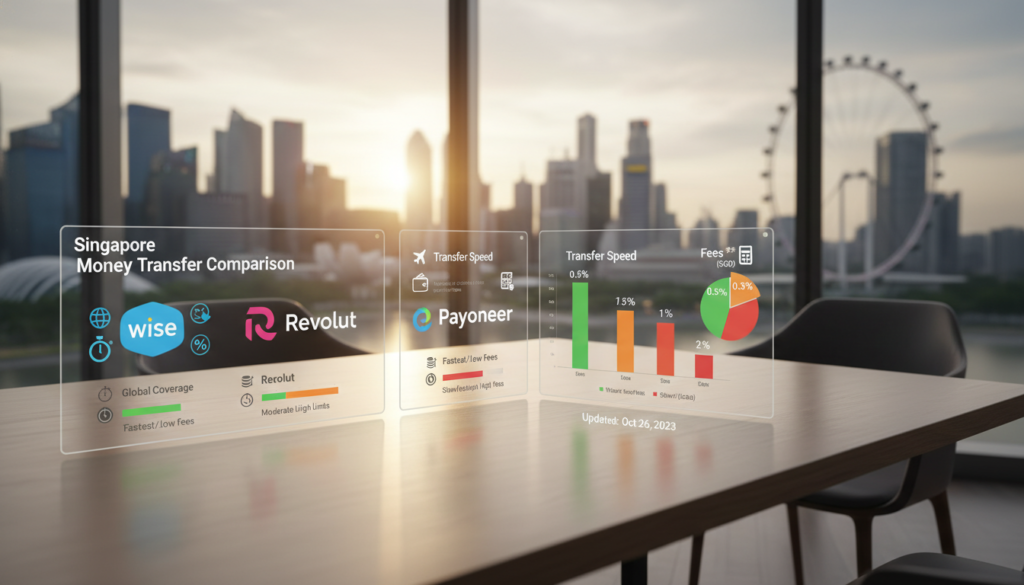
Provider comparison snapshot for Singapore: coverage, speed, limits, and fees
Use this quick shortlist to match common payment needs to likely providers and speed up decision making.
Wise
Fees from 0.32%, broad coverage (160+ countries). Best for bank-account payouts; bank funding is usually the lowest-cost option. Personal accounts have S$100,000/12‑month caps; Wise Business typically has no send limits.
Western Union
Wide reach (200+ countries) and cash pickup or mobile wallet options. Delivery ranges from same day to 5 business days and fees vary by route and speed.
Instarem
Fees from 0.4%, ~60+ countries and 1–2 business days typical. Useful Rate Watch and rate‑lock tools plus loyalty points that reduce effective costs over time.
Revolut
Percentage plus fixed fee (≈0.8% + S$1.75). Instant moves between Revolut users; bank payouts can take up to 5 days. Watch out for out‑of‑hours FX mark‑ups and account limits.
SingX
Markup typically 0.25%–1% with high ceilings (up to S$1m). Positions itself as “no receiving fee”, which helps where recipients face bank deductions.
WorldFirst & Airwallex
WorldFirst offers a World Account (20+ currencies) and capped fees (≈0.60%).
Airwallex focuses on local rails to 120+ countries, strong batch support and integrations; many supported routes settle same day.
Decision note: Treat these figures as indicative. Always get a live quote — pricing shifts by corridor, amount and funding method.
Wise for business international money transfers from Singapore
Wise is clear about the full costs you will pay, which helps treasury teams plan and avoid surprises.
When Wise offers the best value
Bank-funded moves are where Wise typically saves you most. With fees from 0.32% and a mid‑market exchange, the platform shows itemised charges and expected beneficiary amounts before you confirm.
Limits and account types
Personal accounts have a cap of S$100,000 in a 12‑month window. Wise Business removes that ceiling and suits higher volumes and operational scale.
Speed, coverage and operational fit
Some corridors settle same‑day; others take a couple of business days. Timing depends on the currency, receiving bank and cut‑off times.
Recipients generally need a bank account, so Wise fits supplier invoices and contractor payouts well.
“Transparency in pricing is the practical tool that reduces reconciliation time and hidden costs.”
| Feature | Detail | Why it matters |
|---|---|---|
| Fees | From 0.32% | Low markup keeps landed cost predictable |
| Coverage | 160+ countries | Wide reach for account‑to‑account payments |
| Account | Multi‑currency + debit card | Hold balances to avoid frequent conversions |
When not ideal: choose other services for cash pickup or marketplace collection needs where local payout options matter more than bank rails.
Western Union for cash pickup and flexible delivery methods
When recipients need cash on the ground, a network with broad payout options often wins on practicality.
What Western Union does well: coverage across 200+ countries and territories, with delivery to cash pickup points, bank accounts and mobile wallets. That reach matters when recipients lack reliable bank access or require immediate cash.
Best use cases
Use Western Union for cash payouts, emergency payments and markets with limited banking penetration. It suits operations that must send money quickly to many different countries and local delivery types.
What to watch
Fees and exchange rates vary by route, speed and funding method. Two cost checks matter: visible transfer fees and the FX mark‑up applied to the exchange rate. Together they shape the final received amount.
“Flexibility in delivery can simplify payroll and supplier payouts, but it may cost more per funded payment.”
| Feature | Detail | Why it matters |
|---|---|---|
| Coverage | 200+ countries/territories | Wide reach for diverse recipient needs |
| Delivery options | Cash pickup, bank deposit, mobile wallet | Solves last‑mile and unbanked recipient scenarios |
| Speed & cost | Same day to 5 business days; fees vary | Timing depends on time zones, holidays and payout method |
| Rewards | My WU discounts for repeat users | Can lower fees on frequent smaller payments |
Instarem for fast transfers and rate-tracking tools
Instarem pairs clear pricing with practical FX controls to help teams time payments and protect margins.

Fees from 0.4% and often same‑day to 1–2 business day settlement on common corridors make Instarem a pragmatic choice for supplier payouts.
Fees, speed expectations, and loyalty
Competitive fees and quick settlement mean fewer urgencies and lower operational strain when sending money. For frequent small-value runs, loyalty points can be redeemed to reduce effective costs over time.
Rate Watch and rate lock
Use Rate Watch to get alerts when target rates hit. A short‑term rate lock lets you secure an exchange rate for a limited period, lowering timing risk when margins are tight.
Operational note: ensure beneficiary details and payment references match your ledger to avoid reconciliation work at month end.
“Rate locks and alerts are practical tools that cut FX timing risk.”
Comparison prompt: always check a live quote against Wise, SingX and other platforms for your amount and corridor before you send money.
Revolut and SingX for modern payments and cost control
App-first providers often solve different problems: one speeds internal moves, the other lowers recipient-side deductions at scale.
Revolut: fee mechanics, timing and perks
Fees: Revolut charges about 0.8% plus a fixed S$1.75 per send. Out‑of‑hours FX mark‑ups can apply, so check quoted rates before you confirm.
Peer-to-peer moves between Revolut users are instant. Bank payouts depend on the corridor and can take up to five business days.
Account limits typically cap rolling activity at S$100,000 per 365 days. Higher-tier plans add perks such as travel allowances and priority support.
SingX: higher ceilings and limiting receiving deductions
Markup and limits: SingX commonly adds a 0.25%–1% markup and offers higher ceilings — individual country rules can allow up to S$1,000,000.
SingX positions itself with “zero cost for receiving money”, which helps avoid short‑paid invoices when recipient banks charge to accept funds.
Expect same‑day to three business day settlement on supported rails. Cash payout is limited (notably the Philippines), so confirm delivery options for each corridor.
“Use Revolut when instant in‑app moves and plan perks speed your workflow; choose SingX when high caps and minimised recipient fees matter more.”
| Provider | Typical fee | Speed | Best for |
|---|---|---|---|
| Revolut | 0.8% + S$1.75 | Instant (in‑app), bank payouts up to 5 days | App-led teams, instant internal moves |
| SingX | 0.25%–1% markup | Same day to 3 days | High ceilings, minimise recipient deductions |
| Key caveat | Check out‑of‑hours FX mark‑ups | Verify cash availability by corridor | Match to recipient needs and limits |
WorldFirst and Airwallex for scalable business payments and multi-currency operations
WorldFirst and Airwallex are built as finance‑operations platforms rather than single‑purpose remittance apps.
Multi‑currency accounts let you hold USD, EUR, GBP and other balances to avoid forced conversions. WorldFirst’s World Account supports 20+ currencies with capped fees (~0.60% on major pairs). Airwallex offers similar accounts and FX mark‑ups around 0.4%–0.6%.
Local receiving details and marketplace collections
Both platforms provide local bank details — US routing numbers, UK sort codes and EU IBANs — so sellers and marketplaces get paid like a local and avoid extra currency hops.
Local networks vs SWIFT
Use local rails to cut intermediary deductions. Airwallex claims ~93% same‑day arrivals on local payouts; WorldFirst reports high same‑day rates via its networks too. SWIFT remains an option with higher fees (Airwallex S$20–35 for SWIFT).
Batch payments, workflows and FX tools
- Batch size: Airwallex up to 1,000; WorldFirst up to 200.
- Team controls: role‑based access, approvals and integrations with Xero/NetSuite.
- FX risk tools: firm orders, forward contracts and automated rules to lock costs.
Practical recommendation: for marketplace sellers or high‑volume supplier runs, prioritise a platform that combines local rails, multi‑currency accounts and accounting integrations to reduce fees and simplify transactions.
How to save money on international transfers from Singapore without increasing risk
Compare live quotes and plan payment windows to keep costs down and suppliers happy.
Start with clarity: get a full cost quote that shows fees, FX spread and any receiving deductions. Pricing changes by corridor and amount, so check the exact figure for each transaction before you confirm.
Get quotes and compare before sending
Run live quotes for the same amount across providers. A service that is low-cost for small runs may be expensive for larger sums because of different fee structures and spreads.
Avoid last-minute transfers and plan around time zones
Urgent payments often attract higher fees and carry more operational risk. Schedule payments in advance and avoid cut-offs and public holidays to reduce delays and extra costs.
Reduce conversions with multi-currency balances
Keep local balances to receive and pay in the same currency. This reduces double conversion and lets you convert when exchange rates look favourable.
Negotiate for volume and regular runs
If your transactions are frequent or large, ask providers for better FX pricing or lower service fees. Platforms will often improve terms when they see steady flows.
Fraud and phishing checks
Protect accounts with multi-factor authentication, approval workflows and strict beneficiary change controls. Verify any email or domain changes by phone and keep an audit trail for each payment.

| Step | Action | Benefit |
|---|---|---|
| Quote comparison | Obtain live quotes per corridor and amount | Find true landed cost, avoid surprises |
| Schedule | Plan payments around banking hours and holidays | Lower urgency fees and reduce delays |
| Multi-currency | Use accounts to hold and pay in the same currency | Cut conversion leakage and timing risk |
| Negotiate | Request volume pricing or caps | Reduce recurring fees and spreads |
| Controls | Enforce approvals, MFA and beneficiary checks | Maintain security without raising operational risk |
Rule of thumb: measure total landed cost alongside controls and provider support. Lower price matters only if delivery and risk controls meet your supplier SLA.
Compliance and safety: choosing MAS-regulated transfer services
A licensed payments firm reduces operational risk and sets expectations for how customer funds are protected.
Why MAS licensing matters for secure, reputable payments
MAS regulation is a non-negotiable baseline: it signals oversight, safeguarding rules and conduct standards that protect client accounts and funds.
Both banks and MAS‑licensed remittance platforms can be reputable. Verify the provider’s licence status and Major Payment Institution notices before you send money.
Documentation, verification and purpose-of-payment
Operational compliance typically means KYC checks, beneficiary validation and clear purpose‑of‑payment fields. These steps reduce holds and downstream queries.
Incomplete documentation can cause delays, rejections or compliance reviews — and may incur extra fees or lost days of liquidity.
“Verify licences, preserve clear payment references and enforce beneficiary checks to avoid costly delays.”
- Maintain a vendor master with validated bank details and limits.
- Use approval workflows for new beneficiaries and high-value payments.
- Pick providers with secure authentication, audit logs and responsive support.
Methodology: how to compare providers for cost, speed, and business usability
Start with a reproducible scoring method so your team can compare like‑for‑like quotes across corridors.
Cost analysis inputs
Record the mid‑market rates at quote time, the provider exchange mark‑up and any visible fees. Note expected receiving deductions and SWIFT charges that banks may add (often 1–3% on FX).
Use these figures to calculate the total cost per transaction and the landed amount the beneficiary will receive. This reproducible check shows true value across transfer services.
Performance inputs
Compare expected delivery windows, whether local rails are used and the variability caused by banking hours. Track actual arrival times for the same payment path to spot outliers.
Capture coverage and per‑transaction limits so your normal run size will not be blocked by caps in banks or provider rules.
Business usability inputs
Score platforms on batch support, approvals, multi‑user roles and accounting integrations. Check whether an account gives downloadable proofs and tracking for audits.
Practical tip: compare the same amount, currency pair and delivery method when testing. That way you can rank each provider by landed cost, speed and operational fit and choose the best option for your business needs.
Conclusion
Balance speed, clarity and landed cost when you decide how to send money overseas. Focus on the total amount your supplier receives, not the headline fee.
Start by mapping corridors, volumes and acceptable delivery time. Shortlist providers with transparent pricing, then validate with live quotes to compare true landed fees and rates.
For routine payments, local payout networks often arrive faster and cost less than SWIFT; keep multi-currency accounts and batch uploads for regular runs. Use banks or SWIFT rails only where coverage or legal needs demand it.
Finally, pick MAS-regulated services, enforce approvals and beneficiary checks, and treat fraud prevention as part of the real cost of your payment operations. This way, your chosen option saves time and protects cash flow.
FAQ
Who is this buyer’s guide for and what does "cheapest" mean for Singapore businesses?
How do cross-border transfers actually move funds across currencies and banking systems?
Why does the chosen method affect delivery time, deductions and reconciliation?
What is the mid-market rate versus an exchange rate margin and why do small spreads matter?
Fixed fees or percentage fees — which is preferable for typical payment amounts?
What are SWIFT charges, receiving fees and intermediary bank deductions?
How do funding and recipient payout methods change the total cost?
What should I check when comparing exchange rates and pricing transparency?
What are realistic transfer speed expectations — same-day vs multi-day?
What limits and controls should businesses expect?
How broad is provider coverage — countries, currencies and recipient account needs?
Which business features reduce operational cost and friction?
What options suit frequent large transfers versus occasional payments?
When are cash payouts necessary and which operators handle them well?
How do online fintech platforms compare with bank SWIFT wires?
How can local payout networks reduce cost and improve speed?
When is SWIFT still required?
How do providers like Wise, Revolut, Airwallex and others differ in practice?
What limits and account types should businesses expect with Wise and similar services?
What are the strengths of Western Union for business payouts?
How can tools like Instarem’s Rate Watch help reduce timing risk?
What business controls and workflows do Revolut and SingX offer?
How do multi-currency accounts from WorldFirst and Airwallex reduce conversion costs?
What FX tools help businesses manage risk at scale?
How can I save money on transfers without increasing risk?
Why is MAS regulation important when selecting a provider?
What documentation and verification will businesses need?
How should I compare providers methodically for cost, speed and usability?
What inputs matter most in a cost analysis?
What performance and usability factors should I track?

Dean Cheong is a Singapore-based B2B growth strategist and the CEO of VOffice. He helps companies scale revenue through sharper sales execution, CRM implementation, and go-to-market strategy, backed by a strong foundation in business banking and finance from Nanyang Technological University and a track record of driving sustainable, performance-led growth.