

Curious which provider will cut fees, speed up settlement and scale as you grow?
This short guide helps merchants choose the right mix of payment gateway providers for online and in-store selling in Singapore.
The market now expects fast, frictionless payments and clean reconciliation. We compare gateway capabilities, method coverage, pricing and fees, settlement speed, security and integration effort.
Leading names like Airwallex, Stripe, PayPal, Adyen, HitPay, eNETS and FOMO Pay appear on the short‑list. Fit depends on your channels, model and customer locations.
Cross‑border sales can erode margin through FX mark‑ups and forced conversion. That is why multi‑currency settlement and transparent pricing are key lenses for this roundup.
Expect practical takeaways: what to prioritise before comparing, which fees to watch, and a checklist for demos so teams can decide with confidence. For support with setup and office needs, see merchant services.
Key Takeaways
- Compare payment gateway features, fees, settlement and integration effort.
- Prioritise security, scalability and clear reconciliation tools.
- Watch for FX mark‑ups; favour multi‑currency settlement where possible.
- Short‑list providers and match them to your channels and customer locations.
- Use a demo checklist to test pricing, reporting and onboarding time.
Singapore’s digital payments landscape in 2025-2026
QR codes and e-wallets have turned instant, tap-or-scan checkout into everyday habit.
Why QR code payments and e-wallets are now the norm
Over 90% of the population has enrolled in national e-payment schemes and nearly every merchant accepts QR codes such as SGQR. That widespread acceptance changed customer behaviour across retail, F&B and eCommerce.
Consumers complete purchases faster when familiar payment methods — cards, digital wallets and PayNow-style transfers — are available without friction. Faster checkout directly lifts conversion rates on both web and in-store channels.
What merchants expect from modern platforms
Today merchants list stable uptime, quick onboarding and clear reporting as table stakes. They need one platform that handles online and in-store acceptance, so teams do not juggle multiple portals.
Local payment methods are also in demand for lower fees and faster authorisation. Operational efficiency — reconciliation, analytics and clean integrations — matters as much as simply being able to accept payments.
What a payment gateway does for online and in-store transactions
A gateway is the traffic controller that moves a customer’s card or app data from checkout to your bank accounts. It encrypts details, forwards them for authorisation and returns the result to the till or web page.
How payment processing works from checkout to settlement
At checkout the customer initiates a transaction via card, wallet or QR. The gateway encrypts the data and sends it to a processor or acquiring partner.
The processor checks with the issuing bank for approval. Once authorised, the clearing and settlement stage moves funds into merchant bank accounts.
Settlement timing differs by provider, method and risk checks — faster payouts improve cash flow, while holds reduce fraud risk.
Gateway vs processor vs acquiring bank
Gateway: the front-end platform that captures and secures details and shows status in a dashboard.
Processor: the service that routes and verifies transactions with issuing banks.
Acquiring bank: holds the merchant account that ultimately receives settled funds and issues settlement reports.
| Role | Merchant view | Key feature |
|---|---|---|
| Gateway | Checkout, SDKs, reporting | Encryption, authorisation flow |
| Processor | Routing, reconciliation data | Transaction verification |
| Acquiring bank | Settlement into accounts, payouts | Funds custody and statements |
Some providers bundle all three roles into one platform, while others mix vendors for online in-store coverage. Keep an eye on PCI DSS alignment and encryption — these are the compliance basics that sit across the whole flow.
digital payment solutions singapore business: what to prioritise before you compare providers
Start by deciding whether most of your customers are local or overseas — that choice narrows viable providers fast.
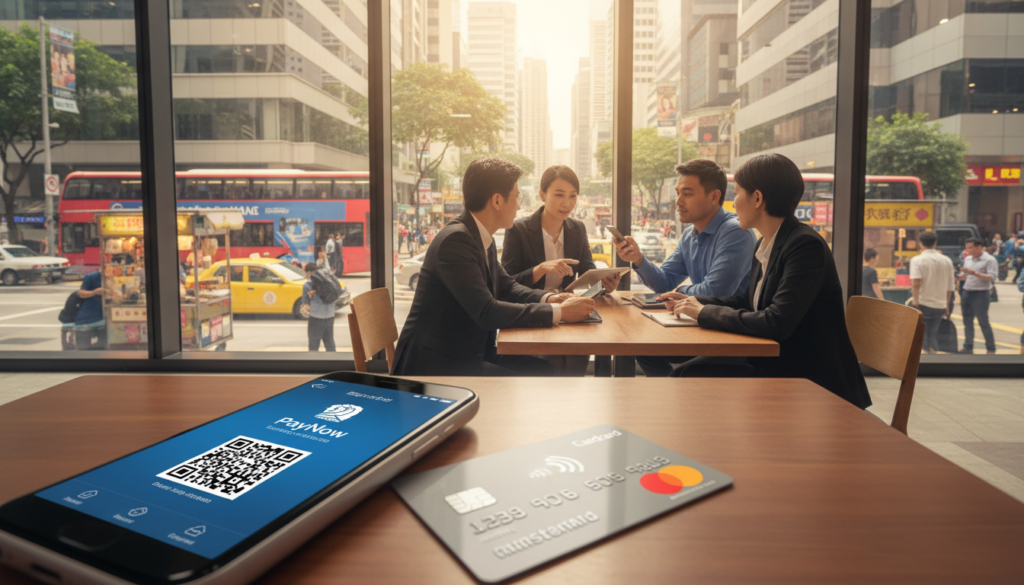
If most sales stay within Singapore, prioritise coverage for local payment methods such as PayNow, FAST and SGQR. These options cut card fees and lift conversion for daily retail and F&B trade.
Local payment methods that matter
Support for PayNow, FAST and SGQR reduces transaction cost and speeds authorisation. For SMEs serving residents, local payment access is often non‑negotiable.
International transactions and margin control
Cross‑border sales can add hidden FX spreads and forced conversions. Look for multi‑currency settlement and transparent FX mark‑ups to preserve margin and provide true global reach.
Integration with platforms and accounting
Operational efficiency matters as much as rates. Ensure the platform offers plugins for Shopify, WooCommerce or Magento and links to accounting tools to cut reconciliation time.
- Map customer geography, channels (web, retail, pop‑ups) and growth plans.
- Rank providers by local method coverage, FX transparency and integration depth.
- Choose MAS‑licensed vendors where continuity and trust matter.
Payment methods your customers will actually use
Which methods you show at checkout often decides whether a visitor becomes a buyer. Offer a concise set that matches your audience and channel, rather than every available option.
Credit and debit cards and conversion
Cards (Visa, Mastercard, Amex) still drive conversion for international shoppers and many online sales. Card payments often have higher approval rates for cross‑border transactions and are expected by tourists and overseas buyers.
Digital wallets: Apple Pay, Google Pay and PayPal
Apple Pay, Google Pay and PayPal cut friction on mobile checkouts. They speed authorisation and increase trust, which lifts completion on small, impulse and mobile orders.
Bank transfers for larger tickets and B2B
For higher ticket sizes, suppliers and corporate clients prefer bank transfers to avoid card limits and fees. Real‑time transfers or invoiced bank moves reduce chargeback risk for big transactions.
BNPL and alternatives
Buy‑now‑pay‑later options such as Afterpay or Klarna raise average order value. Fees and settlement timing vary, so balance AOV gains against cost and cash‑flow needs.
| Method | When to offer | Key advantage |
|---|---|---|
| Cards (Visa/Mastercard/Amex) | Cross‑border shoppers, tourists | High approval, wide acceptance |
| Digital wallets (Apple Pay, Google Pay, PayPal) | Mobile and fast checkout | Lower friction, faster auth |
| Bank transfers / PayNow / SGQR | Large orders, local customers | Lower fees, reduces chargebacks |
| BNPL | Higher AOV, instalment buyers | Higher conversion, variable fees |
Tip: Align methods to your customer mix—locals often pick PayNow or SGQR, tourists expect Alipay/WeChat or cards, and overseas buyers favour cards or PayPal. For regional trends see APAC payment methods.
Fees and pricing models to compare across payment providers
Understanding true cost per transaction is the quickest way to protect margin. Compare headline rates, fixed per‑transaction fees and any monthly or minimum charges. Don’t forget method‑specific rates for cards, wallets and bank transfers.
Transaction fees: domestic vs international cards
Domestic card rates often run lower than international. For example, Stripe in Singapore charges about 3.3% + SG$0.50 for domestic cards and ~3.6% + SG$0.50 for international cards.
PayPal’s examples are higher: roughly 3.9% + SG$0.50 domestic and 4.4% + SG$0.50 international. High overseas volumes can push your blended fee materially higher.
Currency conversion costs and hidden FX mark‑ups
Look beyond headline transaction fees to FX spreads. Stripe may add ~+0.5% above interbank; PayPal often applies ~3–4% over wholesale rates.
Hidden spreads and add‑ons can outweigh a low merchant fee, especially on cross‑border sales.
Interchange++ vs flat‑rate pricing
Interchange++ shows the underlying card network interchange plus a margin. It can lower fees at scale but is more complex to predict.
Flat‑rate pricing is simpler and more predictable for SMEs. Ask providers for sample monthly statements so you can model your effective rate.
Chargebacks, refunds and dispute fees
Chargeback fees eat margin. For example, some providers charge ~SG$15 per dispute. Refunds, admin fees and fraud losses also reduce profitability.
Request details on chargeback handling, fraud tools and refund policies during demos to see how tooling can reduce disputes and operational cost.
- Compare the full cost stack: per‑transaction rates, fixed fees, monthly charges and minimums.
- Model blended rates for your customer mix (local vs overseas).
- Ask for a rate card and a real monthly statement during demos to reveal true effective fees.
Security and compliance standards for Singapore merchants
Security standards are the unseen guard that keeps card data and merchant funds safe. Choose platforms that make compliance a default rather than an optional extra.
PCI DSS compliance as the baseline
PCI DSS is the minimum standard for handling cardholder data. A provider with PCI DSS certification reduces your legal and financial risk and lowers exposure from unauthorised access.
Ask for evidence of PCI DSS scope and where tokenisation removes card data from your systems. That separation cuts breach risk and simplifies audits for merchants.
Fraud detection: AI monitoring, risk scoring and chargeback prevention
Modern fraud detection uses AI monitoring, velocity checks, device fingerprinting and risk scoring to flag suspect transactions in real time.
These controls reduce chargebacks and manual reviews while letting low‑risk customers pass through quickly. Look for platforms that explain model logic and let you tune rules.
MAS licensing and operational continuity
MAS licensing signals regulatory oversight, governance and resilience. Choosing MAS‑licensed providers improves trust and helps ensure continuity if issues arise.
Merchants must also play a role: keep clear refund policies, collect evidence for disputes, and enforce access controls. Providers can automate reporting, forensic logs and basic dispute workflows.
- Checklist for comparisons: PCI DSS scope, fraud detection transparency, 3DS/SCA support, rules customisation and analytics clarity.
- Balance: strong security with minimal checkout friction to protect conversion and customer trust.
Settlement speed, payouts and cash flow control
Settlement timing shapes whether a merchant can buy stock, pay staff and take on growth without surprise cash shortfalls. For SMEs, predictable cash flow turns slow months into manageable cycles and fast payouts into a competitive edge.
How payout timing impacts working capital for SMEs
Fast settlement lets you meet supplier terms, fund payroll and restock quickly. Slow or irregular payouts can force short-term borrowing or missed discounts.
Settling and holding funds in multiple currencies
Holding balances in the same currency as your costs reduces forced conversions. Providers that offer like‑for‑like settlement in multiple currencies (for example, Airwallex’s multi-currency accounts) let businesses receive USD and pay USD suppliers without extra FX drag.
- Compare payout schedules, cutoff times and refund windows.
- Ask about risk holds and method-specific payout speeds for cards, wallets and transfers.
- Check whether you can keep balances or withdraw to multiple bank accounts.
Settlement is not an afterthought — it directly affects margins, forecasting and your ability to scale with confidence. Treat payout terms as a core selection criterion when you evaluate providers.
Integration and implementation: getting a payment solution live quickly
Choosing the right integration path decides whether you launch in days or months. Keep the initial scope tight and pick a route that matches your team and growth plans.
No‑code links, hosted checkouts and APIs
No‑code payment links get you selling the fastest. They require no developer time and work well for pop‑ups, social checkout and MVPs.
Hosted checkout lowers PCI scope and fits sites that want branded flows without full API work. It is a good middle ground.
APIs suit tailored journeys, subscription models and complex payment processing needs. They need dev effort but enable best‑in‑class UX and custom rules.
Plugins and platform compatibility
Check Shopify, WooCommerce and Magento plugins for local method support, refund flows and compatibility with tax or shipping apps.
Look for clear docs, maintained extensions and examples of online in-store reconciliation to avoid surprises at scale.
Omnichannel basics
Choose a gateway that links POS terminals or SoftPOS with your web platform. Unified reporting and consistent receipts make accounting and customer service easier.
| Implementation path | Time to live | PCI scope | Best for |
|---|---|---|---|
| Payment links | Hours–days | Minimal | Pop‑ups, MVPs |
| Hosted checkout / plugins | Days–weeks | Lower | SMEs on Shopify/WooCommerce |
| API / custom | Weeks–months | Full (tokenisation reduces risk) | Custom UX, subscriptions |
Common pitfalls include reconciliation mismatches, partial captures, subscription edge cases and multi‑currency reporting complexity. Plan webhooks, sandbox tests and operational training before go‑live.
Tip: Pick a platform that scales from no‑code MVP to API‑first optimisation. That reduces switching costs and keeps your growth path clear, whether you use Airwallex, Stripe or Adyen as core providers.
Airwallex for cross-border eCommerce and multi-currency settlement
Airwallex focuses on simplifying cross‑border flows so you keep more margin when selling overseas.

Its platform accepts payments from 180+ countries and supports 160+ local payment methods, helping merchants localise checkout beyond cards.
Local method coverage and market reach
Local payment methods are available at scale, which boosts conversion in markets where wallets or bank transfers dominate.
Like‑for‑like settlement to avoid forced conversions
Airwallex offers like‑for‑like settlement in 11 currencies. For example, receive USD from US customers, hold USD and pay USD suppliers without converting to SGD.
Business account features
The Global Accounts let teams hold multiple currencies, issue corporate cards and run batch transfers to 1,000 recipients. FX is typically around 0.4–0.6% above interbank, and transfers reach 110+ countries.
Integration and best‑fit cases
Integration options include no‑code Payment Links, plugins (Shopify, WooCommerce, Magento) and full APIs for custom checkouts.
- Best for exporters, SaaS with global subscribers and merchants managing overseas suppliers.
- Strong where margin protection, multi‑currency reporting and operational controls matter.
Stripe Singapore for API-first payment processing and experimentation
Stripe is built for teams that want full control over checkout logic, experiments and detailed reporting. Its API-first model suits merchants who run tests, tune approval rates and deploy new payment methods across markets.
Payment method coverage and local options
Stripe supports 100+ payment methods, including cards, wallets and local payment rails such as PayNow. That breadth helps merchants match methods to customer preference and increase conversions.
Security and fraud prevention
PCI Level 1 compliance and Stripe Radar’s AI give strong fraud detection while keeping legitimate transactions flowing. Tokenisation and network card updates reduce retries and lost revenue.
Pricing signals to watch
Typical rates: domestic cards ~3.3% + SG$0.50; international ~3.6% + SG$0.50. Currency conversion can add ~+0.5% above interbank and dispute fees run around SG$15 per case. Model these to understand unit economics.
Best-fit and integration notes
Stripe fits tech-driven SMEs, subscription services and marketplaces that need recurring billing, advanced invoicing and developer tooling.
Expect to use webhooks, sandbox testing and modest developer time for safe experimentation without breaking reconciliation.
| Feature | Why it matters | Example |
|---|---|---|
| Method coverage | Matches customer choice | 100+ methods incl. PayNow |
| Fraud detection | Reduces chargebacks | Stripe Radar (AI) |
| Fees & FX | Impacts margin | 3.3% domestic; +0.5% FX |
| Integration | Enables experiments | APIs, webhooks, sandbox |
PayPal for trusted wallet-led checkout and international buyers
PayPal remains a go-to wallet for many shoppers who value a familiar checkout name when buying from overseas. Its brand familiarity can remove hesitation and speed the final click.
When PayPal improves conversion through brand familiarity
Recognition matters. For tourists and cross-border customers, seeing PayPal at checkout often raises trust and lifts conversions. The wallet stores cards and balances, which reduces friction on mobile and repeat buys.
Cost considerations: higher transaction fees and FX spreads
Example fees are higher than many gateways: domestic rates around 3.9% + SG$0.50 and international at ~4.4% + SG$0.50. FX spreads commonly sit at 3–4% over wholesale. These add up on low‑margin orders.
“PayPal’s ease can justify premium fees on small volumes, but model the impact on margin for cross‑border orders.”
Best-fit scenarios: freelancers, marketplace sellers and cross-border D2C
Consider PayPal when you need quick trust signals for overseas buyers or when invoicing international clients.
- Freelancers: fast invoicing and simple receipts for remote clients.
- Marketplaces: meet buyers where they already pay and reduce cart abandonment.
- D2C brands: use PayPal to capture international shoppers who expect wallet options.
Recommendation: Use PayPal strategically as an add-on method rather than your sole option. Track how its transaction fees and FX affect average order value, and plan dispute handling, refund workflows and reconciliation mapping before launch.
Adyen for enterprise-grade omnichannel payments
Enterprise merchants value a single source of truth for online and in‑store transactions. Adyen delivers a unified platform that links e‑commerce, in‑app checkout and physical POS terminals. That single view speeds reconciliation and simplifies reporting across channels.

Unified online and in‑store payments with advanced analytics
The platform consolidates transactions and receipts so teams see one ledger for orders and refunds. This helps operations, finance and marketing act on the same dataset.
Risk management and machine‑learning fraud detection
Adyen uses machine‑learning models and configurable rules to surface risky activity while letting low‑risk shoppers pass. That balance reduces chargebacks and manual reviews for high‑volume merchants.
Understanding Adyen’s pricing approach
Pricing is method‑dependent with a fixed processing component plus variable fees. For instance, local rails may use a format similar to SGD $0.13 + 1.30%, though full rate sheets vary by method and market.
| Feature | Why it matters | Example |
|---|---|---|
| Omnichannel reporting | One view of online and in‑store | Unified dashboards, exportable reports |
| Risk & fraud detection | Reduces disputes | ML models, custom rules |
| Pricing model | Impacts blended fees | Fixed + variable per method |
- Request method‑specific rate cards and local rails for Singapore.
- Test approval rates and reporting granularity in a sandbox.
- Best for larger retailers that value global method coverage and consolidated operations over fastest onboarding.
HitPay for local SMEs needing fast onboarding and PayNow-first acceptance
HitPay focuses on rapid setup, mobile POS and PayNow as primary acceptance methods. It suits teams that need to start taking payments quickly and keep daily operations simple.
Strengths for retail and F&B
Mobile POS, QR acceptance and invoicing fit counter service, pop‑ups and cafe tills. Recurring billing and simple invoicing help with repeat customers and subscriptions.
Onboarding is often same‑day for basic accounts, which reduces time to first transaction and lowers setup friction.
Fee ranges to assess
Compare PayNow versus card pricing and wallet surcharges. Typical examples:
| Feature | Typical rate | Best for |
|---|---|---|
| PayNow | ~0.65%–0.90% | Low‑value local transfers |
| Online cards (domestic) | ~2.8% + SG$0.50 | Local card shoppers |
| Online cards (international) | ~3.65% + SG$0.50 | Cross‑border orders |
| Digital wallets | Varies by method (higher) | Tourist wallets like Alipay/WeChat |
“Fast onboarding and clear reporting make day‑to‑day ops easier for small retailers.”
Best-fit scenarios and ops checks
HitPay works well for Singapore‑first merchants, pop‑ups, home sellers moving to retail and tourist‑facing outlets. Check settlement timing, refund flows and staff training before launch.
Exportable reports simplify bookkeeping and tax filing, so verify reporting exports match your accounting workflow.
eNETS and FOMO Pay for Singapore-centric bank and QR payment methods
For merchants serving mainly domestic shoppers, platforms that tie into local bank rails and QR schemes simplify everyday transactions.
eNETS: direct bank transfers and institutional trust
eNETS is run by the NETS group and is widely trusted by local institutions. It supports direct bank transfers via major local banks, SGQR and PayNow‑style flows alongside card acceptance.
Typical ranges quoted include cards at about 3.4% + SG$0.50 and bank/QR around 0.8%, though merchant plans vary. The platform settles in SGD and suits sectors such as services, education and bill‑style transactions that need clear reconciliation.
FOMO Pay: unified QR and wallet acceptance
FOMO Pay consolidates multiple QR and wallet methods into a single gateway. A unified QR can handle Alipay, WeChat Pay and PayNow‑style scans, which helps tourism and retail merchants capture diverse visitors without multiple terminals.
Pricing is often customised by volume and method, so expect tailored quotes rather than flat cards. Request method‑specific fees and sample statements during demos to model true costs.
- Why local providers work: when most transactions use bank rails or QR codes, local gateways reduce friction and improve approval rates.
- Best fit: merchants prioritising local payment methods and SGD settlement over multi‑currency holding.
- Operational checks: verify reconciliation exports, receipt mapping for QR scans, refund flows and dispute handling before onboarding.
How to choose the right provider mix for your business model
A pragmatic provider mix reduces checkout friction and improves approval rates across customer segments. Choose complementary platforms so each covers strengths the other lacks.

Stacking gateways to expand payment methods and approval rates
One gateway rarely wins on everything. Pair a global, multi‑currency provider with a local QR or bank‑rail specialist to capture tourists and residents alike.
Example: use an API‑first gateway for online transactions and a QR‑centric provider for in‑store footfall. Add a wallet provider for trust‑led checkouts.
Matching providers to channels: online, in‑store and omnichannel
Map channels to priorities: online needs fraud tools, API depth and plugins. In‑store needs fast SDKs, POS and clear reconciliation exports.
For omnichannel, pick a gateway set that shares reporting and supports unified refunds and receipts.
A short checklist for demos and onboarding discussions
- Confirm method coverage, supported currencies and settlement schedules.
- Ask about transparent fees, FX mark‑ups and dispute handling.
- Validate plugin maturity, API docs, webhook reliability and sandbox test support.
- Request reporting exports, chargeback tooling and SLA for support response.
Decision framework: prioritise customer experience first, then margin, then operational integration, and finally scale. That order keeps conversions high and costs predictable as your company grows.
Conclusion
Choosing the right gateway mix lets you capture customers and protect margin. Match local rails such as PayNow and SGQR with a provider that offers global reach, clear FX and fast settlement.
Prioritise PCI DSS certification and fraud tools so trust and security do not become a hidden cost. Test real statements to compare headline rates against effective fees and dispute charges.
Decide by channel: shortlist vendors by whether you are local‑first or cross‑border, by online versus in‑store needs, and by the level of developer effort you can support.
Request demos, run a small pilot and measure approval rates, settlement speed and reporting quality before you commit. Optimise for the methods your customers use, then refine checkout with analytics over time.
FAQ
What are the top methods customers in Singapore use to pay online and in-store?
How does a payment gateway differ from a payment processor and an acquiring bank?
What should I prioritise when comparing providers for a Singapore company?
How do transaction fees differ for domestic and international card payments?
What is Interchange++ and how does it compare to flat‑rate pricing?
How quickly will I receive settlements and how does this affect cash flow?
Do I need PCI DSS compliance and what does it involve?
How do providers detect and prevent fraud?
What are typical hidden FX or currency conversion costs to watch for?
How important is local payment method coverage for international merchants?
Can I integrate a new gateway without developer resources?
Which providers suit exporters and merchants with multi‑currency needs?
How do chargebacks and dispute fees affect profitability?
Should I support Buy Now, Pay Later (BNPL) and alternative methods?
What POS and omnichannel features should retailers prioritise?
How do I choose the right mix of providers for my model?

Dean Cheong is a Singapore-based B2B growth strategist and the CEO of VOffice. He helps companies scale revenue through sharper sales execution, CRM implementation, and go-to-market strategy, backed by a strong foundation in business banking and finance from Nanyang Technological University and a track record of driving sustainable, performance-led growth.