
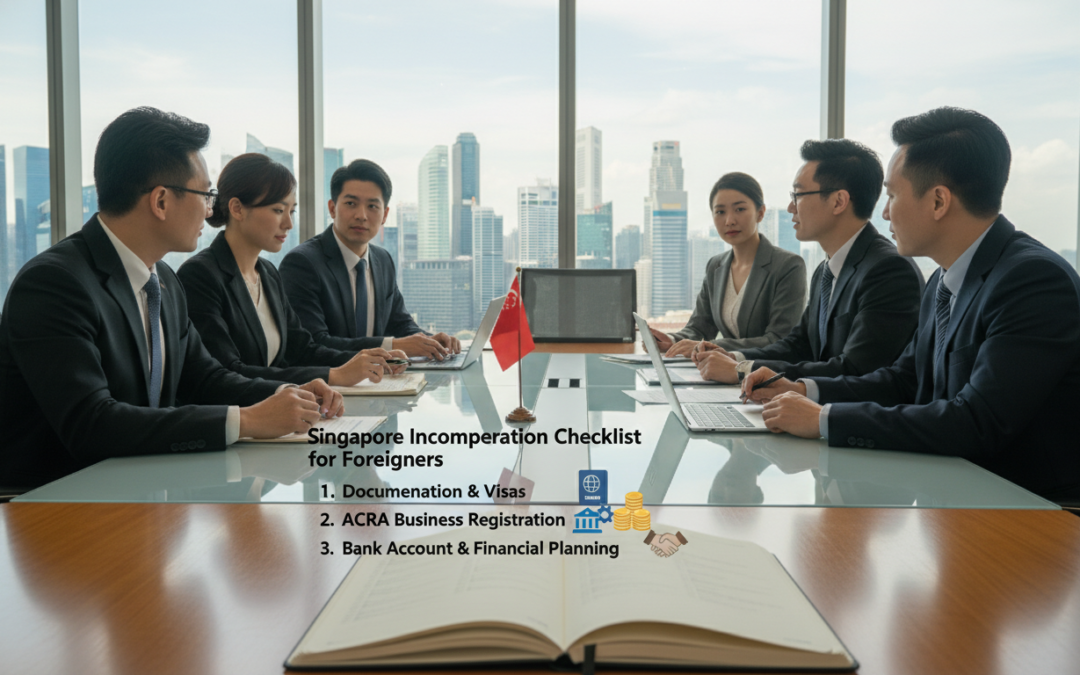
Can a non-resident really form and own 100% of a private limited company remotely?
This practical, step-by-step guide shows how a foreign owner can start a company and meet all compliance needs without being on the ground.
We cover name reservation with ACRA, choosing business activities, share capital, local registered address and required appointments. You will find clear notes on the constitution, shareholders/director particulars and KYC-ready identity and address proofs.
Expect a logical sequence: name approval via BizFile+ first, then preparation of documents, then filing. The process ends with a digital Certificate of Incorporation and an official confirmation email once ACRA accepts the submission.
Use this as a working pack if you plan to operate from overseas or later relocate. Note that industry licences may add steps, so pair this list with sector-specific obligations.
Key Takeaways
- One resident director and a local registered address are common must-haves.
- Prepare constitution, shareholder and director particulars before filing.
- File name approval and submission through BizFile+ to ACRA for digital certification.
- Keep KYC documents ready to avoid delays and ensure smooth company registration.
- Sector licences may be required; check industry rules alongside this guide.
- For a practical formation pack, see the detailed company registration checklist.
Why Singapore is a strong base for foreign owners

Many business owners choose this market because it blends strategic location with stable governance and excellent infrastructure.
Practical ownership rules: You can hold 100% of the company’s shares and keep full control without a local partner. That helps owners plan equity, voting rights and investor talks.
Credibility and limited liability
A private limited company is a separate legal entity. Limited liability means personal loss is usually limited to unpaid amounts on shares.
Tax and regulatory points to factor
Headline corporate tax is 17% and there is no capital gains tax. GST registration is required once annual taxable turnover exceeds SGD 1 million (GST 9%).
| Item | Rule | Practical impact |
|---|---|---|
| Corporate tax | 17% | Plan profits and incentives |
| GST | Registration at >SGD 1M, 9% | Affects pricing and invoicing |
| Withholding tax | Applies to payments to non-residents | Structure cross-border payments carefully |
| Regulator | Corporate Regulatory Authority (ACRA) | Ensures transparency and filings |
Before you start business, assess expected revenue, where customers pay from and likely payment flows. These factors determine if you must register for GST early or change contract terms.
For further practical guidance on running a foreign-owned business see the foreign-owned businesses guide.
Pre-incorporation essentials in your singapore incorporation checklist foreigners
Getting foundational inputs right reduces friction during filing. Confirm an approved company name, define SSIC-coded activities, set capital and share arrangements, and choose a compliant registered address before you submit on BizFile+.

Choose and reserve a compliant company name with ACRA via BizFile+
Reserve your proposed name on BizFile+. The fee is SGD 15 and the name must be unique and free of prohibited or undesirable words.
Practical checks: avoid identical or confusingly similar names, make sure the name fits branding and any future licensing, and confirm the name is acceptable for the sector you plan to operate in.
Define business activities and select the right SSIC code
List your core activities and pick the correct SSIC code early. This affects licensing, banking and regulatory compliance.
Tip: Match the business activities with future permits to prevent reclassification later.
Confirm share capital, ownership split and share structure
Start with the minimum paid-up capital of SGD 1 if it suits your needs, but record a sensible capital plan for banking and contracts.
Decide the number and classes of shares, and ensure ownership split aligns with shareholders’ agreements and what you will file.
Decide your Singapore-registered address requirements
The registered address must be a physical local address (no P.O. Boxes) and be open to the public for at least three hours on business days.
If the address changes, update ACRA within 14 days to avoid breaches. Many founders use service providers; ensure they meet accessibility rules.
“Approved name, SSIC, capital decisions and a confirmed address are the four inputs you must finalise before you can complete the registration filing.”
Final actionable checklist: approved company name, chosen SSIC for activities, documented capital and share plan, and a verified registered address. Also review the terms and conditions of any service provider you engage.
People you must appoint to meet corporate regulatory requirements
Early confirmation of key personnel smooths filings and avoids last‑minute regulatory surprises. Plan appointments before you file so the process is not held up by missing consents or KYC documents.
Resident director and director pathways
Resident director rule: a private limited company needs at least one resident director (a local citizen, permanent resident or an Employment Pass holder).
You may appoint non‑resident directors, but a resident must still be in place. Common routes: engage a local resident director service or relocate later and obtain an Employment Pass to serve as the resident director.
Directors, shareholders and beneficial owners — what to prepare
Prepare full particulars for all directors, company secretary and shareholders. ACRA requires:
- Full legal name and nationality
- Identification number (passport or NRIC) and date of birth
- Residential address and contact details
- Details of beneficial owners and ownership percentages
Company secretary duties and residency rule
The company secretary must have their principal place of residence in the country and be appointed within six months of incorporation.
The secretary maintains statutory registers, handles filings and ensures compliance with corporate and accounting corporate obligations.
“Map the mandatory appointments early — missing any stalls registration or creates immediate compliance gaps.”
| Role | Residency requirement | Key particulars to supply |
|---|---|---|
| Resident director | Must be resident or Employment Pass holder | Name, ID number, address, contact, DOB |
| Non‑resident director | No residency required | Name, passport, address, contact, DOB |
| Company secretary | Must reside locally; appoint within 6 months | Name, ID, address, contact; role consent |
| Shareholders / beneficial owners | No general residency rule | Ownership %; ID; address; corporate documents if entity |
People checklist: resident director confirmed, all directors listed, shareholders and beneficial owners identified, and company secretary appointment planned and documented.
Company incorporation documents and KYC checklist for ACRA submission
A well-assembled document pack speeds ACRA submission and avoids delays with banks and service providers.
Core governance papers: The company constitution sets internal rules and now commonly replaces the older Articles of Association term. You may adopt ACRA’s standard constitution or supply a tailored company constitution that governs share classes, voting and director powers.
Appointment forms: Signed Consent to Act forms are required for every director and for the company secretary. Missing consents can invalidate an appointment and stall your filing.

KYC documents: Provide passport copies and recent utility bills or bank statements as proof of address. Non‑English documents need certified translations. Service providers and banks also request background details under AML rules.
Corporate shareholders: Include a board resolution, a current company profile and a certificate of registration or incorporation. Provide certified true copies when opening a corporate bank account or other accounts.
“Check spellings and addresses across all papers, attach translations where needed, and obtain notarised or apostilled copies early to avoid delays.”
Filing the registration and getting your Certificate of Incorporation
Submit via the BizFile+ portal once your data and documents match exactly across every form. Accuracy is the main lever for speed; mismatched names or addresses cause referrals and delays.
What you upload and enter:
Submitting via ACRA BizFile+ and what details are required
Follow the portal flow: enter the approved name transaction number, select the SSIC activity, add the registered address, and state share capital and shareholder splits.
Then upload the constitution, director and shareholder particulars, beneficial‑owner details and signed consents to act.
Approval timeline expectations and what you receive after acceptance
Straightforward filings may be approved quickly. Some files need extra review and take longer, so allow buffer time.
“You will receive an official confirmation email and a digital Certificate of Incorporation to use for banking and contracts.”
Government fees to budget for name reservation and company registration
Statutory fees: SGD 15 for name reservation and SGD 300 for company registration. Professional service fees are additional if you use a provider.
Next actions: prepare bank account documents, apply for licences if needed and align future Employment Pass plans with the roles and remuneration recorded at filing.

| Item | Detail | Practical note |
|---|---|---|
| Portal | BizFile+ | Follow ordered submission steps; consistency matters |
| Required data | Name ref, SSIC, address, capital, KYC, consents | Upload clear scans; translate non‑English docs |
| Fees | SGD 15 (name), SGD 300 (registration) | Budget for provider fees separately |
| Outcome | Confirmation email + digital Certificate | Use for bank accounts, contracts and vendor onboarding |
Conclusion
Once the formal filing is done, the practical work begins: open a corporate bank account and set up accounting so the new company is operational and compliant. Keep KYC, constitutions and signed consents handy to speed bank onboarding.
Note, you are ready if the name is approved, SSIC activities selected, capital and ownership confirmed, a registered address is set, people are appointed, KYC is prepared and filing is complete. Good planning reduces follow‑ups and cuts time to trade.
Immediate priorities: open a corporate bank account, install bookkeeping, and begin tax planning. Check GoBusiness for licences, and maintain annual returns (within 7 months after FYE) and AGMs (within 6 months after FYE). Treat tax as an ongoing workstream and update this checklist as shareholders, directors, address or activities change to stay ready to start business.
FAQ
What are the first steps to set up a private limited company as a non-resident owner?
Who must be appointed to meet corporate regulatory requirements?
Can foreign nationals be directors and shareholders?
What identification and KYC documents are required for ACRA submission?
What is the company constitution and when does it replace the Articles of Association?
How long does name reservation and registration usually take via BizFile+?
What fees should I budget for company registration and related filings?
Do I need a minimum share capital to start trading?
What extra documents are required for corporate shareholders?
How do I open a corporate bank account after registration?
What employment pass options exist for hiring foreign staff or relocating a director?
When is notarisation or apostille necessary for documents?
What must be declared about beneficial ownership and directors-shareholders particulars?
How can I ensure my chosen company name is compliant?
What happens after company registration is approved?
Do I need to register for taxes and file annual accounts?

Dean Cheong is a Singapore-based B2B growth strategist and the CEO of VOffice. He helps companies scale revenue through sharper sales execution, CRM implementation, and go-to-market strategy, backed by a strong foundation in business banking and finance from Nanyang Technological University and a track record of driving sustainable, performance-led growth.