

Could a single transfer of proceeds change your group’s tax outcome overnight?
From 1 January 2024, Section 10L alters how disposal gains are treated in Singapore. The new rule can tax foreign-sourced disposal gains when those gains are received in Singapore, unless adequate economic substance is shown for non-IPR assets in the relevant basis period.
This short guide scopes the issue to Section 10L of the Income Tax Act 1947. It explains when disposal gains become chargeable, how authorities evaluate substance evidence in real structures, and who should read on: Singapore-incorporated entities in multinational groups, investment holding structures, and any Singapore entity that may receive disposal proceeds into local bank accounts.
Key planning points are clear. Substance is mainly tested at the entity level and must be present in the year of disposal. Special rules can apply to IPR disposals, and IRAS offers advance rulings within one year to reduce uncertainty in complex deals.
Key Takeaways
- Section 10L can tax foreign disposal gains when proceeds are received in Singapore.
- Assessment focuses on whether the entity has adequate substance in the year of disposal.
- IPR disposals face additional scrutiny and may not be fully exempt even with strong substance.
- Use IRAS advance rulings when a disposal is expected within a year to reduce risk.
- Determine scope by testing: entity in scope, asset foreignness, receipt in Singapore, and adequacy of substance.
What changed from 2024: Section 10L and the foreign-sourced disposal gains tax regime in Singapore
From 1 January 2024 a new rule can turn certain cross-border sale proceeds into taxable income when brought into Singapore.
Policy rationale: The tax regime preserves the absence of a general capital gains tax but seeks to prevent routing of untaxed gains into local accounts without real activity here.
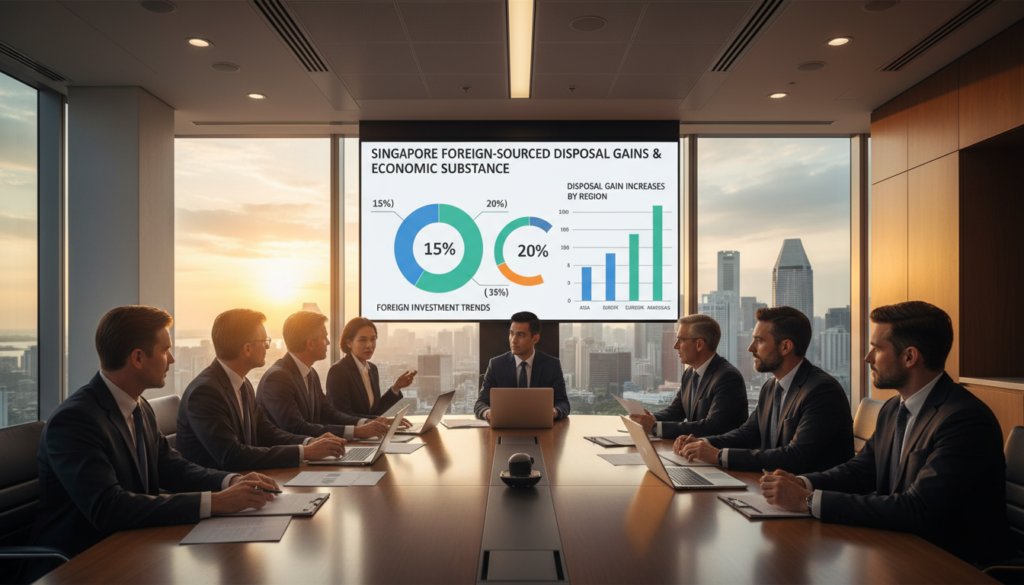
How the trigger works
For disposals on or after 1 January 2024, certain foreign-sourced disposal gains received locally by a covered entity of a relevant group may be treated as income under Section 10(1)(g) of the income tax act when conditions in section 10l apply.
What counts as ‘received in Singapore’
- Remitted, transmitted or brought into Singapore;
- Applied to satisfy a debt linked to a trade or business carried on here;
- Used to buy movable property that is then brought into Singapore.
Timing and carve-outs
The taxable event hinges on receipt, not accrual, so intercompany routing and remittance timing can change when disposal gains crystallise.
| Element | Effect | Practical question |
|---|---|---|
| Trigger date | Disposals from 01/01/2024 | When was the sale disposal? |
| Charging mechanism | Treated as income under Section 10(1)(g) | Are proceeds received here? |
| Carve-outs | Adequate protection for non-IPR assets; special IPR rules | Is there adequate proof in the basis period? |
Is your Singapore entity in scope: covered entities, relevant groups, and “outside Singapore” indicators
Start by confirming whether your legal person is a covered entity within a relevant group. The test is structural: it looks at legal form, consolidation and any overseas place of business.

How IRAS defines an entity and a group
Entity covers legal persons such as companies, LLPs, partnerships and trusts. Membership of a group follows inclusion in consolidated financial statements.
An entity is still in the group if it is only excluded for size/materiality or because it is held-for-sale.
When a group becomes relevant
A group is relevant if not all group members are incorporated, registered or established locally, or if any member has a place of business outside singapore.
“If one consolidated member keeps a branch overseas, the group can fall within scope even if the local entity alone would not.”
Practical checklist and common scenarios
- Map your legal forms and confirm which entities appear in consolidated accounts.
- Check whether any group entities have an overseas branch, PE or operations that amount to a place abroad.
- If all entities are local and no member has a foreign place of business, Section 10L will not apply.
| Test | Indicator | Outcome |
|---|---|---|
| Consolidation | Included in group accounts | Counts as a group member |
| Place of business | Overseas branch or PE | May make the group relevant |
| Legal form | Company, LLP, trust, partnership | Qualifies as an entity |
First decision point: if you are not a covered entity of a relevant group, Section 10L does not apply and you can stop here. If you are in scope, carry the mapping exercise into the disposal year.
What is a foreign asset under Section 10L and which disposals trigger tax exposure
Not all disposals trigger local tax. The test looks to where an asset is legally situated, which makes the concept of foreign assets a legal and tax question rather than a banking one.

Common categories that count
- Immovable property situated outside Singapore, such as overseas real estate.
- Unlisted shares of companies incorporated abroad and listed securities on a foreign exchange.
- Loans where the creditor is tax resident outside Singapore.
- Intangible property (IPR) where the owner is tax resident outside Singapore.
How situs is determined for loans and IPRs
The residence of the lender or the owner controls situs. For loans, it is the creditor’s tax residency that matters; borrower accounting entries do not change that conclusion.
For IPRs, the owner’s tax residency decides where the right is situated. Registration jurisdiction is secondary to residency for Section 10L.
Underpriced sales and valuation risk
If a sale is below open-market value, the Comptroller can compute an adjusted taxable amount using A + B − C, where:
| A | B | C |
|---|---|---|
| Gains received in Singapore | Open‑market price | Actual sale price |
Note: The open‑market uplift is taxed only to the extent any gains are actually received in Singapore.
“Robust valuation support and arm’s‑length documentation reduce exposure on intra‑group transfers.”
Governance takeaway: keep clear valuations, independent evidence and arm’s‑length sale records for any sale disposal foreign transactions, especially share exits and loan repayments from non‑resident creditors.
economic substance singapore foreign holding company: the economic substance requirement and how it is assessed
The key test asks if core activities were carried out and controlled in Singapore at the time of the disposal.
What the requirement means in practice: it is not enough to be incorporated or to have a registered address. The test examines whether the entity runs and governs its core functions locally. Good evidence shows decisions, staff and costs that match the entity’s role.
Assessment level:
Entity-level testing
Authorities normally assess at the entity level. Each legal person must demonstrate adequate substance relative to its risks and functions.
Basis period focus
The qualifying test applies in the basis year when the sale disposal occurs. Planning after remittance is too late. Ensure substance is in place before signing or completion.
What “managed and performed in Singapore” looks like
Typical indicators include local board minutes, documented investment committee decisions, and day-to-day execution by Singapore-based staff or properly controlled local service providers.
People standard: full-time employees include those working 35+ hours, executive directors, and FTE-calculated part-time staff. This helps smaller teams meet headcount indicators.

- Good governance: documented approvals and board activity.
- Operational proof: office evidence, payroll, job descriptions.
- Commercial reality: fees, contracts and oversight that align with entity operations.
“For non-IPR foreign assets, adequate substance in the relevant basis year keeps foreign-sourced disposal gains from becoming taxable when received locally.”
Documentation mindset: build an audit file—minutes, contracts, invoices and staff records—rather than relying on one-line confirmations. Proper records materially reduce tax risk.
Meeting substance for a pure equity-holding entity (PEHE)
When an entity’s sole role is to hold shares, authorities expect clear local management if sale proceeds are to avoid local tax.
What a PEHE is and permitted income
Definition: a pure equity-holding entity holds equity interests and earns only dividends, gains from sale/disposal of shares, or incidental holding income.
Following conditions in the disposal basis period
- Statutory filings: up-to-date ACRA records, registers, resolutions and accounts must be available as evidence.
- Managed and performed locally: governance and key decisions must occur in the jurisdiction.
- People and premises: adequate staff and an operational office or approved alternatives.
Practical thresholds and non-qualifier
A practical model is at least one skilled local executive or director who oversees share decisions. Acceptable premises include a leased office, co‑working space, shared premises with an associated entity, or the Singapore office of an outsourced service provider performing core activities.
Don’t rely on a registered address used only for mail and secretarial services. That will not meet the premises criterion.
“Company A met the test with Singapore-based oversight and an on-site director; Company F failed because critical sale decisions were taken overseas.”
Meeting economic substance for non-pure equity-holding entities: people, spend, and decision-making
Assessing whether non-pure equity entities run real operations locally is a facts-led exercise with concrete markers. Non-PEHEs are simply entities that do more than hold shares; the test is facts and circumstances driven for operating and financing structures.
How IRAS evaluates core income-generating activities
First, identify the entity’s core activities that generate income, then test whether those activities were managed and performed in the basis year. Evidence must show that key tasks happened here, not just that records exist.
Headcount and capability
Full-time employees include staff working at least 35 hours. Executive directors count. Part-time roles may be combined as FTEs. Qualifications and experience of local personnel must match the complexity of decisions made.
Local spend and governance
Business expenditure such as salaries, office costs and professional fees supports the case for local commitment. Board minutes, delegated authority matrices and local signatories show where key decisions are made.
Examples: Company G met the test with two qualified full-time employees and S$100,000 local spend. Company H met the test with one capable worker and S$50,000 spend when that person performed core activities locally.
| Indicator | Company G | Company H |
|---|---|---|
| Headcount | 2 full-time employees | 1 full-time employee |
| Local spend | S$100,000 | S$50,000 |
| Decision-making | Investment & financing approvals in jurisdiction | Critical approvals made locally |
Tax impact: Where adequate economic substance is evidenced for non-IPR assets in the basis year, foreign-sourced disposal gains can remain outside local tax even when proceeds are received here.
SPVs, outsourcing, and group entities: applying the substance test in complex structures
When a low-cost SPV holds assets, the test may reach up the chain to the entity that calls the shots.
Why SPVs are a flashpoint under section 10l: SPVs often have minimal headcount and spend. Regulators will therefore trace control to the group entity that designs strategy and takes the economic benefit.
Who is tested when an SPV exists
The rule is simple in practice. If an intermediate or ultimate holding body defines investment mandates, approves disposals and receives the upside, that holding body — not the SPV — is usually assessed.
What effective control looks like
Practical signs include who appoints directors, who controls bank accounts, and who signs acquisition or disposal approvals. Regular reporting and documented approval gates strengthen the case that control sits in a given place.
Outsourcing and dedicated resources
Outsourced activities can support a local case if the work is actually carried out in the jurisdiction, the outsourcing entity exercises direct oversight, and resources are dedicated (measured in person-hours).
Transfer pricing and planning
An arm’s-length fee is expected where services are sold intra-group. Keep contracts, time sheets and fee calculations. Where uncertainty remains, seek an advance ruling or consult the specialist guide on special purpose vehicles (SPVs) for practical examples.
“Direct oversight, dedicated resources and clear economic benefit allocation determine which group entity bears tax risk on a sale disposal foreign proceeds.”
Conclusion
Tax risk now often hinges on remittance timing and demonstrable onshore decision‑making in the disposal year.
Start with a simple decision tree: confirm scope (covered entity + relevant group), confirm the asset sits outside the jurisdiction, check whether gains are received locally, then verify that adequate substance exists in the basis period.
For non‑IPR assets, robust local governance, people and premises can preserve exemption even when proceeds arrive in local accounts. IPR sales face special rules and may still be partly taxable.
Align treasury rules, claim allowable deductions or loss offsets where relevant, and seek double taxation relief if tax was paid overseas. When in doubt and a disposal is likely within a year, consider an IRAS advance ruling or consult the Section 10L technical guide.
Action checklist: refresh group charts, map assets and exits, strengthen local decision records, validate premises and staff, and review outsourcing and transfer pricing before any sale.
FAQ
What changed in 2024 with Section 10L and the new foreign-sourced disposal gains tax regime?
Why adopt this regime if Singapore has no general capital gains tax?
When do disposal gains become taxable on receipt under Section 10(1)(g)?
What counts as “received in Singapore” for disposal gains?
How does IRAS define an “entity” and a “group” for scope purposes?
When does a group become a “relevant group” because activities are outside Singapore?
What is a common scenario where a Singapore company has a foreign branch inside a larger group?
Who is out of scope of Section 10L?
What types of assets are “foreign assets” under Section 10L and which disposals trigger exposure?
How is tax residency relevant for loans and intellectual property rights (IPRs)?
When can open‑market value adjustments apply to sale or disposal transactions?
At what level is substance assessed for the requirement introduced alongside the regime?
Which basis period matters for meeting the substance conditions?
What does “managed and performed in Singapore” look like in practice?
What is a Pure Equity‑Holding Entity (PEHE) and what income can it earn?
What statutory filing obligations must a PEHE meet as evidence of compliance?
What counts as adequate human resources in Singapore for equity‑holding operations?
What qualifies as adequate premises for a PEHE?
Can a registered address with no real operational use satisfy the premises requirement?
Can you give examples where PEHE outcomes differ depending on decision location?
How does IRAS evaluate core income‑generating activities for non‑PEHE entities?
What headcount and capability indicators are relevant?
How is Singapore business expenditure used as a substance indicator?
How should an entity demonstrate where key business decisions are made?
Can you provide examples involving investment holding with financing activities?
Which holding company is tested when an SPV exists in a structure?
What shifts the test to a holding entity under effective control and economic benefit conditions?
Is outsourcing to third parties or group entities acceptable to meet the test?
What demonstrates direct and effective control when activities are outsourced?
How do dedicated resources and arm’s‑length fees relate to transfer pricing expectations?

Dean Cheong is a Singapore-based B2B growth strategist and the CEO of VOffice. He helps companies scale revenue through sharper sales execution, CRM implementation, and go-to-market strategy, backed by a strong foundation in business banking and finance from Nanyang Technological University and a track record of driving sustainable, performance-led growth.