

Can selling to Singapore shoppers while being paid from abroad be simple, secure and profitable?
This short guide shows how to reduce checkout friction, standardise workflows and protect margins while staying compliant with MAS rules and SGD settlement norms.
Singapore is a high-opportunity market with about 3.51 million ecommerce users and a mature financial system. Local method expectations strongly affect conversion, so getting payments right is vital for growth.
By the end you will build a practical payment stack, a cross-border invoicing approach, FX handling rules and a security checklist. Expect to tackle failed transactions, confusing fees, settlement delays and trust issues.
Core levers include diversified methods, instant transfer options, transparent pricing and robust risk controls. Regulations and tax details do matter; validate implementation with qualified advisers.
Key Takeaways
- Design a payment stack that matches local expectations to lift conversion.
- Use multiple payment methods and instant transfers to reduce failed orders.
- Clear pricing and FX rules protect margins and customer trust.
- Follow MAS guidance and confirm tax rules with advisers.
- Implement risk controls to prevent fraud and speed settlements.
Understanding Singapore’s payment landscape for remote businesses
More than two-thirds of residents now shop online, so checkout design directly affects revenue.
Why this market matters for growth
About 71% of people shop online frequently and average orders can reach US$137.4. That intensity makes the choice of payment methods a growth lever: the right mix raises approval rates and cuts abandoned carts.
What local customers expect at checkout
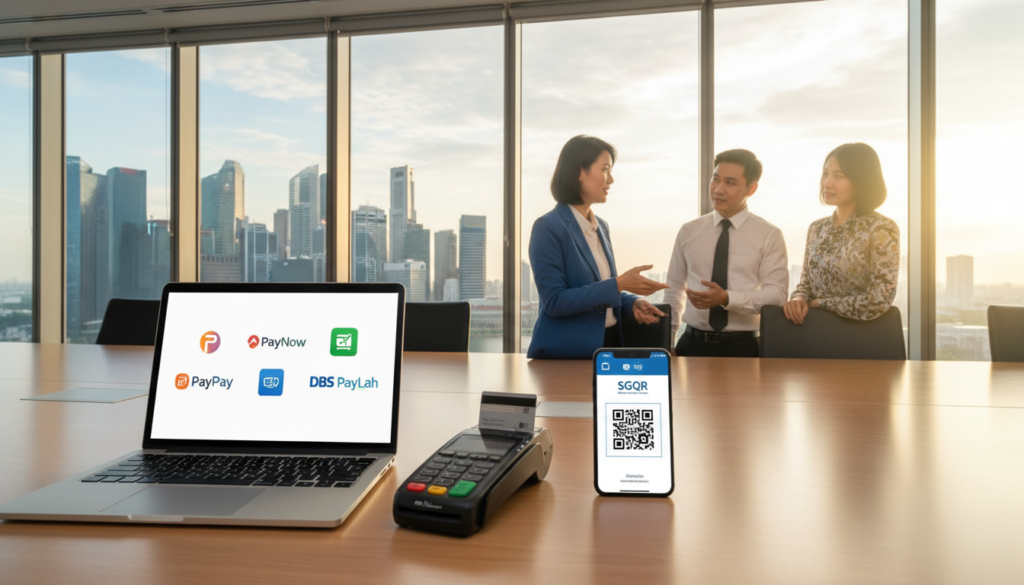
Shoppers want fast confirmation, mobile-first flows and recognisable options such as cards, wallets, bank transfers and QR codes.
Visa data shows 31% favour contactless cards and 23% prefer online card payments, so card usability online and in-person both shape expectations.
Regulation, currency and trust
The Monetary Authority of Singapore acts as central bank and regulator, which underpins trust in the wider payments system.
“Clear SGD pricing reduces surprise fees and improves conversion.”
Localising transactions by presenting SGD helps customers see true cost. Still, offer multicurrency options for cross-border buyers to avoid friction.
- Include both traditional and digital methods — adoption spans age groups, including seniors.
- Design for mobile and clear settlement expectations to protect margins and service levels.
Choose the right payment methods for Singapore-based customers and overseas clients
Local expectations around cards, wallets and bank rails shape which options you should offer first.
Start with trusted methods: prioritise card flows and major digital wallets, then layer on bank rails for faster settlement and cross-border options for travellers.
Card payments and contactless day-to-day
Optimise the card checkout for speed: saved cards, minimal fields and clear prompts. Contactless habits mean many customers expect quick, mobile-friendly flows.
Digital wallets that matter
Offer Apple Pay and Google Pay for device convenience. Add GrabPay because nearly half of wallet users report active use, which helps conversion for local shoppers.
FAST, PayNow, SGQR and instant bank transfers
FAST is the instant rail: immediate confirmation reduces pending tickets and speeds fulfilment. PayNow and SGQR let customers pay via familiar banking apps, keeping the mobile checkout low-friction.
BNPL, alternatives and crypto watch
Introduce BNPL only for higher baskets or younger segments where conversion lifts are clear. For tourists, enable region-specific wallets via your gateway. Treat crypto as experimental — adoption is rising but volatility and refund complexity need fiat settlement and compliance controls.
“Test method mix by segment, monitor failed transactions and iterate rather than launching everything at once.”
international clients payment singapore remote business workflows that scale
Map every step from quote to payout to make sure your platform, bank accounts and suppliers align.

Start by documenting the flow: quote → invoice → customer payment → reconciliation → settlement → payout. This visibility shows where funds pause and which team owns each hand-off.
Choose how to invoice and collect
Decide between invoices, payment links, hosted checkout or subscriptions based on product type and contract length. Use hosted flows for retail, links for ad-hoc work and subscriptions for retainers.
Multicurrency and local currency checkout
Present local currency at checkout to lower friction and lift completion rates for overseas customers. Offer a multicurrency option so buyers can choose their preferred rate and avoid surprise fees.
Manage FX, rates and settlement expectations
- Apply rates transparently; conversion fees typically range 1%–3% at checkout.
- Decide when to convert: on authorisation or at settlement to protect margins.
- Clarify settlement time vs authorisation time so teams know when funds are available.
Controls: set refund approvers, match transfers to invoices and keep audit-ready records of bank account entries and cut-off times.
Select a payment gateway or platform that fits your business model
Choosing the right gateway shapes checkout success and the way money flows into your accounts.
A gateway is the technical layer that securely captures card and wallet data, requests bank authorisation and returns confirmation to your checkout system. It sits between the customer’s bank, your merchant bank and your accounting tools.
Why choice matters: 77% of shoppers may abandon an order if their preferred payment method is missing. Coverage of local methods and clear fees often matter more to revenue than the lowest headline rate.
Compare providers on core criteria
- Domestic versus international fees and FX mark-ups.
- Support for local methods: PayNow, FAST, GrabPay and wallet rails.
- Chargeback tooling, dispute workflow and reporting depth.
- Settlement schedules, payout controls and reconciliation tools.
“Coverage and settlement currency can protect margins as much as fee rates.”
Like‑for‑like settlement and integrations
Like‑for‑like settlement means receiving and holding the same currency you charge. That reduces conversion losses when you price in SGD or other currencies. Airwallex and Adyen offer like‑for‑like options in key currencies for merchants in the market.
Integration paths vary by maturity:
- Hosted checkout — fastest go‑live and less PCI scope.
- Plugins — easy for common ecommerce platforms.
- Payment links — quick invoicing and sales outreach.
- APIs — full control for custom flows and nuanced routing.

| Provider | Best for | Local methods | Notable feature |
|---|---|---|---|
| Stripe | Developer-first platforms | Cards, wallets | Rich APIs and plugins |
| Airwallex | FX-heavy, treasury control | Bank rails, multi-currency | Like-for-like settlement in 20+ currencies |
| Adyen | Enterprise omnichannel | Cards, local rails | SGD/HKD/USD settlement options |
| Shopify / PayPal / HitPay / Opn | SME simplicity / marketplaces | Cards, wallets, local methods (varies) | Low-friction setups and plugins |
Operationally, check cut‑off times, refund handling and how finance can reconcile multi‑method receipts. Run a short A/B test: measure authorisation rate, end‑to‑end fees and support responsiveness before you commit to a single platform.
Set up secure payment processing and protect customer data
A layered security approach lets you process transactions with confidence and clarity.
Reduce data exposure by choosing vendors that tokenise card details and offer hosted checkout. Limit stored fields to essentials and use encrypted feeds between systems. This lowers your technical and compliance burden.

Fraud prevention essentials
Enable 3D Secure for stronger authentication where risk is higher. Use tokenisation to remove raw card data from your systems. Keep CVV checks for basic verification and apply velocity rules to block repeated attempts.
Privacy and regulatory basics
Follow PDPA: collect only necessary personal data, log consent, and document purpose. Ensure vendors meet MAS expectations under the Payment Services Act and maintain AML controls aligned with FATF guidance.
Operational readiness
- Monitor transactions for unusual patterns and cross-border anomalies.
- Maintain access controls, logging, patching and vendor security reviews.
- Keep audit-ready records to speed dispute responses and regulatory reviews.
“Fraud costs Singaporean customers an average of 1,648 SGD per year — strong controls protect trust and conversion.”
Plan incident playbooks, escalation paths and regular audits. Good security and compliance reduce risk and act as a conversion driver, not just a cost centre.
Handle fees, taxes, and compliance without slowing down payments
Fees and tax rules shape your checkout economics and affect how quickly funds reach your accounts. Keep billing simple so customers see the full cost and your finance team can reconcile fast.
GST in Singapore and when it applies
The GST rate is 9% and must be collected by registered sellers on taxable goods and services. Show GST clearly on invoices and receipts so customers know the breakdown.
Remit collected GST to IRAS on schedule and keep a separate ledger line for GST so remittances do not mix with operating cash.
Common cross-border cost categories
- International card fees: issuers and networks add 0.3%–1.5% on top of base rates.
- FX surcharges: currency conversion fees typically range 1%–3% and affect the net you receive.
- Bank transfer charges: corridor fees and receiving bank costs can be fixed or percentage-based.
Contractors, records and operational controls
Most contractors are self-employed and handle their own tax affairs. Businesses generally do not withhold tax or pay CPF for contractors, though exceptions can apply — verify per engagement.
Require contracts to state the currency for transfers and whether you will pay in SGD or another currency. Keep invoices, payment confirmations and FX breakdowns for at least five years.
“Transparent fees cut support requests and speed fulfilment.”
Practical controls: use separate accounts for collections and payouts, adopt consistent invoice numbering, and automate reconciliation. A clean chart of accounts and timely records make remittance and audits painless.
| Cost type | Typical range | Who usually bears it | Operational tip |
|---|---|---|---|
| GST | 9% | Seller (collected from customer) | Show GST line on invoices; remit to IRAS |
| Card network fees | 0.3%–1.5% | Merchant or passed to buyer | Negotiate rates; test absorbing vs passing on |
| Currency conversion | 1%–3% | Often merchant; can be passed on | Lock FX rules per invoice; store FX details |
| Bank transfers | Fixed or small % | Either party depending on corridor | Use local rails where possible; list charges clearly |
Reduce disputes, chargebacks, and payment failures
Disputes and chargebacks cost time and margin, so prevention must be built into checkout flows.
Why prevention matters: Singapore’s Consumer Protection (Fair Trading) Act and card network rules often place the burden of proof on the seller. That means clear records and fast responses protect revenue and reputation.
Timelines and what to expect
Customers can typically raise a dispute up to 120 days after a purchase. Networks like Visa and Mastercard then give merchants a shorter window — often around 45 days — to submit evidence.
Evidence checklist to defend a claim
- Invoice and order details with visible pricing.
- Customer communications and proof of refund policy acceptance.
- Delivery confirmation, access logs or fulfilment receipts.
- IP/device signals and billing address match where relevant.
Operational fixes to reduce failures and disputes
Use clear statement descriptors, accurate delivery dates and easy refund flows. Retry soft declines, prompt customers to update billing details, and offer alternative payment methods at checkout to lower abandoned carts.
“Instant receipts and order tracking turn many potential disputes into non‑issues.”
| Area | Action | Benefit |
|---|---|---|
| Checkout | Offer preferred payment methods and retry logic | Fewer declines; lower abandonment |
| Post‑sale | Send instant receipts and tracking | Reduces “did not receive” claims |
| Dispute handling | Store invoices, comms, delivery logs | Faster, stronger responses to chargebacks |
Continuous improvement: review dispute reasons monthly, tune fraud rules to avoid false blocks, and update checkout copy to set clear expectations for customers and teams.
Conclusion
Practical fixes — method mix, transparent pricing and fast rails — deliver quick wins.
Understand local expectations, choose the right methods and standardise cross-border workflows to reduce friction. These steps boost conversion and make cashflow more predictable.
Priorities: cover cards, wallets and instant rails like FAST/PayNow/SGQR, show clear currency handling, and set settlement SLAs so teams know when funds arrive.
Governance matters: embed security controls, PDPA‑aware data handling and routine compliance checks to keep scaling safe.
Action checklist: audit your stack, shortlist gateways by method coverage and FX, run a pilot and monitor disputes and failure rates. For payroll or hire options, review a trusted partner such as payroll options.
Keep optimising: track checkout drop‑off, approval rates, net fees and time‑to‑funds to improve results over time.
FAQ
Why is Singapore a strong market for online payments and growth?
What do local customers expect at checkout in Singapore?
How does MAS oversight affect transaction handling and currency use?
Should I prioritise card payments or digital wallets for day-to-day transactions?
Which digital wallets should businesses support in Singapore?
What does “instant” mean for FAST transfers and customer experience?
When is it appropriate to offer BNPL or alternative methods?
Are cryptocurrencies worth integrating, and what are the risks?
How should I invoice and get paid across multiple countries?
When should I offer multicurrency pricing and local currency checkout?
How do FX rates and conversion fees impact my margins?
What settlement timelines and bank transfer expectations should I set?
What exactly does a payment gateway do?
How do I compare gateway and platform providers?
When does like-for-like settlement matter to protect margins?
Which integration options should I consider for my website?
Which providers are commonly used in Singapore?
What fraud prevention measures are essential?
How do I comply with PDPA and protect customer data?
What obligations does the Payment Services Act impose?
How should I prepare for cybersecurity incidents and audits?
When does GST apply to goods and services sold to Singapore customers?
What cross-border fees should I expect?
How should I manage contractor payments and tax records?
How can I reduce disputes and chargebacks?
What evidence is effective for defending a chargeback?
What operational fixes reduce payment failures and abandonment?
How does adopting preferred local methods lower abandoned cart rates?

Dean Cheong is a Singapore-based B2B growth strategist and the CEO of VOffice. He helps companies scale revenue through sharper sales execution, CRM implementation, and go-to-market strategy, backed by a strong foundation in business banking and finance from Nanyang Technological University and a track record of driving sustainable, performance-led growth.