
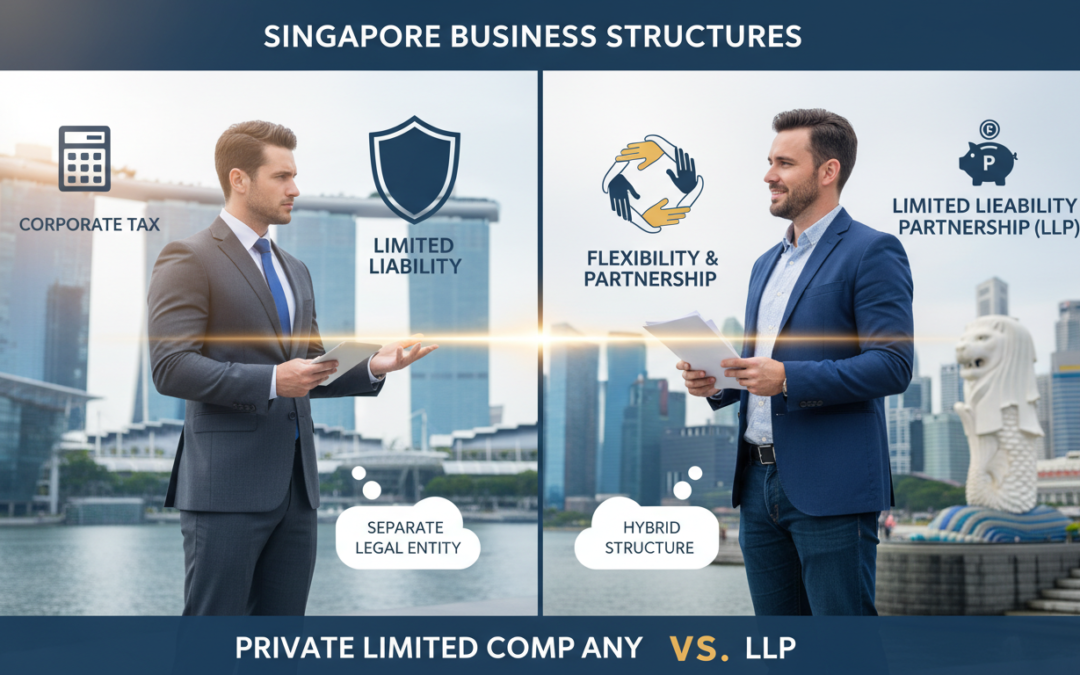
Which choice today can save you time, tax and risk as your venture grows? This guide compares a pte ltd company with a limited liability partnership so founders can decide with confidence.
Choosing the right business structure affects tax bills, personal exposure, compliance effort and how banks or investors view your venture. Early decisions can avoid costly restructuring later.
The article previews legal status, liability limits, tax treatment, management control, incorporation steps and capital‑raising potential. You will see where both options protect personal assets and where their protections differ in practical disputes and professional claims.
Read on for a clear snapshot for quick scanning, followed by deeper sections to help you stop second‑guessing and pick the setup that matches growth plans and administrative capacity.
Key Takeaways
- Decide early: the right choice can reduce future restructuring costs.
- pete ltd offers corporate tax treatment and stronger investor credibility.
- An LLP gives pass‑through taxation and simpler running costs at small scale.
- Liability protection exists for both, but scope varies by claim type.
- Consider compliance load, funding needs and management control when choosing.
Why choosing the right business structure in Singapore matters
Choosing the correct legal form shapes how your enterprise pays tax, manages risk and handles everyday admin.
Tax outcomes change with structure. Some entities pay tax at the company level while other arrangements pass profits to individuals or partners. That difference alters cash flow planning, dividend decisions and projected tax bills.
Liability protection is more than a label. The chosen form decides whether creditors can reach personal assets after debt recovery, professional claims or disputes. Conduct and governance also affect how protections hold up in practice.
The day-to-day compliance requirements differ too. One setup may need annual returns, audited financial statements and a company secretary. Another may require a simpler annual declaration and fewer filings. These choices influence ongoing accounting and secretarial costs.
- Match structure to your business goals—consultants and early startups value different trade-offs between flexibility, governance and investor readiness.
- Switching later carries hidden costs: professional fees, contract novations, bank changes, licence updates and stakeholder notices.
Practical checklist: decide once, set up cleanly and minimise compliance friction as the business grows.
What is a Private Limited Company (Pte Ltd)?
Forming a pte ltd creates an entity that holds assets, signs contracts and bears liability in its own name.
Separate legal entity: A pte ltd is a legal entity distinct from its owners. It can own property, enter agreements and sue or be sued in its own name.
Limited liability protection: Shareholders normally risk only the capital they invest. This separation helps founders manage personal exposure to business debts and claims.

How shareholding and governance work
Shares move by transfer, which makes ownership changes and exits straightforward compared with other structures.
Directors run the company while shareholders own it. A corporate secretary and at least one local director are statutory requirements that boost governance and regulatory discipline.
- Ownership: flexible share transfers for exits or new co‑founders.
- Credibility: banks, larger clients and investors favour the governance signals a company sends.
- Trade‑offs: stronger financing options and scalability come with higher compliance and costs.
For a side‑by‑side look at how a pte ltd compares in practice, see our pete ltd comparison.
What is a Limited Liability Partnership (LLP) in Singapore?
An LLP blends partnership-style teamwork with the protections of a separate legal entity.
How an LLP combines flexibility with limited liability
A limited liability partnership is formed by two or more partners and has its own legal identity. It offers pass-through tax treatment so profits flow to partners for personal taxation.
Management stays partner-led and agreements can fix profit sharing and decision rights. Compliance is lighter: no AGMs and a single annual declaration replace heavier company filings.
Who it suits and key limits
Professional services firms — consultants, lawyers and accountants — often choose this model for simplicity and collaboration.
“Partners are not liable for each other’s misconduct, but remain personally liable for their own negligence.”
| Feature | Practical effect | When it matters |
|---|---|---|
| Separate legal entity | Can contract and hold assets in its name | Client engagements, leases |
| Pass-through tax | Profits taxed at partner level | Cashflow planning |
| No shares | Funding via partner contributions | Scaling and investor raises |
- Best for small professional teams seeking low admin.
- Bear in mind personal liability for your own acts when offering regulated services.
private limited vs llp singapore: snapshot of the key differences
Use this side-by-side view to see how ownership, tax, compliance and fundraising differ between the two setups.

Legal entity and ownership model
pete ltd and an LLP both operate as separate legal entities in practice. Ownership in a pte ltd rests in shares. That makes ownership transfers and exits cleaner.
In an LLP, partners govern ownership by agreement. There are no shares and changes rely on partner consent.
Tax treatment at a glance
pete ltd pays tax at the company level under corporate tax rates. An LLP uses pass-through taxation so partners pay tax on their share of profits.
Compliance requirements and ongoing admin
A pte ltd typically files annual returns, prepares financial statements and appoints a secretary. Compliance and reporting are heavier.
An LLP needs a lighter annual declaration and record-keeping but still must meet statutory requirements.
Capital raising and growth potential
A pte ltd can issue shares to raise capital and scale faster. An LLP relies on partner contributions and may face limits when courting external investors.
Quick guide: consider ownership flexibility and your growth plan first; later sections unpack each comparison row with practical advice on when each factor matters most.
Legal entity status and liability protection for personal assets
How a business is recognised by law determines who answers for its debts and claims.
Separate legal entity explained: A recognised entity can hold assets, sign contracts and be sued in its own name. That separation means creditors first look to the entity, not the people behind it, when obligations are unmet.
Pte Ltd liability boundaries
A company generally keeps debts and contractual obligations at company level. This offers clear liability protection for shareholders’ personal assets in most cases.
Exceptions include personal guarantees, fraud or directors’ breaches. For large loans, lenders often ask for guarantees that can pierce that protection.
LLP liability boundaries
An LLP protects partners from liabilities caused by other partners. However, a partner remains personally liable for their own negligence or wrongful acts.
For client-facing firms, professional indemnity claims can create direct exposure for the individual at fault.
Business continuity and succession
Companies typically offer stronger perpetual succession and smoother ownership transfers. This reassures investors and creditors.
An LLP can continue after partner changes if the agreement provides for it, but practical continuity depends on the partnership deed and governance.
- High-risk contracts or heavy borrowing: consider a company for clearer separation and stakeholder confidence.
- Small advisory teams with lower borrowing needs: an LLP may balance flexibility with useful protection from others’ misconduct.
| Aspect | Who bears liability | Practical notes |
|---|---|---|
| Debts and contracts | Entity | Creditors claim against company or partnership; personal guarantees change this |
| Professional negligence | Individual at fault | Partner or director can be personally liable for own misconduct |
| Succession | Company: stronger | LLP: continuation possible with clear agreement |
Taxation in Singapore: corporate tax vs pass-through taxation
Understanding tax treatment helps you plan distributions, reinvestment and founder take‑home pay.

Pte Ltd corporate tax rates and exemptions to know
Companies pay tax on profits at the corporate level. The headline corporate tax rate is 17%.
Early-stage firms often benefit from exemptions that reduce effective tax. For example, a practical relief sometimes cited is a 75% exemption on the first S$100,000 of taxable income for qualifying companies.
LLP pass-through taxation and personal tax rates for partners
An LLP is usually treated as pass-through. Each partner is taxed on their share of profits at their personal tax rates.
Where a partner is a company, that partner’s share is taxed at the corporate rate. Personal tax bands can reach higher marginal rates than the company rate.
When a Pte Ltd can be more tax-efficient as income grows
Pass-through is attractive for low or uneven income because partners may pay less tax individually.
As income rises and profits are retained for growth, a pte ltd often becomes more efficient. The company retains earnings taxed at 17%, which can be cheaper than high personal tax bands on distributed profits.
Profit distribution and withdrawal considerations for LLP partners
Plan allocations and withdrawals carefully. Deductible losses or allowances may be limited to capital contributed and excess withdrawals can be treated as taxable income.
Bottom line: tax outcomes depend on partner profiles, reinvestment plans and pay strategies. Seek accountancy advice before choosing a structure.
| Aspect | Effect | When it matters |
|---|---|---|
| Tax base | Entity-level vs pass-through | Reinvestment strategy |
| Typical rates | 17% corporate; personal bands higher | High-earner partners |
| Withdrawals | May be taxed if excess | Regular profit draws |
Compliance requirements and annual filings with ACRA
Keeping on top of statutory deadlines stops small compliance slips becoming costly problems.
Companies must meet ACRA filing rules year round. That includes annual returns and, where applicable, the preparation and filing of financial statements. Statutory registers and minute books must be maintained to prove proper governance.
Pte Ltd obligations
A pte ltd typically files annual returns, prepares financial statements and keeps statutory registers. A company secretary is required to manage resolutions, filings and deadlines.
These steps underpin governance expectations from banks, investors and regulators.
LLP obligations
An LLP faces fewer formalities: no AGM requirement and a simpler annual declaration process. It still must keep accurate records of transactions and its financial position.
Practical impact on accounting and costs
Compliance translates into bookkeeping, annual accounts preparation and secretarial retainers. Outsourcing compliance and accounting services is common to lower the risk of late filings and penalties.
Choose the structure that matches your administrative capacity: lean operations may favour lower recurring obligations, while growth plans often justify higher governance costs.
Management and control: directors, shareholders, and partners
Who runs the organisation day-to-day shapes decision speed, accountability and how earnings are shared.
Pte Ltd governance splits ownership from control. Shareholders hold ultimate ownership, while a board of directors runs the company’s daily affairs.
This separation aids scalability. Clear roles help when hiring executives, dealing with audits or courting investors.

Pte Ltd board versus shareholders
Directors make operational decisions; shareholders vote on major changes. That formal division creates predictable governance and legal accountability.
Partner-led operations
In an LLP, partners manage the business directly. Decisions can be quicker and align with client work and billings.
Profit sharing in a partnership can be flexible. Partners may agree allocations that reflect contribution, client origination or seniority rather than strict ownership ratios.
Practical friction arises when partners disagree. A robust agreement is essential to govern disputes, decision thresholds and exit terms.
| Aspect | Pte Ltd | LLP |
|---|---|---|
| Decision maker | Directors | Partners |
| Profit allocation | Dividends by shareholding | Contractual, flexible |
| Stakeholder clarity | High (formal) | Moderate (agreement dependent) |
Takeaway: choose a pte ltd when governance scalability and role clarity matter. Choose an LLP when collaborative delivery and flexible economics are priorities.
Incorporation requirements and set-up costs in Singapore
Setting up a company correctly reduces delays and prevents avoidable compliance costs.
Minimum roles and appointments
Pte Ltd typically needs at least one locally resident director and a company secretary. A private limited company must meet these appointments before registration.
Limited liability partnership requires at least two partners and one local manager to act as the authorised contact for filings.
Registration fees and budgeting
ACRA fees differ by structure. Expect approximately S$315 to register a pte ltd and S$115 for an LLP. Include these figures when planning initial incorporation costs.
Registered office and core documentation
Both entities must provide a registered office address in Singapore for official correspondence.
Prepare identification and proof of address for relevant individuals, plus a company constitution for a company and a partnership agreement (recommended) for an LLP.
“Clear documentation and correct role appointments stop costly re-submissions.”
| Requirement | Pte Ltd | LLP |
|---|---|---|
| Minimum local appointment | One local director; company secretary | One local manager; two partners |
| ACRA registration fee | S$315 | S$115 |
| Core documents | ID, address proof, company constitution | ID, address proof, partnership agreement |
When to use professional services
Incorporation services can handle name checks, draft agreements and ensure the requirements and filings are met the first time. This reduces delays and regulatory risk.
Raising capital, bringing in investors, and scaling the business
Raising outside funds becomes easier when the vehicle allows for standard equity instruments and clear ownership records.
Pte Ltd advantage: issuing shares to raise capital
A pte ltd can issue shares, which is the cleanest way to bring in capital and investors. Equity sales allow startups to attract angel or venture investment without immediate cash repayments.
Issuing shares also supports employee equity plans. That helps retain talent during growth.
LLP limitations: partner contributions and investor perception
An LLP cannot issue shares. Funding usually comes from partner contributions or retained earnings.
External investors often prefer companies because standard term sheets and due diligence maps onto share capital structures. This can make partnerships less attractive for high-growth funding.
Ownership transferability: share transfers vs partner consent
Shares in a company are generally transferable, subject to articles and shareholder agreements. This makes exits and new investment cleaner.
Changing ownership in an LLP typically needs partner consent and renegotiation of economic and governance rights. That process can slow growth and complicate investor exits.
- Why choose a company for growth: issuing shares simplifies fundraising, onboarding investors and offering employee equity.
- Scaling with equity: capital raised can fund hiring, product development and market expansion without draining cash flow.
- Partnership reality: funding relies on partners or cashflow; some investors may decline structures that lack share instruments.
- Practical tip: if you expect VC, angel investment or strategic investors, start with a pte ltd to align with typical term sheets and due diligence.
- Future-proofing: even bootstrapped teams may choose a structure that preserves options and avoids disruptive restructuring later.
| Aspect | Company | Partnership |
|---|---|---|
| How to raise capital | Issue shares, investor rounds | Partner contributions, retained earnings |
| Investor appeal | High—standard instruments | Lower—requires bespoke terms |
| Ownership change | Share transfer procedures | Consent and deed renegotiation |
Bottom line: choose a structure that matches your fundraising ambitions and keeps future options open for growth and investor exits.
Credibility, banking, and winning clients in Singapore
Perception influences commercial outcomes. Credibility can be the difference between winning a tender and being screened out. Larger buyers and financiers often read governance signals as a proxy for reliability.
Why a pte ltd can signal stability for contracts and financing
A pte ltd often reads as more structured and governed. Procurement teams and banks favour entities with formal roles, audited accounts and clear reporting lines.
This makes it easier to secure larger contracts, negotiate credit and satisfy investor due diligence. A limited company also offers corporate separation that reassures counterparties about legal protection.
When an LLP credibility is sufficient for niche professional services
For specialist services that sell partner expertise, an LLP can be enough. Clients buying adviser knowledge judge individuals more than the legal vehicle.
- Enterprise clients and institutional funding usually prefer a pte ltd for scale and governance.
- Small teams delivering bespoke services may operate effectively as a partnership if reputations are strong.
Practical takeaway: match your structure to the buyer you want — choose the model that best supports your sales, banking and risk objectives.
How to choose between a private limited company and an LLP
Start by asking whether you need equity instruments and investor appeal, or simple profit sharing and low admin.
Best fit for startups aiming to grow, hire, and seek investment
If your business plans include hiring, stock incentives and external funding, a private limited company often wins. A pte ltd lets you issue shares, run employee equity schemes and present a familiar structure to investors.
Best fit for small teams prioritising flexibility and low admin
Small adviser teams or collaborators benefit from a limited liability partnership that keeps compliance light. Partners can agree flexible profit splits and run operations with fewer formal filings and lower secretarial cost.
Risk and liability checklist for professional services firms
- Client money handling — clear segregation and protocols.
- Advice liability — assess professional indemnity needs.
- Regulatory obligations — licences or registration for regulated services.
- Individual negligence exposure — who bears personal liability.
When to consult legal and accounting professionals before incorporation
Seek counsel if there are multiple partners, cross-border owners, regulated activities or plans to restructure soon. Good legal and accounting advice prevents costly changes later.
Tax and admin checkpoint: estimate profit levels, whether profits will be reinvested, and your ongoing capacity for compliance and accounting. These factors determine whether touted tax benefits are real for your case.
“If you expect investor rounds or wide hiring, favour a company; if you need simple partner-driven delivery, an LLP may suit.”
If/then summary: if you aim to scale quickly, hire and attract investors, choose a pte ltd; if you are a small, hands-on team that values flexibility and low admin, consider a limited liability partnership. For a detailed comparison, see this guide.
Conclusion
Your choice of legal form shapes how you pay tax, raise funds and manage risk over the next few years.
, In short: a pte ltd usually suits a growth-focused company that needs investor credibility and share-based fundraising. A limited liability partnership suits partner-led service firms that value flexible profit sharing and lighter compliance.
Key practical differences are clear: how tax is applied, the degree of liability separation, annual compliance workload and the ability to raise capital through shares.
Decide with your 12–36 month plan in mind — projected income, hiring, financing needs and client type — since correct incorporation now avoids costly restructuring later.
Next step: shortlist goals, speak to an accountant or lawyer, then register the structure that best supports your Singapore business plan.
FAQ
What are the main differences between a Pte Ltd company and an LLP in Singapore?
How does choosing the right business structure affect tax and liability protection?
Can I switch from an LLP to a Pte Ltd later, and what are the costs?
What tax rates and exemptions should I know for a company?
How is income taxed for partners in an LLP?
What ongoing compliance obligations does a company have with ACRA?
How do compliance requirements for an LLP compare?
What are the governance differences between directors/shareholders and partners?
What are the minimum appointments and set-up costs for each entity?
Which structure is better for raising capital and attracting investors?
How does each option affect business credibility and banking relationships?
When is a company the better choice for startups and growth-focused businesses?
When does an LLP make more sense for small teams or professional practices?
What liability risks remain for partners in an LLP?
What should I discuss with advisers before incorporating?

Dean Cheong is a Singapore-based B2B growth strategist and the CEO of VOffice. He helps companies scale revenue through sharper sales execution, CRM implementation, and go-to-market strategy, backed by a strong foundation in business banking and finance from Nanyang Technological University and a track record of driving sustainable, performance-led growth.