

Could one administrative choice shape your tax, licence and grant outcomes?
This practical introduction explains why selecting the right SSIC code is more than a formality. It affects compliance, licensing, tax treatment, grants and processing time during registration.
By the end of this short guide you will be able to prepare clear activity descriptions, use ACRA keyword search and browse the SSIC list with confidence. You will also learn how to handle hybrid business models and check licence or referral implications.
Key constraints matter: a local firm may register a principal and an optional secondary classification, so prioritisation matters from day one. Apply the accuracy principle — the classification should reflect what you actually do, not branding or future plans.
This article is a practical how-to for founders, SMEs and overseas teams planning incorporation. Choose correctly and you reduce delays; choose poorly and expect extra reviews and hold-ups.
Key Takeaways
- Correct selection impacts compliance, tax and licences.
- Prepare precise activity descriptions before registration.
- Use ACRA tools and the SSIC list to validate entries.
- Prioritise a principal classification and an optional secondary.
- Reflect actual operations, not aspirations.
Understanding SSIC in Singapore and why it matters for registration
A short numeric label can shape how regulators view your trade and what you must apply to operate.
What it is: The standard industrial classification is the national system used to classify a business activity for regulatory and statistical use. It maps local operations to the international standard and helps agencies interpret what a firm does.
Who maintains it: The Singapore Department of Statistics (SingStat) maintains and updates the list. Updates follow international changes and shifts in the economy to keep categories relevant.

How ACRA uses the classification
During registration ACRA checks your entry to spot regulated activities. This can trigger referral checks or flag licences that must be applied before operations begin.
How IRAS applies the list
IRAS uses the designation to decide tax treatment and whether incentive schemes or exemptions may apply. Correct classification can influence eligibility for grants and tax relief.
Cross-agency visibility and founder impact
The designation becomes part of the official business profile. Other government agencies rely on it when assessing licences, inspections and support schemes.
Why founders should care: A mismatched classification can cause compliance friction, incorrect tax assumptions and extra scrutiny. If you want a quick primer, read what they are and why they.
How Singapore Standard Industrial Classification codes are structured
Understanding the numbering system helps you read a business classification at a glance.
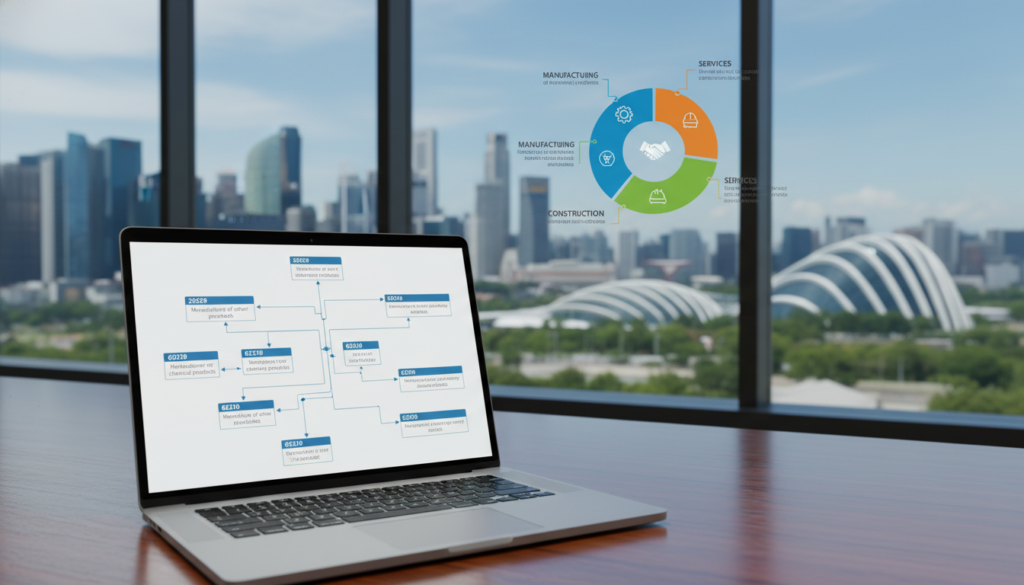
The list uses a clear hierarchy: section (letter), division (2-digit), group (3-digit), class (4-digit) and sub-class (5-digit). The five-digit entry is the one you pick during ACRA registration and bundles all higher levels into a single identifier.
Practical example: Section C (Manufacturing) → Division 26 → Group 261 → Class 2611 → Sub-class 26112 (wafer fabrication). This shows how a specific 5-digit number reflects broader categories above it.
Common endings and markers
Trailing “0” usually means no further split. Codes ending in “9” often denote n.e.c. (not elsewhere classified). Choose an N.E.C. only when no specific sub-class matches your activity.
Some entries carry markers: a single asterisk can signal agency approval; a double asterisk may require a licence before operations. These flags can affect timelines and the need for permits or licensing checks.
| Level | Label | Digits | Meaning |
|---|---|---|---|
| Section | Letter | — | Broad sector (e.g., Manufacturing) |
| Division | 2-digit | 26 | Major industry area |
| Group/Class | 3–4 digit | 261 / 2611 | Increasing detail |
| Sub-class | 5-digit | 26112 | Selected during registration |
- Read numbers left to right: broader to specific.
- Use markers to anticipate approvals and avoid misclassification risk.
Preparing your business activity details before you choose a classification code
Begin with a plain-language inventory of revenue streams and daily operations before you search the list.
Worksheet approach: write down each source of income and every operational task in one line. Use terms customers would recognise: sales of goods, repair services, software development, manufacturing or storage. This makes later mapping to a numeric label far easier.
Defining principal, secondary and ancillary activities
Principal activity is the one that creates the most value. If value added (VA) is unavailable, use sales value, gross output or employment as a proxy.
Secondary activities are meaningful external services the firm provides but do not generate the most revenue. Ancillary activities (HR, bookkeeping, internal storage) usually do not determine the industrial entry.
Choosing up to two SSIC codes and aligning them to revenue or value contribution
You may register two entries only. Pick the principal entry for the highest revenue or VA contributor, then select a secondary entry if the next activity is material and external-facing.
Example: retail sale of handphones as principal; device repair services as secondary. Ensure each description matches the actual services, manufacture or processing you do.

Final tip: produce a short mapping document showing revenue lines, chosen entries and the proxy used (sales, shipments or wages). A clear record reduces queries during ACRA checks and licence referrals.
ssic code selection for singapore company using ACRA search and keyword techniques
Use ACRA’s search tool with plain English terms to narrow down matching industry entries quickly.
Start simple: enter a single, non-technical keyword a customer would use (for example: “web design”, “catering” or “device repair”). This improves the likelihood the official list returns a close match.
Choosing keywords that describe what you do in plain terms
Translate sector jargon into everyday phrases before you search. Industry slang often differs from the wording in the registry.
Keep a short list of synonyms and use them one at a time.
Testing keyword variations to improve search results
Try broader and narrower terms, upstream or downstream activities, and common misspellings. Record which keywords return useful entries.
Validating the SSIC code against your actual services, manufacture or processing work
Once you shortlist an entry, compare its description to what you actually sell and how you produce it. If the match is weak, keep searching.
Using a custom business activity description when no perfect match exists
Choose the closest functional fit and add a clear custom description in BizFile to explain scope without contradicting the chosen entry.
Manual browsing in the SSIC 2020 list when search results are unclear
If results are interchangeable, open the 2020 list and read adjacent sub-classes by section and division. This often reveals a better fit.
“Keep an internal note of why you chose the entry — what you sell, how you earn and who you serve.”
Handling tricky classification scenarios and modern business models
Modern business models often blend sales, services and digital products, making classification tricky.
Ranking hybrid activities
Decide the principal activity by ranking revenue or value added. Use the second entry only when another activity is genuinely significant.
Outsourcing and platforms
If fulfilment is outsourced, classify what your business economically does: selling goods, operating a platform, or providing professional services.
For online marketplaces, consider marketplace-specific ssic code entries like 63201, 63202, 63203 or 63209 rather than merchant goods.
Tech, data and development splits
Distinguish software development (62011/62012/62013) from IT consultancy (62021/62022). Use 63119 for data analytics or processing where no fit exists, cautiously.
Trade distinctions and misclassification risk
Wholesale is B2B distribution; retail sells to end consumers; manufacturing transforms inputs into goods. Misclassifying affects licences and tax.
“Classify by economic role: who pays, who uses the inventory and where value is created.”
- Who is the customer: consumer or business?
- Do you own inventory or merely facilitate sales?
- Do you transform inputs or earn fees/commissions?

| Scenario | Key question | Example entry |
|---|---|---|
| Marketplace | Do you run the platform or sell goods? | 63201 / 63209 |
| Software vs consultancy | Do you build products or advise? | 62011 / 62021 |
| Retail vs manufacturing | Do you transform inputs or resell? | Retail: retail class / Manufacturing: manufacturing class |
Licensing, grants and tax implications of choosing the right SSIC code
Picking the correct industrial label affects more than paperwork—it can change licences, grants and tax outcomes.
Licences and permits: Your registration entry acts as a signal to agencies. ACRA may flag an activity and forward details to licensing authorities. That can lead to licensing checks or the need to apply for specific permits before operations begin.
A concrete example: a real estate agency must hold a licence from the Council for Estate Agencies. Selecting a related industry entry can trigger immediate checks and requests for supporting documents.
Grants, tax and government support
Government grants and tax incentives often depend on industrial classification. IRAS uses the designation to assess eligibility for incentives and tax rebates.
Choose the right SSIC code and you improve your chance of accessing grants and support schemes. Choose poorly and you may miss targeted incentives or face reassessment.
Regulated sectors and referral timelines
Certain entries prompt referral to bodies such as MAS or Enterprise Singapore. Referral reviews can extend approval time and push the process from days into weeks.
| Trigger | Referral agency | Estimated review time |
|---|---|---|
| Financial activities | MAS | 14–60 days |
| Export / industry grants | Enterprise Singapore | 14–60 days |
| Licenced trades (e.g., real estate) | Relevant authority | 14–60 days |
Practical advice: pick the most accurate entry, prepare concise supporting explanations, and build the extra time into your incorporation and launch plans. Lenders and insurers also review industry labels when assessing risk, so correct classification helps with financing and contractor engagement.
For a practical guide to choosing the right ssic code, keep a short mapping of activities, revenue proxies and licences required before you submit your registration.
Common SSIC codes by business category and how to shortlist quickly
Use practical cues—who pays and what you deliver—to narrow a long list to a few likely matches.
Fast shortlisting approach: start with the sector (technology, trade, F&B, real estate, finance). Then pick the sub-class that maps to your main revenue-generating product or service.
Technology, IT consultancy and data processing
Common picks: 62011 (software/apps), 62012 (games), 62013 (cybersecurity software). Use 62021 when you provide IT consultancy; use 62022 if consultancy focuses on cybersecurity. Choose 63119 for data analytics or processing n.e.c.
Online marketplaces
Marketplace entries include 63201 (goods), 63202 (health services), 63203 (education), 63209 (services n.e.c.). These suit platform operators earning commissions or fees rather than direct sellers.
Wholesale, retail and product examples
Wholesale examples: 46309 (food & beverage n.e.c.), 46522 (electronic components), 46412 (other trade). Retail examples: 47411 (handphones), 47510 (fashion), 47729 (pharmaceutical/medical goods n.e.c.).
F&B, real estate, transport and finance
F&B: 56111 (restaurants), 56121 (fast food), 56130 (pubs), 56200 (catering). Real estate and transport entries (68101, 68201, 49214) and financial entries (64120, 64922) often trigger licences — choose with extra care.
Professional and frequent service entries
Common professional listings include 69101 (legal), 69201 (accounting), 71111 (architecture), 73100 (advertising), 74192 (design), 93111 (fitness), 96022 (beauty salons).
| Sector | Typical entry | When to pick | Quick cue |
|---|---|---|---|
| Technology | 62011 / 62012 / 63119 | Product vs game vs analytics | Main revenue from software |
| Marketplace | 63201 / 63209 | Platform fees or commissions | Operator, not merchant |
| Retail / Wholesale | 47411 / 46522 / 46309 | Consumer retail vs B2B trade | Who buys your stock |
| F&B / Services | 56111 / 56200 / 69101 | On-premise service vs catering vs professional | Service model and customer |
Validation reminder: even with a shortlist, confirm the official description matches your actual business activity and customer proposition before you lock the entry in. Keep a short mapping note to justify the pick during registration checks.
Conclusion
Your registration label acts as the government’s shorthand of what you do; treat it precisely.
,Choose an accurate ssic entry and you smooth the incorporation and registration process. Define principal and secondary activities, shortlist with ACRA search and manual browsing, then match the official description to real operations.
Picking the right code reduces referral delays, avoids missed permits and supports correct tax treatment. If activities change, update the profile via ACRA BizFile and review the list when it is revised.
Next step: write one short business description, list top revenue activities and run a final check for licensing triggers before you submit.
FAQ
What is the purpose of the Singapore Standard Industrial Classification and who maintains it?
How does the industrial classification affect my company registration and compliance?
How is the SSIC 2020 structure arranged and what do the digits represent?
What do common endings like “0” or “n.e.c.” mean in the classification list?
When might a particular classification trigger licensing or approval requirements?
How should I prepare my business activity description before choosing a classification?
How many classification entries can I choose and how should I prioritise them?
What search techniques help find the appropriate classification using ACRA’s tools?
How do I validate a chosen entry against real services, manufacturing or processing work?
What if no single entry perfectly matches my business activity?
How should hybrid businesses decide their principal activity when operations are mixed?
How are digital, software and cybersecurity activities distinguished in the classification?
How can businesses avoid misclassifying retail, wholesale and manufacturing activities?
In what ways can the classification affect licences, grants and tax incentives?
Which regulated sectors require extra checks and can extend approval timelines?
What are common entries used by technology, IT consultancy and data processing firms?
Which entries suit online marketplaces that handle goods, education or health services?
How do I shortlist classification entries quickly for wholesale, retail or food businesses?
What entries are commonly used by professional services, real estate, transport and finance firms?
Where can I get help if I remain uncertain about the right classification?

Dean Cheong is a Singapore-based B2B growth strategist and the CEO of VOffice. He helps companies scale revenue through sharper sales execution, CRM implementation, and go-to-market strategy, backed by a strong foundation in business banking and finance from Nanyang Technological University and a track record of driving sustainable, performance-led growth.