

Wondering what immediate steps will protect your new business from fines, banking friction and regulator notices? In 2026, higher regulatory expectations and more digital reporting mean founders must act fast. This short guide maps the essential tasks that keep a new company compliant, clear and ready to trade.
Compliance is not a single checklist item. It is an ongoing governance process that starts the day you form the legal entity and continues through each financial year.
This guide explains key milestones: choosing your Financial Year End, checking audit needs, appointing a company secretary, issuing shares, keeping registers, setting up accounting, licensing, banking and annual filings. Founders and business owners will find a practical, step-by-step map and advice on integrated corporate services that reduce filing errors and regulatory risk. For a fuller six‑month checklist and next steps, see this must-do checklist.
Key Takeaways
- Compliance starts at formation and continues year‑round.
- Your Financial Year End shapes filing deadlines and workload.
- Early appointments—secretary, auditor (if required)—avoid penalties.
- Integrated secretarial, accounting and tax services cut errors.
- Missing deadlines can cause bank issues, fines or striking-off.
Why post-incorporation compliance matters for Singapore companies
Clear early compliance keeps a new company resilient to fines, banking delays and regulatory scrutiny. Good habits made in the first months reduce risk and make growth smoother.
What these duties cover
- Corporate records: maintain registers, minutes and share ledgers.
- ACRA filings: timely annual returns and updates for director, shareholder or registered office changes.
- Tax filings: IRAS submissions, ECI and corporate tax returns on time.
- Governance: board resolutions and documented processes under the Companies Act framework.
Risks of non‑compliance today
Regulators and banks now cross‑check records digitally. Data analytics make inconsistencies easy to spot. Small record errors can trigger late fees, follow‑up notices, rejected bank onboarding, investor friction and, in serious cases, striking‑off.
Use the rest of this guide to build simple systems that keep filings consistent, reduce tax risk and support fundraising and year‑end reporting.
Set your Financial Year End to control deadlines and workload
A well‑timed Financial Year End turns recurring deadlines into predictable workflows for your team.

How FYE guides ECI, AGM timing and filing windows
FYE sets the clock for Estimated Chargeable Income submissions, AGM scheduling and filing annual returns. Pick a date and the regulatory windows follow.
Common FYE choices and which suits your cycle
Popular dates are 31 March, 30 June, 30 September and 31 December.
| FYE Date | Best for | Why it helps |
|---|---|---|
| 31 March | Retail with year‑end sales | Aligns with post‑Q4 stock and sales reports |
| 30 June | Project billing cycles | Fits mid‑year project closes |
| 30 September | Subscription models | Spreads workload outside tax peak months |
| 31 December | Calendar year businesses | Matches corporate planning and investor reporting |
First‑year timing pitfalls to avoid
Choosing an FYE too soon after formation can force rushed bookkeeping and incomplete reconciliations. That raises error risk on ECI and other filings.
“Pick an FYE that eases your close process, not one that creates a deadline crunch.”
Document the rationale for your chosen FYE so directors can justify timing during audits, funding or compliance reviews. Spread close tasks away from peak business months to reduce strain and costly mistakes.
Check whether you must appoint an auditor within three months
Early audit decisions shape your company’s financial credibility and filing timetable.
An auditor provides an independent review of your company financial statements. This supports recognised reporting standards and gives stakeholders confidence in the numbers.
The rule is clear: appoint an auditor within three months of incorporation unless your business meets the small company exemption.
Audit exemption thresholds
- Annual revenue ≤ S$10,000,000
- Total assets ≤ S$10,000,000
- Full‑time employees ≤ 50
All three conditions must be met to qualify for exemption. Falling short on any one means the company must appoint an auditor.
When growth changes your obligations
Exceed any threshold in a later year and the requirement to appoint an auditor kicks in. Directors should plan for timing, fees and audit readiness.
| Trigger | Why it matters | Action |
|---|---|---|
| Rapid hiring | Pushes employee count over 50 | Forecast payroll and timetable audit appointment |
| Asset-heavy model | Raises total assets above S$10m | Prepare valuations and reconcile records |
| Step-change revenue | Surpasses S$10m revenue | Budget for audit costs and tighten controls |
Even if exempt, clean books make bank and investor checks faster and reduce compliance risk.
Appoint a corporate secretary within six months
A prompt appointment of a company secretary helps founders keep records accurate and ensures timely filing. You must appoint a secretary within six months of formation; missing this deadline risks penalties under the law.

Eligibility requirements
The secretary must be a natural person residing in Singapore and cannot be the sole director. They should hold recognised professional membership (for example ISCA, ACCA or CPA Australia) or have suitable experience for the role.
Core duties and practical value
The company secretary manages filings, maintains registers, prepares resolutions and supports governance year‑round. This role covers director and shareholder records, share issuances, changes of company particulars and safe document retention.
If your secretary resigns
Document the resignation date and secure a clear handover of statutory books. Appoint a replacement within six months to avoid a compliance gap. Many founders use professional secretarial services to maintain continuity and reassure banks, tax agents and investors.
For guidance on appointing personnel and formal notifications, see the ACRA guide on appointing a company secretary.
Issue and record share certificates for directors shareholders
A properly executed share certificate is the paper trail investors and banks will check first.
What a share certificate is and when to issue one
Definition: A share certificate is a legally binding document that evidences a shareholder’s ownership and the number of shares held.
Certificates are typically issued on new allotments and on transfers. Ensure each issuance aligns with company registers and any allotment paperwork.
Execution methods with or without the common seal
- If you use a common seal, follow the company’s execution rules when affixing it.
- Without a seal, sign by two directors; or one director and the company secretary; or one director witnessed by a third party.
Keeping share capital and transfer records accurate for future fundraising
Align executed certificates, allotment forms and register entries immediately. Clean records reduce due diligence delays and investor queries.
| Action | Who signs | Why it matters |
|---|---|---|
| New allotment | Two directors or director + secretary | Creates clear proof of issue for shareholders |
| Transfer | One director with witness or two directors | Ensures legal transfer and cap table accuracy |
| Record update | Company secretary or authorised officer | Keeps registers and bank checks consistent |
| Secure storage | Company custodian | Protects documents for fundraising and audits |
Good governance means storing executed certificates and filing any changes promptly.
Maintain statutory registers and statutory books at your registered office
Accurate registers stored at the registered office create a reliable trail for directors, investors and auditors. These official records prove who runs the business and how decisions were made.
What the books must contain
- Registers of officers: names, appointment and resignation dates for directors, auditors and secretaries.
- Shareholder records: shareholdings, transfers and certificates.
- Charges and debentures: details of any security held over assets.
- Minutes and resolutions: AGM minutes, board resolutions and related paperwork.
How often to update and who is responsible
Update these records whenever a change occurs. Do not leave updates to a year‑end tidy‑up because gaps or backdating create compliance exposure.
The company secretary usually compiles and maintains the books. They must ensure entries align with filings made to ACRA and with real‑world governance.
“Clear record keeping prevents mismatches that can block bank accounts or delay fundraising.”
Simple controls to reduce risk
- Keep a change log and store signed resolutions.
- Schedule quarterly checks to match filings, records and practice.
- Use professional secretarial services if continuity is needed during turnover.
Set up an accounting system that meets Singapore reporting standards
Good record systems turn messy receipts into reliable financial insight.
Every company must track income and expenses from day one. Even pre‑revenue businesses incur fees, subscriptions and professional costs that affect tax and reporting.
Record-keeping expectations and the risk of backlogs
Poor records create errors that surface during audits, due diligence or tax reviews. Rushed reconciliations lead to misclassifications, missing documents and mismatched numbers between financial statements and tax filings.
Keep books current to reduce IRAS queries and the risk of penalties or allegations of tax evasion.
Align bookkeeping with SFRS and practical controls
The Singapore Financial Reporting Standards (SFRS) form the baseline for company financial reporting standards. Directors should use SFRS‑aligned templates so statements are audit‑ready and investor‑friendly.
- Start a chart of accounts and document a receipt capture process.
- Enable bank feeds and perform monthly reconciliations.
- Maintain a simple monthly close discipline even when transactions are few.
Small, regular steps keep accounting accurate and make tax filings simpler.
Well‑maintained accounting supports ECI, corporate tax filing and clearer business decisions. Clean records help directors see profitability, cash runway and plan for sustainable growth.
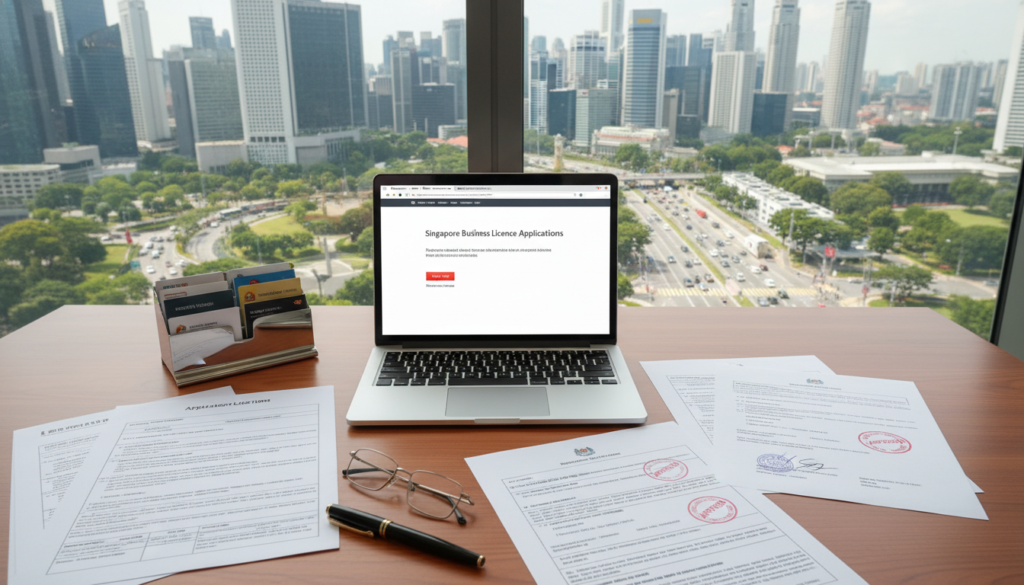
Apply for the right business licences before you start operations
Before you welcome customers, check whether your planned services need prior approval. Certain sectors must secure licences before trading, marketing, hiring or serving customers. This is an operate‑first gate that affects how you roll out your company and model.
Industries commonly requiring licences or permits
Examples: food and beverage outlets, travel agencies, employment agencies, financial services, educational institutions and import/export firms.
Other activities that often need permits include clubs and bars, telecoms/infocomm, manufacturing, healthcare and general trading.
How to confirm licensing requirements with the relevant authorities
Match your primary activity to the right statutory board or agency (for example, check Enterprise Singapore or the sector regulator). Confirm whether more than one licence applies when you combine services.
| Activity | Common Regulator | Key requirement |
|---|---|---|
| F&B | NEA / Food Authority | Food hygiene licence and premise approval |
| Financial services | MAS | Licence before accepting customers or funds |
| Education | MOE / CPE | Approval for curriculum and premises |
| Import/export | Customs / Enterprise Singapore | Permits for controlled goods and licences |
Risk note: launching without permits can lead to fines, stop‑work directions, reputational harm and bank friction during onboarding.
Practical tip: create an “operations readiness” checklist listing licence status, renewal dates and an owner. Correct licensing speeds partnerships with landlords, platforms and payment providers and supports smoother compliance.
Open a corporate bank account and prepare for stricter bank checks
A dedicated corporate bank account gives your company credibility with clients, suppliers and regulators.
Why it matters: a separate bank account keeps personal funds apart, supports neat bookkeeping and is often required to sign contracts or receive payments.
Documents banks typically request
Most banks ask for the Certificate of Incorporation, company constitution, IDs of beneficial owners and a board resolution that names authorised signatories.
Governance, signatories and onboarding
Boards must pass a resolution naming signatories and controls for payments. Maintain clear minutes and registers so records match what the corporate bank checks.
In‑person versus digital account opening
Traditional banks often require directors or the secretary to attend in person. Some fintechs allow fully online onboarding depending on risk checks. When you open corporate accounts, ask the bank about identity and verification steps early.
Funding the company: once the bank account is active, shareholders deposit share capital to fund the business. Keep the deposit trail intact to speed future due diligence.
“Clear ownership and consistent records reduce delays and lower the chance of rejection.”
For full terms on service provision and record handling, review our open corporate bank account.
File Estimated Chargeable Income with IRAS after your FYE
Estimate and file your company’s taxable income promptly to avoid cash surprises and compliance checks.

What ECI covers and its link to income and expenses
ECI is an early estimate of taxable income after deducting allowable business expenses. It records revenue and deductible costs so IRAS sees a sensible interim view of your tax position.
Deadlines and variance outcomes
File the ECI within three months of your Financial Year End. Your chosen FYE therefore controls this timeline.
If actual taxable income is lower than the ECI, excess tax may be refunded. If it is higher, the company must pay the difference (usually within one month of notification). Plan cash flow for both possibilities.
Practical process and risk control
- Gather reconciled management accounts, invoices and bank statements.
- Adjust figures for tax treatments and confirm revenue accuracy.
- Submit via IRAS myTax Portal and retain records for review.
Late or inaccurate ECI submissions can trigger follow‑ups and weaken your standing with banks and auditors.
| Step | Why it matters | Action |
|---|---|---|
| Prepare accounts | Makes the estimate defensible | Reconcile and document expenses |
| File ECI | Meets filing deadline | Submit within three months of FYE |
| Review variance | Manages cash and tax risk | Adjust payment or claim refund as needed |
Hold your first AGM and approve company financial statements
Planning the first annual general meeting (AGM) should be a priority once your year end closes. The AGM is the formal shareholder checkpoint for governance and ensures the board and owners align on the company’s results and next steps.
Timing and what shareholders must review
Rule: hold the first AGM within six months of the Financial Year End. This gives shareholders a structured forum to review the year’s performance.
Shareholders review and approve the full set of company financial statements: Profit and Loss, Balance Sheet, Changes in Equity, Cash Flow Statement and accompanying notes. Whether statements are audited or unaudited depends on the company’s audit status.
Typical AGM approvals beyond accounts
Beyond the accounts, meetings commonly approve dividends (if any), director appointments or reappointments, auditor matters and other standard resolutions that affect business governance for the year.
Virtual meetings and written resolutions in practice
Virtual AGMs and written resolutions are widely used to reduce logistics and suit founders running operations across locations. Ensure meeting platforms support identity verification and voting records.
Clear minutes and signed resolutions matter: they feed into Annual Returns and reduce future disputes.
Practical tip: close the accounts early so directors can answer shareholder questions confidently, which reduces rework and speeds approvals.
Complete statutory obligations after incorporation singapore with ACRA and IRAS filings
The year‑end filing window is where board decisions, accounts and records must align into formal submissions.
File Annual Returns with ACRA and avoid late penalties
Annual Returns capture company particulars, officers, share structure and financial snapshots. Directors must lodge them within seven months of the Financial Year End to meet ACRA requirements.
Late submissions can attract fines — commonly S$300 per breach and, in some cases, penalties that rise to S$600. Diary key dates and assign an owner to prevent costly slips.
Submit Form C‑S or Form C via myTax Portal
File your corporate tax return through IRAS using Form C‑S or Form C on the myTax Portal.
Form C‑S suits smaller, simpler companies — typically those with annual revenue under S$5m and without complex claim items. Use Form C where revenue is higher or you claim capital allowances, group relief or other specialised items.
Prepare the correct documents and meet deadlines
Assemble a clean pack before filing: signed financial statements, tax computation and supporting schedules. Include any claim forms relevant to reliefs or allowances.
| Submission type | Deadline after FYE | Notes |
|---|---|---|
| Paper corporate tax | 30 November | Hard copy returns; prepare early |
| Online corporate tax | 15 December | Later deadline but needs reconciled accounts |
“An integrated workflow between the company secretary, accounting and tax services reduces mismatches and speeds reviews.”
Practical tip: align registers, financials and tax computations so filings to ACRA and IRAS use the same figures. This reduces queries from banks, auditors and regulators and simplifies year‑end administration.
Conclusion
A clear compliance pathway reduces surprises and keeps your company ready for banking, investment and growth.
Follow the practical sequence: choose your FYE, confirm audit position, appoint a company secretary, issue and record shares, keep registers up to date, build an SFRS‑aligned accounting system, obtain licences, open a corporate bank account, file ECI, hold the AGM, then complete ACRA and IRAS filings.
Embed tasks into monthly routines so compliance is cheaper and less stressful than year‑end catch‑ups. Good records improve credibility with banks, investors and partners and smooth fundraising or expansion.
Directors should diarise deadlines, assign clear owners and keep resolutions documented. Review your status against FYE deadlines and engage professional services for secretarial, accounting or tax support if you need capacity.
Strong compliance discipline supports resilience, better cash management and faster decisions as the company grows.
FAQ
Why does post‑incorporation compliance matter for companies in Singapore?
What do compliance duties under the Companies Act and tax rules typically include?
What are the risks of not meeting compliance requirements?
How does choosing a Financial Year End (FYE) affect my deadlines?
What common FYE choices suit different business types?
What first‑year timing pitfalls should new companies avoid?
Must I appoint an auditor within three months of incorporation?
What are the audit exemption thresholds and how do they work?
What are the eligibility requirements for a company secretary?
What are the key duties of a company secretary?
What should a company do if the company secretary resigns?
When must share certificates be issued and recorded?
How are share documents executed with or without a common seal?
What should be included in statutory registers and books kept at the registered office?
How often must statutory records be updated and who is responsible?
What accounting system requirements apply from day one?
How do I align bookkeeping with Singapore Financial Reporting Standards?
Do I need business licences before I start operations?
How can I confirm specific licence requirements for my business?
What documents do banks usually require to open a corporate bank account?
How do board resolutions and signatory appointments affect account opening?
How should a company fund its bank account through share capital deposits?
What is Estimated Chargeable Income (ECI) and when must it be filed?
What happens if ECI differs from actual taxable income?
When must a company hold its first AGM and what must shareholders approve?
Are virtual meetings and written resolutions acceptable?
What ACRA and IRAS filings must a company complete each year?
How do I choose between Form C‑S and Form C for corporate tax?
What documents should I prepare for tax and annual filings?
What are the filing deadlines for paper versus online submissions?

Dean Cheong is a Singapore-based B2B growth strategist and the CEO of VOffice. He helps companies scale revenue through sharper sales execution, CRM implementation, and go-to-market strategy, backed by a strong foundation in business banking and finance from Nanyang Technological University and a track record of driving sustainable, performance-led growth.