

Do you know which date dictates every statutory deadline for your business? This guide answers that question and lays out a practical, year-round plan. It shows what to do right after incorporation and how to diarise tasks to avoid last‑minute rushes.
Expect clear deadlines and simple steps. We cover ACRA and IRAS obligations, recurring employer duties and records that must be kept. The Financial Year End (FYE) is the anchor that determines most filing dates and planning milestones.
The four core annual tasks every company must track are: preparing financial statements, holding an AGM or qualifying for exemption, filing an Annual Return, and submitting tax filings such as ECI and Form C/C‑S. Directors remain legally responsible even when a secretary or accountant prepares filings.
Missing deadlines can trigger fines and enforcement. This introduction previews worked examples for common FYEs and a penalties section so you can assess urgency and prioritise next steps.
Key Takeaways
- The FYE is the central date that sets most statutory deadlines.
- ACRA and IRAS duties are recurring and affect every financial year.
- Four core annual tasks determine most filing effort and timing.
- Directors are legally accountable for timely submissions.
- Penalties rise with delay; plan early to avoid fines.
What “annual compliance” means for Singapore companies
Annual compliance is a repeating set of statutory tasks that keep a business in good standing with regulators. These tasks are routine: prepare accounts, hold required meetings and submit filings on set dates. Missing them can trigger fines or enforcement.
Two parallel obligation tracks help simplify planning. ACRA handles corporate governance: financial statements, AGM (unless exempt) and the Annual Return. IRAS manages tax: file Estimated Chargeable Income (ECI) within three months of the financial year end and submit Form C / C‑S by 30 November.
Even if operations are quiet or loss-making, directors must ensure returns are made or valid exemptions are recorded. Dormant status (no business activity and no income) can reduce burdens, for example by allowing an audit exemption, but it rarely removes the need to file records or notify regulators.
- Recurring duties maintain transparency for shareholders.
- Public registries stay accurate when filings are up to date.
- Most deadlines are measured from the financial year end and fall in the months that follow.
| Regulator | Primary duties | Key deadline examples |
|---|---|---|
| ACRA | Prepare financial statements; hold AGM (unless exempt); file Annual Return | AGM within 6 months of FYE (typical); Annual Return within 7 months of FYE |
| IRAS | File ECI; submit corporate income tax return (Form C / C‑S) | ECI within 3 months of FYE; Form C / C‑S by 30 November (YA mapping) |
| Dormant cases | Possible audit relief; must still confirm dormancy and lodge required declarations | Exemptions reduce work but do not usually remove filing obligations |
Key regulators and systems you will use in Singapore
Most filings pass through a handful of digital systems that every director should know.
Accounting and Corporate Regulatory Authority and BizFile+
ACRA is the national corporate regulatory authority that holds company records and enforces filing rules. BizFile+ is the online portal used for annual returns, officer updates and document lodgement.
Inland Revenue Authority and the Year of Assessment
IRAS, the inland revenue authority, handles tax. Income from a financial year becomes taxable in the next Year of Assessment (YA). In plain terms: your financial year results map to the following YA for corporate tax.
CorpPass access and authorising users
CorpPass is the access layer for corporate submissions. Authorising users means assigning roles so directors, secretaries or outsourced advisers can submit filings on behalf of the entity.

- Confirm UEN and BizFile+ access.
- Set up a CorpPass admin and assign user roles.
- Gather required documents and check authorisations before key dates.
| System | Primary use | Typical delay risk |
|---|---|---|
| BizFile+ | Officer updates, annual return | Missing login |
| IRAS e‑services | ECI, Form C submissions | Incorrect YA mapping |
| CorpPass | Authorise users | Expired roles |
Practical note: many problems are operational — missing access, missing documents or expired authorisations — and can add days or weeks to your schedule. Fix these early to meet deadlines that are measured in days and months from your year end.
Why your Financial Year End drives every deadline
A single anchor date — the financial year end — determines when filings, meetings and tax returns fall due. That date converts ongoing activity into fixed deadlines. Plan around it and you turn ad hoc work into a predictable schedule.
Choosing an FYE that suits reporting and tax planning
Define the financial year end clearly early. It sets when accounts are prepared, when an AGM must be held and when tax filings are due.
Pick a date that smooths workload peaks. Many founders choose 31 March, 30 June or 31 December to align with seasonal revenue or group reporting. Each option shifts when the busy period lands and affects how many months of post‑year activity fall into a single quarter.
Changing your FYE and how it shifts compliance dates
Altering the financial year can help with fundraising cycles, group alignment or seasonality. But a change moves all downstream deadlines measured from that date.
- Benefit: better alignment with investors or parent reporting.
- Risk: compressed tasks in the transition year and extra bookkeeping work.
- Practical step: decide soon after incorporation so routines and software map to the chosen year end.
“All ‘within X months after FYE’ obligations depend on the anchor date — diarise them immediately.”
Singapore company registration compliance timeline: the annual cycle at a glance
Knowing which deadlines follow your financial year end makes planning straightforward. Below is a compact, screenshot‑friendly view of the core dates every director should diarise.
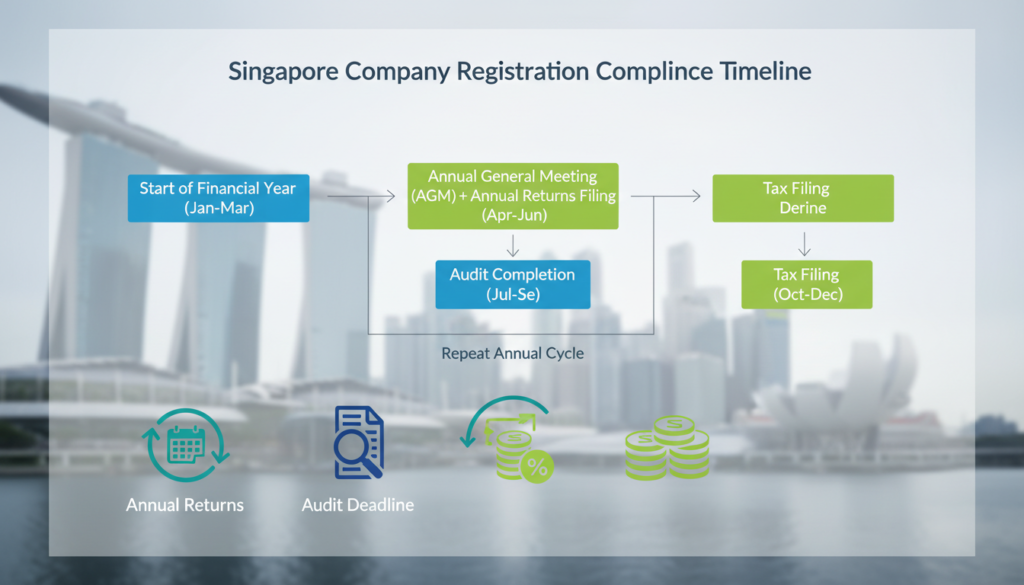
High‑level timeline:
- FYE → 3 months: Estimated Chargeable Income (ECI)
- FYE → 6 months: Annual General Meeting (for unlisted firms)
- FYE → 7 months: file the Annual Return with ACRA
- By 30 November: submit Form C / C‑S for the relevant Year of Assessment
These “within X months” deadlines are measured from the end of the financial year, not from when accounts are prepared. Operationally, finalised accounts are needed before shareholders can approve them and before accurate tax filing can occur.
For unlisted entities the usual sequence is: prepare financial statements → hold the AGM or record an exemption → lodge the annual return. Some groups may use Form C‑S where eligible, but the 30 November corporate income tax deadline remains unchanged.
Treat this as the minimum viable compliance calendar and add buffers for approvals, XBRL conversion and access or authorisation delays.
Immediately after incorporation: your first compliance set-up steps
In the initial 30 days you make practical choices that reduce future filing risk and delays.
UEN and the Business Profile window
After incorporation the UEN is issued automatically and becomes your primary identifier across ACRA, IRAS and GoBusiness. Download the BizFile+ Business Profile within the free 30 days. Banks and licensing portals commonly request this document.
Key officer appointments
Appoint at least one director immediately and a company secretary within six months. The company secretary usually handles routine ACRA filings and keeps corporate minutes up to date.
Set up accounting and access early
Register CorpPass and choose bookkeeping software now. Early setup avoids rushed data entry before the first FYE.
- First 30 days: download Business Profile, set CorpPass and open a bank account.
- Records checklist: chart of accounts, invoicing rules, expense capture and secure storage of supporting documents.
- Assign roles: who approves accounts, who signs resolutions, who files with regulators.
Practical result: good record keeping produces faster financial statements, fewer tax estimation errors and lower risk of late filings.
Preparing annual financial statements and keeping proper records
Well-prepared financial statements are the backbone of accurate tax returns and clear shareholder reporting. They show performance and position. That information supports both investor decisions and correct tax filings.
Directors’ responsibility and the role of your accountant or service provider
Accountants and a service provider prepare the accounts. Directors must review, approve and ensure accuracy.
Directors remain legally responsible even when they delegate preparation. Check figures, supporting invoices and key estimates before signing off.
SFRS requirements and when XBRL filing is relevant
Prepare statements under the Singapore Financial Reporting Standards (SFRS). Disclosures and format matter as much as numbers.
Some filings require XBRL. ACRA uses XBRL to standardise submissions. Larger or filing-active entities are more likely to need XBRL output.
Audit exemption for small and dormant private companies
Many small or dormant private companies may qualify for audit exemption under the Companies Act. Confirm eligibility early; do not assume relief applies.
Record retention expectations
Keep accounting records for at least five years. That includes invoices, contracts, bank statements, payroll evidence and board resolutions.
- Monthly reconciliations to stay audit- and tax-ready.
- Clear expense categories and source documents.
- Document related‑party transactions and approvals.
| Item | What to keep | Typical period |
|---|---|---|
| Financial statements | Balance sheet, P&L, notes | Permanent |
| Source records | Invoices, receipts, bank statements | At least 5 years |
| Payroll | Payslips, CPF records, contracts | At least 5 years |
| Audit & filing format | SFRS reports; XBRL where required | Per filing cycle |
Annual General Meeting requirements and options in practice
An annual general meeting lets directors explain the year’s results and obtain formal approvals from shareholders. It is the main forum for presenting financial statements and approving key matters such as dividends or director appointments.
Timing rules founders often miss
For unlisted entities the first AGM must occur within 18 months of incorporation. After that, hold the annual general meeting within six months after the financial year end.
Tip: schedule the AGM with enough lead time to finalise accounts, since the AGM date affects when the Annual Return can be filed.
Format options and effective participation
Meetings may be physical, virtual, hybrid or conducted by written resolutions (a “paper AGM”) if permitted and well-documented.
Effective participation means shareholders can receive information, ask questions and vote — whether present in person or online. Ensure voting methods and notices meet legal standards.
When a paper AGM makes sense
A written resolution suits a small shareholder base and straightforward approvals. It reduces logistics but requires clear circulation and signed records.
- Checklist of outputs: signed minutes or resolutions
- Approval of financial statements
- Confirmation of officer and shareholding particulars
- Retention of notices, proxy forms and voting records
Filing the Annual Return with ACRA accurately and on time
Think of the Annual Return as the legal photo of the company’s structure and finances at year end. It keeps the public register current and demonstrates statutory compliance.
What the Annual Return contains
- Officer details and registered office particulars.
- Shareholders, share capital and any transfers or allotments.
- AGM date or confirmation of AGM exemption and attached financial statements (XBRL where required).
Timing rules
For unlisted firms the return must be lodged with ACRA within 7 months after the FYE. Even if the AGM is held early, the absolute deadline remains seven months from year end.
Who files and who is responsible
Filings are commonly executed by the company secretary via BizFile+. Directors, however, remain legally accountable for the accuracy and timeliness of the annual return.
Practical checklist
- Verify officer details and share transfers before the AGM.
- File within days or weeks after the AGM to reduce risk.
- Retain AGM minutes, signed resolutions and evidence of financial statements.

IRAS tax filing timeline for corporate income tax
Tax reporting for businesses follows a two-step cycle: an early estimate, then a final return. Treat both as linked deadlines and plan resources accordingly.
ECI within three months: who must file and administrative concession scenarios
Estimated Chargeable Income (ECI) is a short projection of taxable profit due generally within months of the year end—normally three months after FYE. IRAS asks for this so it can assess interim liabilities.
Some entities may receive an administrative concession for a particular year. Relying on concessions is risky; the safer plan is to prepare to file unless you have written confirmation otherwise.
Form C / Form C‑S by 30 November: how FY income maps to the next Year of Assessment
The final corporate return (Form C or C‑S) is due by 30 November for the relevant Year of Assessment. Put simply: profits in one financial year map to the following YA, so a 2025 FYE usually leads to a 2026 YA filing.
Notice of Assessment and what happens if IRAS raises an estimated assessment
A Notice of Assessment (NOA) sets the tax due and affects cash flow and instalment planning. If returns are late, IRAS may issue an estimated assessment that becomes payable straight away and can trigger further action.
“Late or missing filings can create immediate payment obligations and an avoidable disputes workload.”
- Reconcile revenue and expenses to accounts before filing.
- Document deductible claims and retain supporting records.
- Coordinate accountants early to avoid estimated assessments and unexpected cash calls.
Worked timeline examples using common Singapore FYEs
These worked examples convert general rules into clear, actionable calendars tied to common financial year ends.

FYE 30 June: step‑by‑step
For a FYE of 30 June 2026 the sequence is simple: ECI due 30 Sep 2026, AGM by 31 Dec 2026, annual return by 31 Jan 2027 and Form C by 30 Nov 2027.
Practical window: finalise financial statements well before the AGM so shareholders can approve them. Allow at least six to eight weeks for external review and board sign‑off.
FYE 31 August: month‑by‑month
After a 31 Aug 2026 end the ECI arrives quickly: 30 Nov 2026. From Sept to Nov you must close books, reconcile and prepare the ECI.
December to February is for AGM planning and notices. File the annual return by 31 Mar 2027 and then prepare for the Form C by the next 30 Nov.
FYE 31 December and 31 March notes
Year‑end on 31 Dec 2026 brings holiday congestion and mid‑year ACRA pressure; plan audits early.
A 31 Mar 2027 end gives more runway to the 30 Nov tax filing, but companies must not delay bookkeeping; monthly closes and quarterly reviews keep work routine.
| FYE | ECI | AGM | Annual Return | Form C (YA) |
|---|---|---|---|---|
| 30 Jun 2026 | 30 Sep 2026 | 31 Dec 2026 | 31 Jan 2027 | 30 Nov 2027 |
| 31 Aug 2026 | 30 Nov 2026 | 28 Feb 2027 | 31 Mar 2027 | 30 Nov 2027 |
| 31 Dec 2026 | 31 Mar 2027 | 30 Jun 2027 | 31 Jul 2027 | 30 Nov 2027 |
| 31 Mar 2027 | 30 Jun 2027 | 30 Sep 2027 | 31 Oct 2027 | 30 Nov 2028 |
Tip: turn these examples into a recurring internal schedule. Monthly closes plus quarterly reviews make the dates predictable rather than urgent.
For a fuller annual regulatory plan, see our annual regulatory compliance timeline.
Penalties and enforcement risks if you miss compliance deadlines
Failing to meet filing deadlines exposes directors and the business to swift enforcement. Regulators prioritise accurate public registers, sound governance and timely tax collection. That focus explains why late submissions often attract immediate action rather than gentle reminders.
ACRA enforcement outcomes
ACRA can impose composition fines for late Annual Return lodgement and escalate to prosecution for persistent breaches. In severe cases, the regulator may apply to strike the company off the register, a result with serious commercial consequences.
Director consequences
Directors remain personally accountable for statutory obligations even when tasks are outsourced. Personal liability, disqualification and reputational harm are real risks that follow repeated defaults.
IRAS enforcement and tax penalties
IRAS may issue late‑filing penalties, raise estimated assessments that become payable immediately, and escalate to summons or court action for continued non‑compliance.
“Late filings often produce avoidable cash calls and damage trust with banks, regulators and investors.”
- Why it matters: enforcement protects public trust and revenue collection.
- Commercial impact: strike‑off or penalties can block banking, licences and investor deals.
- Prevention: set internal cut‑offs before statutory dates, keep a live calendar and document written delegations.
Other compliance requirements businesses often overlook
Beyond yearly filings, routine duties demand attention throughout the financial year. Annual tasks sit on top of ongoing requirements that can trigger fines even between year‑end deadlines.
Maintaining statutory registers and nominee records
Keep registers current from incorporation. These include registers of controllers, beneficial owners and any nominee arrangements. Accurate records support transparency and help when regulators request verification.
Timely ACRA updates — often within days
Many officer and share changes must be lodged quickly — commonly within 14 days. Do not wait for the Annual Return to correct officer appointments, registered office moves or share transfers.
Employer monthly obligations
Employers must make CPF and SDL contributions each month for eligible staff. Set payroll controls and reconciliation routines to avoid underpayments and penalties.
GST threshold and timing
If turnover exceeds S$1 million, GST registration becomes mandatory. Voluntary registration is possible below the threshold but affects invoicing and pricing once active.
Quarterly checklist for founders:
- Verify statutory registers and nominee records.
- Confirm no officer or address changes remain unfiled.
- Reconcile payroll, CPF and SDL entries.
- Review turnover vs GST threshold and decide on registration timing.
| Ongoing area | Action required | Typical deadline |
|---|---|---|
| Statutory registers | Update controllers, beneficial owners, nominee records | Continuous; verify quarterly |
| ACRA filings | Officer changes, office address, share allotments | Commonly within 14 days |
| Employer duties | CPF and SDL contributions; payroll reconciliation | Monthly |
| GST | Register if turnover > S$1 million; adjust invoicing | When threshold exceeded or by chosen voluntary date |
For practical guidance on offshore arrangements and related duties, see our offshore compliance requirements.
Conclusion
Start with a firm financial year end and build simple routines around it. That single date anchors ECI, the AGM, the annual return and Form C/C‑S so you can plan work backwards and avoid last‑minute pressure.
Keep records tidy and allow buffers for accounts finalisation, approvals and portal access. For a singapore company the key filing requirements fall in set windows measured from the financial year, often within months of the year end.
Remember: companies must remain active in their duties even if dormant or loss‑making. Directors must ensure tax and statutory returns are submitted and that governance requirements are met.
To stay compliant, adopt monthly bookkeeping, quarterly register checks and pre‑deadline reviews. Engage a service provider—a secretary or accountant—when founders need to focus on growth.
Practical next step: make a one‑page calendar from your FYE and assign clear owners for ACRA and IRAS tasks today.
FAQ
What does "annual compliance" mean for a Singapore-registered business?
How do ACRA and IRAS split corporate and tax obligations?
Why must compliance continue if the business is dormant or loss-making?
Which regulators and systems will I use for filings?
How does my Financial Year End (FYE) affect deadlines?
What are the immediate compliance steps after incorporation?
When must Estimated Chargeable Income (ECI) be filed?
When is the Annual General Meeting (AGM) required?
By when must the Annual Return be filed with ACRA?
When must I file the corporate income tax return (Form C / C‑S)?
What are the record‑keeping requirements for financial statements?
When is audit exemption available?
What are my options for holding an AGM?
What happens if I file the Annual Return late with ACRA?
What are the consequences of late tax filings to IRAS?
What other compliance areas are commonly overlooked?
Who is legally responsible for ensuring all filings are made?
How can I reduce the risk of missed deadlines and penalties?

Dean Cheong is a Singapore-based B2B growth strategist and the CEO of VOffice. He helps companies scale revenue through sharper sales execution, CRM implementation, and go-to-market strategy, backed by a strong foundation in business banking and finance from Nanyang Technological University and a track record of driving sustainable, performance-led growth.