

Curious how a single missing invoice can turn an honest claim into a costly headache?
This short guide explains why clear documentation matters now more than ever. From 1 January 2024 the tax rate rose to 9%, and registered businesses must file returns via Form F5. Firms must keep supporting evidence for at least five years, and failure to comply can lead to fines of up to S$5,000 per offence.
We define what proper documentation means in this context: capturing, organising and retaining the evidence that backs figures sent to IRAS. You will get practical steps to build an audit-ready system, not last-minute document chasing.
The article outlines how output tax minus input tax works and why clear proof is vital to substantiate claims. It also flags the overlap between IRAS and ACRA standards, so you can align corporate and tax processes.
Expect a step-by-step reference to decide what counts as proper records, who must comply, retention periods, secure storage and how poor practices can lead to rejected claims, added exposure and penalties. Use this as the blueprint for a monthly compliance routine and internal checklist.
Key Takeaways
- Keep clear documentation to substantiate tax figures and claims.
- Form F5 is used for filing and supporting evidence must be retained for five years.
- Align IRAS and ACRA standards to avoid duplicated gaps in compliance.
- Poor documentation can lead to rejected input claims and penalties.
- This guide gives a step-by-step framework to build an audit-ready routine.
Why GST record keeping matters for Singapore businesses</h2>
Clear financial evidence is the bedrock of reliable returns and defensible claims. For GST-registered businesses, filing Form F5 depends on substantiating output and input tax positions with valid tax invoices and supporting documents.
How good records support accurate returns and input tax claims
Input tax is only defensible when supported by valid tax invoices and related evidence. Missing or incomplete documents risk IRAS disallowing claims, which can increase tax due and penalties.
Reducing audit stress with a clear audit trail
A practical audit trail means each entry in your accounting system ties back to a source document. Where relevant, that source links to a bank line item such as in bank statements.
Better cash flow visibility
Organised invoices, receipts and bank statements make receivables, payables and upcoming liabilities easy to spot. Better visibility helps managers make pricing, stock and service-level decisions while meeting compliance obligations.
- Proper records include both accounting records and source documents.
- Well-ordered files speed retrieval, reduce inconsistent narratives and cut audit friction.
- Clear documentation supports accurate reporting and stronger business decisions.
What counts as proper records for GST and tax purposes in Singapore</h2>
Knowing exactly which paperwork backs each entry prevents costly challenges later.
Accounting records are the ledgers, journals, listings and schedules that summarise transactions into figures you report. These show income, expenses, assets, liabilities and profit or loss. They make totals ready for tax submissions and audit review.
Source documents are the originals that prove each entry: supplier invoices, customer invoices, receipts, contracts and delivery orders. IRAS expects every accounting entry to be traceable back to a source document so auditors can verify amounts and dates.
For GST-registered firms, additional evidence is required. This includes tax invoices (or simplified tax invoices), import/export permits for goods and GST account summaries that reconcile input and output tax. These items support claims on Form F5 and other filings.

| Item | Example | Why it matters |
|---|---|---|
| Accounting records | General ledger, trial balance | Summarises transactions for returns |
| Source documents | Supplier invoice, delivery order | Provides primary proof for entries |
| GST evidence | Tax invoices, export permit | Supports zero‑rating and input claims |
| Overlap | Sales invoice used for income and GST | One document can support both tax purposes |
Practical examples: a standard-rated service invoice needs a tax invoice. Exported goods must have export paperwork to support zero-rating. Above all, proper records must be complete, legible and retrievable for the required period to meet legal obligations and avoid disputes with IRAS.
Who must follow singapore gst record keeping requirements</h2>
Knowing which documents you must keep helps businesses avoid disputes and wasted time.
Baseline for every company
Every company must maintain sufficient accounting records to explain business transactions and support tax reporting. These accounting records include ledgers, journals and supporting invoices that back income tax and statutory filings.
Additional obligations for registered entities
When a business registers for gst, it must hold tax invoices, GST reconciliations and sale or disposal paperwork for goods and assets. These documents support Form F5 and any gst audits by IRAS.
Common scenarios that need extra documentation
- Goods taken for private use or disposed of — retain disposal records and valuation notes.
- Mixed supplies of goods and services — keep clear split documentation.
- Asset sales — track sale invoices and movement of title.
Quick self-check
Ask: Are you gst-registered? Do you import or export? Do you sell both goods and services? A “yes” to any adds documentation needs.
Directors remain responsible for ensuring systems work in practice, not only at year-end. Once you know your category, set the correct retention period and storage approach to maintain compliance.
How long to keep GST and accounting records in Singapore</h2>
Retention timelines matter: a simple miscalculation can leave you exposed to enquiries and penalties.
The five-year rule and calculating the retention period
Keep accounting and GST records for at least five years from the end of the relevant Year of Assessment. That end date, not the invoice date, starts the retention clock.
Practical method: identify the Year of Assessment tied to the accounting period, then add five years. Use a simple timeline for each financial year so teams apply one consistent approach.

When longer retention may apply
Certain documents may need to be retained beyond five years. Confirm against current IRAS or ACRA guidance for long-term contracts, capital allowances or disputed tax positions.
After closure or cessation
If a business stops trading or cancels registration, retention duties still apply. Ensure archived files remain accessible for the prescribed period and for any future tax or income tax enquiries.
- Use a retention register and archive labels.
- Set a destruction policy that only acts after the full period.
- Consider keeping critical files longer to manage warranty or dispute risk.
What documents you must maintain to stay compliant with IRAS and ACRA</h2>
A tidy archive of business paperwork makes tax audits faster and disputes easier to resolve.
Core sales and income files: serially numbered invoices, receipts and credit notes. Ensure tax invoices are issued within 30 days of supply and use simplified tax invoices for transactions ≤ S$1,000.
Payment evidence: bank statements and payment gateway reports (Stripe, PayPal) to prove timing and reconcile debtors.
- Purchase files: supplier invoices, receipts, payment vouchers, purchase orders and delivery notes.
- Cross‑border proof: import/export permits and shipping documents to support zero‑rated supplies.
- Payroll: remuneration vouchers, CPF contribution evidence and payroll listings.
- Ledgers & statements: sales listings, purchase listings, general ledger, balance sheet, profit and loss and supporting schedules.
- Assets & stock: fixed asset register, disposals, depreciation workings, stocklists and movement logs.
- Expense substantiation: travel, entertainment receipts and approvals.
| Group | Typical items | Why it matters | Where used |
|---|---|---|---|
| Sales & income | Invoices, receipts, credit notes | Supports output tax and income figures | Form F5, income tax |
| Payments | Bank statements, gateway reports | Proves receipt timing and reconciliations | Audit, cashflow |
| Assets & stock | Asset register, stocklists, disposals | Substantiates capital allowances and COGS | Tax computations |
GST account summary: maintain an input/output reconciliation that ties to your filings. Missing or incomplete documentation can lead to penalties and disallowed claims, so keep files organised and traceable.
Where and how to store GST records securely and accessibly</h2>
Deciding where to keep files should be a deliberate board-level choice, not an afterthought.
Registered office or director-approved alternative
By default, a company stores files at its registered office. Directors may approve another site. Record that decision in writing and show who is responsible for access.
Keep a clear log of locations, retention time and who may retrieve source documents during the retention period.
Cloud storage: legibility, access and controls
Electronic storage is acceptable if files remain legible and retrievable. Use PDF exports for bank statements and other non-editable documents.
- Use a folder structure that mirrors the checklist in Section 6 so staff find documents fast.
- Apply role-based access, multi-factor authentication and encryption where possible.
- Assign owners for upload, edit and deletion actions and keep version history.
“Storage practices are compliance practices; failure to produce files on request creates enforcement risk.”
| Storage type | Pros | Controls |
|---|---|---|
| Registered office | Direct oversight, physical access | Locked archive, access log |
| Director-approved site | Scalable, local backups | Signed approval, inventory list |
| Cloud | Remote access, restore testing | MFA, encryption, scheduled backups |

How to set up a practical record keeping system for ongoing compliance</h2>
A monthly file system stops last‑minute scramble and makes compliance routine.
Step‑by‑step setup plan
- Choose one filing method for the whole company: chronological, alphabetical or by document type. Consistency reduces missing files.
- Deploy accounting software (Xero, QuickBooks, Zoho Books) and enable OCR to capture invoices and receipts automatically.
- Create a monthly close checklist: upload source documents, post journals, run bank reconciliations and lock the period.
Monthly routines and controls
Reconcile bank statements to the ledger each month to keep cash flow visible and spot unreconciled payments early.
For accounts payable, verify each invoice, match it to delivery notes or purchase orders, update the ageing report and mark payments when made.
| Task | Who | Frequency |
|---|---|---|
| Upload source documents | Accounts clerk | Daily |
| Bank reconciliation | Accountant | Monthly |
| Invoice verification & ageing | AP lead | Weekly |
| Period lock and review | Finance manager | Monthly |
“A consistent system and clear approvals cut errors and speed audits.”
Practical controls: use a naming convention, approval workflows and a missing document tracker so the business keeps complete accounting records and stays audit-ready.
How to stay audit-ready and avoid common GST record keeping mistakes</h2>
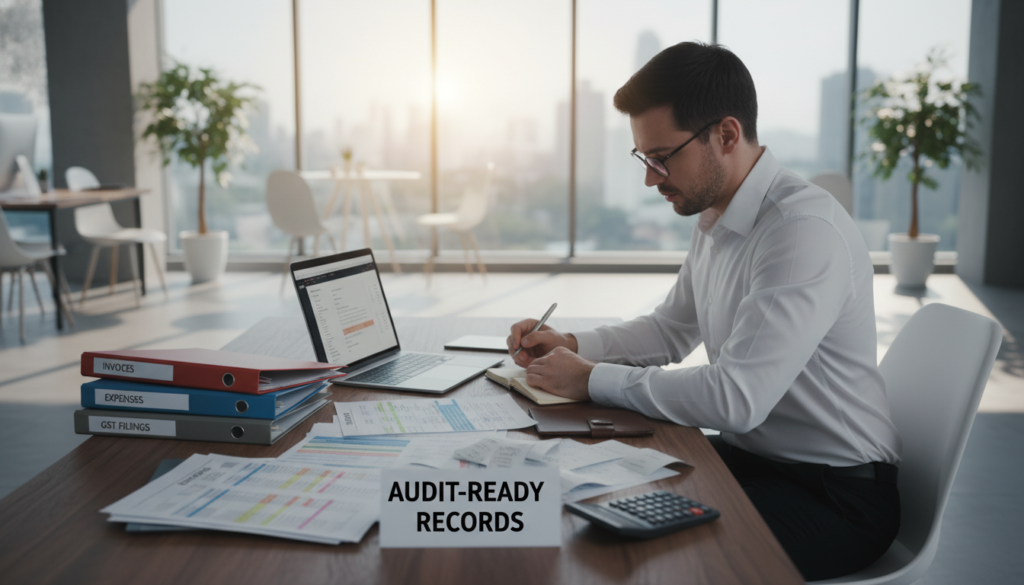
Staying audit-ready means your finance team can reproduce any tax figure within hours, not days. That readiness reduces disruption and shows good governance when authorities query returns.
What audit-ready looks like
You should be able to produce invoices, receipts, contracts and reconciliations quickly. Totals must agree with GST returns and financial statements.
Typical gaps flagged by IRAS
Inspectors often find missing source documents, late entries that shift periods, and misclassification of supplies. These gaps distort reported figures and can trigger inquiries.
Practical checks and prevention
- Enforce cut-off dates and require supporting documents before posting.
- Standardise chart-of-accounts mappings to reduce misclassification.
- Ensure tax invoices exist for input claims and keep export proof for zero-rated supplies.
Periodic internal reviews
Run monthly or quarterly sampling from source to ledger to bank line to GST reporting. Use an exception report to flag transactions without attachments, unusual vendor patterns and manual journals affecting GST.
“Even genuine expenses and claims fail if the documentary trail is incomplete.”
| Check | Why it matters | Frequency |
|---|---|---|
| Attachments present | Proves the transaction | Daily |
| Reconciliations | Aligns accounting records to returns | Monthly |
| Classification review | Prevents GST mismatches | Quarterly |
Penalties and consequences of poor GST record keeping in Singapore</h2>
A weak documentary trail invites enquiries that can escalate into formal assessments and penalties.
Enforcement risk: If a business cannot substantiate transactions with documents, IRAS may deny input tax claims and disallow expense or capital allowance positions. Such outcomes increase tax due and can trigger detailed reviews.
How enforcement typically progresses
Missing records prompt queries. Queries can lead to deeper audits. If gaps remain, official assessments and penalties follow.
Legal and financial exposure
Record-keeping failures can attract fines of up to S$5,000 per offence. Under the Companies Act, serious breaches may expose officers to fines and even imprisonment of up to 12 months in extreme cases.
Indirect costs include professional fees to reconstruct documents, operational disruption during reviews, delayed refunds and reputational harm with banks or partners.
“A modest investment in retention and controls often prevents costly disputes.”
- Retention discipline: keep files for the full required period.
- Reconciliations and attachments: tie invoices to ledger and bank lines.
- Documented controls: approval flows and an owner for compliance obligations.
Conclusion</h2>
Strong documentation and a simple routine make compliance a manageable part of everyday finance.
, Keep the focus practical: split files into clear categories, run monthly checks and use secure storage. Good practice supports accurate tax returns and defensible input positions, and it speeds responses to enquiries.
Keep invoices, receipts, bank evidence, payroll files, ledgers and GST account summaries to support financial statements. Retain these for at least five years from the relevant Year of Assessment and extend retention if a matter is unresolved.
Store records at the registered office or a director‑approved site, or use a compliant cloud system with access controls and backups. For a quick primer on accounting records and filing, see accounting records.
Next step: adopt the checklist, set a monthly timetable and name an owner so compliance becomes routine, not reactive.
FAQ
What are the core obligations for companies regarding GST record keeping?
How do accounting records differ from source documents under IRAS and ACRA?
Which documents qualify as valid tax evidence for input tax claims?
Who must comply with these obligations and does it apply to non-registered businesses?
How long should businesses keep records and how is the five-year period calculated?
When is a longer retention period necessary?
What should businesses do with records after they cease operations or deregister for GST?
What are the essential sales and income documents to maintain?
What details must tax invoices contain and what is the 30‑day practice?
How should payment evidence be preserved for GST and tax purposes?
Which purchase and expense documents are critical for compliance?
What import and export paperwork supports zero‑rated supplies?
What payroll and statutory records must be available?
Which journals, ledgers and financial statements are necessary?
How should fixed assets and disposals be documented for tax and GST?
What records are needed to manage stock and inventory for tax purposes?
What constitutes sufficient substantiation for expense claims like travel?
How should businesses track input and output tax for filing Form F5?
Where may companies store records and what approvals are required?
Are cloud storage solutions acceptable and what controls are needed?
What data protection and continuity measures should be in place?
How should firms set up a practical ongoing system for compliance?
Which accounting software features help reduce errors and speed compliance?
What monthly routines keep books in order?
What controls should govern accounts payable to avoid issues?
What common mistakes trigger audits or adjustments?
How do internal reviews help maintain audit readiness?
What are the enforcement risks for poor compliance?
What penalties might arise from inadequate documentation or false claims?

Dean Cheong is a Singapore-based B2B growth strategist and the CEO of VOffice. He helps companies scale revenue through sharper sales execution, CRM implementation, and go-to-market strategy, backed by a strong foundation in business banking and finance from Nanyang Technological University and a track record of driving sustainable, performance-led growth.