
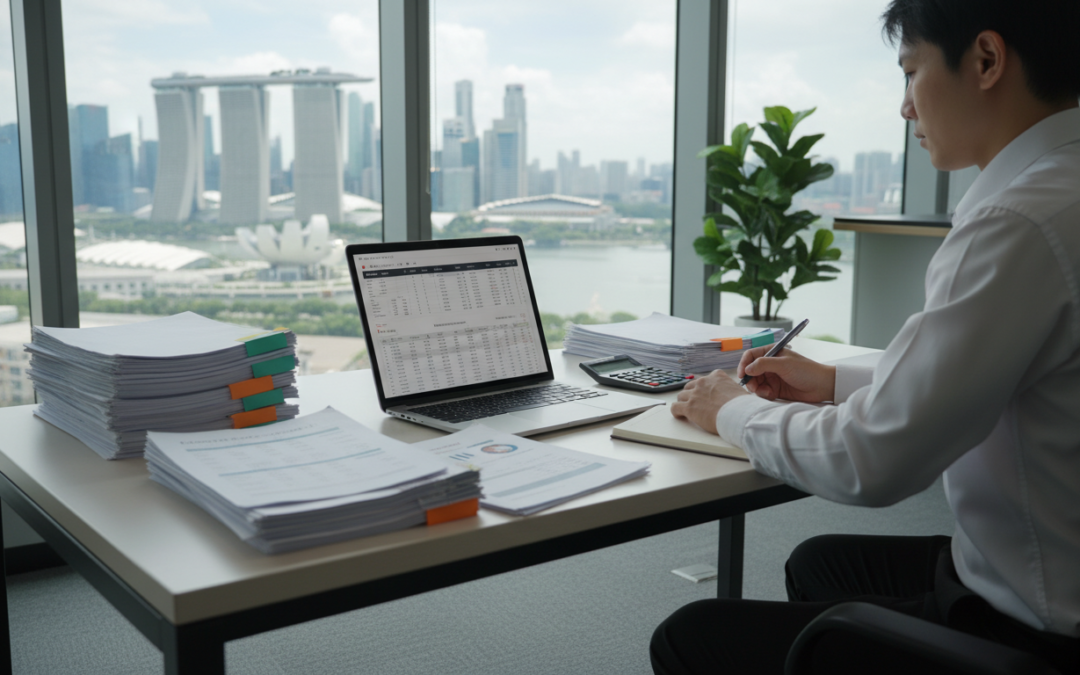
Are you confident your business keeps the right financial trail to stay compliant and grow?
Good bookkeeping is the systematic recording and organisation of transactions — sales, purchases and expenses — so a company can report accurately and meet legal expectations. In this guide we focus on local rules set by ACRA and IRAS, and what those requirements mean for everyday operations.
Timely entries, complete supporting documents and a reliable system produce dependable records. Get this wrong and a business faces compliance exposure, wasted time and poor visibility. Get it right and you gain control, confidence and readiness to scale.
This article acts as a buyer’s guide for directors and finance leads. You will learn why bookkeeping matters, how it differs from accounting, who regulates the rules, GST specifics and how to assess services and software. Use later sections as a practical checklist to match compliance with operational efficiency.
Key Takeaways
- Understand the core legal duties to keep proper records and support filings.
- Good processes mean timely, complete entries and reliable reports.
- Non-compliance risks time loss, fines and weaker investor appeal.
- Assess services by control, clarity and technology fit for your business.
- Use the guide as a checklist when choosing support or software.
Why bookkeeping matters for Singapore businesses today
Clear, current financial records give owners the line of sight they need to manage cash and plan growth. Timely figures help teams spot what is owed, what is due and which expenses repeat each month.

Cash flow visibility and sharper management decisions
Up-to-date books improve cash flow forecasting by showing receivables, payables and recurring costs. When income and expenses are coded consistently, management can see margins by product line or outlet.
Reducing compliance risk with ACRA and IRAS
Accurate books cut the risk of late filings and errors in tax returns. Clean financial records also reduce friction during audits and regulatory checks.
When poor records limit growth and operations
Pain signals include unexplained cash leakage, mismatched bank balances and uncertainty over GST or tax positions. These issues slow funding approvals because lenders and investors want clear historical performance.
- Practical result: better decisions on hiring, pricing and inventory.
- Operational drag: owners spend less time running the business and more time chasing receipts.
The goal is not only compliance but a finance function that scales. Review service terms before you sign — see our service terms.
Bookkeeping vs accounting: what you need to buy, and why
A neat ledger captures daily sales and costs; accounting turns that ledger into guidance.
What bookkeeping covers
Plain definition: day-to-day recording of sales, supplier bills, staff costs and other financial transactions into ledgers so each entry is complete and traceable.
Why it matters: accurate recording creates the reliable foundation needed for any later analysis. Without it, reports and insights can mislead owners and stakeholders.
What accounting adds
Accounting adjusts entries, prepares financial statements and interprets trends. It turns raw data into management reporting, tax-ready returns and strategic insights.
- Bookkeeping services: data entry, reconciliations and transaction trails.
- Accounting bookkeeping services: month-end close, reporting packs, tax support and performance analysis.
- Avoid scope gaps: confirm who handles statutory submissions and tax computations when you outsource only the day-to-day work.
Operational example: a retail or F&B outlet records daily sales and expenses as transactions. An accountant then reviews margins, spots trends and recommends cost controls.
Buyer takeaway: buy services to match transaction volume, stakeholder needs and compliance complexity, not price alone. Choose the mix that gives timely reporting and actionable insights.
Regulators and standards that shape record-keeping in Singapore
Regulators and standards set the baseline that turns raw transaction logs into trusted financial reporting.
ACRA’s role and corporate obligations
ACRA oversees corporate reporting under the Companies Act and expects businesses to keep adequate accounts and credible statements. Directors must ensure records support statutory filings and that internal controls produce reliable financial reporting.
How SFRS influences recognition and measurement
SFRS governs how items are recognised and measured, which directly affects your financial statements and comparability over time. It is based on IFRS but includes local modifications, so service providers must know local norms to prepare compliant statements.
Small company concept and reliefs
A company meets the small company criteria if it fulfils at least two of these: annual revenue ≤ S$10m, total assets ≤ S$10m, and full‑time staff ≤ 50. Qualifying firms may face reduced disclosure in their statements, easing the reporting burden.
Choosing a financial year‑end
Pick a year‑end that matches seasonality, inventory cycles or major projects. The financial year cannot exceed 12 months and should remain consistent year‑to‑year to avoid extra admin and confusing comparative accounts.
Practical tip: confirm eligibility for small company relief each year if growth is near thresholds. Once the framework is clear, set up record processes that meet IRAS and GST obligations.

Singapore bookkeeping requirements for companies under IRAS
A clear retention policy and retrievable transaction trails are the backbone of tax compliance. IRAS mandates that businesses keep proper records and accounts for at least five years, supported by invoices, receipts, vouchers and other documents.

What proper records look like
Proper records mean source documents that back every ledger entry and can be located quickly. Examples include cash register tapes, daily sales record books and invoices for income.
Expense evidence should include receipts and a daily purchases record book. Keep vouchers and bank statements that match ledger entries.
The five‑year and calendar rule
Retain records for five years from the relevant accounting period. If your financial year does not end in December, keep documents until the calendar end of the fifth year to avoid premature disposal.
Multi‑currency accounts and reporting
If accounts are kept in foreign currency, tax computations and statements may use that currency. Always declare the equivalent Singapore dollar amount on the Income Tax Return.
Practical risks and an action checklist
- Weak documentation can lead to disallowed deductions, additional assessed income and penalties.
- Ensure ledgers are reconciled and supporting schedules are ready at assessment time.
- Store records so they are retrievable within days, not weeks.
- Make accounting tax readiness part of month‑end routines to reduce year‑end costs.
Next: GST brings extra invoice rules and stricter trails that you must follow when charging and claiming GST.
GST and invoicing: practical record-keeping rules you can’t ignore
Crossing the GST threshold alters daily finance routines and the depth of transaction tracking. Businesses with annual turnover above S$1 million must register and charge GST on taxable supplies. That change makes accurate transaction detail a business imperative.

What audit-ready records look like
Every GST-related sale or purchase should tie to a supporting document. Use correct tax codes and keep a clear link from invoice to bank entry.
Audit-ready means you can locate a source document within days and show the ledger entry that matches it.
Invoicing and receipts: controls that reduce errors
- Simplified tax invoices are permitted when the total (including GST) is below S$1,000.
- Keep consistent numbering and retain copies to improve accuracy and reduce time lost reconciling.
- Non-registered businesses should issue sequential receipts and keep duplicate copies; give a receipt on request.
Practical change: reduce cash handling to preserve a clean trail and cut reconciliation time. GST complexity often tips owners towards professional services or structured software; see our GST invoicing tips to help decide.
DIY bookkeeping vs outsourcing bookkeeping in Singapore
Deciding whether to manage accounts in-house or hire an external team starts with an honest tally of hours, skills and risk.
When managing your own books is realistic
A small business with simple sales channels and low invoice volume can succeed with DIY routines.
Owners must commit weekly time to reconciliations and use cloud software to keep entries tidy.
Triggers that signal it’s time to outsource
If time pressure, frequent errors or missed deadlines appear, consider outsourcing bookkeeping.
Lack of tax expertise, payroll complexity or multi‑currency needs are clear red flags for business owners.
Hybrid models and roles
Many SMEs hire an in‑house bookkeeper and retain an external accountant for month‑end close and tax.
This model balances daily control with professional review and reduces the chance of reporting mistakes.
Benefits and daily habits
Outsourcing bookkeeping often speeds closes, improves compliance and gives cleaner reporting for funding or audits.
Regardless of the model, keep receipts organised, standardise expense categories and minimise cash to aid traceability.
Next: once you choose outsourcing, use clear buying criteria to select the right bookkeeping services singapore providers offer.
What to look for when buying bookkeeping services Singapore providers offer
The right provider fits your daily sales patterns, invoicing rhythm and cash cycles. Start by mapping your business needs to the provider’s service design so expectations match reality.
Fit to business needs and industry transaction patterns
List typical transactions (e‑commerce payouts, retail takings, project billing) and ask how each will be processed. Ensure the team understands peak days, refund flows and payment gateways.
Due diligence: track record, reviews and confidentiality
Read reviews, request references and confirm experience with accounts similar to yours. Check data security controls and NDAs to protect sensitive financial records.
Service scope clarity
Agree tasks that are included and excluded: invoicing, AR/AP, ledgers, bank reconciliations, payroll, management reports and year‑end support. A clear scope avoids surprise costs.
Technology readiness
Prefer providers using cloud workflows, secure document capture and reconciliations in software that supports efficient coding and reporting.
Service agreements, KPIs and communication cadence
Set deliverables, turnaround times and KPIs for accuracy and timeliness. Define responsibilities and escalation paths to keep the relationship long term.
Pricing and value
Compare outsourced monthly packages with hiring costs (salary, CPF, leave and training). Outsourcing often wins for startups and early stage teams.
Software buyer’s comparison
| Software | Typical tiers | Best for |
|---|---|---|
| Xero | Starter S$33 / Standard S$50 / Premium S$65 | Growing businesses needing robust integrations |
| QuickBooks Online | Simple Start S$23 / Essentials S$35 / Plus S$47 | SMEs wanting familiar UI and strong reporting |
| Zoho Books | Free plan; Standard US$12 / Professional US$24 / Premium US$36 | Cost-conscious teams needing good automation |
“The best provider consistently delivers accurate books, compliant reports and clear communication.”
Buyer takeaway: choose the provider that maps to your transaction mix, proves security and offers transparent scope, tech and pricing. That alignment saves time, reduces risk and improves financial records.
Conclusion
Conclusion
A disciplined accounts process turns scattered receipts into reliable data that leaders can act on.
Good bookkeeping underpins cash flow control, keeps a company compliant with ACRA/SFRS, and strengthens decision‑making. Key anchors include IRAS’s five‑year retention rule, correct GST invoicing, and clear multi‑currency reporting.
Treat bookkeeping and accounting as an operating system, not a once‑a‑year chore. Match the level of support to your needs: DIY when simple, outsource with rising complexity, or use a hybrid as you scale.
Start by auditing receipt capture, reconciliations and reporting cadence. Then shortlist providers using due diligence and clear service agreements — see this guide on accounting requirements to help evaluate fit.
Cleaner books today reduce finance firefighting tomorrow, freeing owners to focus on customers and growth.
FAQ
What records must a company keep and for how long?
How does the five-year rule apply if our financial year-end is not 31 December?
Which documents support income and expense claims?
Do foreign currency transactions need special treatment?
When must a business register for GST and what records are required?
Can small businesses use simplified invoices?
FAQ
What records must a company keep and for how long?
Companies must retain accurate financial records and supporting documents for at least five years. Records should show sales, expenses, payroll, bank statements and other transactions so directors and accountants can prepare statutory accounts and file tax returns.
How does the five-year rule apply if our financial year-end is not 31 December?
For year-ends other than 31 December, the five-year retention period is counted to the calendar end of the fifth year following the year of assessment. Keep documentation until then to meet audit and tax requirements.
Which documents support income and expense claims?
Acceptable documents include invoices, sales receipts, contracts, bank and credit card statements, payroll records and supplier bills. Maintain originals or reliable digital copies that establish the business purpose and value of each transaction.
Do foreign currency transactions need special treatment?
Yes. Transactions in other currencies must be recorded and reported in local currency using an appropriate exchange rate. Keep the conversion method and source documented for tax and reporting transparency.
When must a business register for GST and what records are required?
Registration is required when taxable supplies exceed the mandatory threshold. Once registered you must issue compliant tax invoices, keep detailed transaction records, submit periodic GST returns and maintain audit-ready trails for input tax claims.
Can small businesses use simplified invoices?
Yes. For supplies below S
FAQ
What records must a company keep and for how long?
Companies must retain accurate financial records and supporting documents for at least five years. Records should show sales, expenses, payroll, bank statements and other transactions so directors and accountants can prepare statutory accounts and file tax returns.
How does the five-year rule apply if our financial year-end is not 31 December?
For year-ends other than 31 December, the five-year retention period is counted to the calendar end of the fifth year following the year of assessment. Keep documentation until then to meet audit and tax requirements.
Which documents support income and expense claims?
Acceptable documents include invoices, sales receipts, contracts, bank and credit card statements, payroll records and supplier bills. Maintain originals or reliable digital copies that establish the business purpose and value of each transaction.
Do foreign currency transactions need special treatment?
Yes. Transactions in other currencies must be recorded and reported in local currency using an appropriate exchange rate. Keep the conversion method and source documented for tax and reporting transparency.
When must a business register for GST and what records are required?
Registration is required when taxable supplies exceed the mandatory threshold. Once registered you must issue compliant tax invoices, keep detailed transaction records, submit periodic GST returns and maintain audit-ready trails for input tax claims.
Can small businesses use simplified invoices?
Yes. For supplies below S$1,000 a simplified tax invoice is often acceptable, but it must contain the minimum information required by the tax authority. Retain all invoices—simplified or full—so input tax and expense claims can be substantiated.
Is it viable to manage books in-house for a small firm?
Many micro and small firms can handle daily recording, receipts and basic reconciliations in-house if transactions are limited and staff are trained. However, complexity, payroll, GST and year-end reporting often make outsourcing more efficient.
What signals indicate it’s time to outsource bookkeeping?
Outsource when bookkeeping consumes too much management time, errors increase, cash-flow visibility suffers, or compliance deadlines are missed. Outsourcing brings expertise, better reporting and reduces risk around tax and statutory filings.
What should I check when selecting a bookkeeping services provider?
Assess fit to your business, industry experience, client reviews, confidentiality controls and scope clarity—payroll, reconciliations, invoicing and management reports. Also check software capability, service agreements, KPIs and pricing versus hiring in-house.
Which software options suit small businesses?
Popular cloud platforms include Xero, QuickBooks Online and Zoho Books. Choose one that integrates with your bank, supports multi-user access, handles GST and produces audit-ready reports to streamline accounting and reporting workflows.
How do good daily habits improve accounts and cash flow?
Simple practices—promptly recording sales, saving receipts, reconciling bank statements, minimising cash transactions and reviewing reports weekly—reduce errors, improve forecasting and support faster, better-informed decisions by owners and managers.
Will outsourcing affect confidentiality and control?
Reputable providers use secure cloud systems, access controls and non-disclosure agreements. Define roles in the service agreement, set reporting cadence and KPIs, and maintain oversight through regular review meetings to balance control with professional support.
,000 a simplified tax invoice is often acceptable, but it must contain the minimum information required by the tax authority. Retain all invoices—simplified or full—so input tax and expense claims can be substantiated.
Is it viable to manage books in-house for a small firm?
Many micro and small firms can handle daily recording, receipts and basic reconciliations in-house if transactions are limited and staff are trained. However, complexity, payroll, GST and year-end reporting often make outsourcing more efficient.
What signals indicate it’s time to outsource bookkeeping?
Outsource when bookkeeping consumes too much management time, errors increase, cash-flow visibility suffers, or compliance deadlines are missed. Outsourcing brings expertise, better reporting and reduces risk around tax and statutory filings.
What should I check when selecting a bookkeeping services provider?
Assess fit to your business, industry experience, client reviews, confidentiality controls and scope clarity—payroll, reconciliations, invoicing and management reports. Also check software capability, service agreements, KPIs and pricing versus hiring in-house.
Which software options suit small businesses?
Popular cloud platforms include Xero, QuickBooks Online and Zoho Books. Choose one that integrates with your bank, supports multi-user access, handles GST and produces audit-ready reports to streamline accounting and reporting workflows.
How do good daily habits improve accounts and cash flow?
Simple practices—promptly recording sales, saving receipts, reconciling bank statements, minimising cash transactions and reviewing reports weekly—reduce errors, improve forecasting and support faster, better-informed decisions by owners and managers.
Will outsourcing affect confidentiality and control?
Reputable providers use secure cloud systems, access controls and non-disclosure agreements. Define roles in the service agreement, set reporting cadence and KPIs, and maintain oversight through regular review meetings to balance control with professional support.
Is it viable to manage books in-house for a small firm?
What signals indicate it’s time to outsource bookkeeping?
What should I check when selecting a bookkeeping services provider?
Which software options suit small businesses?
How do good daily habits improve accounts and cash flow?
Will outsourcing affect confidentiality and control?

Dean Cheong is a Singapore-based B2B growth strategist and the CEO of VOffice. He helps companies scale revenue through sharper sales execution, CRM implementation, and go-to-market strategy, backed by a strong foundation in business banking and finance from Nanyang Technological University and a track record of driving sustainable, performance-led growth.