

Curious how a seemingly simple closure can stall a company’s end and leave directors exposed? This guide explains why careful preparation matters when you apply to remove a company’s name from the registry.
Strike off is often used by solvent, inactive firms as a cost-effective alternative to liquidation. Yet the process is document-driven and hinges on meeting regulatory conditions to avoid objections and delays.
The article will walk directors, company secretaries and service providers through eligibility checks, pre-application clean-up, filing on BizFile+ and the post-submission stages. It will highlight common risk areas — unresolved liabilities, taxes, bank accounts, annual returns and ongoing disputes — and show how to reach a clean “nil assets, nil liabilities” position.
Key Takeaways
- Prepare records early to reduce objections and speed the process.
- Confirm tax and creditor matters are settled before filing.
- Follow the formal application steps on BizFile+ for a smooth journey.
- Directors and secretaries must keep clear communication with stakeholders.
- Administrative diligence often determines timing and legal certainty.
Understanding strike off in Singapore and why compliance matters
This section explains what happens when a company’s name is removed from the public register and why meeting regulatory checks is vital.
What it means when a company is struck from the company register
Removal ends legal existence. Once the company is struck from the company register it no longer exists as a legal person. It cannot trade, hold assets or incur new liabilities.
ACRA’s role as the accounting corporate regulatory authority
ACRA acts as the corporate regulatory authority that assesses each application against set criteria. The regulatory authority verifies declarations about assets, liabilities, taxes and filings before any final decision.
How removal differs from winding up
Removal is an administrative route for inactive, solvent entities. Winding up is a formal liquidation with a liquidator and creditor processes. Solvent firms may apply to strike company records; insolvent firms normally need winding up to protect creditors.
“If records and declarations do not align with ACRA’s expectations, the application will be delayed or halted.”
- Directors should confirm nil assets and liabilities before they file.
- When in doubt about disputed debts or contracts, consider liquidation as a safer option.

Singapore strike off compliance impact on your company, directors, and stakeholders
Losing corporate status means a firm can no longer contract, bill clients or provide service, creating immediate practical risks.
Loss of legal existence and effects on contracts, clients and ongoing services
Once a company ceases to exist as a legal person it cannot sign new agreements or legally perform existing ones. This affects customers, suppliers and any service arrangements that rely on corporate capacity.
Ensure all contracts are novated or terminated and that clients are informed in good time to avoid disputes or unpaid invoices.

What happens to company assets and why timing matters
If company assets remain at the point of removal they may vest in the government. Directors should distribute or dispose of company assets well before the final date to protect shareholder value.
Hidden items—small bank balances, prepaid fees, domain names or intercompany receivables—often trigger objections during proceedings. Check these early in the winding timetable.
Director risk and foreign director considerations
Director exposure is real: a director involved in three removals within a five‑year period risks disqualification for five years after the third. Keep records to show proper steps were taken.
Foreign directors should pause before finalising closure. Re-establishing banking and immigration links can be harder after removal, so consider dormant status as an alternative if future access or flexibility is likely.
Practical next steps
- Notify clients, vendors and landlords early to reduce objections during proceedings.
- Complete asset searches and settle or transfer company assets before the final period.
- Discuss options with advisers if reopening bank relationships or maintaining service continuity matters.
Eligibility criteria ACRA expects before you submit a strike-off application
ACRA expects a straightforward, document-backed case. Prepare evidence that the company has ceased activity, settled obligations, and has shareholder authorisation before you lodge an application.
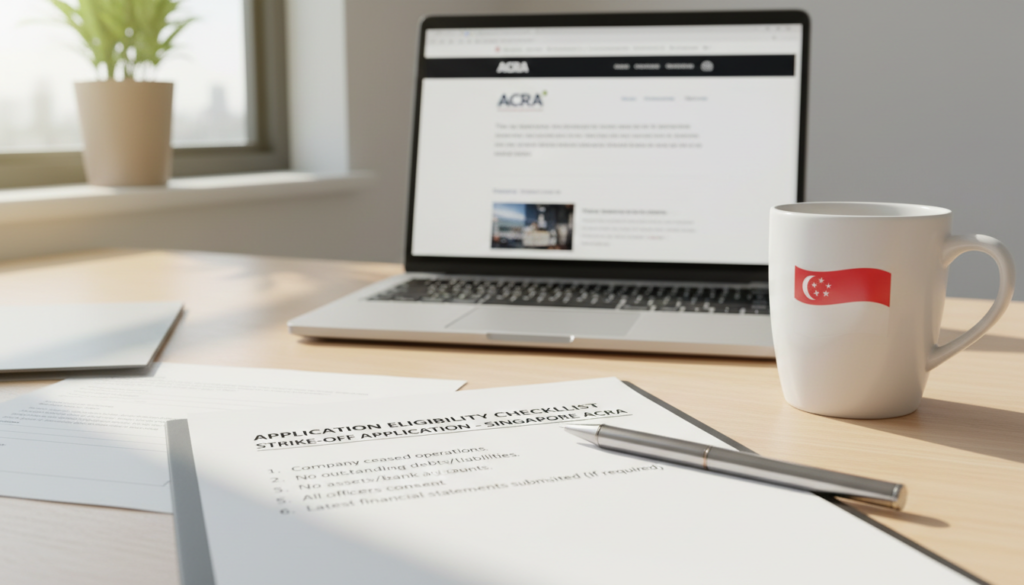
Non‑commencement or cessation of business
Show no recent revenue, terminated contracts, cancelled licences and dormant bank activity. Written records of cancelled services and notice letters reduce the chance of objections.
No court, regulatory or disciplinary proceedings
There must be no active disputes in local courts or overseas, and no pending regulatory action. Any litigation or disciplinary matter will halt the process.
Charges, creditors and tax/statutory clearance
The register of charges must be clear and creditors resolved. Ensure no outstanding tax with the inland revenue authority, no unpaid CPF, and no other government debts.
Financial position, shareholder consent and accounts
Accounts must show nil assets and nil liabilities, including contingent liabilities such as guarantees or claims. Obtain written majority shareholder consent and keep the latest unaudited balance sheet (or audited accounts where required).
Practical warning: if any asset or liability exists, provide disposal, settlement or waiver evidence before you apply to avoid queries and objections.
Pre-strike-off compliance checklist to avoid objections and delays
Start the closure process by checking bank relationships and clearing any leftover transactions that can trigger objections. A focused sequence of steps reduces queries and keeps the application moving.

-
Closing bank accounts and final banking tasks
Close all bank accounts and terminate facilities. Clear standing instructions and bank fees.
Obtain written confirmation of closure to prove no residual assets or liabilities remain with your bank.
-
Completing annual returns and statutory filings
Bring annual returns and any outstanding filings up to date before submission.
Missing filings are a common administrative blocker and will pause the review.
-
Preparing financial statements
Produce concise financial statements that reconcile with closed bank accounts and cleared payables/receivables.
Show nil assets and nil liabilities clearly, and retain supporting ledgers and bank confirmations.
-
Handling outstanding debts
Collect receivables, pay debts and, where settlement is not possible, obtain written waivers from creditors.
Keep settlement receipts and waiver letters as evidence against any company outstanding claims.
-
Final tax housekeeping
Submit outstanding tax returns and resolve any taxes due. Seek practical correspondence with IRAS to reduce objections.
Tax clearance documents or evidence of arrangements help prevent last‑minute holds.
-
Document pack you should keep
Assemble consents, directors’ resolutions, bank closure proofs, disposal records, settlement or waiver letters, and tax correspondence in one audit‑ready pack.
Timing discipline is crucial: complete this checklist before applying to avoid the most common reasons applications are delayed.
Tip: Keep digital and paper copies of every item; ACRA may request documents during the review window.
How to file the strike-off application with ACRA via BizFile+
Filing through BizFile+ requires precise declarations and supporting documents to back each claim.
Who may submit: a director, the company secretary or an authorised corporate service provider can lodge the strike-off application. Directors must approve the decision and ensure shareholder consent is recorded.
Key declarations to prepare: cessation of business activity; nil assets; nil liabilities (including contingent liabilities); no unresolved tax, CPF or regulatory matters; and correct officer details as shown on the register.
Supporting documents ACRA may request: latest unaudited balance sheet or audited accounts, bank account closure letters, disposal or settlement receipts, creditor waiver letters and written shareholder consent. Keep copies ready to substantiate every declaration.
- Check that names, addresses and officer details in BizFile+ match the register to avoid missed notices.
- Only submit when the company is genuinely clean on liabilities and filings; the declaration is central to ACRA’s assessment.
- Sole proprietorships and partnerships must file a “Cessation of Business” transaction on BizFile+ via CorpPass rather than the company strike-off route.
Practical tip: follow the official striking-off guide for step-by-step BizFile+ instructions and required documents.
| What to file | Who files | Typical documents |
|---|---|---|
| Strike-off application | Director / Company Secretary / CSP | Accounts, bank closure, shareholder consent |
| Cessation of Business | Proprietor / Partner via CorpPass | Business closure notice, tax forms |
| Supporting evidence | Filer (documents uploaded as requested) | Receipts, waivers, final bank statements |
What happens after submission: notices, Government Gazette, and the waiting period
After you submit the application, a formal sequence of notices and publications begins that directors must monitor closely.
Approval means ACRA will proceed to notify the company and relevant stakeholders. Formal letters are dispatched to the registered address and other parties within 14 days of approval.
The accuracy of the registered address is therefore vital. If mail is returned or delays occur, the process can stall and queries may follow.
Notices and Gazette publication stages
Initially there is a one-month period during which objections may be lodged informally. After that, ACRA issues an intention notice in the government gazette.
From the date of the first Gazette notice, interested persons then have 60 days to object. If no objection is received, ACRA completes the removal and publishes the final notice in the government gazette.
Timing expectations and common delays
Typical waiting time runs from a few months to longer if there are objections. Delays often stem from incomplete records, unresolved tax matters, returned mail or creditor disputes.
Practical tip: monitor postal correspondence and BizFile+ closely and be ready to respond promptly. For procedural detail on preparation and follow-up, see our striking-off process guide.
| Stage | Action | Typical timing |
|---|---|---|
| Approval | Notices sent to registered address | Within 14 days |
| Pre-Gazette period | Initial one-month window for objections | 1 month |
| Gazette publication | Intention notice then final notice if no objections | First notice + 60 days objection window |
Managing objections, appeals, and restoration if your company is struck off
When an objection is lodged, the application is paused and a short window opens to fix problems. ACRA notifies the company and the file is put on hold so the case does not proceed until the matter is cleared.
Why objections arise
Common triggers include outstanding liabilities, unresolved tax matters, creditor disputes, forgotten bank balances and mismatches between declarations and actual filings.
Clearing an objection and restarting progress
Once notified, companies normally have two months to resolve objections. Act quickly: settle debts, obtain creditor waivers, correct statutory filings and obtain tax clearances.
After remediation, the objector must lodge a Clearance of an Objection to Striking Off transaction so the removal can continue. If the objection is not cleared, the application may be withdrawn and must be refiled only after all issues are settled.
Appeals and timing
If the company is struck from the register, a Notice of Appeal can be filed within one month of the striking off order. Typical grounds include ongoing business activity, remedied statutory defaults, or administrative errors such as incorrect address notifications.
“Prepare clear evidence and consider legal representation for any appeal to the relevant court proceedings.”
Restoration via Court Order
Restoration is possible within six years by obtaining a Court Order and lodging it electronically on BizFile+. This changes the status from “Struck Off” back to “Live” and reinstates corporate capacity for contracts and accounts.
| Issue | Immediate action | Outcome |
|---|---|---|
| Outstanding creditor claim | Settle or obtain written waiver | Objector lodges clearance; application resumes |
| Unfiled statutory returns | File returns and provide proof | Regulator accepts correction; hold lifted |
| Tax queries | Resolve with tax authority; get clearance | Tax evidence lodged; objection cleared |
| Post‑removal dispute | Apply for Court Order for restoration | Status changed to Live after BizFile+ entry |
Conclusion
singapore strike off compliance impact comes down to preparation and clear records. Ensure nil assets and nil liabilities, settle taxes and CPF, close bank accounts and bring filings up to date.
Choose this administrative route only when the company is inactive and solvent. If uncertainties, disputes or debts exist, consider liquidation or alternatives instead.
Protect directors with written shareholder consent, tidy financial statements, bank closure evidence and accurate declarations on BizFile+.
After submission, monitor notices and Gazette stages and respond quickly to any objections to avoid delays.
If you are unsure, engage a qualified company secretary or corporate service provider — professional help usually saves time and reduces risk.
FAQ
What does it mean for a company to be struck off the company register?
What is the role of the Accounting and Corporate Regulatory Authority (ACRA) in a strike‑off decision?
How does striking off differ from winding up or liquidation?
How does removal affect existing contracts, clients and ongoing services?
What happens to company assets after removal and why does timing matter?
Are directors at risk of disqualification after multiple companies are struck off?
Why should foreign directors consider alternatives before applying for removal?
What eligibility criteria does ACRA expect before a strike‑off application is submitted?
How do I prove the company has ceased trading or never commenced business?
What if there are ongoing court proceedings or regulatory actions?
Can a company with registered charges apply for removal?
What tax and statutory clearances are required before applying?
What financial position must a company demonstrate for removal?
Is shareholder consent required for a strike‑off application?
What financial statements are needed when applying?
What steps should be taken to close bank accounts and settle banking arrangements?
Which statutory filings must be up to date before submitting an application?
How should outstanding debts be handled prior to removal?
What is practical tax clearance and how do I secure it?
What documents should I keep as part of the final company pack?
Who can submit a strike‑off application via BizFile+?
What must be declared on the BizFile+ application and what supporting documents might ACRA request?
Are there special considerations for sole proprietorships and partnerships when ceasing business?
What happens after submission: notifications, Government Gazette and waiting periods?
How do Government Gazette publications and objection windows operate?
What is the typical timeline for the entire process and what can extend it?
What are common reasons for objections and how can they be avoided?
How can an objection be cleared if it is lodged against my application?
What are the grounds and timeframe for appealing a striking‑off decision?
How does restoration via Court Order work and what changes occur in BizFile+?

Dean Cheong is a Singapore-based B2B growth strategist and the CEO of VOffice. He helps companies scale revenue through sharper sales execution, CRM implementation, and go-to-market strategy, backed by a strong foundation in business banking and finance from Nanyang Technological University and a track record of driving sustainable, performance-led growth.