

Curious whether your company can skip a full statutory audit this year? This guide explains what the phrase audit exemption singapore criteria means in practice.
Under the Companies Act, eligible companies may prepare unaudited annual financial statements instead of undergoing a statutory audit. This measure keeps compliance proportionate for smaller businesses while preserving directors’ duties for proper records and accurate accounts.
We cover the main eligibility route for small companies, how group tests affect entitlement, and why the relief is reviewed each financial year rather than treated as a one‑off. Expect clear notes on when an auditor must be appointed and what filings and ACRA declarations typically look like.
For practical detail and examples, see our further explanation at understanding audit exemption. Verify any decision against your company’s accounts and regulatory filings.
Key Takeaways
- Relief reduces recurring compliance for qualifying SMEs but does not remove directors’ reporting duties.
- The small company route is the main eligibility path and is assessed each financial year.
- Group tests matter: a single small company can lose relief if its group does not qualify.
- Unaudited accounts can be filed when conditions are met; otherwise an auditor is required.
- Always confirm your position against ACRA/Companies Act requirements and your financial statements.
Audit exemption in Singapore: what it means under the Companies Act
Where conditions are met, a private company may prepare financial statements without a public accountant conducting an independent audit.
Statutory audit vs unaudited financial statements: what changes (and what doesn’t)
Statutory audit means an external review of a company’s annual financial statements by an independent public accountant. It includes fieldwork and an expressed opinion on the accounts.
Unaudited statements remove the need for an auditor appointment and audit procedures. They do not remove the duty to keep proper records or to prepare accounts under applicable accounting standards.
Who this relief is designed for: SMEs and proportionate compliance
The companies act supports proportionate compliance for smaller, owner-managed firms. Many small companies and growth-stage SMEs have lower public-interest risk and benefit from reduced compliance burden.
Even when relief applies, companies must still hold an AGM unless separately exempt, file Annual Returns with ACRA, and submit tax filings to IRAS based on their financial statements.
| Aspect | Audited | Unaudited |
|---|---|---|
| External opinion | Required | Not required |
| Director accountability | Maintained | Maintained |
| Preparation standard | Accounting standards | Accounting standards |
| Regulatory filings | Annual Return, tax | Annual Return, tax |
Audit exemption Singapore criteria for a small company
The small company test is the practical starting point for most SMEs considering audit relief. It is the core pathway many companies use to determine whether they can prepare unaudited accounts.
Private company requirement in the financial year in question
The company must be a private company during the financial year being assessed. Temporary or past private status does not qualify a firm. In short, the company must hold private company status for that year.
The two consecutive financial years test
You must check the immediate past two consecutive financial years. The company needs to meet at least two of the three numerical thresholds in both of those years.
Thresholds explained
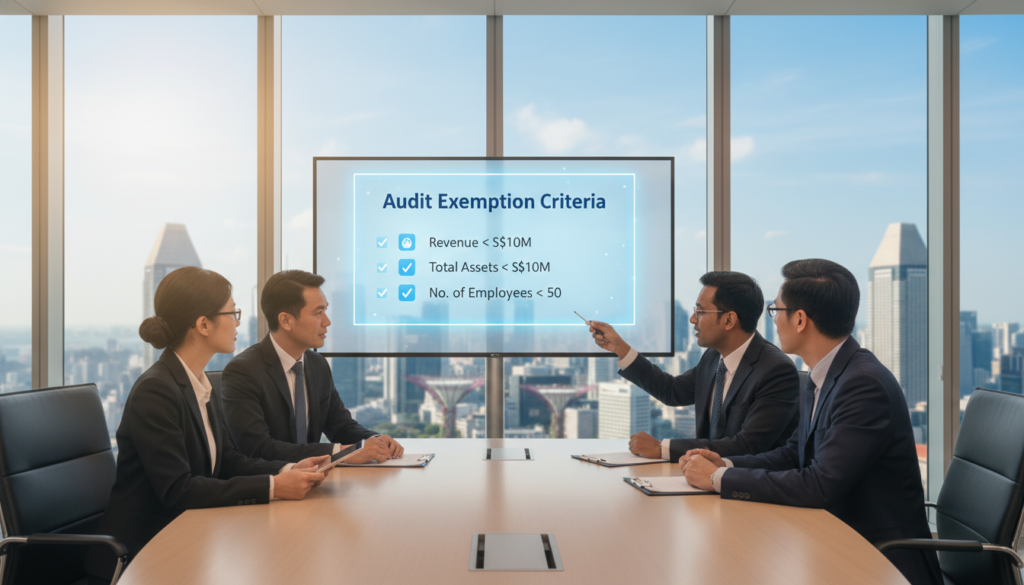
- Revenue: total annual revenue not exceeding S$10 million.
- Assets: total assets not exceeding S$10 million.
- Employees: no more than 50 full‑time employees.
Meeting any two of these thresholds is enough. For example, if annual revenue is under S$10m and employee numbers are below 50, the company qualifies even if assets exceed the limit.
Since 1 July 2015 a company no longer needs to be an exempt private company to qualify. That means corporate shareholders do not automatically disqualify a firm.
Note: These are the headline requirements. Measurement rules and group tests come next and can change whether a company qualifies in practice.
How to measure revenue, total assets, and number of employees correctly
Correctly measuring revenue, assets and staff numbers determines whether a company meets the small‑company thresholds. Use the figures exactly as they appear in your financial statements prepared under your chosen accounting framework.

Using figures from your financial statements under applicable accounting standards
Look for “total revenue” on the primary statements and supporting notes. Total assets usually sit on the statement of financial position and in the notes under major balances.
Consistency matters: apply the same accounting policies year on year so the two‑year test is defensible. Document any policy changes and tie management schedules back to ledgers.
Employee count at financial year‑end: what “full‑time” means in practice
The employee number is the contractual full‑time staff on payroll at the end of the financial year, not an annual average. Exclude casual or short‑term hires unless they are on full‑time contracts at year‑end.
- Reconcile HR records and payroll to the reporting date.
- Keep supporting schedules that link to the statements and payroll reports.
- Remember that growth can push a company over the S$10m / 50 employee thresholds unexpectedly.
Next: group measurement rules may require consolidated totals rather than entity‑level figures.
Small group rules: when a company is part of a group</h2>
Where a company forms part of a parent‑subsidiary group, the law tests the size of the whole group as well as the individual entity.
Group rules are triggered when one company controls or is controlled by another. The regulator looks beyond a single entity because economic control can shift risk across members.

Two‑layer test: company and group must both qualify
To qualify audit exemption for a group member, the company must meet the small company thresholds and the entire group must qualify as a small group.
Consolidated basis across the entire group
Small group status requires meeting at least two of the three thresholds (revenue, assets, employees) on a consolidated basis for the immediate past two consecutive financial years.
Consolidated basis means treating the group as one economic unit and totalling each item across all members.
Foreign holding companies and overseas entities
All companies in the group count, including foreign holding companies and overseas entities. Cross‑border operations can push consolidated turnover or asset totals above the limits.
Watch‑out: subsidiary losing relief
A subsidiary can fail to qualify even if its own numbers remain small. If the entire group exceeds thresholds, the member may need to appoint an auditor.
- Use consolidated financial statements where available; otherwise aggregate member figures using consistent accounting policies.
- Directors should coordinate with group finance early to assess whether the group remains a small group and to plan for any required audit.
New companies and transitional provisions since 1 July 2015</h2>
The regime took effect for financial years beginning on or after 1 July 2015, so the start date of the financial year is decisive.

Existing companies have a transitional bridge. They may qualify by meeting the quantitative requirements in the first or second financial years commencing on or after 1 July 2015. This gives a business two opportunities to satisfy the tests during the initial period.
In each of those early years the company must be private and meet at least two of the three thresholds in that year. Treat each financial year as a separate assessment until the normal past two consecutive test applies.
Newly incorporated companies on or after 1 July 2015 follow the same approach. With no prior years to compare, a company can qualify if it meets the two-of-three thresholds in its first or second year after incorporation.
Practical tip: set up clear bookkeeping and HR records from day one. That makes it easier to show revenue, assets and employee numbers at year‑end and to confirm the requirements for the past two consecutive periods.
Note: this historical change still matters for older groups and restructurings when tracing qualification across consecutive financial years. The next section explains how status continues or is lost over time.
Keeping audit-exempt status over time: continuation and disqualification triggers</h2>
Once a company has met the small company test, that status continues unless a clear disqualification event occurs.
How a company continues to qualify until it is disqualified
Qualification is a continuing position, not a year-by-year re‑start. Once a firm qualifies as a small company it remains so until a trigger happens.
Ceasing to be a private company during a financial year
If the company ceases to be a private company at any time during a financial year, the company must be treated as disqualified for that year.
Failing the thresholds for the immediate past two consecutive financial years
The other common trigger is failing to meet at least two of the three quantitative criteria for the past two consecutive financial years.
Practical examples: a hiring spike that pushes staff above 50 at year‑end, or a large contract that lifts revenue above S$10m for two years running.
What changes for groups once a small group no longer meets the criteria
A group that qualified as a small group continues until it fails the consolidated two‑of‑three test for the immediate past two consecutive financial years.
If the group fails, the disqualification can cascade. A subsidiary that looks small on its own may still need an auditor because the group no longer qualifies.
- Monitor regularly: directors should track revenue, assets and headcount to anticipate whether the company qualifies.
- Plan ahead: reinstate auditor arrangements early if failure looks likely so filings remain on time.
- Consider stakeholders: banks and investors may still request audited accounts even where exemption applies.
Remember: maintaining exemption status requires ongoing checks against the statutory requirements. Where doubt exists, the company should seek timely professional advice.
How to declare audit exemption and meet ongoing compliance duties</h2>
There is no prior approval from ACRA; directors must assess eligibility each year and document their conclusion.
No prior approval required: assessing eligibility annually
Boards should carry out a clear review of company size and records before the year‑end. Keep a short note that explains the basis for the decision and the numbers used.
Declaring unaudited status when filing the Annual Return with ACRA
When completing the Annual Return, indicate that the statements are unaudited. Ensure the filing package includes the directors’ resolution and the set of financial statements required for submission.
Ongoing obligations
Unaudited status does not remove duties. Prepare complete financial statements, maintain proper accounting records and meet filing deadlines.
Hold a general meeting unless the company qualifies for an AGM exemption, and make sure members receive the statements in good time.
Unaudited statements still support tax computations and must be used for IRAS filings.
Audit exemption vs filing rules
Note: relief from an audit is separate from filing exemptions under the Companies Act. Check both sets of requirements before you submit returns or claim companies exempt status.
- Prepare before filing: directors’ resolution, statement set, eligibility notes and dates.
- Document the basis for the decision to limit regulatory risk.
- Where uncertain, seek professional advice and consider the guidance on audit exemption for small companies.
Conclusion</h2>
Deciding to rely on audit exemption requires a clear check of status and numbers. Start with whether the firm is a private company and then apply the two consecutive financial years test. Meet at least two of the three thresholds (revenue, assets, employees) to qualify as a small company.
Remember that relief removes the statutory review, not the duty to keep proper accounts or to file on time. Common pitfalls include miscounting staff, using inconsistent revenue measures and overlooking consolidated group totals.
Practical step: review eligibility soon after year‑end, keep written records of the decision and align finance, HR and secretarial teams so filings correctly state whether accounts are audited or unaudited.
Used carefully, this relief lowers compliance burden. Where doubt exists, seek timely professional advice to reduce regulatory risk.
FAQ
What does the Companies Act allow for small private companies regarding statutory checks?
How does a statutory check differ from unaudited financial statements?
Which businesses is this relief intended for?
What is required for a private company to qualify in a given financial year?
What is the two consecutive financial years test?
What is the turnover threshold for qualifying?
What is the total assets threshold?
How is the employee threshold calculated?
Which figures should I use to measure revenue, assets and employees?
How is “full‑time” defined for the headcount threshold?
What happens when a company is part of a group?
How are consolidated thresholds applied across the whole group?
Do overseas entities affect small group status?
When might a subsidiary lose the right to prepare unaudited accounts?
When did the current rules take effect?
How do transitional provisions affect existing companies?
How do newly incorporated companies qualify?
How does a company retain qualifying status over time?
What triggers loss of qualifying status during a year?
How does a change in group status affect members of the group?
Is prior approval required to claim the relief?
How do I declare that a company is relying on unaudited statements when filing with ACRA?
What ongoing duties remain for qualifying companies?
Are the tests for unaudited status the same as those for filing financial statements?

Dean Cheong is a Singapore-based B2B growth strategist and the CEO of VOffice. He helps companies scale revenue through sharper sales execution, CRM implementation, and go-to-market strategy, backed by a strong foundation in business banking and finance from Nanyang Technological University and a track record of driving sustainable, performance-led growth.